Royalty Accounting Client Churn Patterns by Catalog Size
Small and large clients churn for opposite reasons tied to catalog complexity.

Royalty accounting client relationships fail in patterned ways, not random ones, and the pattern tracks almost exactly to catalog size. Small-catalog clients often leave when the relationship stops delivering clear value relative to cheaper alternatives. Large-catalog clients leave when manual processing bottlenecks pile up until errors and delays become the client's problem to solve, not the firm's. Both are predictable. Both are preventable, but only if a firm knows which threshold applies to which client, because the fix for one looks nothing like the fix for the other. This has nothing to do with price or how much a client likes their account manager. It comes down to whether the firm's systems match the complexity tier the client actually lives in.
How the royalty accounting software market stratifies by catalog size
The market splits into three tiers, and the vendors serving each one make that split obvious. At the bottom sit solo creators and small rosters, generally under 10 to 15 artists, served by tools like Roster Royalties (free up to 15 artists, paid plans starting at $9 a month) or InfiniteCatalog. Cheap, simple, no accounting background required.
One rung up sit growing SMB catalogs, where platforms like Curve (a partner to more than 800 labels, publishers, and rights holders) or MetaComet start replacing manual spreadsheet labor with real automation, without dragging in enterprise-grade complexity. At the top sit large catalogs with global rights exposure, running on Vistex or Rightsline, systems built to process hundreds of millions of transaction lines in a single period.
Reprtoir occupies the upper-SMB layer in between: it pulls royalty statement spreadsheets from more than 70 sources through a smart importer and handles multi-currency work across more than 150 currencies. LabelGrid, meanwhile, has bolted on embedded AI assistant support (Claude, Cursor, or any MCP-compatible assistant through an open-source MCP server), a sign that AI-assisted workflows are creeping down into SMB-tier tools, not staying locked in enterprise software.
None of this is cosmetic. Each tier carries a different contract structure, a different transaction volume, and a different reconciliation burden, so the churn trigger is different at each tier too. A firm managing clients across all three tiers is managing three separate churn risk profiles at once, whether it realizes that or not. Most don't, and that's the whole problem in one sentence.
What small-catalog clients need, and where the relationship breaks
Small-catalog clients (solo artists, micro-labels, boutique publishers) usually start on spreadsheets or a free-tier tool like Roster's. The cost of switching into a firm's managed service is low. So is the cost of switching back out, which is the part firms tend to forget.
The trigger here is complexity outpacing the tool. A single song can carry multiple rightsholders (songwriter, composer, performer, sub-publisher, record label), each with a different share, and some of those shares shift as deals get renegotiated. As a client adds artists, territories, or licensing streams, the flat-rate spreadsheet logic they started with quietly stops working. If the firm doesn't flag that transition, the client usually finds out the hard way: a statement error, or a dispute with an artist who thinks they got shorted.
Small clients also measure the firm against a very visible baseline. Roster's monthly artist plan and Curve's self-serve portal sit one browser tab over. If the managed service doesn't obviously beat those, the math on the relationship stops working. A firm that signs a one-release client without a clear upgrade path is building its own churn into the contract from day one.
And small-catalog churn tends to be quiet. No complaint, no renegotiation, just a non-renewal, because the client rarely has the vocabulary to explain what went wrong. They just felt like the value wasn't there anymore.
The 90-day window where small-catalog churn is decided
Most of it happens fast. Per a focus-digital.co analysis of SaaS churn benchmarks, 43% of SMB customer losses in B2B SaaS happen within the first 90 days after purchase, and clients who hit their first real value milestone within 30 days churn at meaningfully lower rates afterward.
Firms that get a client to that first "time to value" moment in under seven days see 50% lower churn. In royalty accounting terms, the moment is concrete: did the client's first statement come out clean, on time, and in a format the artist could read without a phone call to ask what it means?
Leaving a new small-catalog client sitting in an onboarding queue for weeks is the single riskiest move in the relationship, even if the eventual output is flawless. Correct and late reads the same as wrong, from where the client sits. That is why small-catalog churn looks random to firms that aren't tracking it closely: by the time the annual renewal conversation rolls around, the decision was made in month one or two. The renewal call is a formality nobody bothered to tell the firm about.
What large-catalog clients need from manual processing bottlenecks that become exit conditions
Large-catalog clients (established labels, major publishers, distributors, IP holders in pharma or tech) don't churn over tool fit. They've already spent the money on purpose-built platforms. Their exit trigger is operational failure at scale.
Streaming platforms, distributors, and collecting societies each ship royalty data in different formats on different schedules, which turns data standardization into a permanent reconciliation headache. A publisher managing millions of copyrights, or a multinational label processing hundreds of millions of transaction lines a month, cannot review exceptions by hand. The volume makes manual review structurally impossible, not just inconvenient. And errors at this scale aren't small: a miscalculation can trigger disputes or damage trust with talent that took years to build.
The failure mode is slow, then sudden. One missed territory rule becomes a pattern across statement cycles. One delayed cycle becomes a governance question the client's finance team starts asking about. One royalty dispute becomes a full contract review. Large-catalog clients rarely fire a firm on impulse. They leave after a documented pattern of errors the firm didn't catch before the client did.
Switching costs keep these clients in place longer than they'd otherwise stay. A full ERP-integrated royalty platform rollout at a major entertainment or pharmaceutical company can take 12 to 24 months and run between $500,000 and $5 million in professional services fees, so that friction suppresses churn right up until the pain of staying outweighs the pain of leaving. Watch for the client that starts running its own spot-checks on the firm's statements. That client has already mentally checked out. It just hasn't sent the termination letter yet.
Why B2B SaaS churn benchmarks map directly onto royalty accounting firm retention
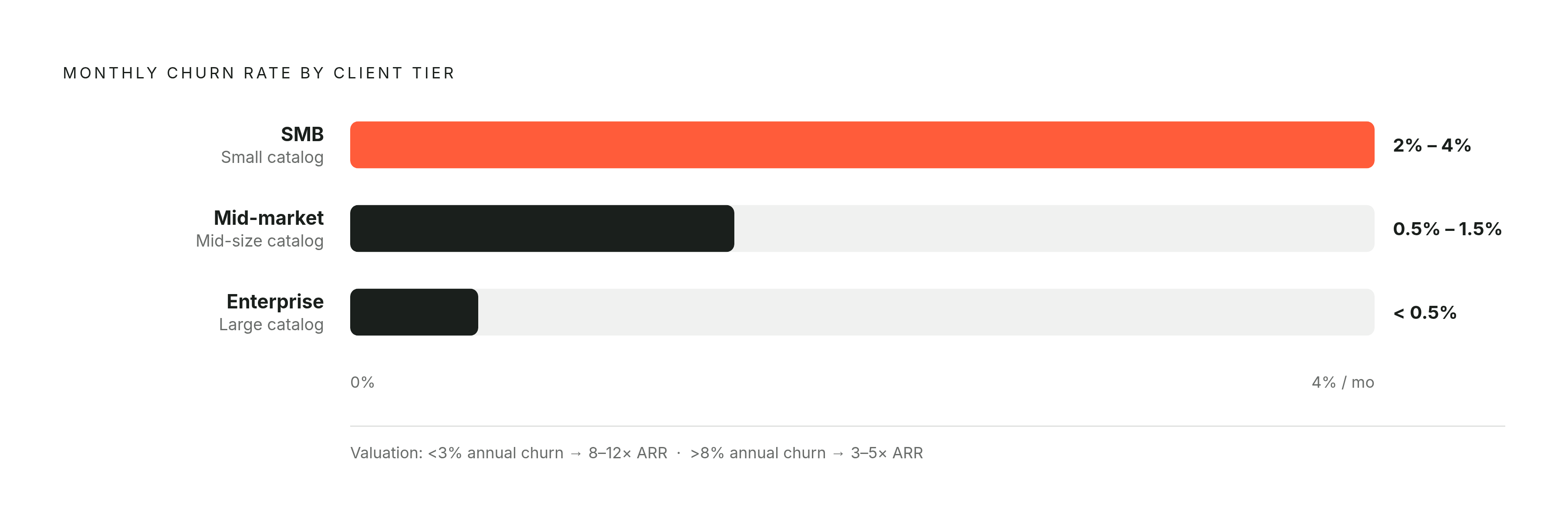
No public churn data exists for royalty accounting firms broken out by catalog segment. The SaaS benchmarks apply anyway, because royalty accounting software and managed royalty services run on the exact same client-size dynamics that drive SaaS retention curves.
Monthly churn in SaaS runs 2% to 4% for SMB and prosumer products, 0.5% to 1.5% for mid-market, and under 0.5% for enterprise. That spread is the churn risk a firm carries, depending entirely on who fills its client book. Enterprise customers retain far better than SMB customers despite costing more to land and taking longer to close, and translated into royalty terms: landing one large-catalog client and keeping it beats cycling through a rotating door of small-catalog signups, every time.
The Recurly Churn Report puts median annual B2B SaaS churn at 3.5%, a fair benchmark for any firm trying to figure out whether its own numbers, by segment, are healthy. The valuation math backs up why this matters beyond bragging rights: SaaS businesses under 3% annual churn typically trade at 8 to 12 times ARR, while those above 8% trade at 3 to 5 times ARR or worse. A firm's book of business follows the same logic even without a public multiple attached to it, which is the whole argument for catching the catalog-size threshold early instead of trying to rescue the relationship after the third missed statement.
Where the complexity threshold sits for each catalog tier
On the small-catalog side, the tooling mismatch appears in specific, spottable moments. The roster outgrows a single-format structure. The first multi-territory deal lands. The first sync placement or three-way split appears on a statement, and suddenly the cycle needs manual exceptions that didn't exist at onboarding. The client starts asking for a self-service artist portal, the kind Roster offers natively, and the firm doesn't have one. Eventually the client asks a question the firm can only answer by building a one-off custom reconciliation, the clearest sign they've outgrown what they're paying for.
On the large-catalog side, the signals look different. Reconciliation backlogs stretch across statement cycles and the team is permanently a cycle behind. Exception queues (unmatched transactions, format mismatches from a digital service provider, territory rule conflicts) pile up faster than anyone clears them. Statement turnaround creeps past what the contract promises. Client-side audit requests start arriving before the firm has finished its own internal review, with the client's finance team now doing the firm's job in parallel, for free, out of necessity.
At the large-catalog tier, data standardization is the structural problem because every platform, distributor, and collecting society delivers data on its own schedule in its own format, and the reconciliation overhead doesn't scale linearly with catalog size. It compounds. A firm running the identical workflow for a small-roster client and a client with a vastly larger catalog is underserving both. The small client needs proof of value fast. The large client needs errors suppressed at volume. Those are not the same problem wearing different clothes, and treating them as one is how firms lose both kinds of clients at once.
How AI-assisted workflows change where these thresholds sit
The manual bottleneck driving large-catalog churn is what AI-assisted royalty workflows target. MetaComet's tools cut manual processing time by 90%, eliminate common errors, and take the labor out of statement generation and reporting. Synchtank built its IRIS engine for the data explosion in digital music publishing, an engine built specifically for the data explosion in digital music publishing, with data matching designed to recover revenue that would otherwise sit lost in a mismatched file. Reprtoir's importer pulls statement spreadsheets from over 70 sources and splits millions of transaction rows between rightsholders in minutes, work that used to chew up real hours of manual labor at the mid-market tier.
For small-catalog clients, that kind of automation shrinks the time-to-first-value window, which is the single highest-leverage variable in the 90-day churn math covered above. For large-catalog clients, it shrinks the exception queue that turns into a governance problem three cycles later.
The threshold itself moves. With AI handling ingestion, format normalization, and exception flagging, a firm can take on a meaningfully bigger catalog without the per-client manual overhead that used to force a choice between more errors or more headcount. LabelGrid's embedded AI assistant, working through Claude, Cursor, or any MCP-compatible tool, points at where this is heading. AI gives the royalty accountant leverage rather than a replacement. It's giving that accountant leverage over the parts of the job that used to require a specialist and several hours nobody had.
The build-vs-hire decision for accounting firms facing a catalog-size gap in their current workflow
When a firm spots a catalog-size gap (clients sitting at a tier its current workflow can't serve well), the reflex is to hire. Another royalty analyst, another reconciliation specialist, someone to throw at the backlog. That reflex is usually wrong, and the timeline is why.
Senior embedded roles commonly take several months to fill. During that stretch, the large-catalog client already living through statement delays isn't sitting patiently in a waiting room, it's documenting every missed deadline for the eventual conversation about switching firms. Per LinkedIn Talent Insights and the Hired State of Software Engineers report, a U.S.-based embedded AI engineer runs $160,000 to $200,000 a year fully loaded, a heavy fixed cost for an SMB accounting firm to absorb before a single workflow actually improves.
Building the specific workflow that closes the gap beats hiring a person and hoping the gap closes as a side effect. A system aimed squarely at the actual bottleneck, whether that's the large-catalog reconciliation backlog or the small-catalog onboarding delay, solves the problem the hire was meant to solve. It does it faster, and without six months of runway spent waiting for someone to accept an offer letter. The pattern holds regardless of industry: the underlying mechanical problems of high-volume data ingestion, exception handling, and output generation recur across industries. Closing them looks less like adding headcount and more like fixing the pipe.
Sources
- Record Label Accounting Software | Royalty Tracking & Reporting | Roster
- Reprtoir » Royalty Accounting Software Solution
- Royalty Management Software: Tracking & Reporting | MetaComet
- Top 10 Royalty Accounting Software: Features, Pros, Cons & Comparison - scmGalaxy
- curveroyaltysystems.com
- focus-digital.co
- livmo.com
- Royalty Accounting Software Market Research Report 2034