AI Pilot Failure Modes in Small Freight Brokerages
Small brokerages fail AI pilots by choosing the wrong bottleneck first and rushing timelines.
The freight brokerage business is having what economists might charitably call a correction and what most brokers call a bloodbath. IFA Commercial Factor has tracked the pattern through 2024 and 2025: weak demand, spot rates that refuse to recover, costs that won't come down, and credit that keeps tightening. Brush Pass Research pulled the FMCSA numbers and found the damage: over 3,100 brokerages shut down in 2024, on top of nearly 2,400 in 2023. Active brokerages fell roughly 18% in two years. By January 2025, the number of active brokers had settled around 25,271, down from December's 25,334, a population that's smaller now but presumably better capitalized, since the fringe has mostly been swept out to sea. In that kind of market, a failed AI pilot carries a real cost that lingers. It's a direct hit against a margin that was already thin, and it's lost ground against competitors who, according to debales.ai's guide, are already quoting in under 60 seconds while resolving 70% of exceptions without a human touching them.
What the AI failure statistics actually measure in contexts that don't map onto small brokerages
The stat that gets forwarded in every industry team chat is the MIT Media Lab NANDA finding: 95% of corporate generative AI pilots fail to produce measurable P&L impact. It's the most-cited number in the AI failure conversation, and it's also the most frequently misapplied.
Gartner's report, based on a survey of 782 IT infrastructure and operations leaders conducted that November and December, found 57% had lived through at least one failed AI implementation, with only 28% of AI infrastructure projects delivering the returns promised on the slide deck. IDC's 2025 study for Lenovo put the proof-of-concept failure rate as high as 88%. RAND Corporation clocked enterprise AI failure north of 80%. These numbers all point the same direction, and they all describe the same kind of company: a large enterprise wrestling with governance committees, data scattered across hundreds of legacy systems, and the political infighting that occurs when a transformation program touches more than three departments.
A twelve-person freight brokerage has none of that. It doesn't have a legacy data lake spanning four acquisitions. It has a TMS, a handful of spreadsheets, and a team that answers the phone. The failure mode at that scale, per the SMB AI pilot analysis from officeproconsulting.com.au, is structurally simpler and far less forgiving: a vendor builds the tool, hands it over, and walks away. The tool dies quietly because nobody left behind knew how to use it, monitor it, or make sense of what it produced.
Alfonso Quijano, CTO at LSG, told FreightWaves in July 2026: "Companies that didn't have technology teams found themselves investing a ton of money into AI to see if it worked for them." The experimentation phase, in other words, is over, and the bill has arrived. The broader data backs this up from the enterprise side too: widespread adoption has not translated into widespread financial returns. If the giants with dedicated budgets are struggling to convert priority into profit, a five-person brokerage running its first pilot needs to understand exactly which parts of that struggle apply to it, and which don't.
Picking the wrong bottleneck first
The mistake recurs in the same shape. A brokerage notices something painful, slow quoting, gaps in carrier communication, exception handling that eats an afternoon, and buys or builds an AI tool aimed squarely at that one pain point. Six months pass. The tool works, technically. It just hasn't moved anything that matters.
BCG's framing on this is blunt: "Without structural redesigns, the benefits of tools like AI remain out of reach." Automating a task inside a broken workflow just automates the broken part, more precisely and with better uptime, leaving the workflow itself unfixed. It just automates the broken part, more precisely and with better uptime. Automating check calls is not the same project as redesigning carrier communication so AI handles the routine 80% while brokers spend their attention on the 20% that actually needs judgment and a relationship behind it.
Point solutions make this worse, not better. A quoting AI that has no idea what the exception-handling AI just processed creates a gap that a human has to bridge manually, which quietly erodes the return on both tools. Gartner's analysis found logistics companies running three or more disconnected point solutions spend between $28,000 and $51,000 a year just on integration maintenance, before counting what the tools themselves cost.
Before any pilot gets funded, the question to ask is which bottleneck matters most to remove. It's which bottleneck, if it disappeared, would change what the business is capable of taking on. Quijano's warning from that same FreightWaves piece cuts at this from another angle: companies are wrapping AI around problems that used to have clean, rules-based solutions, and making those problems less predictable in the process. Sometimes the fix for a manual process is a better manual process.
What the timeline pressure does to pilot design
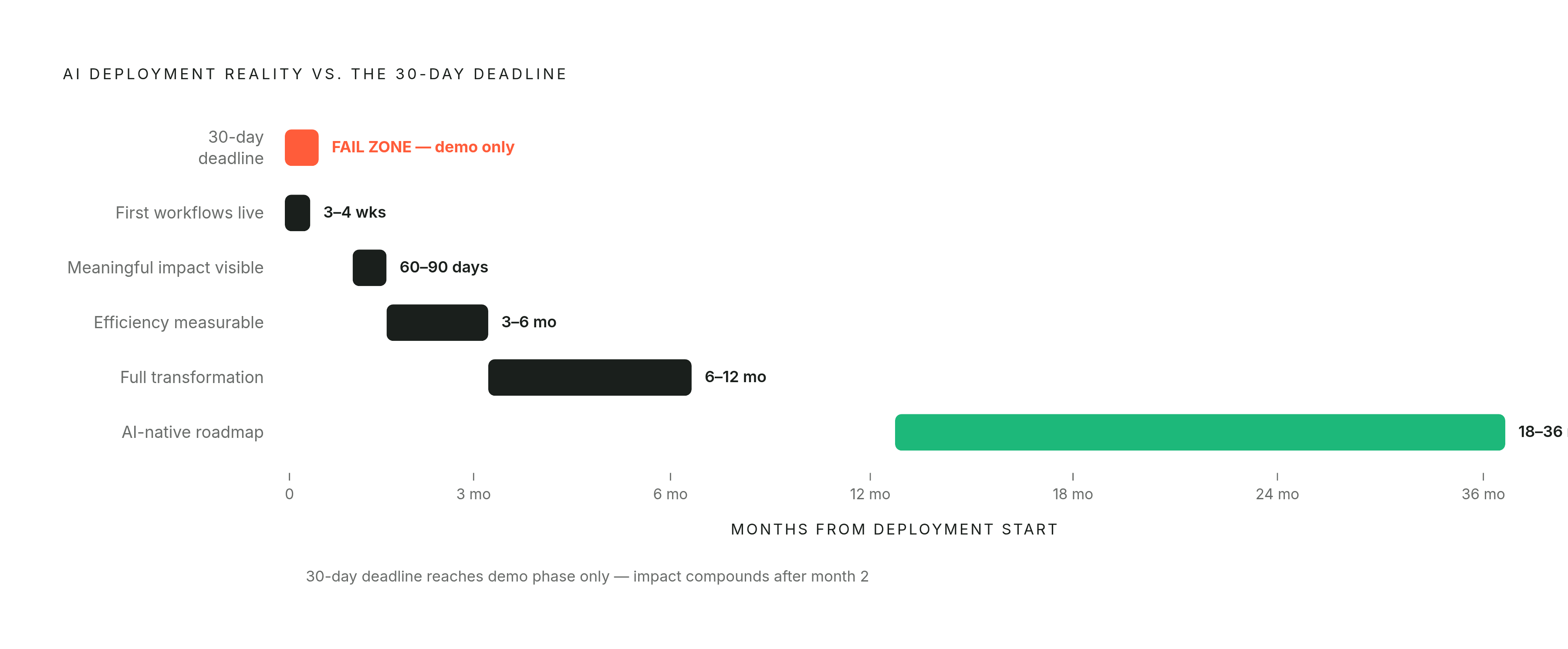
A short, compressed window, often far less than the 60 to 90 days needed for meaningful impact, is commonly what small brokerages give themselves to prove a pilot was worth the spend, and it's a structural cause of failure baked in before a single line of code gets written. A 30-day deadline selects for tasks that produce visible output fast. It has nothing to do with selecting for the workflow changes that actually compound.
The realistic timelines look nothing like that. First automated workflows tend to go live in three to four weeks, sure, but meaningful impact typically becomes visible in 60 to 90 days. Workflow automation platforms generally need three to six months before the efficiency gains are measurable, because teams need that long to adapt around the tool rather than working around it. Full transformation runs six to twelve months depending on how tangled the existing tech stack already is, and a complete logistics AI roadmap, from data foundation to something resembling AI-native operations, spans 18 to 36 months. Market intelligence platforms like FreightWaves SONAR can show value in 30 to 60 days through sharper rate negotiations, but that's the exception the whole industry treats as the rule, and conflating the two sets an expectation that workflow automation simply can't meet on that clock.
Force a team to prove ROI in 30 days and watch what happens: they scope the pilot to the demo, not to the deployment. The demo goes great. Then production quietly dies, because nothing about the demo was built to survive contact with a real month of freight volume. Quijano again, from FreightWaves: "You're eventually going to have to fire this new employee, which is another thing that I'm seeing very, very frequently now. There was a wave of AI projects that started earlier in '25 that companies are suddenly finding ways to get out of." Firing an AI employee. Somebody had to write that HR policy eventually.
There's a cost angle here too, and it's the kind of number that gets left out of the pitch deck on purpose. Legacy TMS and WMS integration typically eats 30 to 40% of a project's total cost. Business cases modeling only the AI development side therefore understate the real investment by 40 to 60%. A pilot designed to prove value in 30 days is, functionally, a pilot designed not to touch anything that takes longer than 30 days to change. That's most of the stuff that needs changing.
Vendor handoff as the moment most pilots die
The build finishes. The model works. Integration runs clean. And then everything around it collapses, because nobody was trained to use it, nobody's watching for accuracy drift, and nobody's job is to surface what the thing actually produced.
The officeproconsulting.com.au analysis has a good illustration of this from a Sydney construction company: an AI extraction tool worked exactly as designed. It ran, it extracted data, it did its job. Without a reporting layer and a human review queue, the outputs had nowhere useful to land. The team couldn't find what the tool produced, and when they did find it, they didn't trust it enough to act on it. So they kept doing the process by hand, in parallel, next to a tool that technically functioned. The fix wasn't a better model. It was a reporting layer and a human review queue, the unglamorous plumbing nobody budgets for.
Embedded implementation support, where someone stays inside a customer's environment through go-live and beyond, exists for exactly this reason, but it has historically been concentrated in larger enterprise accounts with budgets to match. Small freight brokerages sit structurally outside that market. The unit economics don't work for the big labs to send an engineer to sit inside a twelve-person shop in a small regional market. The role is still built for large organizations with large budgets, leaving out the brokerage running its first real pilot.
Quijano's line from FreightWaves gets at the deeper issue: "Even if the technology had democratized access and everybody could download OpenAI and Claude, it doesn't mean that you're an AI company. You actually need good project management. You need good change management. You need to have good control of your costs. Who knew?" The answer, apparently, is not many people. That is why a vendor-neutral embedded model sized for companies between 11 and 500 employees, the "forward deployed studio" concept described at utsubo.com, matters. The value sits in what happens after the build. It's in staying through the part where the build either gets used or gets quietly bypassed, catching that moment before the bypass becomes the new normal.
Teams never part of the build quietly killing the deployment
Watch what happens when dispatchers start overriding AI routing recommendations without logging why. It seems harmless in the moment, a judgment call here, an exception there. But those unlogged overrides become training data, and the model starts converging back toward the exact behavior it was built to replace, because that's what the corrupted ground truth is teaching it.
From the outside, this looks like the AI getting worse. It's actually learning from decisions nobody told it were decisions.
Flexsin's analysis found organizations that allocate less than 15% of an AI project's budget to training and change management see adoption rates 2.8 times lower than organizations that budget properly for the human side. That's a 2.8-times difference in adoption rates. That's why a tool gets used while another gets merely tolerated.
Gnosis Freight named the deeper issue that the most valuable logistics data often stays undocumented in a FreightWaves interview: "The most valuable logistics data often lives in the heads of the people managing exceptions every day. There is a lot of nuance in how a specific business interprets a milestone, handles an exception, or structures a workflow that no integration alone gets you." And on what happens when that knowledge never makes it into the system: "AI does not create accuracy, it amplifies whatever you feed it. If the underlying container data is incomplete, delayed, or conflicting, the AI does not just fail quietly."
Certain tells signal this, and they're specific enough to watch for. If nobody in the building can name the one person who opens the tool every single day, "the ops team" is not an owner, it's a committee that quietly agreed to ignore something together. If the outputs land in a shared inbox or a database nobody opens, there's no dashboard and no review queue. There's no way for anyone to catch what's broken before working around it becomes the default behavior. A tool without a named champion doesn't get debugged. It gets abandoned, one skipped login at a time.
The team doing the actual work needs to shape the build, and not as a courtesy. Their exception logic, their sense of which carrier gets a phone call instead of an email, their read on which shipper is about to walk, that's the raw material the system needs in order to be right. Quijano frames the adoption bar simply: "You kind of have to make it invisible for it to be adopted as it should within organizations." A tool that feels like a separate system layered on top of the real job gets resented and skipped. One built into the job itself is just how the job gets done now, so it doesn't need to be adopted. It's just how the job gets done now.
What a pilot that compounds looks like in a small brokerage
The production benchmark, per debales.ai's freight broker guide, looks like this: 80% or more of inbound carrier emails handled without a human, quote response down from 47 minutes to under 5, payback inside 60 to 120 days. That's a number from brokerages that kept the tool alive past the handoff. That's a number from brokerages that kept the tool alive past the handoff.
Whether this replaces the dispatcher is the wrong reflex. In production deployments, dispatchers aren't cut, they're redeployed, toward carrier development, toward the exceptions that actually need a human, toward new lanes the brokerage couldn't chase before because nobody had the hours. FreightWaves' State of Freight Brokerage report puts labor at 31% of operating expenses for mid-market brokers. AI doesn't zero out that line. It changes what those hours are buying.
Adoption is still uneven across the industry, and that unevenness is the opportunity. A Truckstop and Bloomberg Intelligence survey found roughly 36% of freight brokers had deployed AI tools at all. Truckstop's February 2026 guidance put planned 2026 adoption above 40%, with about 48% of brokers still sitting with no plans whatsoever. The window to move is real, but it's not indefinite, and every quarter a competitor spends quoting in under five minutes is a quarter that gap gets harder to close.
Parade's CoDriver Voice 2.0, released March 5, 2026, is a useful case study in staged rollout done deliberately. It was rebuilt from the ground up, A/B tested against thousands of real calls, and it landed at 27% more quotes from the same call volume. Parade's own language around it is instructive: choose what it does and when it engages, start simple, expand when ready. That's the actual shape of a pilot that survives past month one. That's the actual shape of a pilot that survives past month one.
The compounding pattern, when it works, follows a straightforward sequence. The first system clears the bottleneck that used to force a new hire or a longer wait on quotes. The second system builds on the capacity that frees up. The same team is now quoting faster, has picked up a service line it couldn't have staffed six months earlier, and is making calls that used to require pulling in a specialist. A two-week diagnosis of the single highest-leverage bottleneck, a production build around exactly that, and an engineer who stays embedded as the system compounds, rather than handing off a black box and disappearing, tends to produce results measured in hundreds of hours saved a month rather than a demo that impressed someone once.
None of this hinges on whether a small brokerage should run a pilot. It should. The real decision is whether the pilot is built to prove a point in 30 days, or built to change what the business can actually do in 90.