Embedded AI Engineer vs AI Software Subscription for SMBs
Embedded engineers solve business bottlenecks while subscriptions speed up existing tasks.

For SMBs deciding how to actually use AI, the choice usually gets framed as subscription versus hire, cheap versus expensive. The actual variable at stake is depth of integration. A subscription adds a tool to work you're already doing, while an embedded engineer removes a bottleneck that was capping what the business could do in the first place. AI adoption among small businesses jumped from 39% in 2024 to 55% in 2025, according to pymnts.com, and Salesforce's Small & Medium Business Trends Report puts the experimenting-or-using figure at 75%. But those numbers describe sentiment; stricter measures of AI actually embedded in production workflows tend to come in well below the headline stats. The decision lives precisely in the gap between "using AI" and "AI changing what the business can do", and it's worth mapping carefully before you sign a contract or write a job posting.
What an AI software subscription actually gives you
The pitch is simple: deploy fast, pay monthly, skip the technical hires, with no infrastructure or waiting required.
Worth splitting subscriptions into two categories, because they behave differently. Point solutions are standalone tools bolted onto a workflow: a writing assistant, a chatbot, an AI feature in your email marketing tool. Platform-embedded AI works differently: it's a capability switched on inside software you already run, with no new login, no integration project, and no change management meeting.
The second category is becoming the more consequential one. Platform players are rolling out AI features that monitor performance, flag inventory gaps, and coordinate across tools already in use. These capabilities function as an autonomous operating layer sitting on top of a business that's already running. Payroll and HR platforms are similarly embedding AI that handles anomaly detection and policy questions, tasks that used to eat up a specialist's afternoon or get routed to an outside firm. The pattern bears out across the data: SMBs getting real results from AI are mostly doing it by turning on capability already sitting inside their existing platforms, rather than shopping for new point solutions.
Subscriptions earn their keep in functions that are self-contained: customer messaging, content drafting, scheduling, invoice reminders. They're also the right entry point for businesses early in their AI journey, where the goal is building comfort and banking a few quick wins before anything more ambitious. Teams without the time or headcount to scope a custom build should simply start here.
Subscriptions watch individual tasks, not how work moves through a business. A handoff between your sales team and your fulfillment team lives outside any single piece of software; it lives in the seams, and seams are where subscriptions stop working.
Where subscription ROI is real and where it stalls
The topline numbers are genuinely good. Salesforce's report found 91% of SMBs using AI report a revenue boost and 90% say operations run more efficiently; separately, pymnts.com data shows 54% of small business owners credit AI with contributing to business growth. Take a regional consulting firm that automated data entry: at five employees each saving ten hours, at $50 an hour, that's $130,000 a year in recovered labor against an AI software cost of roughly $3,000 annually. That's a business case any owner would sign off on without a second meeting.
But read that example again and notice what made it work: the task was discrete, repeatable, and never touched a handoff between teams. That's the ceiling, not the floor.
Pymnts.com data shows 74% of SMB leaders report improved productivity through AI, but most of those gains sit below 25%. That's a faster version of the same task, and the ceiling on speed gains matters more than the topline percentage suggests. The cost side has its own gravity: data preparation alone typically runs 3 to 5 times the price of the AI tool itself, while implementation and integration fees tend to land 50 to 80% above whatever the sales rep quoted. Layer a tool on top of a broken handoff and the handoff acquires a new step bolted onto it.
The structural issue is that a subscription answers "how do I do this task faster?" while the harder question, "what's actually slowing this business down?", stays unasked. Those are different questions, and only one of them has a ceiling on it.
What an embedded AI engineer actually does differently
An embedded AI engineer works inside the business's actual operations, not at a comfortable distance. The job is to find the real constraint, build a working system around it, and stay close enough to keep improving it as the business learns what's possible.
That separates the role from a freelancer or a one-off consulting engagement. A consultant ships a report or a prototype and moves on; an embedded engineer ships something the team actually runs and sticks around long enough to keep it healthy.
The work generally moves through three phases. First, diagnose: find the highest-leverage constraint in the business, which runs deeper than the obvious "let's add a chatbot" opportunity anyone in the room can name. Second, build: ship a production-ready system against that constraint, something the team actually runs rather than a demo that looks good in a slide deck. Third, compound: stay embedded so the first win generates the data and insight that makes the second build faster and sharper.
An embedded engineer watches how work actually moves across people, systems, and handoffs, and builds something specific to that reality where a subscription can only offer a generic template. Enterprise players have already validated this model at scale, embedding engineers directly inside customer teams to ship production systems and transfer capability in-house, compressing what used to take months of implementation into days. SMBs are getting access to a version of the same idea, scaled to their size. The result is new capacity: the same headcount can now take on work it would previously have turned away, hired for, or waited on a specialist to handle.
The real cost of hiring a full-time AI engineer, and why most SMBs aren't there yet
Small businesses are hiring for this role, and the pace is picking up. Gusto's payroll database, which covers more than 400,000 businesses, shows roughly 1 in 1,000 employees hired in 2025 had "AI" in the job title. The share is small, but small businesses hired as many AI-titled employees in 2025 as they did across the previous four years combined. That's a meaningful shift in hiring behavior.
The cost of that hire is bigger than the number on the offer letter. Total compensation runs well above base salary once benefits, tooling, and LLM API spend all get added in. Most businesses burn through months of recruiting, onboarding, and ramp time, often chewing through a meaningful chunk of a year's salary, before that engineer ships a single production system.
Time-to-productivity is the part owners tend to underestimate. Recruiting alone realistically takes 4 to 8 weeks, and that's before onboarding and ramp even start; a first production system typically lands somewhere between 6 and 12 weeks after the hire starts, meaning the business waits most of a quarter before anything real shows up. An embedded partner typically ships a first build in 1 to 2 weeks because they show up with a playbook already developed.
There's also a retention problem hiding underneath all of this. AI engineer tenure tends to be short, and when that person leaves, the institutional knowledge of how your business actually works walks out the door with them, and the company starts the whole ramp-up process over from scratch.
Full-time hiring makes sense for businesses that have already proven AI's value inside their operations and have enough sustained build work stacked up to justify carrying that cost long-term. That's generally a company well past the revenue range where most SMBs sit today. For everyone else, the embedded partner fills the space between a subscription's limited depth and a full-time hire the business genuinely can't justify yet.
How quickly each model delivers working results
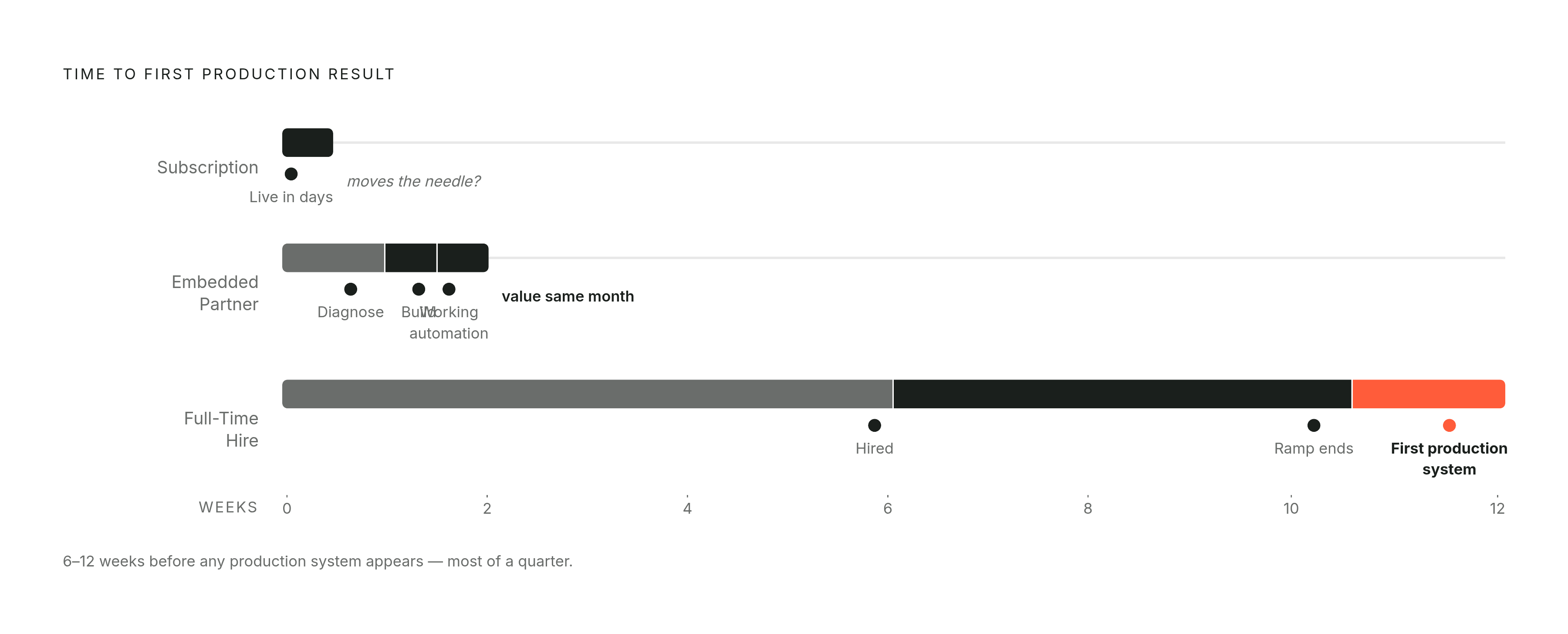
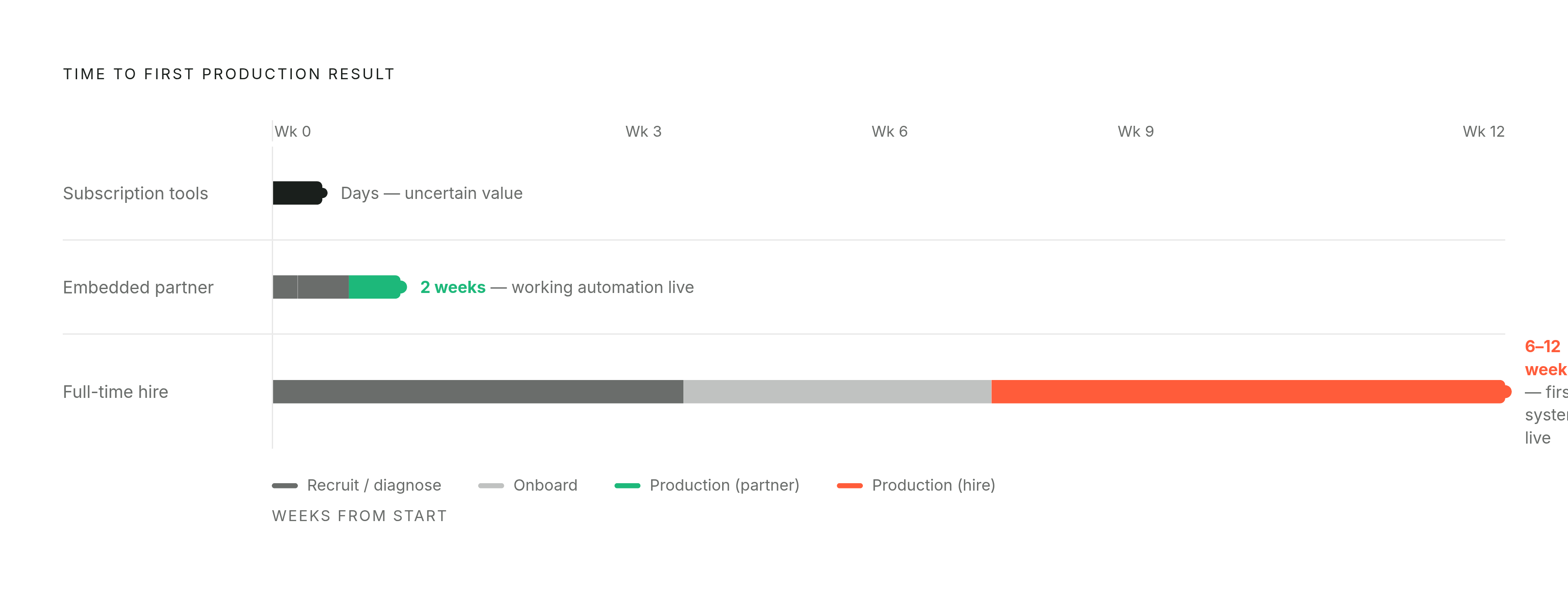
Time to first value is the variable owners underweight, right up until they've spent a quarter waiting for nothing.
Subscription tools go live in days. The open question is whether what goes live actually connects to anything that moves the needle. An embedded partner running a structured process, diagnose, build, stabilize, can deliver working automations inside two weeks, available to businesses regardless of whether they have a technical co-founder on staff. First value lands in the same calendar month the engagement starts.
A full-time hire runs on a longer timeline. Figure 4 to 8 weeks just to fill the role, then another 3 to 6 weeks for that person to actually learn the business before they produce anything substantive. Realistically, a first production system lands somewhere between 6 and 12 weeks after the hire starts, which means the business is waiting most of a quarter before anything real shows up.
Part of why fast, small builds are even possible now comes down to API economics. GPT-4o-class intelligence runs around $2.50 per million tokens in 2026, down from roughly $30 per million in early 2023. That's a drop of over 90%, and it changes what a small engagement can afford to build and run without burning the client's budget on inference costs alone. Most SMBs see payback within 30 to 90 days when the work targets a real workflow constraint. Whichever model gets there fastest compounds value earliest, and in this game, earliest wins.
The functions where each model fits and the signal that tells you which one you need
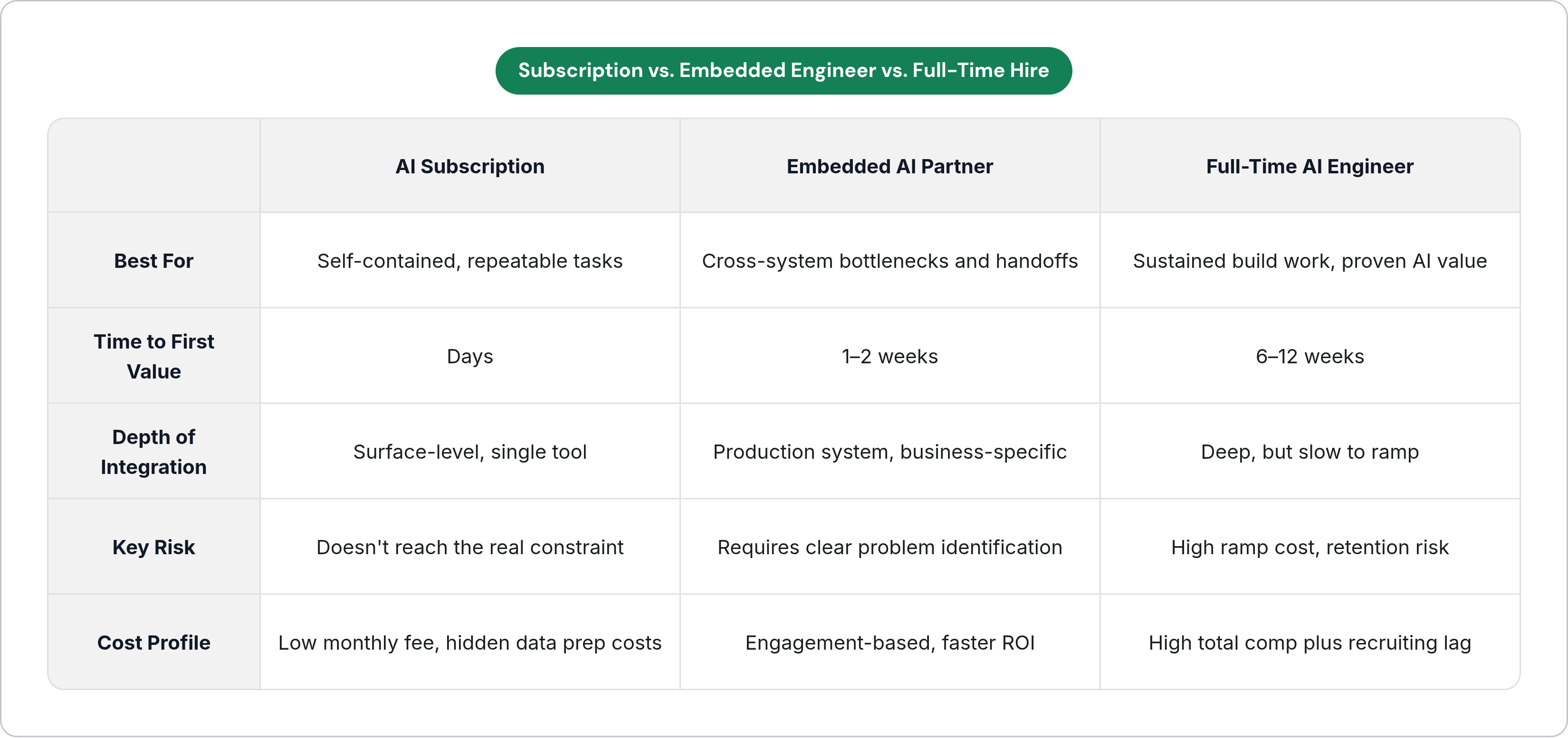
Subscriptions make sense when the function is self-contained: drafting, scheduling, customer messaging, automating one repetitive task that doesn't touch anything else downstream. They're also right when the goal is simply getting the team comfortable with AI before anyone commits to something bigger, or when the business is already running a platform (payroll, CRM, point of sale) with AI features sitting there unused. Turning those on costs nothing and requires no new interface.
An embedded model fits a different shape of problem. The bottleneck is a handoff, a process, or a decision that spans multiple systems or multiple people. The business is turning away work, hiring just to keep pace, or stuck waiting on a specialist it can't yet afford, all signs of an actual ceiling rather than plain inefficiency. Speed matters here too: if the business can't sit around for six months waiting on a new hire to ramp, an embedded partner is the faster path. The goal, in these cases, is a capability that expands what the business can do, well beyond a slightly quicker version of today's workflow.
The clearest test: does the problem have a defined input and output with a clean handoff? If yes, a subscription probably reaches it. If the actual problem sounds more like "we can't grow without adding headcount" or "this decision takes too long to make," that's a signal requiring something deeper than new software licenses.
Most businesses will end up running both. Subscriptions handle the self-contained functions they've already identified and validated. An embedded partner, such as Sansatech, an AI transformation consultancy that diagnoses bottlenecks and builds custom automation systems inside small and mid-sized businesses, takes on the constraint that's actually capping growth, the one that software licenses alone leave unresolved. The sequencing that tends to work is straightforward: start with what's already built into the platforms you're paying for, figure out what those platforms don't and can't reach, and that gap is where the embedded work begins.