Measuring ROI on an AI Investment for a Small Business
Real AI ROI shows up in speed and capacity, not just time saved.
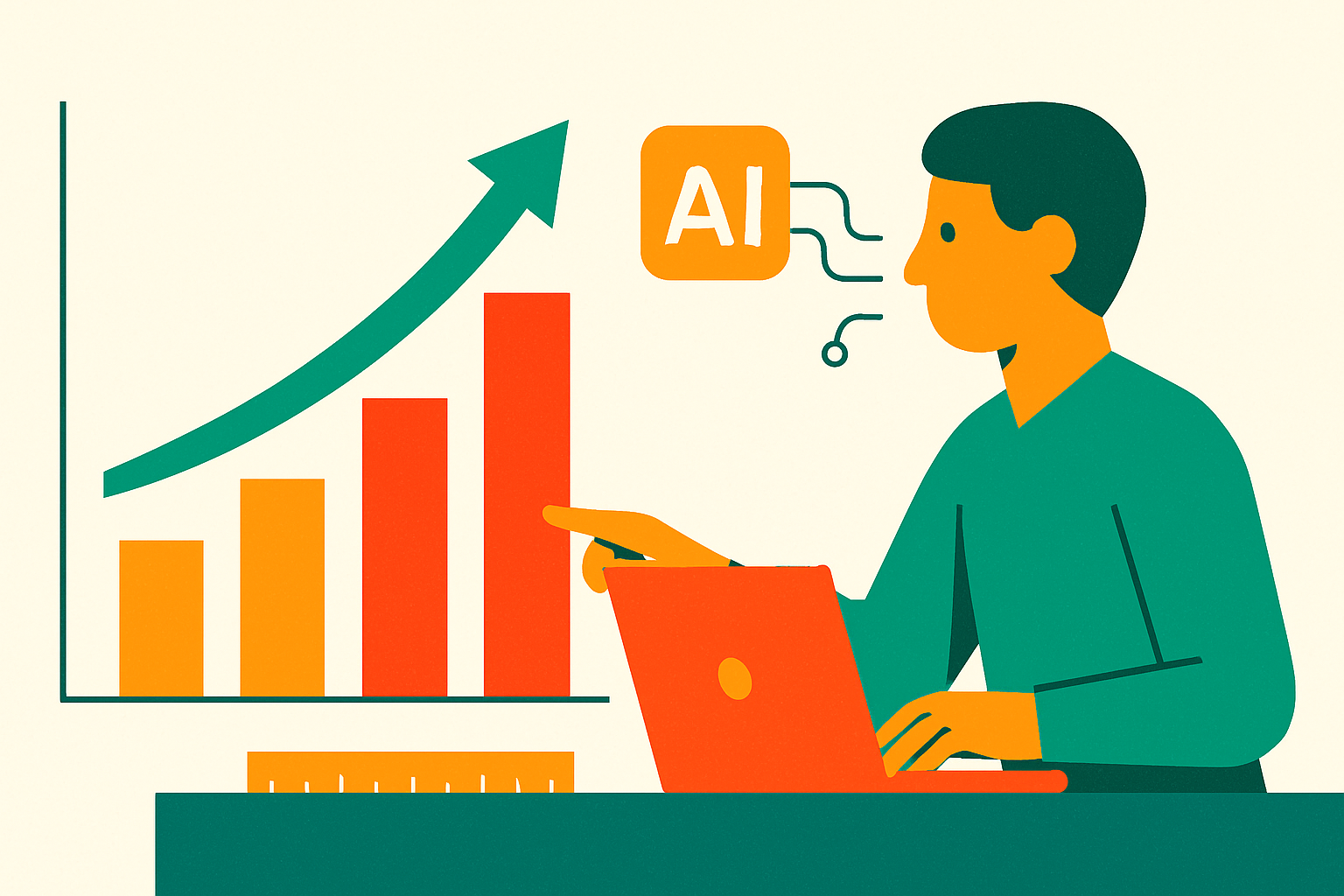
Most SMB owners calculate AI ROI the same way they'd calculate the payback on a new espresso machine: time saved times hourly rate equals payback period. That math is clean and auditable, but it's incomplete for the same reason a stopwatch can't measure whether a business grew. Real ROI shows up in the decisions made faster, the work that used to get turned away, and the hire that quietly never happened. This piece is about how to measure AI's return the way it actually pays out, which takes more effort than the version that's easiest to explain to a skeptical bookkeeper.
What SMB AI adoption data actually reveals about who is getting real returns
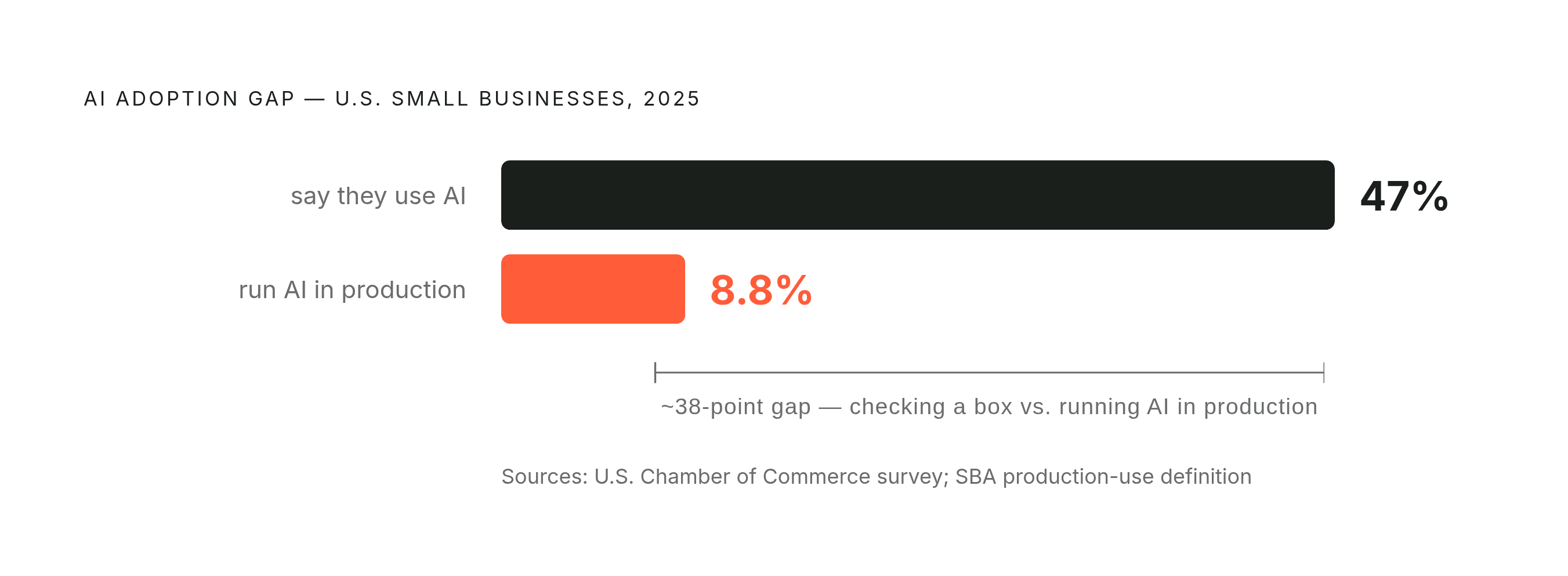
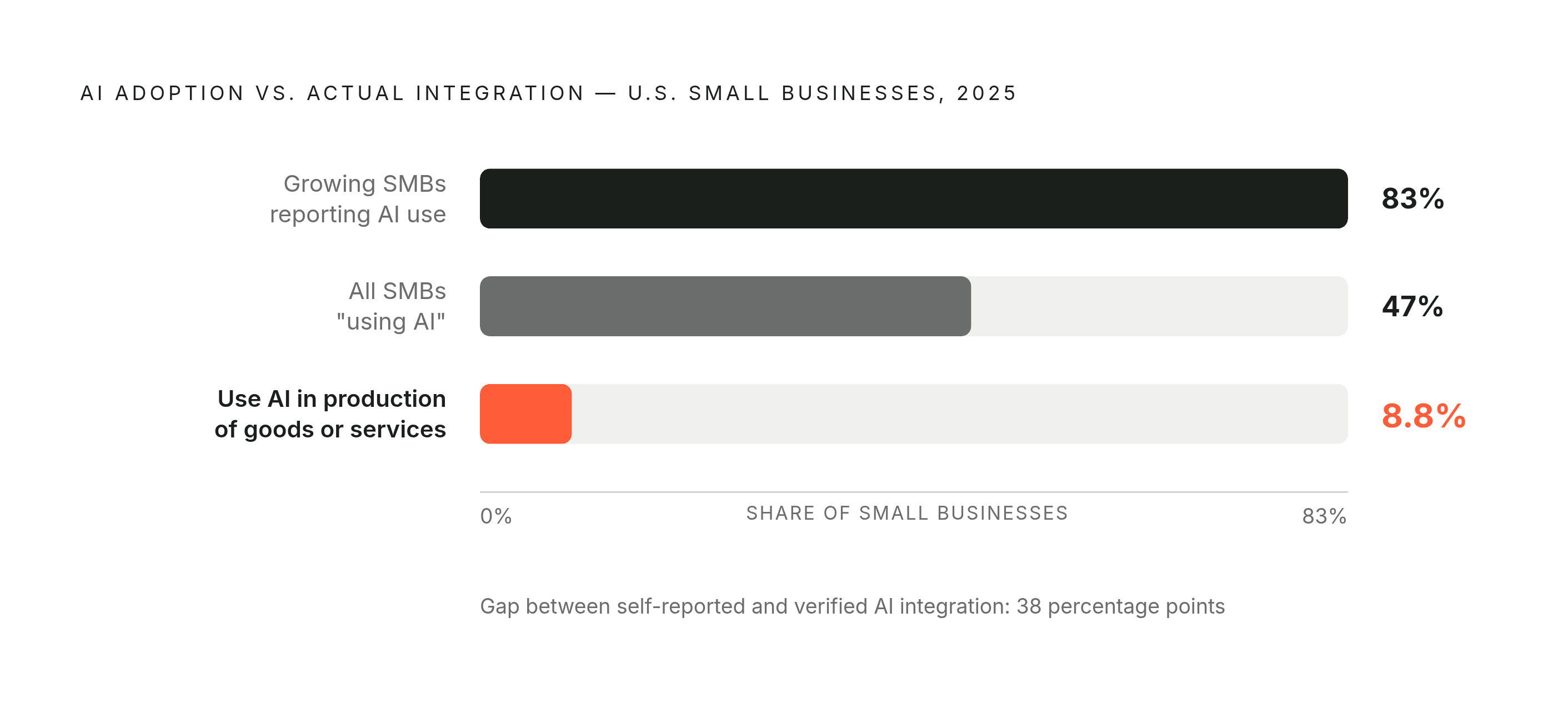
Adoption numbers for small business AI look explosive on the surface. Roughly 47% of U.S. small businesses reported using AI in 2025, up from 23% in 2023, which represents one of the steepest technology adoption curves the small business sector has seen in recent memory.
Then the SBA asked a sharper question: is AI actually used in the production of goods or services? The answer dropped to 8.8% of small businesses under 250 employees, measured as of August 2025. That gap, nearly 40 percentage points, is the distance between someone using ChatGPT to draft a slightly less awkward email and AI running inside an actual business process. Most of the "adoption" headline reflects the former.
There's a performance split buried in the aggregate numbers too. Among growing SMBs, 83% report using AI; among declining businesses, it's 55%. Correlation stops short of proving causation, but the pattern is suggestive: the businesses using AI while growing are using it differently than the ones using it to stay afloat. Separately, 91% of SMBs using AI report revenue increases. But "using AI" in a survey like that spans everything from an employee bookmarking a chatbot to a fully automated intake pipeline, so the number tells you adoption correlates with revenue, leaving open which kind of adoption does the work.
Put it together and the conclusion is unavoidable: depth of integration separates the 8.8% actually running AI in production from the 47% who checked a box on a survey, making it the metric that matters. Everything that follows in this piece is about how to tell which category you're actually in, using your own numbers instead of a national poll.
The three ROI inputs most SMBs measure and the two they miss
Owners tend to measure three things well, because these three things are easy to see. Time saved is the big one: roughly two-thirds of AI-using SMBs report savings of hundreds to a couple thousand dollars a month, and the average owner claws back close to 7 hours a week on administrative work. Do this one right by logging actual hours, not guessing; a week of a timer app beats a year of vibes.
Error reduction is the second: fewer correction cycles, fewer re-dos, cleaner first drafts. Quantify it as hours recovered or rework cost avoided, keeping the measure concrete rather than relying on a vague sense that things feel less messy. Direct cost offset is the third: whatever you used to pay a contractor, a SaaS subscription, or a slow manual process to do, and what AI now handles instead.
All three are legitimate, but they're a partial picture, and here's where most measurement systems quietly give up.
The two inputs that almost nobody builds a tracking system for are decision velocity and capacity expansion. Decision velocity is how much faster a quote goes out, an underwriting call gets made, a freight load gets dispatched. Speed is revenue in disguise: a proposal that closes in two days instead of two weeks delivers a different cash conversion cycle for the entire business. Capacity expansion is the other one, and it's bigger: work the team can now take on that it physically couldn't before. This is the ceiling-removal effect, and it shows up in the revenue line rather than the cost-savings column, which is exactly why it gets missed.
Operationalizing these two is straightforward; it's just rarely done. Track throughput before and after, meaning literal volume: quotes issued, jobs processed, cases closed per week. Watch whether conversion rates shift when response time improves. And flag, in writing, the first time your team says yes to something they would have said no to six months earlier. That moment is worth more than a spreadsheet full of hours saved.
McKinsey's 2025 data on SMBs that embed AI into core workflows shows average cost savings of 18–25%. That number only materializes when the measurement covers decision speed and capacity, not just the line items that were always easy to track.
Why the location of AI in the business determines what ROI is even possible
There's a principle from manufacturing that applies here with almost no modification: the throughput of any system is limited by its constraint, and improving anything that isn't the constraint doesn't improve the system. This is the theory of constraints, and it predates AI by decades, but it explains almost everything about why some AI deployments produce a rounding error and others produce a new business line.
Automate a task away from your actual bottleneck and you'll save time without changing what the business can do. AI-drafted emails might save an hour a week, real and welcome, but if the bottleneck is manual data entry before a quote can even go out, the email tool leaves revenue unchanged. AI that summarizes meeting notes is genuinely useful for tired brains on a Friday afternoon; if the real constraint is the time it takes to process an insurance submission, the summary tool is a nice parlor trick sitting well away from the pressure point.
Hit the actual bottleneck and the picture changes entirely. The constraint lifts, and volume increases without adding headcount. Decisions that used to require a specialist become executable by whoever's on shift. Service lines that were previously impossible, because the team lacked spare capacity to attempt them, suddenly become viable.
Then something compounds. The first win removes a ceiling, the team takes on more work, that additional throughput generates its own data and process clarity, and the second system becomes easier to build because it targets the next constraint with better information than the first one had. A meaningful reduction in manual data entry time saves hours and changes how many submissions the same team can process in a week, which is a revenue multiplier wearing a cost-savings costume.
Calculate ROI before you've identified the real bottleneck and you'll understate what's possible, or worse, credit the wrong deployment for the gain.
AI vs. hiring: what the cost comparison looks like when you run it honestly
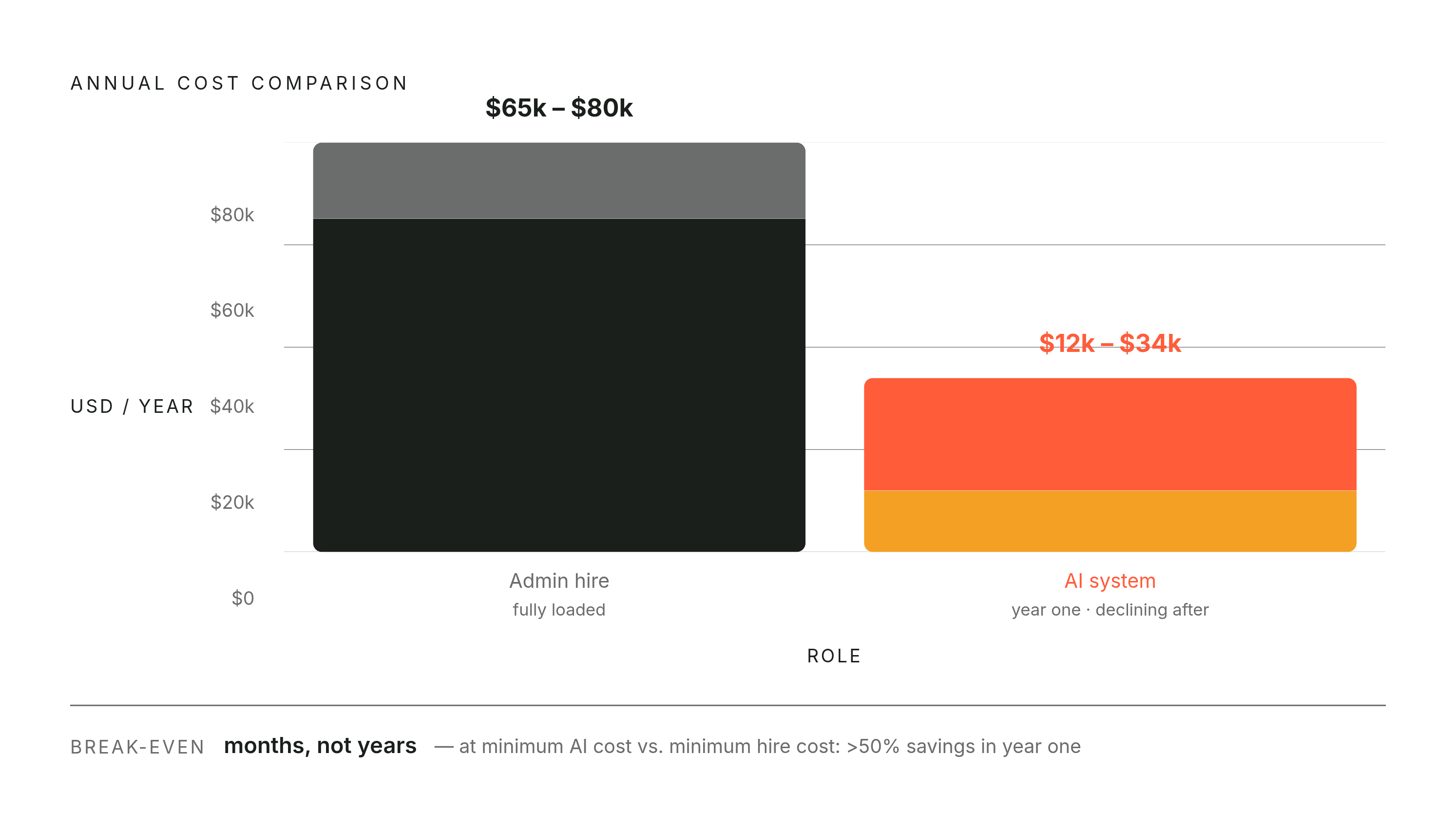
Most owners underprice their own hires. The number on the offer letter understates what actually hits the P&L; a fully loaded U.S. hire, once you count payroll taxes, benefits, equipment, management time, and the inevitable ramp-up period, runs $55,000 to $95,000 a year.
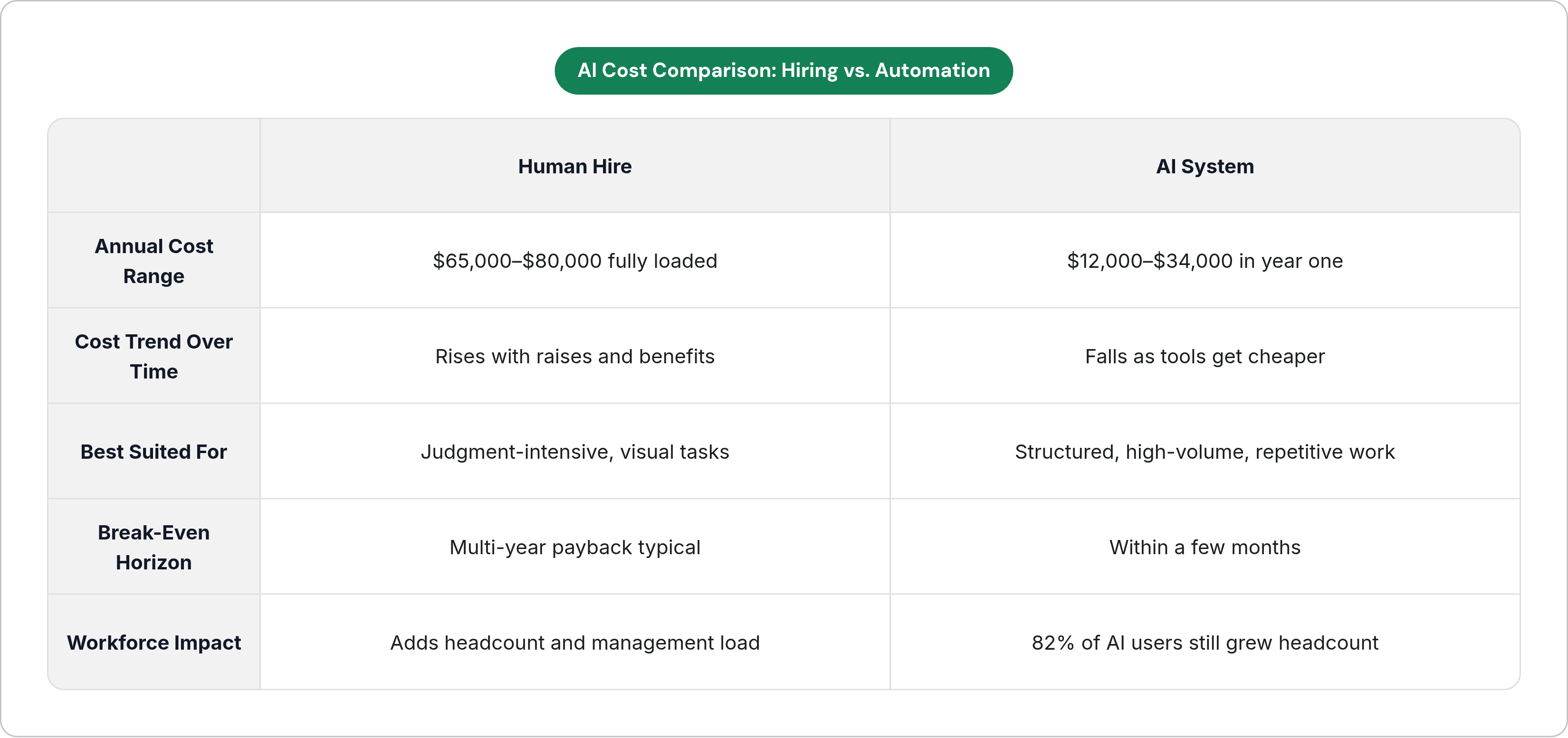
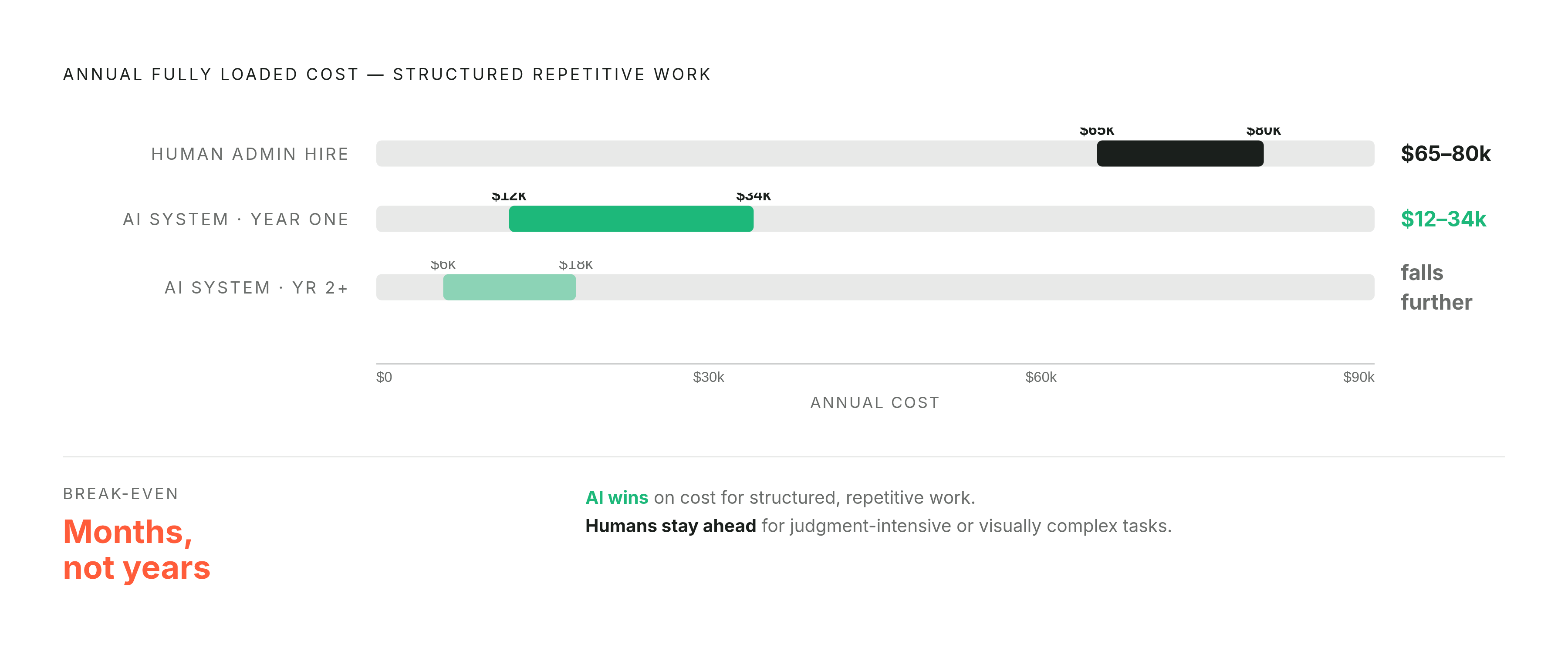
For structured, repetitive work, AI wins the comparison decisively. A fully loaded administrative hire costs $65,000–$80,000 a year. An AI system doing comparable work runs $12,000–$34,000 in year one, and that number tends to fall in subsequent years as the underlying tools get cheaper and more capable. Break-even lands within a few months for most business functions, far shorter than the multi-year payback horizon owners brace themselves for when a vendor starts talking about "transformation."
Here's the honest counterpoint, because including it keeps this reporting rather than a sales pitch: research has found AI automation is far less cost-effective for roles that rely heavily on visual or judgment-intensive tasks. AI wins decisively on cost for structured, high-volume, repetitive work. Humans stay more cost-effective for judgment-intensive or visually complex work, and no amount of vendor enthusiasm changes that math. The real question is which tasks belong to AI and which to humans, and what that leaves you needing to hire for instead.
The data backs this up in a way that should reassure anyone picturing mass layoffs: 82% of AI-using small businesses increased their workforce over the past year. AI complements hiring far more than it replaces it. The team stays; it just stops doing the parts of the job that wasted human judgment.
Hiring pressure avoided rarely makes it into a standard ROI calculation, and it should. The six-month recruiting cycle that got skipped. The management overhead that stayed flat. The institutional knowledge risk of a key employee walking out the door with irreplaceable process knowledge, a risk that disappeared because the process got documented into a system instead. McKinsey's 2025 workforce data suggests 60–70% of tasks are technically automatable, but that's not a mandate to cut 60% of a team. It's an instruction to find the 60% of each person's week that's the wrong use of their judgment, and get it off their plate.
What the embedded AI engineer model means for SMBs that can't afford the enterprise version
Amazon Web Services put a number on how seriously it takes this problem: $1 billion committed to a Forward Deployed Engineering organization, pods of engineers embedded directly in client teams for 45-day stretches, writing production code inside the client's actual systems rather than presenting a deck about what they could theoretically build. OpenAI and Anthropic followed with comparable efforts, together worth billions more, which tells you "last-mile" AI deployment has become its own recognized, high-value category, valued far beyond a side task an engineer picks up. Demand for that kind of embedded role grew 42-fold between 2023 and 2025, according to a LinkedIn report, which is the kind of growth curve that makes venture capitalists weep with joy.
All of this is priced for enterprise budgets, well beyond what a business with 40 employees and a payroll to make can afford. The AWS-style engagement implies costs in the high six to low seven figures, a number that puts it out of reach for the overwhelming majority of small and mid-sized businesses, and that's by design; enterprise clients pay enterprise rates.
But the principle underneath the price tag is worth stealing. An engineer working inside your actual operation, building against your real bottleneck instead of a generic use case, is what produces results you can point to. Buying a tool and hoping someone on the team figures out how to use it produces the gap between the 47% who say they use AI and the 8.8% getting production results out of it.
The SMB-sized version of this model shares the same logic at a smaller scale. It starts with a short diagnostic, two weeks is a reasonable target, to find the single highest-leverage bottleneck, skipping the 40-page audit nobody reads. From there, a production-ready system gets built around that specific constraint, building for production rather than a proof-of-concept that impresses in a demo and then sits unused. Ongoing embedding past handoff lets the gains compound instead of flatlining after the first win.
Knowledge transfer is the detail that separates this from consulting. The team that owns the work needs to be able to run and extend the system itself, independently of any vendor. Applied to businesses in the 10-to-500-employee range, this same logic produces results built directly into the workflow's actual constraint rather than delivered through a tool purchase.
How to build an ROI baseline before you deploy anything
Here's the trap almost every SMB falls into: they deploy AI, things feel noticeably smoother within a few weeks, and then six months later the gain goes unquantified because nobody logged where things stood before. Smoother is a vibe, and vibes don't survive a budget conversation.
Before deployment, document five things. A time log for the targeted process, real hours per week, not an estimate pulled from memory; one week of honest logging beats a year of guessing. A throughput baseline, meaning the actual count of quotes, submissions, invoices, or bookings the team completes per week right now. An error or rework rate, tracking how often the process needs correction and how long that correction takes. Queue depth, or how much work sits waiting at this bottleneck at any given moment, since backlog is really just revenue sitting at risk. And ceiling events: how many times last quarter did the team turn work away, delay a response, or say "we can't take that on right now"?
Two more baselines matter because they capture the compounding gains that show up later. Decision timeline: how long does it take from intake to a finished decision or output for the process you're targeting? That's the number speed improvements will move. Revenue per unit of capacity: what does one additional processed unit, one more quote, one more case, one more booking, actually generate? That figure is what turns a throughput gain from an abstraction into a dollar amount.
At 30, 60, and 90 days post-deployment, measure more than cost saved. Track throughput change, queue depth change, and the date of the first capacity-expansion event, the first time the team said yes to something it previously couldn't.
The baseline doubles as a scoping tool, and this is worth saying plainly: if a process isn't costing enough in time, rework, or missed revenue to justify building a system around it, that's the right answer to land on. A good implementation partner will tell you that instead of selling you a system you don't need.
Reading the ROI signal correctly once results start coming in
Two signals look identical in month one and mean completely different things by month six. Marginal efficiency is the same throughput achieved with less time spent, which is valuable, genuinely, but the ceiling on the business is still exactly where it was. Capacity expansion is the same team producing higher throughput, which means the ceiling itself moved. Confusing the two is the single most common measurement mistake in this entire exercise.
A real compounding signal has a specific look to it. The team accepts a client or job type it used to decline. A decision that once required pulling in a specialist now gets made by a generalist reading the system's output. A service line that was previously impossible becomes real, because the constraint that blocked it is gone. And sometimes a hire that was already budgeted quietly gets deferred, because the capacity showed up without needing another body in a chair.
The first 30 days almost always understate the real number, and there's a reason for that beyond simple caution. The team is still learning the system, so throughput gains accelerate as adoption deepens rather than arriving all at once. The data the system processes in month one trains the decisions it helps make by month three. And the second bottleneck, the one hiding behind the first, only becomes visible once the first constraint is actually gone; compounding starts at the second deployment.
What separates businesses that compound from businesses that plateau after one AI win comes down to a single habit: treating the first system's output as both a result to report and a diagnostic for what to build next. At 90 days, the question worth asking is what you can do now that you couldn't do before, and what's sitting in the way of doing the next thing.