Strategic Bottleneck Identification in a Small Service Firm
Most small service firms deploy AI without first identifying what's actually slowing them down.

Small service firms have crossed the AI adoption line. Thryv's 2025 report puts usage at 55% overall, climbing to 68% among firms with 10 to 100 employees. But the SBA draws a harder line around what counts as production use, meaning AI embedded in a real workflow rather than sampled once and forgotten, and by that standard actual deployment sits somewhere between 17% and 20% through early 2026. The distance between those two numbers is where most small service firms currently live: trying tools without changing anything. This piece is about closing that distance, and it starts with a question most firms skip: did you point the tool at the thing that's actually slowing you down?
The typical AI-using small business now runs several tools at once. That shift, from one experiment to a pile of them, happened fast, and it created a new problem masquerading as progress. More tools don't mean more leverage. They mean more surface area for distraction, more dashboards nobody checks, more subscriptions renewing quietly in the background. The real question is whether the AI landed on the one place in the business where a fix actually matters, separate from whether AI is simply "being used." Get that wrong, and the tool adds overhead instead of capacity, which is a fancy way of saying you now pay for the privilege of being just as slow.
What a bottleneck actually is in a service firm context
A bottleneck, in the classic operations sense, is any point where demand exceeds capacity, forcing the whole system to slow to the pace of its narrowest part. In a factory this is obvious: a machine with a queue in front of it, a bin of unprocessed parts nobody's gotten to. You can see it. You can point at it. You can, if you're feeling dramatic, put police tape around it.
Service firms don't get that luxury. Their bottlenecks live in handoffs, approvals, and waiting periods that nobody wrote down because nobody thought to. An insurance broker where every quote needs a manual data pull before it moves an inch. A freight company where one dispatcher is the sole point of contact for every exception, meaning the business's actual capacity is however many crises that one person can hold in their head on a Tuesday. An accounting firm where partner review creates a queue that backs up the entire delivery calendar, so client work is rate-limited by how many hours one partner has between meetings, far more than by staff headcount.
Here's the property that matters: fixing the bottleneck improves the whole system. Fixing anything else just rearranges deck chairs. That asymmetry is the entire argument for why diagnosis has to come before deployment; a firm can optimize ten things beautifully and see zero change in throughput if none of the ten was the actual constraint.
Service firms are exposed to this in a particular way, because internal delays don't stay internal. An approval that sits for three days becomes a client who waits three extra days. A resourcing decision made late becomes a delivery deadline missed. And bottlenecks are good at hiding: the person everyone describes as the one who "handles everything" is usually the bottleneck wearing a disguise, and nobody says it out loud because it sounds like an insult to say the most valuable person in the building is also the ceiling on how fast the building can move.
Why identifying the right bottleneck is harder than it looks
Firms fall into what's worth calling the micro-productivity trap: they speed up small, visible tasks, faster email drafts, instant report generation, while the actual workflow limiting revenue sits untouched two rooms over. It feels like progress because something got faster. Nothing that mattered did.
The step that looks slowest is frequently downstream of the real problem. Everyone can see the queue; almost nobody traces it back to its cause. A firm automates its client onboarding emails, feels good about it, and discovers the delay was never the emails. It was a manual contract review sitting two steps earlier, quietly backing everything up like a clogged drain three rooms away from the sink you're staring at.
Then there's the trap of automating a broken process, which deserves to be said plainly: automation doesn't fix a broken process, it just runs the broken process faster. You've built a more efficient way to be wrong.
The "busy team" signal makes this worse, because a team working at full tilt looks like a system running at capacity, though it often means the opposite. One overloaded constraint upstream is generating downstream chaos that keeps everyone else sprinting to keep up, and sprinting looks a lot like productivity from a distance. Add to this the barriers that make diagnosis genuinely hard: no one in-house who can read the operational data, fuzzy thinking about what ROI is even supposed to mean here, and an instinct to reach for a tool before anyone's mapped the actual work. Put those together and the real reason most AI projects fail comes into focus: a firm that never correctly named its problem before buying a solution to it.
The diagnostic method: how to find the one constraint that's doing most of the damage
Start by mapping the workflow as it actually runs, not the version described in the employee handbook. Document every step a typical client engagement passes through, from first contact to final invoice, and use value stream mapping to trace how information and handoffs move, not just how tasks get checked off. Ask where work sits waiting. Ask who keeps getting looped back in, again and again, on things that supposedly already have an owner.
Then measure cycle time at each step, not just total throughput. Track how long each step actually takes against what capacity should allow, and watch for accumulation points, the spots where work visibly piles up. Give this eight to twelve weeks before drawing conclusions; cycle time, transaction cost, and revenue per employee all need a real baseline, not a gut read from a bad week.
Once you've found where the pile-up is, chase the root cause rather than the symptom sitting on top of it. The 5 Whys method works here: keep asking why the delay exists until the answer stops being about a person and starts being about a structure. Fishbone diagrams help when a delay has several tangled causes feeding into it at once. A common real-world pattern: invoice approvals stuck waiting on manual sign-off can look like a people problem, someone's too slow, someone's too busy, but the root cause is usually a missing rule for routing the decision in the first place. No one built the road; you can't blame the driver for getting lost.
Before building anything, test the candidate constraint against two questions. If this step ran twice as fast, would the whole firm move faster? And if every other step got fixed and this one stayed exactly as it is, would it still be the chokepoint? Two yeses means you've found the bottleneck, not just a bottleneck. Check workload balance while you're at it: is one person or one system carrying a share of the load nobody else could absorb if they left tomorrow?
Last step, and it's the one people skip because they're excited: confirm the bottleneck is actually solvable with AI, because not all of them are. High-volume, repetitive, rule-based steps are strong candidates. Bottlenecks rooted in judgment, relationships, or strategy usually aren't, at least not directly, no matter how good the pitch deck is. And if the constraint turns out to be a broken process rather than a slow one, fix the process design first. Automating a mess just gets you a faster mess.
What the right bottleneck looks like once you've found it
A true high-leverage constraint has three properties, and it's worth checking a candidate against all of them before committing budget. It shows up on nearly every job, not as an occasional edge case. It involves at least two system handoffs, or one human approval that can't be quietly delegated to someone with more time. And removing it does one of three things: raises throughput, shortens delivery time, or frees a senior person from work that's beneath what they're actually paid to think about.
Business process mapping, applied to a real constraint, can lift operational efficiency by a meaningful margin for small and mid-sized firms without a dollar of new capital investment. The catch is that this only holds when the mapping targets the actual constraint. Aim it at something peripheral and you get a nicer-looking process chart and the same revenue ceiling you started with.
Here's what a misidentified bottleneck looks like on the ground: a firm automates a task, saves several hours a week, genuinely, measurably, and then can't convert a single one of those hours into revenue because the real constraint, capacity to quote, capacity to onboard, is still sitting exactly where it was. The hours saved just evaporate into slightly shorter afternoons. Run the throughput test instead: does fixing this step let the firm take on one more client, deliver a week faster, or quote without the usual wait? That's the actual ceiling being raised, and it's the only test that separates a real fix from a nice-to-have.
The compounding effect is the part worth sitting with. The right bottleneck, once removed, doesn't just save time on a spreadsheet. It removes the reason the firm was turning away work, or hiring, or telling a good prospect to check back next quarter.
How to move from identified bottleneck to a scoped first deployment
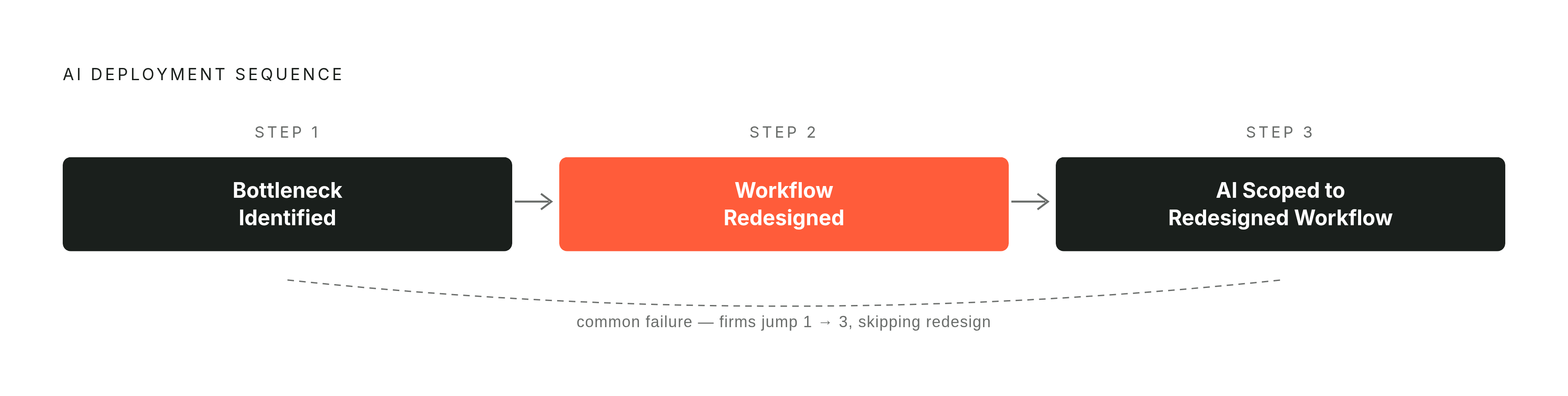
The most common mistake at this stage is finding the bottleneck and then sprinting to find a tool that matches it. That's still the wrong order, just wearing a diagnosis as a costume. The correct sequence is bottleneck identified, then workflow redesigned, then AI scoped to the redesigned workflow, in that order, no skipping ahead because a vendor demo looked good.
Scope the first deployment narrow: one workflow, one measurable outcome, and a shared definition, agreed on before anyone starts building, of what "done" actually looks like. A meaningful share of AI project delays trace straight back to unclear requirements at the outset, and a narrow, milestone-driven scope removes most of that ambiguity before it has a chance to metastasize into a six-month project with no end date.
Build the measurement case before deployment starts, not after. Retrofitting a way to prove value once the thing is already live is where most projects that technically reach production still fail to demonstrate they were worth doing. A reasonable production-readiness bar for a small service firm: cycle time on the target workflow measurably down, error rate flat or better against the manual baseline, and reclaimed capacity tracked in actual hours per week, not in the kind of productivity language that means nothing to anyone signing the check.
There's a real difference between handing a team AI licenses and embedding someone with the authority to change how the work happens. Distributing licenses to people who can't redesign their own workflow just scales access to the bottleneck without touching it. Embedding someone, internal staff or an outside specialist, with the standing to follow the workflow across systems and actually remove a handoff is what turns a diagnosis into a change anyone notices. McKinsey's 2025 Superagency in the Workplace report found that the companies getting the most value from AI are the ones redesigning workflows around it, rather than layering tools on top of workflows that never changed.
The ceiling a correctly identified bottleneck lets you raise
Most AI conversations aimed at small firms get framed as cost-cutting: fewer hours logged, lower overhead, the same business running a bit leaner than before. That framing is accurate, but only for the wrong bottleneck. It describes the floor. It says nothing about the ceiling.
When the right bottleneck actually gets removed, the change is that the firm can take on work it physically couldn't staff before, quote faster than the competitor still waiting on a manual data pull, or make calls that used to require a specialist on payroll the firm couldn't afford to hire, well beyond the same work simply getting done more cheaply. Run the five-person test: once the bottleneck is gone, can those same five people do what used to require a sixth hire, a longer runway, or turning a good client away with an apology?
That points to a capability gain rather than a mere efficiency one, and it only compounds if the constraint identified was the real one and not a comfortable stand-in for it. The diagnostic work laid out here isn't hard because finding a bottleneck is technically difficult, it usually isn't. It's hard because skipping it is exactly how a firm ends up with a tool nobody asked for, instead of a system that actually changes what the business is capable of doing.