Define Strategic vs Tactical When Bootstrapped
Strategic moves shift what your business can sell; tactical work just fills your calendar.

Feeling important isn't the test. The test is whether saying yes to this changes the ceiling on what the business can sell, serve, or build. Choosing a market segment, adding a service line, setting pricing architecture, picking which bottleneck to fix first: those move the ceiling. Formatting a proposal, scheduling a follow-up, reformatting a report for the third time this month: those stay below the ceiling, however urgent they feel at 11pm on a Tuesday.
A second test catches what the first one misses. Would a capable person, given a clear process, produce roughly the same output? If yes, it's tactical, and it gets delegated, systematized, or automated freely. Strategic decisions share three traits worth memorizing. They're slow or impossible to reverse, like which partner to sign or which pricing model to commit to, and they require context that lives only in the founder's head: customer relationships, actual risk tolerance, the stuff no dashboard captures. Their effects compound; a good call pays out for years, while a bad one costs years to unwind.
Here's where most founders get it backwards: they call something strategic because they're good at it, confusing personal competence with ceiling-moving impact. Writing the code, building the deck, tuning the spreadsheet model, these feel like high-value thinking while being pure execution wearing a nice outfit. Competence and leverage are different things. Ask the ceiling question before the hour gets spent; that habit matters more than any taxonomy pinned on the wall.
How tactical work captures founder hours even when founders know better
Tactical work arrives disguised as the path of least resistance: a client emails a question answerable in two minutes, so the founder answers it, every time, forever. A report is due and no one else knows the format, so the founder builds it, again. An edge case pops up in the workflow and needs a judgment call, and just like that, the founder is permanently in the loop for a decision that should've been automated on day one.
Each of these choices feels fine in isolation, and that is exactly the problem: they accumulate into a devoured week. Tactical work is visible and completable, producing a satisfying little checkmark, while strategic work is ambiguous and uncomfortable, often producing nothing more than a half-formed thought at the end of the day. Put both on the same calendar and tactical wins by default, every time, because done feels better than thinking, even when thinking delivers ten times the return.
The bootstrapped version of this trap has no floor under it. Enterprises have middle management to absorb the escalations and edge cases; bootstrapped operations have exactly one person, and everything flows to them by gravity. Removing the option entirely is what works: building a system, tool, or hire that owns the tactical work so thoroughly the founder physically cannot pick it back up out of habit.
What AI actually changes about this allocation problem
Here's the actual shift: AI makes a huge slice of tactical work delegatable without hiring anyone. Formatting, summarizing, routing, drafting, extracting, classifying, these are jobs a configured system now does, freeing up a founder's afternoon for something that actually needs a human brain. The cost of running these systems has also collapsed: GPT-4o-class intelligence ran around $30 per million tokens in early 2023 and sits closer to $2.50 now, according to Layer3, and the floor has fallen out from under these costs entirely.
AI use is itself either strategic or tactical, and most bootstrapped operators get this exact distinction wrong. Automating a discrete, repetitive task with a measurable near-term output is tactical AI use, and it's the correct place to start. Deciding which bottleneck to fix, which workflow to redesign, which system deserves to exist at all still requires a human doing actual thinking. Generated output is execution, however fluent it reads, and mistaking it for business thinking is the single most expensive error in this whole exercise.
The deeper mistake is where the tool gets pointed. Most SMBs bolt AI onto the workflow that's easiest to automate instead of the one that's actually constraining growth, because easy is comfortable and constraints are usually attached to something the founder doesn't want to look at directly. AI layered on top of existing work produces marginal efficiency; AI embedded in the actual constraint expands what the business is capable of. Placement determines why two companies can buy the identical tool and walk away with wildly different results.
The bottleneck identification step that determines whether AI is strategic or tactical
The most common mistake in AI implementation is automating a workflow that was never the constraint to begin with. Automate email follow-ups while quoting speed is what's actually strangling the pipeline, and congratulations: tactical automation, aimed at the wrong target, executed flawlessly. Fix the quoting process itself, and the ceiling on new business the team can absorb rises.
Finding the real bottleneck takes three questions, not a consultant. What single step, if it ran twice as fast, would let the business take on meaningfully more work? What is the founder doing personally that no one else can do, purely because no system exists yet to handle it? And where does work visibly pile up, slow down, or get turned away at the door?
Skip the audit and pay for it later. A one-to-two-week audit before building anything is the cheapest insurance available: document the workflow steps, the time each one eats, the error rates, and exactly what triggers founder involvement. The bottleneck usually becomes embarrassingly obvious once it's written down on paper instead of living in someone's head. Research consistently finds that most enterprise AI initiatives stall before reaching production, and the cause is almost always the absence of a concrete first deliverable. Skip the audit, and a bootstrapped 30-day sprint quietly turns into 30 days of exploration with nothing shipped at the end of it.
What a 30-day first deployment looks like when it is aimed at the right target
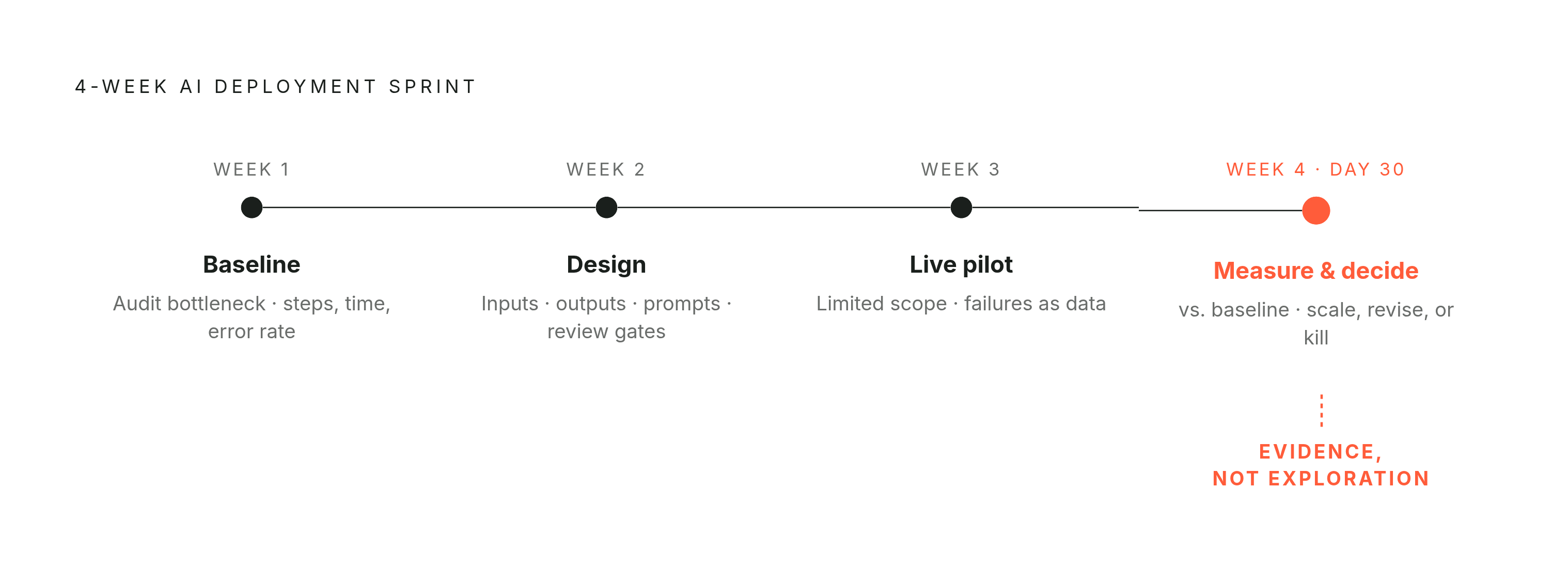
The arc runs four weeks: one workflow, one owner, a live result by day 30. Week one, pick the bottleneck the audit surfaced and document the baseline: steps, time, error rate, how often the founder gets pulled in. Week two, design the actual AI workflow, inputs, outputs, prompts, review gates, keeping a human in the loop anywhere the consequences of a mistake are real. Week three, run it on live work at limited scope, and treat every failure as data instead of a setback. Week four, measure the full outcome against the baseline, fix what broke, and decide whether to scale it, revise it, or kill it outright.
The output of this month is evidence, specific to this business, about where AI creates leverage and where it just creates noise, and that beats a badge that says "AI adoption" by a wide margin. No-code platforms like Zapier, Make, and Relevance AI carry modest monthly subscription costs depending on tier, and AI API costs for SMB-scale workflow intelligence have fallen sharply. Capital is no longer a legitimate excuse.
DIY versus paying someone else to build it is a bet on how much the founder's time is actually worth this month. DIY saves the fee but eats staff time, while managed implementations, such as those from Sansatech, an SMB-focused AI automation firm, tend to deploy faster, and speed matters when 30 days is a firm target. Most operators see the first measurable wins from quick-win automations relatively quickly, with fuller integration compounding from there. The founder's job in that first month is to set the target, decide what goes live, and review the result. The whole exercise is designed to keep the founder out of the building work.
The embedded AI engineer option and what it costs against a full-time hire
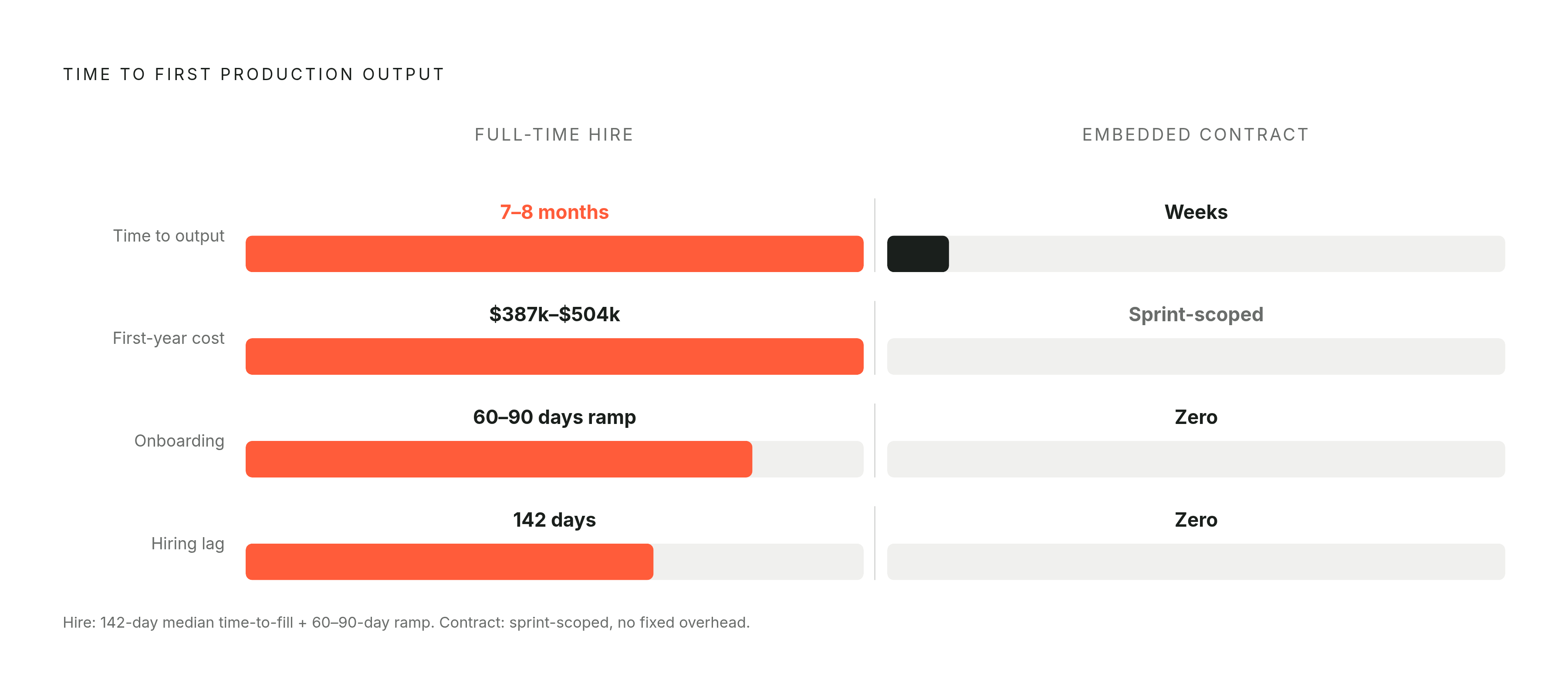
The alternative to doing it yourself is hiring for it, and the math on that doesn't favor patience. The average U.S. AI engineer salary hit $206,000 in 2025, up from $155,000 the year before, and the fully loaded first-year cost, once recruiter fees, benefits, and equity get folded in, typically runs $387,000 to $504,000. That's before the hire has shipped a single feature.
The timeline is the bigger problem. Median time to fill a senior AI engineering role in North America runs 142 days, plus another 60 to 90 days of ramp before that person ships at full speed. Call it seven to eight months from job posting to production. For an operator running a 30-day deployment clock, a seven-month hiring cycle carries a different kind of cost entirely; it's buying a house when what's needed is a rental.
The embedded alternative is an AI engineer who works inside the business's existing systems on contract, owns the implementation sprint start to finish, and leaves once the system runs on its own. Contract AI engineering in the U.S. typically runs hundreds of dollars an hour depending on scope and specialization, but the real comparison is the cost of the sprint against the cost of the hire plus the seven-month wait bolted onto it. An embedded engagement buys a working system in weeks with no long-term fixed cost and no onboarding overhead; a full-time hire buys permanent institutional memory that the embedded model trades away. For most bootstrapped operations, embedded wins on time alone, and it isn't close. The hire makes sense once the first system becomes central enough to the product that someone needs to live inside it permanently.
The market has already priced this in. Demand for forward-deployed AI engineering has grown sharply, and the embedded model is becoming a standard entry point.
How the first system compounds into new capability rather than just saved hours
Most SMBs frame AI's payoff in hours saved, a framing that undersells the whole thing. Sixty-six percent of SMBs report AI saves them $500 to $2,000 a month, according to Capsule CRM, which is real money and still only an efficiency story. The World Economic Forum found something bigger: 51% of generative-AI-using SMBs report revenue increases of 10% or more. That is a higher category of outcome, and a well-placed system deserves to be measured by it.
The mechanism is straightforward once someone points at it. Removing a bottleneck frees up time and changes what the team can take on. Fix the quoting bottleneck and the same team chases deals it used to turn away. Fix the data-entry bottleneck and the business offers a service line that previously would've required another hire just to keep the lights on. Each system removed creates headroom, headroom creates options, and options are the actual product of strategic work.
The typical sequence runs in stages: quick-win automation first, core workflow transformation following, and a genuinely new service or capacity emerging once the earlier systems have taken hold. The founder's role shifts along the same arc, from doing the tactical work personally, to deciding which bottleneck gets removed next, to deciding what to do with the capacity that just opened up. Same person, increasingly strategic use of the hours at every stage.
That question, asked after every system goes live, outlasts any one-time sorting exercise where a founder labels the to-do list and calls it done. Outcomes vary across businesses; the habit that produces the good ones doesn't.