Freight Forwarder vs Broker: What the Difference Means for Your Operations
Forwarders and brokers own different parts of a shipment's risk.
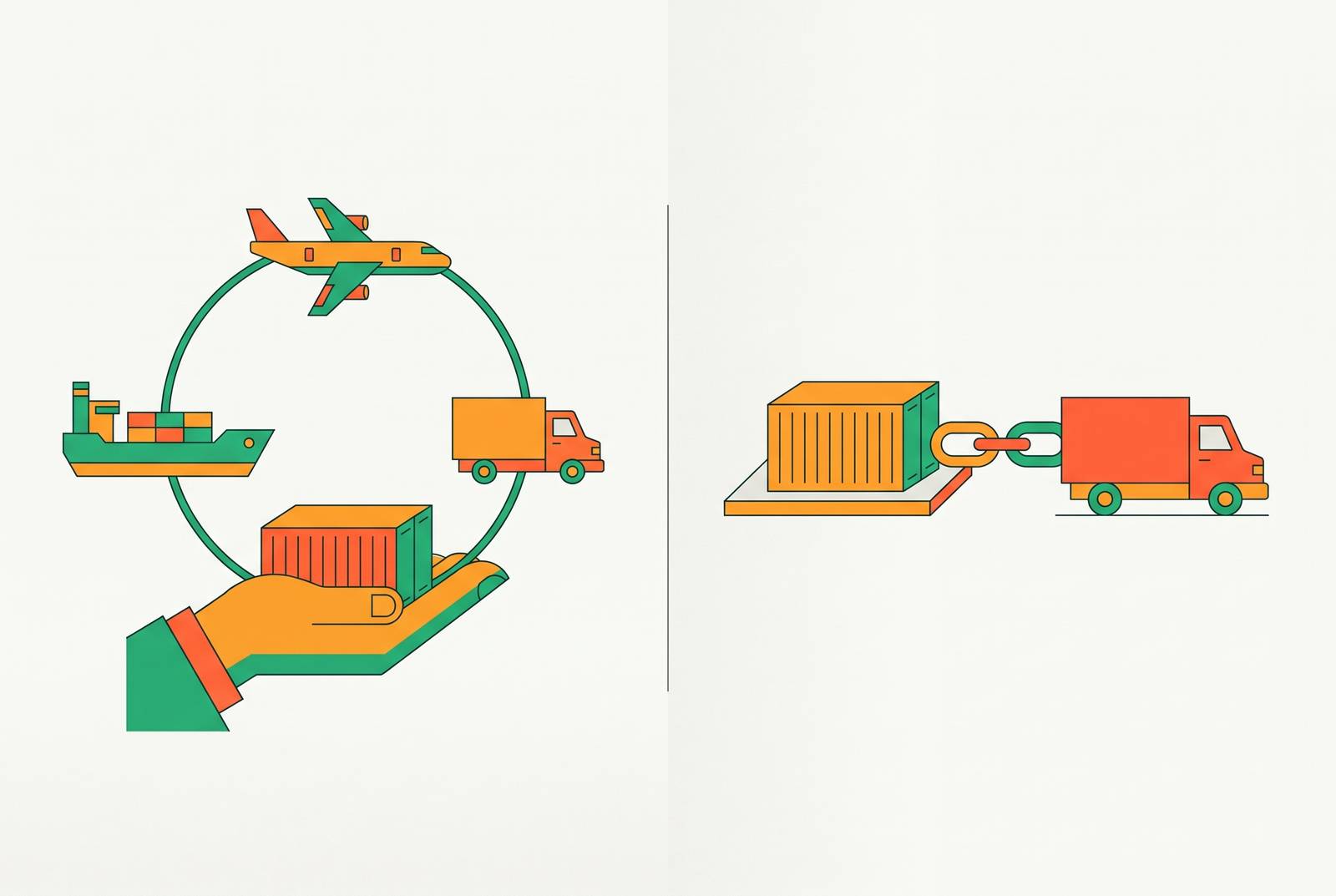
Choosing a freight forwarder or a freight broker is a decision about who owns the work, including booking the transport. The difference determines responsibility for cargo, paperwork, and handoffs when a shipment goes wrong. The right choice matches the provider’s scope to the shipment, then closes the coordination gaps with internal processes or embedded systems.
Why the forwarder-broker label is an operational question, not a terminology one
GoFreight describes a DTC furniture brand in Portland that chose a freight broker over two freight forwarders to move 40ft containers of flat pack furniture from Dongguan, China, to its Oregon warehouse. The broker arranged the ocean leg, doing exactly the job it had taken on. Customs clearance, ISF filing, and drayage were left unhandled. The shipment needed a chain of responsibility, and the shipper had bought one link.
That mismatch is easy to miss during planning. Both providers sit between shippers and carriers, so their titles can sound interchangeable until an unassigned task becomes urgent. A booking confirms only that transportation has been arranged. The shipper therefore needs to establish who is accountable for each part of the move, including the parts between the quoted services.
What each role actually does and where each one stops
Polt.ai distinguishes the roles by their responsibility for the freight itself. A freight broker matches shippers with carriers but never takes possession of the goods, which move under the carrier’s bill of lading. A forwarder takes responsibility for the shipment and may collect, store, consolidate, and ship goods under its own house bill of lading. Custody is the first dividing line between them. It separates arranging transportation from standing in the carrier’s place as far as the shipper is concerned.
Forwarders arrange bills of lading, handle export documentation, and see that customs clearance and regulatory compliance are in place for international shipments. Brokers serve a consultative role, advising clients on paperwork and making sure carriers follow regulations. They do not manage the filing chain or assume compliance responsibility. But taking on more of the work does not give a forwarder the right to carry out every customs task.
Kesco Logistics flags a particularly costly ambiguity in the word “broker.” In US trucking, it means an FMCSA freight broker that books trucks, while a customs broker is licensed by CBP to classify goods and file the entry. Those are not interchangeable permissions, despite the shared noun. A forwarder can assemble documents but cannot classify goods, declare value, or file the entry unless it also holds a CBP broker license.
GoFreight and Corrigan Logistics describe the licensing distinctions behind these boundaries. Freight brokers work under FMCSA broker authority with an MC number and a surety bond, and they do not issue their own bills of lading. Ocean freight forwarders have an FMC Ocean Transportation Intermediary license, and those that act as Non-Vessel Operating Common Carriers can issue house bills in their own names but must keep a larger bond than standard OTI freight forwarders. Domestic forwarders register with the FMCSA and issue their own bills of lading.
How liability actually flows — and why the bill of lading is the operational linchpin
The bill of lading anchors responsibility for the shipment. In a broker-arranged motor-carrier move, the carrier issues it and physically transports the freight. Under the Carmack Amendment, that carrier bears liability for loss or damage in transit. The broker generally bears no cargo liability unless its contract says otherwise or it has held itself out as a carrier. In a loss scenario, the broker’s value lies in having vetted the carrier and confirmed insurance coverage.
A forwarder issuing its own bill occupies a different position. As a domestic freight forwarder or an NVOCC on an ocean shipment, it stands in the carrier’s place and is responsible to the shipper from pickup to delivery, even when another carrier performs the physical move. Corrigan identifies an important exception for an ocean forwarder acting only as the shipper’s agent. Without issuing its own bill, that forwarder generally is not liable for cargo damage. The governing document is more revealing than the business card.
Scope can also change the legal position in the other direction. A broker that starts handling freight or issuing its own bill can be treated as a forwarder or carrier and held liable for cargo. The Portland case illustrates the related operational danger of assuming that one provider owns the full chain when its actual scope is narrower. The shipper needs to ask whose bill of lading governs the shipment and what liability limits apply under it.
Where each provider fits — and where using the wrong one creates operational gaps
A broker fits standard US trucking lanes where access to capacity is the main requirement. Speed to a suitable carrier can be more useful than end-to-end control, particularly when the shipper already has staff or systems to manage documentation independently. Problems begin when the shipper expects that arrangement to cover responsibilities outside it.
A forwarder fits shipments that cross borders, travel by ocean or air, or involve regulated, consolidated, or multimodal cargo. These moves need coordination across more than one transport booking. A shipper seeking door-to-door responsibility, including customs, drayage, and warehousing, needs that broader scope, with customs filing performed by an appropriately licensed party. Forwarders also maintain more direct control over shipments and can reroute, escalate, or adjust them. Broker updates depend on carrier reports, which can limit real-time visibility and the scope for direct intervention.
Total landed cost includes the freight rate at the top of a quote along with customs, documentation, drayage, and penalties. A cheaper broker quote on an international lane can create border costs that dwarf the initial savings. Excluded work does not become free work.
A forwarder handles international legs, while a broker supplies access to a large carrier network for high-volume domestic trucking. The Portland shipment could have used that split with responsibilities understood upfront. The shipper needs to compare everything the shipment calls for with the work each provider takes on.
Where operational gaps widen for smaller shippers managing this coordination manually
Work outside a provider’s scope lands somewhere else. For smaller shippers, it often lands on an internal team with limited logistics capacity. When a broker-arranged move needs customs filing, document assembly, ISF submission, and drayage, the shipper must handle those tasks or appoint other providers to do them. Each handoff creates another opportunity for a missed filing, timing failure, or misunderstanding. The burden is not just completing the tasks but keeping them aligned.
Kesco describes the problem when container data sits with a forwarder and filing authority sits with a separate customs broker. Security filings wait for an email while the terminal’s free-time clock keeps running. Demurrage and detention can accumulate during that coordination gap. Both providers may know their roles, but someone still needs to take charge of the handoff between them.
Even with a forwarder, the shipper may still have to keep some of the work in step. Smaller shippers may receive less proactive management or flexibility than high-volume customers, leaving more follow-up with their own staff. The provider choice is only part of the diagnosis. Internal systems must also be able to manage what falls between providers, especially when documents, status reports, and filing deadlines must stay in step. Without that connective layer, a small team becomes the manual interface between companies.
How embedded AI closes the coordination gap without adding headcount
Much of that interface work is repeatable, document-heavy, and prone to exceptions. Teams have to handle status reconciliation, document pre-auditing, customs data handoffs, and carrier rate comparison often, and doing these tasks by hand leads to delays and errors. They are also low-judgment tasks suited to automation. Embedded AI handles them in the systems teams already use, so staff can get the work done without having to query a separate tool. Its role is to support routing decisions, document processing, exception management, and shipment updates within the workflow.
The distinction is important for a shipper that has already tried AI without seeing a P&L benefit. Most logistics AI deployments remain isolated tools, so their gains stay local. A faster document step is of limited use if the next handoff still stalls. For AI to be better, its design must address a specific bottleneck and connect to the work around it.
SANSA’s model offers freight and logistics SMBs a path between six-figure consulting engagements and waiting 18 months for an internal build. It starts by diagnosing the highest-leverage bottleneck, then builds a production system around that constraint rather than adding another tool for the team to operate. The model takes on work that might otherwise need another logistics coordinator. SANSA says a freight company got back 160+ hours each month by working this way.
The 30-day deployment model puts a working system ahead of a perfect architecture. Whether the constraint is customs data handoffs, document processing, or carrier rate reconciliation, value can begin accumulating while a more elaborate build would still be in planning. Speed has a practical purpose in this setting. The system handles recurring coordination work within the headcount smaller shippers can afford, while the need for a licensed customs broker and the governing bill of lading remain unchanged.
What to actually do before the next shipment decision
Before choosing a provider, the shipper should establish whose bill of lading will govern and what liability limits apply. Price comes after the scope is understood. The shipper should next establish who will file the customs entry and, if that party is separate from the forwarder, who owns the data handoff while the clock is running. The shipper should then identify the coordination left between the provider’s scope and the destination. That remaining work needs internal capacity, a different provider, or a system designed to close the gap.
For standard domestic trucking, a broker is the right fit, backed by carrier vetting, insurance confirmation, and documentation processes. International or multimodal freight calls for a forwarder with an in-house or tightly integrated customs broker capability. The crucial distinction is whether the forwarder holds its own CBP license or works through a partner, and who owns the handoff in the latter arrangement. A partnership alone does not answer that question.
For a small team, the remaining coordination gap is a workflow problem before it is a staffing problem. The next step is to identify the specific bottleneck, such as document assembly, status reconciliation, or invoice auditing, and embed AI there to handle work that would otherwise require hiring someone to manage the gap manually. That approach is faster and more durable when built around the actual work. Businesses that know how the providers’ roles differ and build systems to handle the gaps will spend less to keep the work in step and face fewer surprises over liability. Those that treat the choice as a commodity purchase will leave part of the operation unassigned.