Freight Operations Process Bottlenecks That AI Can Remove
AI automates the freight decisions that don't require human judgment anymore.
Most companies that believe they've modernized their quoting process have, in fact, modernized their record-keeping. They have a TMS. It logs the quote. The dispatcher still picks up the phone, opens three carrier portals, waits, collates numbers, and makes a call. The system got better at remembering while the human kept doing the work.
In spot markets, that gap is expensive. Capacity shifts by the hour. A quote that takes a full day to produce is frequently a load already awarded to someone faster, and nobody holds a post-mortem on loads they never won. That win-rate erosion happens invisibly, load by load, accumulating in a column that never appears in the weekly ops review.
Embedded AI changes the decision cycle. Systems that analyze thousands of rate points across lanes, service levels, and current capacity conditions return optimized options in seconds. RXO reported in its Q1 2026 earnings that agentic AI fully automated over 500,000 broker phone calls in a single quarter, cut time-to-bid by a factor of ten, and increased digital quote volume by roughly 30%.
Placement is what makes or breaks the implementation. AI that surfaces ranked rate options inside the TMS interface the dispatcher already has open is a categorically different product from AI living in a separate tab someone has to remember to open. One removes a step; the other inserts a slightly more sophisticated lookup into an otherwise unchanged process, which is how you end up with a tool that costs real money and produces a polite shrug at the next QBR.
Faster quotes mean more loads quoted per day, higher win rates on competitive lanes, and a team that stops spending meaningful hours on decisions that require no human judgment whatsoever.
The document problem: why paperwork is still costing freight companies money in 2025
The freight document stack is substantial. Bills of lading, proofs of delivery, rate confirmations, customs declarations, packing lists, invoices: most still processed manually or semi-manually, most touching multiple hands before anything useful happens. Industry research puts freight invoice error rates at 3 to 7% [citation needed], and the errors tend to favor the carrier. Uncaught discrepancies are a direct, recurring margin leak.
Customs documentation errors cause 25% of customs holds [citation needed]. In cross-border freight, that translates immediately to detention fees, delayed payment, and the specific kind of customer relationship damage that comes from explaining why a shipment that should have cleared did not.
Here is what manual document processing actually costs beyond the error rate: it consumes staff hours on work that is, at its core, routine. Matching a BOL to a POD to a rate confirmation is routine work. Done across dozens of daily shipments, though, it absorbs hours that look productive because people are visibly occupied, even when the output is just administrative confirmation of things that should already match.
AI-assisted document processing uses NLP and OCR to extract fields from PDFs, scanned forms, and email attachments; validate them against expected values; flag discrepancies; and push clean data directly into the TMS or ERP. One Texas-based broker implemented AI-assisted billing and watched the billing cycle shrink from 21 days to 7, freeing up roughly $180,000 in monthly working capital [citation needed]. The staff role shifts to exception review, a meaningful upgrade in how those hours are spent. NORDEN reduced internal operations emails by 80% after implementing AI-powered communication triage [citation needed], a result worth noting because document volume and communication volume are, in practice, the same problem wearing different formats.
The workflow-embedding requirement applies here as clearly as anywhere else. Document AI that feeds directly into the TMS eliminates re-keying. Document AI that outputs a separate report creates a new task: someone still has to move the data. One is automation; the other is a fancier inbox.
Load matching and carrier selection: where gut instinct is being replaced by ranked probability
Traditional carrier selection is essentially a memory sport. The experienced dispatcher calls down a list, checks a portal, cross-references a mental model of who performed well last month on a similar lane, and makes a call. This works at low volume and degrades under scale. It also evaporates entirely when that dispatcher leaves and takes the institutional knowledge with them, a risk that appears nowhere on the balance sheet until it suddenly does.
The hidden costs are the ones that do not surface as "bad carrier selection" in any dashboard. They surface as service failures, detention fees, and lanes with inexplicably tight margins. The carrier who accepted and fell through. The lane mismatch that produced a late delivery. The missed return-route opportunity that would have cut costs on both sides. These losses are real and mostly invisible.
AI freight matching reframes the question. It asks which carrier is most likely to perform, not merely which carrier is available. Ranked outputs weight past performance on the same lane, return-route overlap with the current pickup, proximity to the load point, and active regional capacity. The output is a reliability ranking, and that distinction compounds across thousands of loads in ways the traditional model cannot track.
XPO has reported that its AI freight matching platform matches 99.7% of loads automatically without human intervention and has been credited with reducing transportation costs by 15% [citation needed]. C.H. Robinson's earlier AI systems reached 50 to 60% automation on load matching before hitting a ceiling; agentic systems routinely break through 90% [citation needed]. That ceiling was an architecture problem, one that agentic AI resolves by acting on the ranking rather than merely surfacing it for a human to act on.
For smaller brokers, this capability is now accessible without full data science teams. The same ranked-probability logic is accessible through SaaS platforms at a deployment cost that does not require a multi-year project. The dispatcher's job contracts to the portion of loads that agentic systems flag as requiring human judgment.
Shipment visibility and exception management: reacting faster versus not having to react at all
Gartner found that 72% of supply chain leaders lack real-time coordination despite operating modern ERP and WMS systems [citation needed]. The mechanism is straightforward: data silos, delayed decisions, information arriving after someone has already made an irreversible call. The infrastructure exists. The visibility does not.
The traditional exception management model is entirely reactive. The driver calls in with a problem, the dispatcher scrambles, and the customer gets notified after the exception has already materialized. Visibility under this model is retrospective; it tells you what happened instead of what is about to happen, a distinction that matters when explaining a missed delivery window to a shipper.
Predictive tracking AI monitors dwell times, congestion patterns, port and rail data, and weather inputs to surface probable delays before they become confirmed ones. ITS Logistics' ContainerAI manages 99.8% of container moves across ocean, rail, and road, aggregating vessel, port, and inland data to prevent detention and demurrage; one Fortune 500 client reportedly saved tens of millions as a result [citation needed]. Leading logistics networks have reported reductions of up to 25% in late deliveries using predictive routing [citation needed].
Routine check calls are a high-volume time sink that AI agents handle well. One transportation company automated 60% of check calls with AI agents, saving tens of thousands of labor hours [citation needed]. Those hours redirected toward exceptions that actually required a human to resolve, where the judgment was always supposed to go.
Dwell-time pattern analysis is worth naming specifically. Recurring congestion at specific yards, docks, and terminals often reads as bad luck until someone aggregates the data across months and identifies the structural cause. Under a reactive model, no single incident is bad enough to justify the investigation. AI makes the pattern visible without anyone having to decide to look for it.
Why bolting AI on top of existing workflows produces marginal results
Here is the pattern behind most of the disappointment with AI in freight: a company acquires a tool, maps it onto the existing process, sees modest improvement, and concludes the technology is overhyped. The deployment was wrong.
BCG's February 2026 supply chain planning report found that 88% of supply chain organizations use AI in some capacity, but only 20% achieve meaningful returns. The gap between adoption and impact is almost entirely an implementation problem.
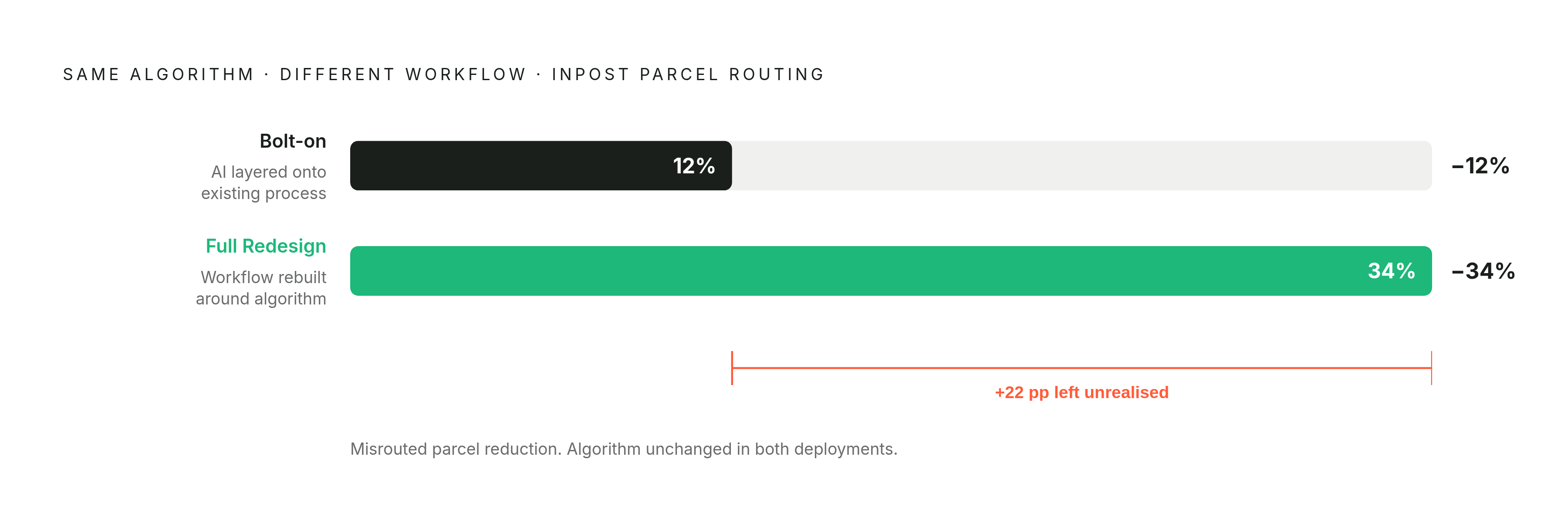
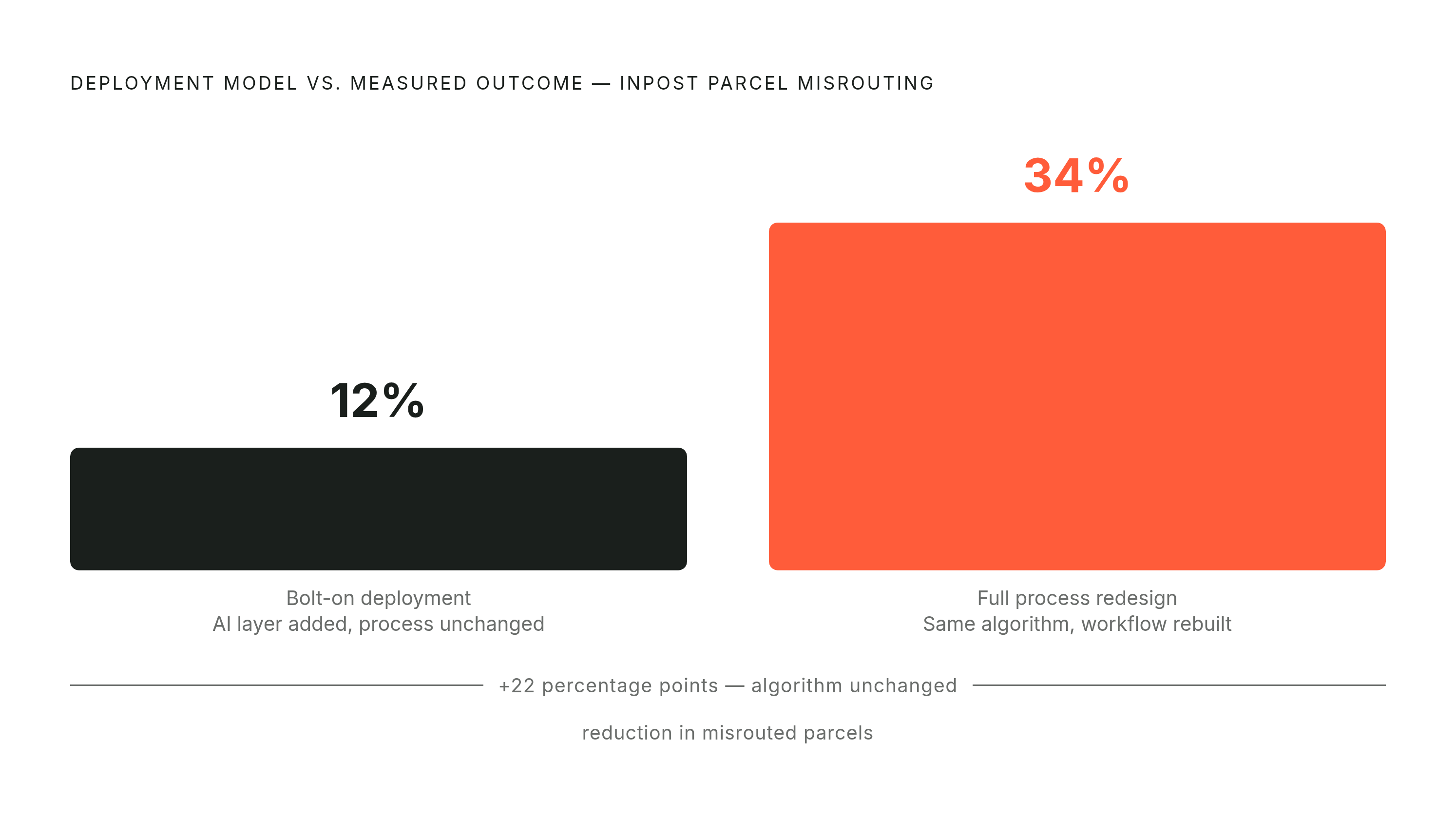
The InPost case is instructive. AI-driven allocation algorithms reduced misrouted parcels by 12% when deployed as a bolt-on to existing processes. The same algorithm delivered 34% improvement after a full process redesign around it [citation needed]. The algorithm did not change. The workflow did. That 22-point difference is the cost of treating AI as a layer rather than a structural component of how work gets done.
In freight terms, the bolt-on looks like this: an AI rate tool produces a spreadsheet, the dispatcher opens the spreadsheet, compares options, and manually enters the selected rate into the TMS. The lookup is marginally faster, every other step is identical, and the accelerated micro-task was a minor one.
The embedded model looks different. The ranked rate surfaces inside the TMS screen the dispatcher already has open. The flagged invoice discrepancy appears in the same queue where invoice approvals already live. No context switch, no extra step, no separate tab to remember to open. Mark Hill, CEO of PCS Software, has stated that most fleets are not suffering from a lack of data; they are suffering from data that shows up too late or in the wrong place [citation needed].
Logistics Viewpoints' 2026 framing describes the effective model as AI built directly into platforms so users experience AI-infused decisions within the tools they already use, rather than querying AI in a separate interface [citation needed]. The right question is where in the actual workflow a tool acts, and whether it removes a step or merely assists one.
What freight teams can handle once the repetitive work is off their plate
A logistics coordinator spending four hours a day on load building, carrier outreach, and invoice reconciliation handles only transactional work. This matters less than it should in the moment because the work feels substantive: things are being decided, loads are moving, customers are being answered. Most of what fills those four hours, though, is data entry with higher stakes.
AI enables a genuinely different allocation of the same person's time: exception management and proactive customer communication instead of reactive firefighting; lane analysis and pricing strategy instead of rate lookup; carrier relationship development instead of check calls. New service lines or lane coverage the team could not staff before, because the people who could have run them were occupied running routine transactions.
Volume scaling without proportional headcount growth is a documented outcome once AI absorbs the repetitive throughput work. Teams handling two to three times the shipment volume with the same staff is a result reported by operators where the throughput constraint has shifted from human attention to system capacity [citation needed]. C.H. Robinson has stated this operational intent directly: AI handles appointment entry and rate lookup so operations teams can focus on exceptions, customer engagement, and strategic optimizations [citation needed].
For smaller freight companies, the economics of this shift are now accessible. Gartner's 2025 estimates put custom internal AI builds for mid-market companies between $2.5 million and $5 million [citation needed]. Established logistics AI platforms integrate in weeks through SaaS deployment paths, not years through internal development. The build-versus-buy calculus has shifted, and a lot of mid-market operators are still pricing this out based on assumptions from several years ago.
The ceiling on what most freight operations can accomplish was the sheer volume of repetitive work consuming the people who had both the talent and the ambition. Remove that constraint and the business has a meaningfully different range of options than it did before.