How a Freight SMB Reclaimed 160 Hours a Month Without Hiring Anyone
A sequenced automation approach frees up operational capacity without adding staff.

AI automation for freight and logistics SMBs works best as a connected sequence. SANSA reports that a freight company saved 160+ hours a month. Clear routine communications first, automate document entry next, and then accelerate quoting, so each improvement creates capacity for the next.
Why a freight SMB's labor problem is structural, not seasonal
People can interpret an unclear request, negotiate a difficult move, and keep a relationship intact when a shipment goes wrong. A brokerage coordinates shippers and carriers rather than owning trucks or touching cargo, so that judgment is central to its value. The problem comes when the same people must also carry every routine piece of information through the business. As load volume rises, the repetitive work rises with it, whether the team is having a busy season or a quiet one.
Email, spreadsheets, and manual data entry can support a small operation, but they do not absorb additional work on their own. Each handoff still needs someone to read the information, work out what it means, and pass it on, so growth depends on how much time staff have. In a thin-margin business, that connection makes cost per load an important constraint. Consultancies like Sansatech address this problem by diagnosing repetitive work and building production-ready automation into the bottleneck. The ceiling is not a shortage of talent or ambition, but the absence of systems that can carry the repetitive load.
Why the order of automation determines whether it compounds
Before automation can remove work, the operation needs one source of truth in its transportation management system, or TMS. An agent acting on conflicting records can update the wrong load or prepare a payment against a rate that changed by phone. Faster processing merely carries the mistake through the operation more quickly. Cleaning up the underlying records is therefore a prerequisite for deployment.
Once that foundation is sound, the sequence should follow both payback and risk. Gathering large amounts of information comes before work that needs clean documents, while people still have to approve decisions that move money, approve carriers, or set prices. The diagnostic phase matters because it establishes those dependencies before a build starts. Sansatech makes that diagnosis the first stage of its engagement, rather than treating every possible automation as equally ready.
The three layers here follow that order, though they cover only some freight workflows. Each removes a constraint that would otherwise limit the next. Skipping the prerequisite work can leave a team rebuilding connections and delay capacity recovery.
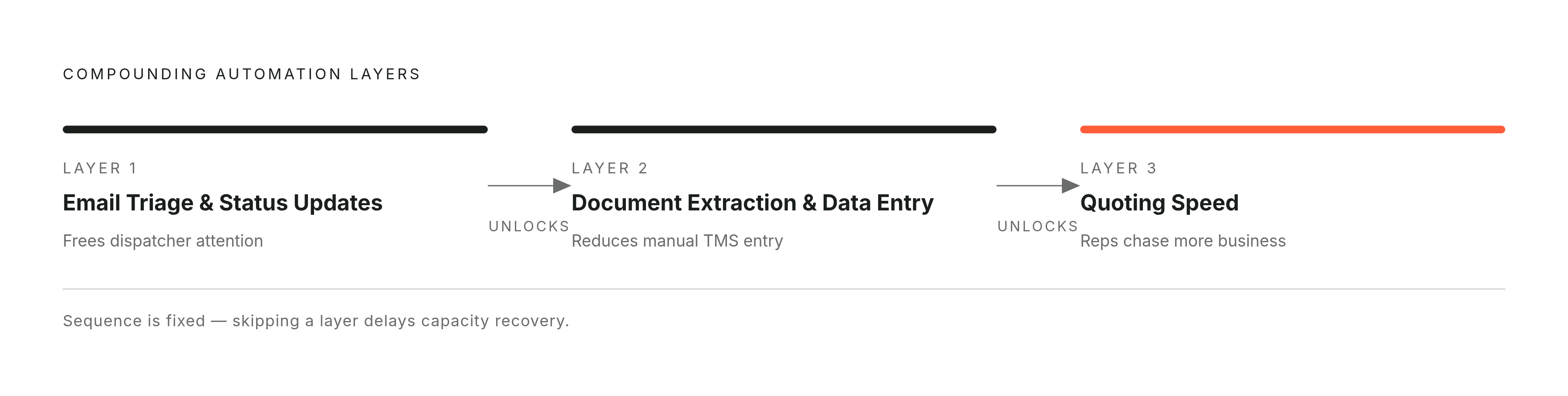
Layer one: stripping email triage and status updates from the operations team
Load tenders, status checks, POD requests, and exception alerts all land in the same queue in a dispatcher's inbox. Check calls stack up while status updates wait to be typed into the TMS. Before the dispatcher can act, someone must work out what each message is about and whether it needs attention. Much of that effort produces no new judgment about the shipment. It simply keeps the information moving.
The first layer separates routine traffic from work that needs a person. AI agents classify incoming messages, distinguish quote requests from status checks and exception alerts, and route or answer routine requests. Check-call agents run the status loop through phone, email, and SMS, record the response in the TMS, and surface genuine exceptions. Tracking feeds can also provide the shipment signal so someone does not have to ask for it again. Trucker Tools offers API and file-feed integration, while Descartes MacroPoint provides integration options for location and status updates.
This pattern is in practical use. C.H. Robinson reports that its agents automate the majority of checks on missed LTL pickups across thousands of shippers. For a smaller operation, the value lies in the same division of labor. In an embedded approach such as Sansatech's, routine communications are a useful first target because clearing them releases attention for the next workflow. The dispatcher now sees the loads that need them, including missing signals, late arrivals, and carrier problems.
Layer two: document extraction and back-office data entry
Once routine communications are under control, the next constraint is the information inside the attachments. Every load brings documents that must become usable records, including rate confirmations, BOLs, PODs, and invoices. Reading each document and retyping its contents can look like a small task in isolation. Across the month's loads, however, it becomes a substantial claim on the back-office team's time. A faster inbox does not help much if its attachments still form a queue.
Document automation closes that gap by connecting intake to the TMS. The pipeline monitors incoming documents, classifies them, extracts fields, checks those fields against business rules, and sends clean data into the operating system. A person handles only the cases flagged as exceptions. The important change is that a model can read a PDF and the operation no longer requires someone to carry its contents through every subsequent step.
That distinction also explains why extraction alone is an incomplete purchase. Cover sheets, duplicate files, and attachments that do not belong must be removed before processing, and the data left must go into the right record. Validation and reliable TMS integration are therefore part of the workflow. The before-and-after is a change from universal manual handling to exception handling, without relying on an unsupported per-load time estimate.
Layer three: quoting speed and win rate
The first two layers recover time from servicing work already in motion. Quoting automation changes which work the team can go after next. A request for quotation still requires a commercial decision, but much of the surrounding work is preparation. Someone must read the request, find the rates that fit, apply pricing rules, and put the response together. When that work has to wait behind status checks and document entry, the brokerage takes longer to reply even if the team knows how to price the load.
An automated quote workflow can parse the request, match it against contracted rates and spot market data, and prepare a quote using the business's margin rules. Pricing logic also needs to account for lane history, customer tier, capacity, and market conditions. People still need to make pricing decisions because a quote put together correctly can still be a poor deal for the business. The system supports that decision by bringing the relevant information together inside the operating workflow.
Faster preparation gives the brokerage a better opportunity to respond while the request is still live. That creates a revenue opportunity, though the size of any win-rate increase remains unproven. The earlier layers matter because winning additional loads is useful only if operations can service them. Together, the layers let broker reps spend less time drafting routine responses and more time on complex multi-modal quotes and customer relationships.
What 160 hours recovered per month actually looks like across a five-person team
SANSA's official website lists a “Paper Freight Company” case study with the result “Saved 160+ hours/month”. That supports the reported outcome, but the supplied case information does not allocate those hours among workflows or establish that the customer had a five-person team. The five-person model is therefore a way to understand the scale of the result. The evidence also gives no grounds to promise that another brokerage will save at least as much time.
The arithmetic is the sum of the net time removed from each person's recurring work over the month. For dispatchers, the largest contribution would come from fewer routine check calls and status updates. For back-office coordinators, it would come from documents that no longer require manual entry. For broker reps, it would come from automated quote preparation, with contributions varying across roles because they carry different workloads.
Time spent handling flagged cases, reviewing pricing, and managing the automation remains work, so it belongs in the calculation. The same saved minute cannot count once under email triage and again under document intake. The 160-hour figure shows how much time the team got back, but working out exactly how much each layer saved would take measurements the case summary does not give.
Why the hours compound into new capability rather than just lower overhead
Hours saved do not always cut payroll costs, especially when the same team stays in place. Their immediate value is capacity that the business can redirect. Dispatchers can focus on disrupted loads, broker reps can build complex accounts, and coordinators can sort out the documents that need someone to work out what they mean. The work changes from processing everything to managing what falls outside the routine. That gives the business a larger operating range.
The compounding effect begins when the first deployment releases the attention needed to implement and use the second. Financial savings can help fund the next build, while staff gain room to work on the next constraint. Document intake then feeds cleaner information into the workflows that follow, and quoting uses those connections. Each layer is more useful because the preceding one has reduced friction around it. Buying more tools without fixing those handoffs will not do the same thing.
This is why integration matters more than the width of an AI toolset. Outputs must reach the system of record, and approval gates must keep consequential decisions with people. Otherwise, the team merely acquires another place to copy information from. When those connections work, the team can handle more quotes without building up the same servicing backlog. The business gains room to accept work that previously forced a choice between waiting, hiring, or declining it.
Why hiring another ops rep is the wrong instrument for this problem
Hiring is a sensible response when the operation needs more judgment, relationship coverage, or specialist knowledge. It is a less direct answer when existing employees spend their time transferring routine information. Another ops rep can absorb part of that workload, but the underlying requirement for manual handling remains. The next increase in volume brings the same problem back. More hands can move the queue without removing the reason it exists.
Recruitment and onboarding also leave the bottleneck in place while the new person becomes effective. An automation build targets the recurring work itself, although its value still depends on the quality of the integration and the exceptions left for staff. The practical comparison is therefore not a person against a piece of software. It is additional manual capacity against a system that releases capacity already on the payroll. For repetitive status loops, document entry, and quote drafting, that system tackles the cause more directly.
Mistakes and edge cases are the strongest reasons to question this approach. That is why the sequence preserves human ownership of pricing, carrier approval, payments, and genuine operational exceptions. Automation should not turn an uncertain case into an unattended decision. A hire adds another person's judgment, while a well-built workflow makes the existing team's judgment available where it is needed. Neither approach makes people unnecessary, but only one removes the repeated handling requirement.
How SANSA builds this stack for a freight SMB without a six-month runway
A small freight team has several ways to automate its work, from functions in its operating platform and connected tracking services to custom systems built around its workflows. The relevant comparison is how much of the handoff each route actually completes. A tracking feed supplies a signal, while document intelligence extracts information and an integrated workflow moves that information into usable records. The best fit depends on the bottleneck, the TMS connection, and the approval rules.
SANSA offers an embedded model through three stages, which are diagnose, build, and embed. Its diagnostic stage promises answers in two weeks by mapping workflows, looking at costs, and scoring opportunities. In the build stage, it builds production-ready systems and custom integrations and runs production testing. In the embedded stage, it trains the team, tracks how well the systems work, and keeps improving them. That sequence addresses both the technical work and the adoption needed to make recovered capacity real.
For a five-person operation, getting advice about automation differs from getting a working system the team can use every day. SANSA's published freight result provides evidence of recovered hours, while its stated delivery model explains how it approaches the work. Neither establishes that every customer will recover the same amount or follow an identical deployment sequence. A useful first win is a production workflow that removes the highest-leverage bottleneck and gives the team room to address the next.
The destination is an operation that moves beyond an inbox with better manners or a faster way to type into the TMS to free staffing decisions from the demands of repetitive workload. When the first win makes the second possible, the old ceiling stops forcing a hire or a turn-away at every increase in volume.