Freight Forwarding Client Acquisition Patterns by Shipment Volume
Top-tier consolidation creates gaps that mid-market forwarders can fill with faster sales cycles.
Global freight forwarding revenue dropped from $202.7 billion in 2022 to $162.4 billion in 2024, a cumulative decline of 19.9%, before climbing back to $166.2 billion in 2025, a gain of 2.3%. That is not a market snapping back to its old shape. A separate estimate from Research and Markets puts 2025 revenue at $213.94 billion, growing to $225.99 billion in 2026 at a 5.6% compound annual rate, and the two numbers don't reconcile because they're counting different things. Treat them as two flashlights pointed at the same room from different angles. Research and Markets projects the market reaching $279.18 billion by 2030, which is a long runway, and the forwarders who spend the next year building pipeline instead of chasing rate spikes are the ones who'll still be standing on it.
That distinction, rate inflation versus volume and complexity, matters because it changes what "winning" looks like. That lever is gone. Growth now comes from shipment volume and the layered services around it: the forwarders who recover fastest are the ones who figured out who to sell to, not just how much to charge them.
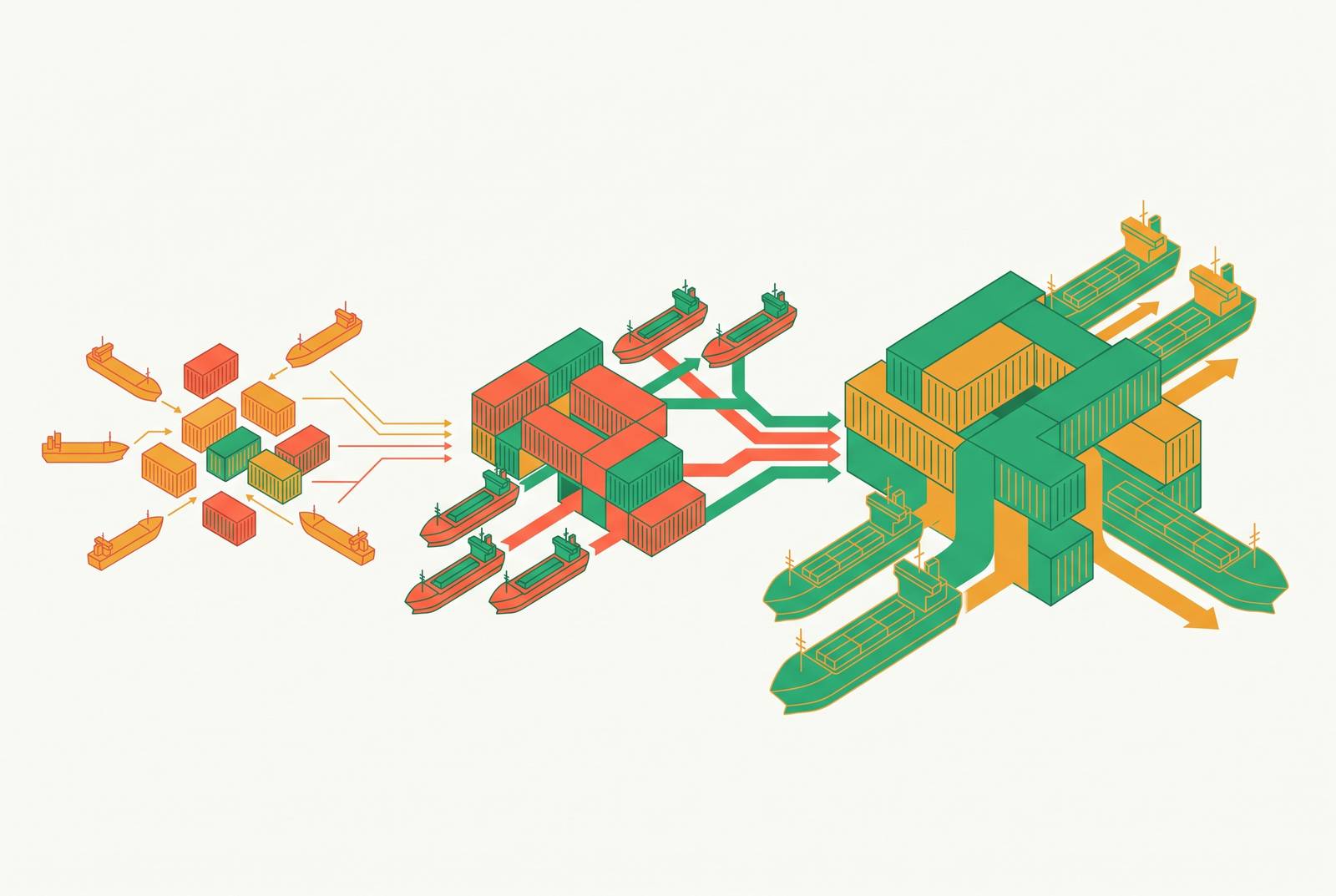
Top-end consolidation and its ripple effect on middle-market client availability
DSV A/S closed its acquisition of DB Schenker in April 2025, and the combined entity now runs close to 160,000 people across more than 90 countries, with DSV holding 15.9% market share on its own and the top five global forwarders controlling 52.9% of total revenue between them. That is a genuinely large piece of the pie sitting with five companies.
Consolidation at that scale is never clean. The integration is expected to cost up to 13,000 jobs at the combined entity, and every one of those roles that touched a client relationship is a relationship now sitting unattended, at least for a while. Enterprise shippers who spread volume across both DSV and Schenker before the merger now have a concentration problem they didn't ask for, and the sensible move is to diversify that risk back out. Some of that volume lands on mid-tier forwarders who were not previously in the conversation. Call it trickle-down freight economics: when the top of the market swallows itself, the middle gets fed.
The window is narrow. Integration is expected to result in up to 13,000 job losses at the combined entity, a signal that client-facing attention will thin during transition, and enterprise shippers who used both DSV and Schenker will consolidate or diversify to avoid concentration risk, with mid-tier forwarders as the natural beneficiary.
The enterprise segment: what a substantial majority of the market demands from a forwarder amid a lengthening sales cycle
Large enterprises accounted for $111.5 billion of 2025 revenue, or 67.1% of the entire global market, a figure Mordor Intelligence backs up independently at 68.50%. Large enterprises generated $111.5 billion in 2025 revenue, representing 67.1% of the global freight forwarding market (Mordor Intelligence corroborates at 68.50%), the largest segment by far, but growing at a slower 4.8% CAGR.
What justifies chasing that segment despite the slower growth is scope. An enterprise account rarely buys one lane or one mode. It is the largest segment by far, generating $111.5 billion in 2025 revenue, representing 67.1% of the global freight forwarding market. That is why the sales cycle stretches the way it does. Selling to an enterprise account isn't a sales motion so much as an endurance sport, and the forwarders who win it are the ones who budgeted the patience for it from day one.
There's also a qualification bar that didn't exist a decade ago. Enterprise buyers increasingly want scope 3 emissions reporting and verified sustainability credentials baked into the vendor relationship, and a lot of smaller forwarders simply haven't built that reporting infrastructure yet. It's less a nice-to-have than a gate: no data, no seat at the table, regardless of price.
The SME segment: the growth engine that digital platforms are making newly reachable
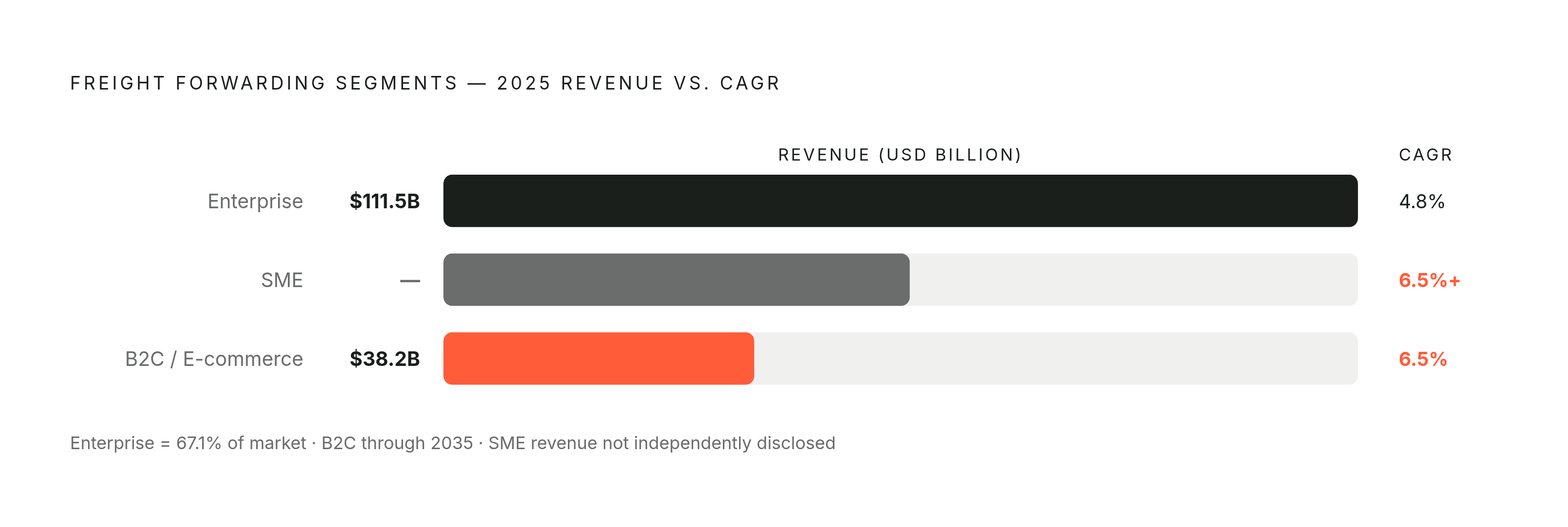
If enterprise is the segment with the money, SME is the segment with the momentum. The gap between enterprise's 4.8% and SME's 6.5%-plus is the whole argument for where sales effort should be trending.
Deal velocity backs that up. SMB deal cycles typically close in 1 to 3 months, far faster than enterprise, meaning pipeline velocity is structurally higher even if individual deal size is lower. Smaller checks, but a lot more of them, a lot faster.
Sticking with the long game keeps the forwarder holding the account as it grows, rather than losing it to whoever competes for it once it's no longer small. An SME shipping a few containers a quarter today can be a mid-size shipper in three years, and the forwarder who picked up that account when it was small is the one still holding it when it's not, because loyalty built early is genuinely hard to dislodge later. That's the compounding case for SME acquisition: it's not about the deal in front of the sales rep, it's about the deal that deal turns into.
Historically, SMEs faced higher friction: rate discovery was opaque, documentation was manual, and carrier access required volume they didn't have. Digital platforms didn't just make the process nicer, they lowered the actual floor of what counts as a viable client, which is a different and much bigger thing.
Quoting behavior and digital access as factors separating forwarders winning SMBs from those losing them by default
SMB buyers favor forwarders offering digital booking, parcel consolidation, simplified customs documentation, and returns coordination, service features that differ from traditional B2B freight. Simple enough.
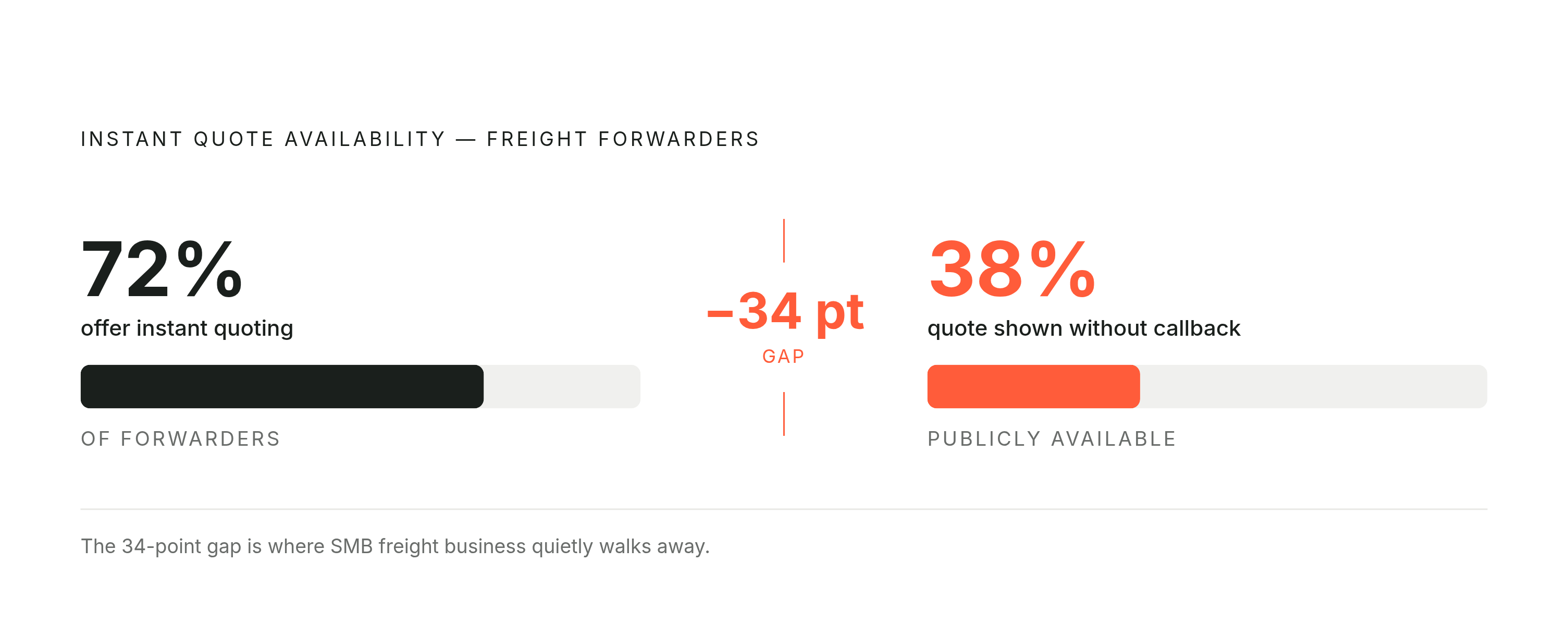
Consider the numbers: 72% of forwarders offer some form of instant quoting, but only 38% make that quote publicly available without a callback first. That's a big enough gap that it functions less like a rounding error and more like a filter, separating forwarders who've actually adapted from ones who've just added a form that still routes to a human. Enterprise customers increasingly require scope 3 emissions reporting and verified sustainability credentials that many smaller forwarders haven't yet cleared, while historically SMEs faced higher friction from opaque rate discovery, manual documentation, and limited carrier access (friction that digital forwarding platforms are now removing, lowering the floor on what counts as a "viable" SMB client). The one who keeps the gate up loses that prospect to whoever answered first.
Ship4wd, a subsidiary of ZIM Integrated Shipping Services (NYSE: ZIM), built its entire SMB acquisition model around exactly this insight: frictionless quoting, support available around the clock, and a booking flow designed to feel less like commercial freight paperwork and more like booking a plane ticket. The approach earned it recognition as Best Freight Forwarder for Small and Mid-sized Businesses in the U.S. and Canada at the 11th Annual Global Brand Awards. The lesson generalizes past any one company: SMB clients don't reward the forwarder with the best rate, necessarily, they reward the one that removes the most friction between "interested" and "booked."
The B2C and e-commerce sub-segment: a distinct acquisition profile that doesn't fit the same playbook
B2C freight is growing at 5.7% CAGR, and retail and e-commerce together made up 29.52% of total 2025 freight forwarding demand, a slice too large to treat as an afterthought. In dollar terms, retail and e-commerce generated $38.2 billion in 2025, 23% of the global market, and that number is expected to grow at 6.5% CAGR through 2035.
The service expectations here diverge sharply from traditional B2B freight. E-commerce shippers want digital booking, parcel consolidation, customs paperwork that doesn't require a customs broker on retainer, and someone who'll actually coordinate returns instead of treating them as the client's problem. None of that resembles what a manufacturing exporter shipping full containers wants from a forwarder, which is exactly the point. This isn't a smaller version of B2B freight; it's a different animal wearing a freight forwarder's coat.
Ship4wd's platform includes dedicated workflows built specifically for Amazon FBA and Walmart Marketplace sellers. That's not a generic feature bolted onto a freight product, it's a purpose-built workflow for a specific channel, and it's the clearest evidence available that the forwarders taking e-commerce seriously are building for the channel rather than repackaging existing B2B tools and hoping sellers adapt to them.
Digital platform forwarders taking share from traditional forwarders
Traditional asset-light forwarders still hold the lion's share of the market, retaining 81.35% of 2025 revenue. Traditional asset-light forwarders retained 81.35% of revenue in 2025, but digital-first platforms are growing at a 17.84% CAGR between 2026 and 2031, the clearest signal of where acquisition growth is headed. The incumbents still have the volume. The upstarts have the trajectory.
What's notable is that this isn't purely a small-shipper phenomenon. Enterprise 3PLs made up roughly 46.5% of total digital freight forwarding platform revenue in 2025. Even the largest shippers, the ones with dedicated procurement teams and existing enterprise contracts, are routing meaningful volume through platform-style interactions. Digital access isn't just an SMB convenience, it's becoming a default expectation across the buyer spectrum.
The five forwarders most frequently named and ranked for 2026, Ship4wd, Kuehne+Nagel, DHL Global Forwarding, DSV, and C.H. Robinson, map the full range of what winning currently looks like. Ship4wd competes on SMB digital access, while the others compete on scale, network, and industry specialization. Neither approach is obsolete. The mistake would be thinking a traditional forwarder needs to become Ship4wd, when the more useful reading is narrower: identify which specific pieces of the acquisition and servicing workflow, instant quoting, self-serve tracking, digital paperwork, can adopt platform behavior without requiring the company to rebuild itself from scratch.
AI's changing economics of serving each volume tier
AI in freight forwarding has stopped being a slide in a vendor pitch deck and started showing up in actual document processing, rate prediction, and customer communication workflows. The money backs that up: the global AI solutions market in logistics passed $13 billion by the end of 2025, which is not proof-of-concept spending, it's operational spending.
Document processing produces the clearest gains. Bills of lading, commercial invoices, packing lists, and customs documents, and forwarders using AI-powered document processing on that stack are reporting a 70 to 90% reduction in manual data entry time. That's not an incremental efficiency gain, it's closer to removing an entire job function's worth of grinding, repetitive work.
The reason this matters differently depending on volume tier is worth sitting with. At the SME level, manual document handling is the actual bottleneck on growth, the reason a lean three-person ops team can only service so many accounts before someone drops a ball. At the SME level, manual document handling is the bottleneck that limits how many clients a lean team can serve, and AI in this workflow directly expands the addressable client base without adding headcount, while at the enterprise level, AI-driven rate intelligence and exception prediction are the differentiators that justify premium service fees. At the enterprise level, the win looks different: AI-driven rate intelligence and exception prediction, catching a customs delay or a port congestion issue before it becomes a client's problem, are what justify charging a premium for the relationship in the first place. Same technology, two entirely different economic effects depending on who's on the other end of it.
An embedded AI engineer's impact on a freight forwarder's client acquisition capacity
Data-science talent is thin on the ground in transportation, and forwarders have mostly responded by cross-training their own ops staff or hiring hybrid "freight-analytics" people who can speak both languages. It's a real gap and a familiar one, the kind every industry going through a tooling shift runs into.
One model gaining traction addresses it directly: the forward-deployed AI engineer, embedded inside a client's own operation to build and ship production AI systems on that client's actual data and infrastructure, rather than a vendor's engineer selling a generic product from the outside. The difference sounds small until you picture the alternative, a vendor demo built on someone else's clean sample data that falls apart the moment it meets a real customs form with a coffee stain on it.
5U AI, a German startup founded in 2025 by Yagiz Abik and Fehmi Sener, both graduates of the Technical University of Munich, is building exactly this kind of digital workforce platform for European freight forwarding teams, and raised $3.2 million in a pre-seed round led by London-based Emerge Capital. The fact that a dedicated startup exists to build this model specifically for freight, rather than freight being an afterthought vertical for a horizontal AI vendor, says something about how real the operational demand already is.
The broader model here follows a simple sequence: diagnose the highest-leverage bottleneck in an operation within roughly two weeks, build a production-ready system around that one bottleneck, and stay embedded as the system compounds rather than disappearing after handoff. For most freight forwarders, that bottleneck sits in ordinary, everyday work rather than some exotic AI use case. It's the same document processing and quoting workflow that's been quietly capping how many SMB clients the sales team can actually pursue and service without everyone burning out.
A practical framework for allocating sales effort across volume tiers, given what the patterns show
Putting the pieces together yields a fairly clean allocation logic. That's a segment you staff for, not one you prospect casually. It's a segment you staff for.
The economics only work, though, if the quoting and documentation friction gets removed first. Selling SME the way enterprise gets sold, long cycles, high-touch relationship building, is a mismatch that burns sales capacity a lean team doesn't have to spare.
B2C and e-commerce need their own motion entirely, built around channel-specific workflows like FBA and Walmart Marketplace integration rather than a generic freight pitch dressed up in different language. At the SME level, manual document handling is the bottleneck that limits how many clients a lean team can serve, and AI-powered document processing (reporting a 70 to 90% reduction in manual data entry time) directly expands the addressable client base without adding headcount. Growth without the operational capacity to back it up is just a longer waiting list. The forwarders positioned to win the next five years aren't the ones chasing every tier equally. They're the ones who worked out which tier their operation can actually support at scale, and built the acquisition motion to match it.