Freight Quote Turnaround Time Benchmarks for Small Brokerages
Speed separates surviving brokerages from those losing freight to faster competitors.

Freight quote speed as the defining competitive variable for small brokerages in 2026
Margins tell most of the story before anything else does. Small-to-mid brokerages run below 15% margin on a typical load, and personnel costs eat roughly 79% of what's left, leaving actual operating room before overhead even gets a turn at closer to $40 a load. That's not a business built for slack. C.H. Robinson's CFO Damon Lee told the Deutsche Bank Chicago Industrials Summit in August 2026 that more than 20% of freight brokers have gone under in recent years, and 83% of the ones still standing expect more competitors to follow. In a market that thin, the brokerage that answers a quote request first is winning the contest that determines which companies survive. It's the one still paying rent next year.
What the pre-automation baseline actually looked like at a working brokerage desk
A brokerage running several hundred to a thousand-plus loads a month usually has the same handful of ops people doing everything in one shift: reading email, quoting lanes, tracking trucks, putting out fires. Nobody specializes, because there's no time carved out to specialize.
Average quote response time in that setup runs 45 minutes or more depending on the hour and the backlog. That's the normal Tuesday, not the bad one. The bottleneck isn't laziness, it's sequence: someone has to look up the lane, check rate guidance, write the reply, and hit send, and every one of those steps gets interrupted by a phone call, a check-call, or a carrier who won't stop texting. Tender acceptance sits in the same trap. The step that AI-assisted desks now clear in under 90 seconds used to eat up to 4 hours on a manual desk, sitting in someone's inbox behind eleven other things marked "urgent."
The benchmark spectrum: what good, average, and slow turnaround looks like in concrete terms
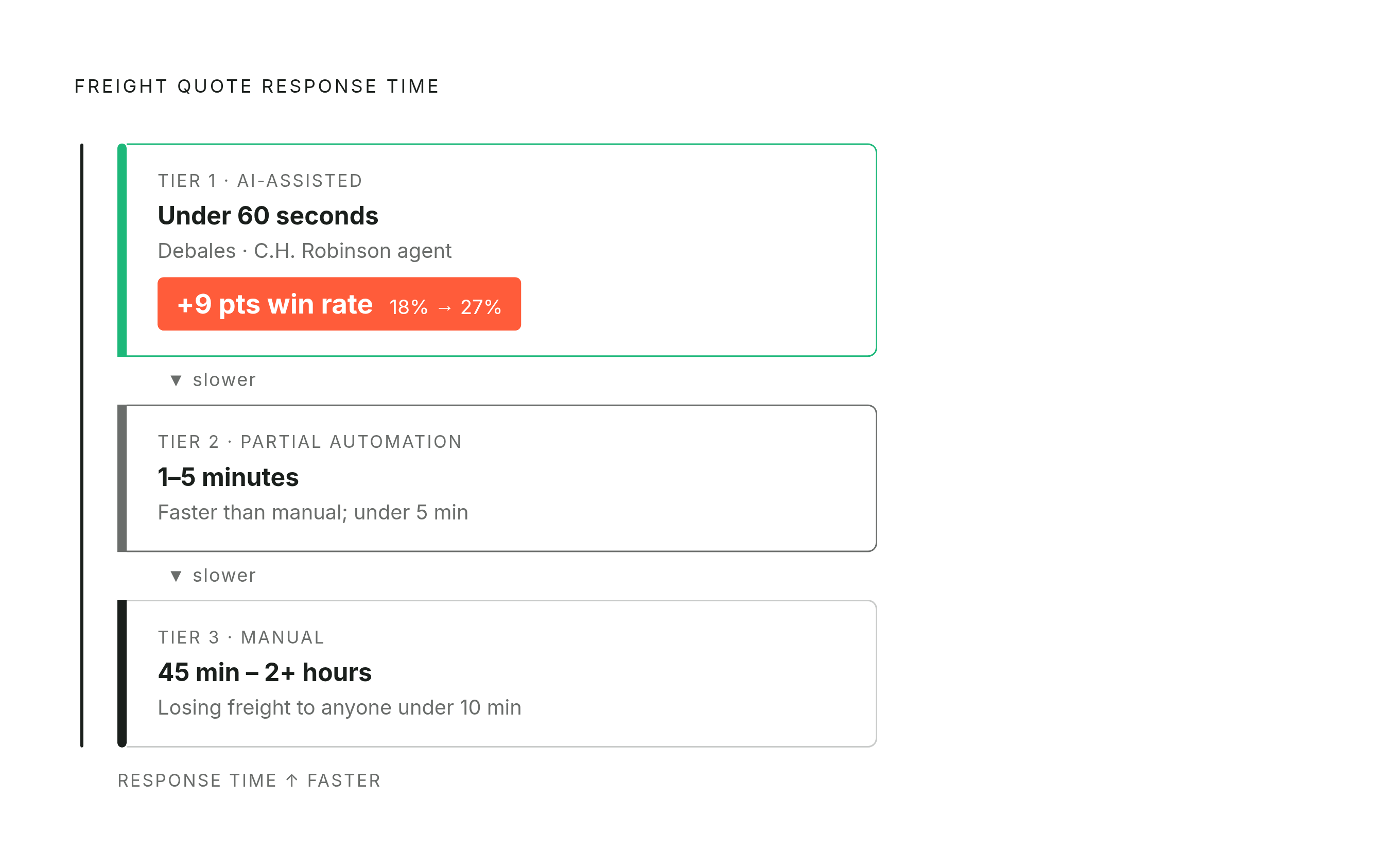
A brokerage can place itself on this spectrum without much guesswork, and the gaps between tiers are wide enough to be embarrassing. The best-equipped desks, running AI-assisted quoting, respond in under 5 minutes, and the leading examples clear it in under 60 seconds. C.H. Robinson's quoting agent runs in well under a minute, roughly the time it takes to read this paragraph out loud.
The middle tier, brokerages with partial automation or a genuinely tight manual process, responds meaningfully faster than a manual desk but still well short of the sub-5-minute mark. Still in the game, but starting to lose the busy lanes where three other brokers are quoting the same load at the same moment. Below that sits the manual or short-staffed desk, at 45 minutes to 2-plus hours, structurally losing freight to anyone who can answer in under 10 minutes. There is no fourth tier below the manual or short-staffed desk. Below "slow" is just "gone."
Industry data anchors the spectrum with one clean number: mid-size brokerages automating inbound carrier email moved from 47 minutes down to under 5. Debales reported a similar jump, 45 minutes down to under 60 seconds, with quote win rate climbing from 18% to 27%. Nobody at Debales negotiated harder. They just answered first, and speed alone carried a 9-point swing in win rate. For a wider frame, AI's effect on freight forwarding RFQ processing cuts average time by 85%, from 2 to 4 hours down to 15 to 30 minutes including a human review step. That's a different corner of freight, not a direct brokerage benchmark, but it says something plain about where manual processing tops out no matter who's running it.
Locating a brokerage's position on the spectrum without a formal audit
No consultant required for this part. Three questions answer it, and the data sits in the inbox already.
How long, on average, does it take between a quote request landing and a reply going out? Most email platforms timestamp both ends, so it's arithmetic, not guesswork. What share of quote requests get no reply? Those loads vanish quietly and are easy to undercount, since a dead thread doesn't announce itself. And how often does a shipper have to follow up and ask where the quote is? That last one is the real tell. A shipper chasing a broker for an answer means the turnaround already failed, whatever the timestamp says.
Inbound email triage is the bottleneck most desks underestimate, mainly because nobody times it. A busy morning feels productive even when none of the motion is closing a load, which is exactly the trap: constant activity, no forward progress. Tender acceptance is a second useful check. If that step takes hours instead of under 90 seconds, a process latency problem is hiding even when quoting itself feels fine. Check-call volume is a decent proxy for buried capacity: totaling the hours per week spent on routine "where's my truck" calls gives roughly the capacity a brokerage could redirect toward quoting instead.
What automation changes in the quote workflow, and what it doesn't
AI in production today handles a narrower, more specific set of jobs than the marketing copy suggests.
Inbound carrier email triage is the clearest win: the system reads the inbox, sorts each message, and pulls the structured fields a human used to retype by hand. Debales reports labor on this task dropping 68%, from about 2.8 hours down to 0.9. Quoting itself, once a request is parsed, becomes a matter of pulling rate guidance and replying, and the better setups get that under a minute. Carrier negotiation is newer ground: Chain's Autopilot Booking Agent opens negotiations inside broker-set rate limits, checks carriers against MC and DOT records, and auto-declines anyone who fails compliance, reportedly having processed 3 million loads across more than 80 brokerage clients as of June 2026. Check calls follow the same pattern: software runs the routine loop by phone, email, and text, logs the answers, and kicks exceptions up to a human. Debales reports check-call completion rising from 55% to 92% under that model.
None of this replaces judgment, and it isn't supposed to. Pricing a lane the system has never seen, managing a carrier relationship gone sideways, handling the exception that doesn't fit any rule: that stays a person's job through 2026 by every account in the current research. AI functions as an assistant on the workflow, not a stand-in for a headcount, and a brokerage expecting it to replace a skilled ops employee across dispatch, carrier management, and billing all at once is setting itself up for a bad quarter. The entry point that actually works for a small shop is narrower: one inbox and one email type, where the AI drafts the reply and a person clicks send. Humans keep the pricing call. The system just removes the dead time spent composing and researching, which was never where the skill lived anyway.
The productivity effect downstream of faster quoting, loads
Faster response speed raises the volume a broker can handle, and volume is what actually gets an owner's attention, not response time in the abstract. Individual broker capacity has historically been a meaningful constraint on how fast a small shop can grow. With automation clearing the routine tasks off a desk, active management climbs meaningfully, a real jump in what one person carries without adding a second chair.
The same automation stack that compresses quote time also expands how many loads one operator can carry, with some platforms reporting multiples of the pre-automation baseline. The capacity gains show up in load counts that would have required additional headcount under the old model. None of that comes from longer hours. It comes from not burning 45 minutes on a quote that should take 5, over and over, all day.
The build-or-buy question for a small brokerage considering its first automation deployment
Buy. The market has enough named options now that building in-house isn't a real contest for a brokerage without an internal engineering team, and pretending otherwise wastes a quarter a small shop doesn't have. Parade handles capacity management. HappyRobot runs AI agents across voice, email, and messaging. Augment targets broker operations workflows. Debales focuses on email automation and multi-agent deployment. Beyond that core group, Raft AI works on document intelligence, Greenscreens.ai does freight pricing intelligence, Freight Technologies runs Zayren Pro.
Timelines are shorter than most owners expect, which is part of why building from scratch is hard to justify. Most small operations can get a first automated workflow live relatively quickly, with payback typically arriving within the first few months. Full-stack platforms are designed to deploy without custom API work, keeping timelines short. Payback on mid-size deployments automating 80%-plus of inbound carrier email is in the 60 to 120 day window. Compare that to hiring: a fully loaded ops employee costs a lot more than the number on the offer letter once payroll taxes, benefits, equipment, training, and turnover risk get stacked on top. The math favors the software before the first quarter's out, and building a custom system to compete with a product that already has 80 brokerage clients on it is a way to lose a year proving a point nobody asked for.
Where a brokerage that closes its turnaround gap ends up, the compounding path past the first win
Getting quote response under 5 minutes removes the ceiling that was quietly forcing a brokerage to hire more people, wait longer, or lose loads it should've kept. Once that ceiling's gone, the next constraint appears on the same schedule, and the pattern repeats: check calls come next, then load acceptance, then carrier vetting, each layer freeing operator time that goes toward a harder lane or a bigger customer instead of another round of "any update?" emails.
Brokers running AI now tend to point it at four jobs: quoting and tendering by email, load matching, carrier vetting and fraud screening, and track-and-trace communication, and that's the arc from a single automated inbox to something closer to a different kind of operation. Industry surveys suggest a significant share of brokers planned to adopt AI or machine learning tools in 2026, while a comparable share had no such plans. Close to half the industry is standing still while the other half compounds a lead lap by lap, and the gap between those two groups will widen rather than hold steady. It's going to widen, quietly, until one side can't see the other in the rearview mirror.