AI Freight Document Classification for Small Brokerages
AI cuts manual document processing costs by 80% while catching errors that hand entry misses.
Three things happen, in order. OCR reads the document, including the crumpled phone photo of a bill of lading a driver texted from a loading dock in Laredo. Machine learning identifies what kind of document it's looking at and how that document's layout is structured. Natural language processing then extracts the specific fields that matter: load number, weight, accessorial charges, delivery date.
Classification is figuring out what the document is. Extraction is pulling the right data out of it. Routing is sending that data to the correct load record inside the TMS. This technology is now commonplace; what separates a system worth trusting from a liability is the confidence score attached to each extracted field. Fields the model reads with high confidence get auto-populated. Fields below a set threshold get kicked to a human review queue instead of guessed at. That routing decision, boring as it sounds, is the entire ballgame: a system that guesses when it's unsure forces someone to audit everything, destroying the trust that makes automation worthwhile.
The technology has clear limits. Rate negotiation, relationship management when a driver's truck breaks down outside Amarillo, and commercial decisions all stay exactly where they've always been: with the broker on the phone.
The starting point for most brokerages is the email inbox itself, because that's where the chaos actually lives. An agent that monitors a shared inbox, identifies what kind of attachment just came in, pulls the load reference number out of the subject line or the document body, and routes it to the right record removes the manual triage step that eats a coordinator's morning before they've had a second cup of coffee.
A typical brokerage needs this applied across a handful of document types: rate confirmations, which need to match carrier and shipper terms before a load ever moves; bills of lading, which verify shipment details at origin; proof of delivery, which triggers the entire invoicing cycle; carrier invoices, cross-referenced against rate cons to catch discrepancies; and the smaller stuff, lumper receipts and accessorial documentation, which is where cost quietly inflates if nobody's watching.
The real cost of manual document processing at a 10-person brokerage
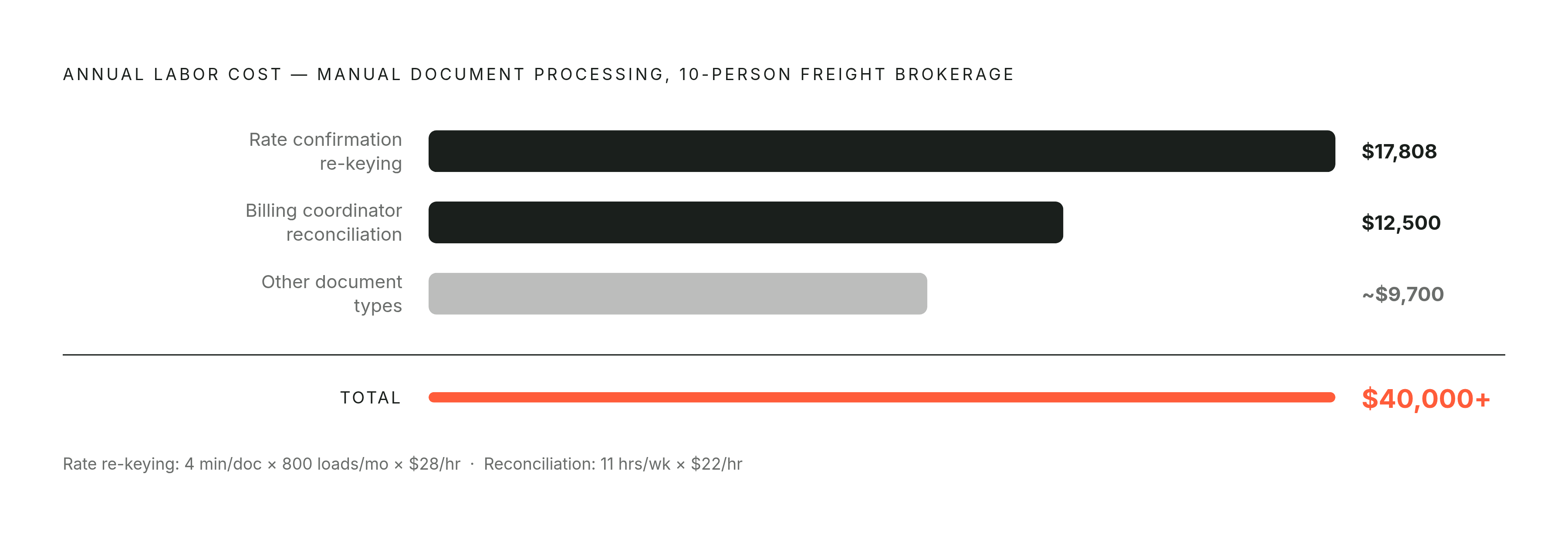
Do the arithmetic once and it stops feeling abstract. A ten-person brokerage re-keying rate confirmation data by hand, at four minutes per document across 800 loads a month, burns 53 hours a month on that single task. At $28 an hour fully loaded, that's $1,484 a month, or $17,808 a year, for one document type.
Add BOL entry, carrier invoice reconciliation, and POD matching to the pile, and total manual processing cost for a brokerage this size clears $40,000 a year without much trouble. Billing coordinators absorb an outsized share of it: 11 hours a week on manual reconciliation at $22 an hour comes out to roughly $12,500 a year in labor spent on a task a properly configured system handles quietly in the background.
Error cost is the part nobody puts on a whiteboard. A $250 discrepancy on a carrier invoice, caught three weeks late or never caught at all, multiplied across a few hundred loads a month, adds up to a number that would make a controller wince. The labor and the errors are one thing; the cash sitting still is another. Every day a POD goes unmatched is a day the invoice can't go out, which means a day the payment clock hasn't started. Run that math on the brokerage's own books before believing any industry average.
How accurate these systems actually are (and where the exceptions go)
Well-trained freight document AI, routed through a confidence-score system, hits 97 to 99% field-level accuracy on standard document types. Manual data entry by experienced staff runs 96 to 99% under normal conditions, and that range slides lower during peak season, when volume spikes and attention frays around hour ten of a shift.
So the averages are close. Fine. The meaningful difference lies in where the misses land. AI errors get flagged and dropped into an exception queue for a human to look at, because the system recognizes its own uncertainty and says so. Manual errors stay silent, with no one raising a hand. They surface, if they surface at all, during billing reconciliation weeks later, by which point the load has shipped, the carrier's been paid, and the discrepancy is somebody's Friday afternoon problem.
For customs and specialized classification work, production deployments show 95%-plus extraction accuracy on structured fields and 85 to 95% first-pass accuracy on commodity classification for common trade lanes. C.H. Robinson's 2025 launch of an LTL classification AI agent, one piece of a fleet of 30 autonomous agents, shows roughly where the ceiling sits for enterprise-scale deployments. The relevant point for a small brokerage is that the underlying approach is now available without the enterprise price tag attached to it. A well-configured exception queue means the coordinator spends time on documents that are genuinely ambiguous, sparing them the documents the system already understands fine.
Before and after: what a lean freight team's day actually looks like
Before: the coordinator opens the shared inbox, eyeballs each attachment to guess what it is, opens the TMS, re-keys the fields by hand, cross-references the rate con against the invoice line by line, flags a discrepancy over email, and waits for someone to answer. Then does it again. Eleven hours a week, every week, rain or shine.
After: documents land, the classifier reads them and routes them to the correct load record, exceptions below the confidence threshold surface in a review queue, and the coordinator works that queue instead of drowning in the inbox. Cross-referencing happens quietly in the background instead of manually, line by line.
The productivity gap between those two pictures isn't subtle. AI-enabled brokers manage 35 to 50 loads a week per coordinator versus 15 to 20 pre-AI, and document processing time drops by roughly 80% according to the underlying research. One documented case: a brokerage cut back-office staff from five to two while increasing load count 40% after putting AI document processing in place. The larger story is that the same commercial team, doing the same sales and carrier work it always did, suddenly had the back-office capacity to move nearly half again as much freight without hiring anyone.
Cash flow deserves its own paragraph, because it's the part that actually keeps a broker up at night. One documented case showed a 16-day reduction in days sales outstanding on a multimillion-dollar monthly revenue base, freeing over a million dollars in working capital that had been sitting trapped in slow receivables, simply because PODs weren't getting matched fast enough to trigger invoicing. That's money that existed the whole time and was just stuck in traffic.
The coordinator's job changes shape in the process, from data entry operator to exception reviewer, and that's a better job by most measures: it uses judgment over typing speed. Margins tell the same story from a different angle. AI-enabled brokerages consistently run 15 to 20% margins against an industry average of 10 to 15%, and in an industry contracting by the year, that gap is the difference between the brokerages still standing in five years and the ones that aren't.
What a realistic 30-day deployment looks like for a small brokerage
Discipline matters more than ambition here. A tight 30-day scope means one workflow, one measurable outcome, and everyone agreeing in advance on what "done" looks like at day thirty. Most of the risk in a project like this is organizational: unclear requirements derail more deployments than the technology itself does.
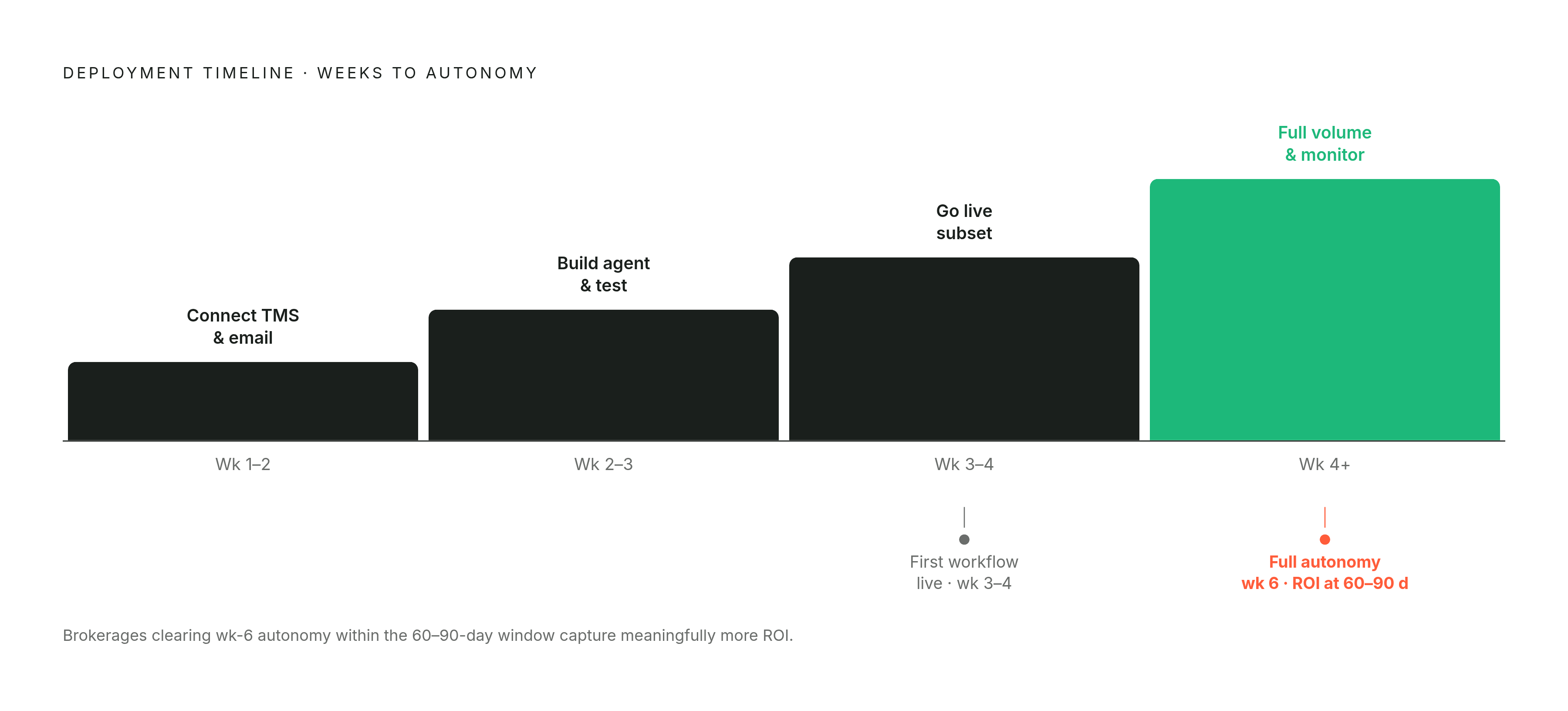
The sequence tends to run in four stages. Weeks one and two: connect to the existing TMS and email setup, map out document types by volume and error rate, and pick the highest-leverage starting point, usually rate con matching or POD processing. Weeks two through three: build the agent, test it against historical documents, set confidence thresholds, and configure the exception queue. Week three into four: go live on a subset of carriers and load types rather than full volume, so any weird failure modes show up somewhere controlled instead of during a Friday rush. Week four onward: expand to full volume and watch classification accuracy and exception rates on a live dashboard.
Most brokers get their first automated workflow live in three to four weeks. Real ROI, the kind that shows up in the P&L, usually takes 60 to 90 days to accumulate as volume runs through the system. Full autonomy on a trained document category, meaning the agent consistently hits high accuracy and humans only touch the exceptions, tends to arrive around week six or later. Brokerages that reach that point within the 60-to-90-day window capture more of the ROI described above; those still stuck in supervised-assist mode see meaningfully less of it.
One quick win worth calling out on its own: carrier onboarding. Automated onboarding compresses a manual cycle that can stretch across a full day or more down to a fraction of that time, which means a carrier that would've been unavailable for a same-day load because the paperwork wasn't done in time is suddenly available. That availability translates directly into revenue that used to walk out the door.
Why building an in-house AI capability is the wrong move for most small brokerages
The math collapses under real-world conditions. Hiring a senior AI engineer in the U.S. carries a substantial base salary, and once bonus, equity, benefits, recruiter fees, and tooling get loaded on, the all-in cost climbs well beyond that base. C.H. Robinson can absorb that cost; for a ten-person brokerage, it represents most of the payroll.
The search itself is its own tax. Specialized AI roles take months to fill, and every one of those months is a month the document bottleneck keeps grinding, loads keep piling up, and the coordinator keeps working eleven-hour weeks on data entry. Some brokerages try to route around the hire by bringing in a freelancer instead. The freelancer builds a system, cashes the check, and disappears, leaving the brokerage to maintain something nobody on staff actually understands. That arrangement leaves the brokerage with a system nobody on staff understands and no one to maintain it.
The workable alternative is an embedded engineer who builds directly inside the TMS and email environment the brokerage already runs, stays through go-live, watches how the system performs under real load, and keeps improving it as the business grows, bypassing the six-figure hire and the three-month search. That model has already shown up in adjacent document-heavy industries: significant time savings for freight companies and steep cuts in manual data entry for document-heavy operations that, structurally, aren't so different from matching rate cons to PODs.
Document classification is the first system a brokerage builds, not the last one it'll need. Once rate con matching runs on its own, the same infrastructure extends to carrier invoice reconciliation, POD-triggered invoicing, and eventually load-level margin reporting, all while keeping headcount flat. The ceiling on how much freight a lean team can move has always been the stack of PDFs sitting between booking the load and getting paid for it. That ceiling is removable now, and the brokerages that remove it first are the ones that'll still be around to read next year's contraction numbers rather than becoming one.