Service Lines a Ten-Person Firm Can Take On Once the Bottleneck Is Gone
Four new service lines become viable once AI frees your delivery capacity.
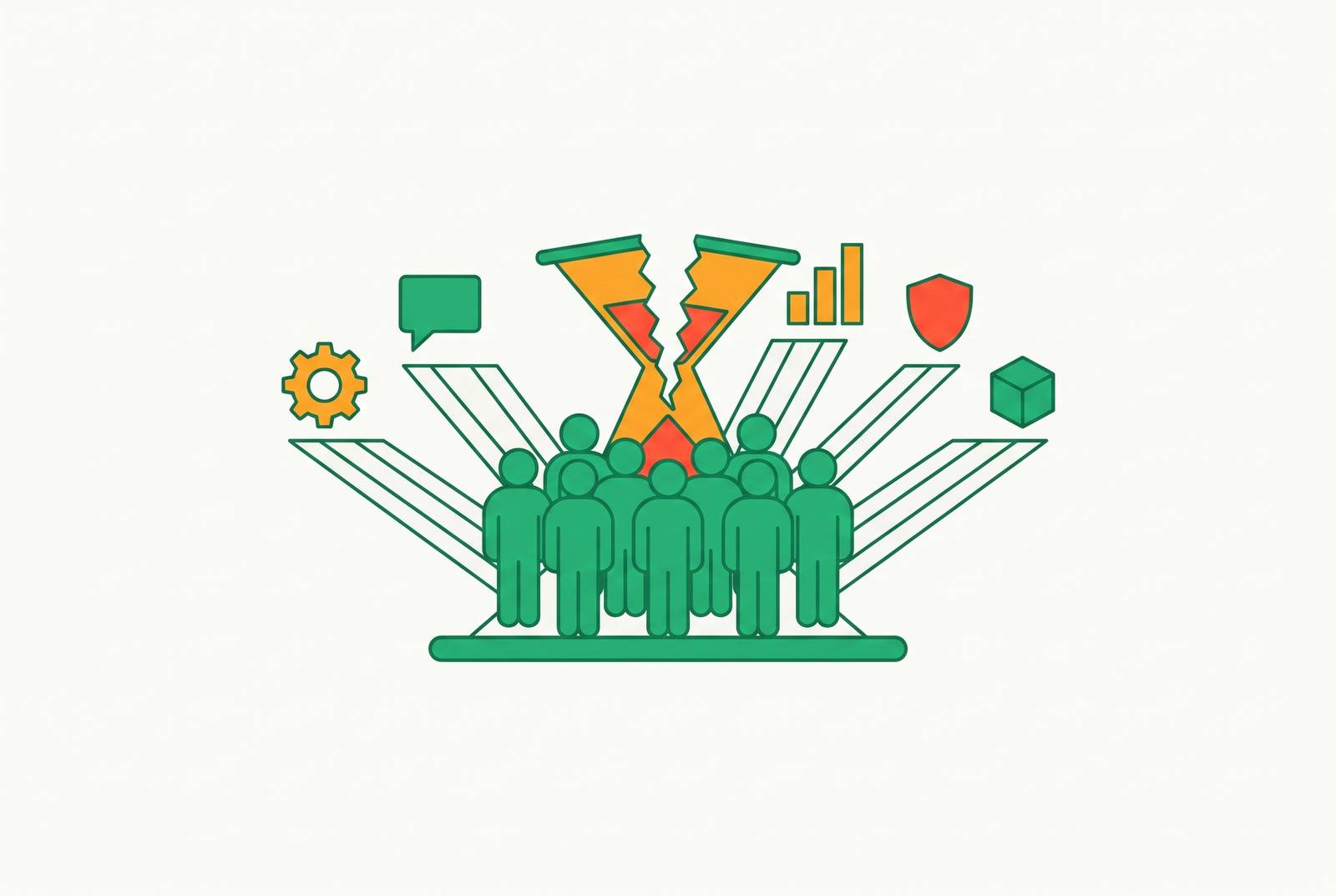
A ten-person firm can use AI to expand what it sells. When AI removes the workflow bottleneck that consumes its delivery capacity, four service lines become possible, including embedded engineering, managed workflow transformation, deployment sprints and AI-versus-hiring advisory. The opportunity depends on turning freed capacity into repeatable delivery, without replacing one constraint with client dependency.
Why a ten-person firm hits a ceiling before it runs out of ambition
A new service line often arrives disguised as a hiring decision. Before the firm can quote the work, it needs someone to deliver it. Recruiting involves lag, ramp time, benefits and management overhead. That work falls to people who are already busy with clients. Talent is not the missing ingredient here. The constraint is throughput, because the team cannot turn its knowledge into more completed work without first taking on costs and responsibilities it has little room to absorb.
That creates a trap for an otherwise capable business. A fully loaded firm can have clients asking for more and still lack the slack to staff, pilot or prove a new offer. Turning work away protects current delivery, but it also prevents the firm from developing the capability that would let it accept similar work later. The opportunity cost accumulates without announcing itself.
What actually changes when AI removes the bottleneck
A tool layered over the same process may help someone finish a task faster while leaving the delivery constraint intact. An embedded system addresses the work that forces the firm to hire before it can accept more business. The distinction is structural, not a staffing cut. The same people have time to deliver work the firm could not take on before.
OTG Consulting describes the move from advisory to embedded execution as the defining commercial change in consulting, with deployments becoming profit centers when firms operationalize AI in actual workflows. Human Agency describes an embedded model in which domain knowledge shapes decisions about data, edge cases and what a good result looks like. An engineer working with the team learns the answers through the work.
SANSA frames its approach as a two-week diagnostic, a production-ready build and an embedded post-launch phase, followed by compounding value. The sequence connects identifying the constraint with building and supporting the system that addresses it. Launch is not the end of the engagement. The embedded phase gives staff time to learn through daily pairing, rather than leaving them with a new system and a training appointment. Human Agency makes that transfer part of the model, so the team can eventually operate and extend the system independently.
Four specific service lines that open once delivery capacity is freed
Embedded AI engineering for clients is the first line, and its starting point is experience with delivery. A firm that has embedded AI in its own operations understands that advising a client and working inside the client’s business require different work. With more time to deliver, it can sell work inside the client’s business. The constraint being removed is hands-on execution time. Understanding the model gives a firm with engineering capability a concrete delivery offer.
Human Agency defines the forward-deployed model as engineers integrating into the client organization, working inside its systems, attending meetings and shipping features every one to two weeks. That proximity also creates an obligation. A firm that builds undocumented pipelines only it can maintain is selling a subscription to the client’s own system, and hostile references are a foreseeable commercial consequence. Deliberate transfer must begin on day one. The same model makes documented systems, hands-on training, architecture reviews and a clear operating playbook core engagement objectives.
SMB AI workflow transformation as a managed service is the second line. It becomes feasible when repetitive workflow handling no longer consumes the capacity needed to support client operations. Customer-facing deployments can return value faster than back-office automation because interaction volumes are higher and the effect on retention is more immediately visible. The offer therefore concerns what the client can do. Lead qualification and scheduling are concrete candidates, while relationship management remains work for people rather than a task to be quietly included in the automation brief.
SANSA reports before-and-after workflow examples of a reduction in manual data entry for an insurance broker and substantial time saved each month for another company. They make the capacity argument tangible. Removing recurring manual work can release time for services that the same team could not previously staff. For a managed service, that evidence supports a conversation about the client’s operating capability.
A 30-day deployment sprint is the third line. Here, the removed bottleneck is build time, allowing a ten-person firm to apply its AI-assisted delivery model to a scoped client deployment without first adding headcount. A time-boxed offer also limits the exposure to budget shifts, stakeholder fatigue and changing priorities that can sink multi-month projects. The entry point stays commercially accessible to SMB clients through bounded scope. The client buys a first deployment without having to commit to an open-ended transformation.
AI-versus-hiring advisory is the fourth line, built on the decision the firm has already made for itself. Its paid analysis can compare a defined implementation that ships in weeks with a technical hire that takes months to recruit and additional months to ramp. The delay is part of the comparison. So is the nature of the work, because AI is strongest on structured, high-volume, repeatable tasks such as data entry and document processing. It cannot replace relationship management or creative judgment, and pretending otherwise weakens an otherwise credible offer. The firm’s proof is its own removal of a delivery constraint.
How these lines compound rather than stack
The four offers need not become four separate businesses. A 30-day sprint produces workflow maps and measurement infrastructure that make a broader transformation engagement cheaper to scope. An embedded engagement then helps the client learn through daily work, so the team can deliver and eventually work on its own. Each engagement leaves something useful for the next. That is different from adding unrelated services whose staffing demands accumulate while their delivery methods remain separate.
A client able to operate independently has a reason to recommend the firm that differs from the reason a dependent client keeps renewing. Genuine advocacy is not the same as reluctant retention. The commercial value comes from having built useful capability, rather than from making departure inconvenient, which connects the transfer obligation directly to future work.
The same sequence applies inside the firm. Its first AI system releases delivery capacity, and the next application of that capacity can support a new service line. Within a year or so, it may be doing work it could not have quoted some months earlier. That outcome is conditional on deliberate sequencing. Otherwise, the business can keep selling the “possibility” that OTG contrasts with a market buying “production,” without developing the delivery model that distinguishes the two.
Where this expansion goes wrong and how to avoid it
Poor sequencing can turn a capacity gain into a fresh overload. A firm acquires software, leaves the surrounding workflow largely untouched and asks the same people to manage both the old process and the new experiment. Pilot fatigue follows. The failure is not simply a question of whether the technology works, because implementation depth includes redesigning the work and training the people who own it. A ten-person firm’s advantage over slide-deck advisory exists only if it protects that depth.
For a firm expanding this way, knowledge transfer must remain part of delivery even when new work competes for attention. Human Agency defines a successful embedded engagement as one that leaves the client team able to continue independently. That is a demanding test of completion. Skipping documentation, training or architecture reviews may shorten the visible engagement, but it substitutes dependency for the capability the client was meant to acquire.
AI-versus-hiring advice loses credibility when it treats judgment, relationships or creative strategy as interchangeable with repeatable processing. Managed transformation can make the same mistake by promising a result for the customer while overlooking the work people must do to achieve it. An honest offer names both the task AI can take on and the responsibility that stays with people, so that capacity claims do not become claims about replacing the service itself.
One service line is therefore the practical starting point. A 30-day sprint that ships and measures provides a proof of concept for the broader model without requiring the firm to establish every offer at once. The firm can then document what changed and expand.
What the firm actually becomes once expansion is underway
With two or three of these lines underway, the firm has a different basis for winning work. Price and availability are no longer the whole proposition, because it can combine AI delivery capability with the domain knowledge that comes from being small and close to the client. That combination is harder for a larger consultancy to replicate than a new service description. Proximity becomes part of the delivery method. Frequent feature releases, real-time knowledge transfer and eventual client independence depend on how the team works.
Removing a small firm’s central delivery constraint gives its existing knowledge more uses, provided it builds the technical capability and transfer practices to match. The practical marker is work it can now quote and win that it would recently have turned away. Headcount alone will not reveal that change. The team can remain ten people while the range of problems it can credibly solve expands.
SANSA’s diagnostic, build and embedded post-launch model fits that transition by connecting the initial bottleneck with production delivery and the team’s ability to sustain it. The outcome is not simply a longer menu of services, but a firm able to turn close client knowledge into working systems at a depth and pace it previously could not offer.