Insurance Submission Triage Workflow for Small MGAs
AI-powered triage routes high-value submissions to underwriters first, without hiring.
A small MGA’s insurance submission triage workflow should get the right risks in front of a lean underwriting team. AI makes that possible without adding headcount, but only when the workflow runs in the right order. From document intake to an underwriter-ready file, each stage must produce information the next stage can trust.
Why small MGAs lose good submissions before underwriting even starts
The highest-value account in a submission inbox can sit at the bottom while the team works through everything above it. Arrival order is not business priority. Yet first-in-first-out is often the practical default when the same people must sort documents, re-key fields, and judge risks. The operational failure is a sequencing problem disguised as a volume problem.
The cost appears before anyone declines a risk. Premium leaks from accounts that age unseen, and brokers turn to faster competitors when quotes lag. Meanwhile, preparation consumes underwriting hours available for risk selection. Renewal season sharpens the squeeze because new submissions peak while the team is committed to existing accounts. Brokers notice the resulting inconsistency from one year to the next.
Growth makes that arrangement harder to sustain. Conning’s 2026 MGA report describes statutory MGA direct premium written growing at more than double the broader P&C market. For a small team, a growing market brings opportunity and more files competing for attention. Hiring more people alone cannot tell the team which of those files to work on first.
What triage actually is, and where the two stages split
Submission triage is the filter between a full inbox and a working queue. Triage concerns incoming risks, with two broad stages that answer different questions. Submit-to-triage covers receiving, reading, and clearing a submission, including whether it is new or duplicated, whether the broker is accredited, and whether the documents are present.
Triage-to-quote then addresses fit, completeness, and priority. Does the risk match appetite, and where should it rank against everything else waiting? Those decisions sound simple until the supporting evidence arrives in ACORD forms, a loss run report, a Statement of Values, supplemental applications, and financials, each following a different agency’s conventions. AI’s role becomes clearer when that work is divided into six operational steps.
Why older automation tools stall at the intake stage
Rules-based automation works best when templates follow a standard and the steps stay the same. Commercial submissions are rarely so obliging. Optical character recognition and robotic process automation can help with intake, but they rely on layouts and fixed rules, which makes unfamiliar documents harder to handle. Reading text from a page is not the same as understanding where it belongs in a submission.
FurtherAI’s 2026 intake guide distinguishes those tools from AI agents that read varied formats, adapt to new layouts, surface gaps, and ask for clarification when data is unclear. An ACORD 130 with handwritten additions presents a different problem from an SOV with merged cells or a scanned loss run. The agent must understand the context and work across the whole workflow, beyond a single step. Otherwise, exposure information can remain trapped in PDFs and spreadsheets as dark data. The MGA owns it, but cannot readily use it.
Stage one: intake and document classification
A submission comes in by email, through a broker portal, or through an API. The system captures and logs it so that it does not remain unseen, with acknowledgment as the immediate goal. In the email workflow, the incoming submission is forwarded to the agent, which identifies and sorts the attachments into ACORD forms, SOVs, loss runs, and supporting documents. Classification comes before underwriting logic begins.
The email body is also treated as a document. Broker notes, urgency flags, and signals about the line of business can provide context that the attachments alone do not supply. The system uses that context for classification. At this point, the system is organizing what it received. Standardizing the contents of an SOV belongs to the extraction step that follows.
Stage two: data extraction and confidence scoring
Once the documents are classified, the agent pulls the fields underwriting needs. These include the named insured, addresses, class of business codes, coverage limits, deductibles, and loss history. The task extends beyond copying labeled boxes. FurtherAI’s 2026 buyer’s guide describes extracting construction class from narrative text, sprinkler status from a footnote, and total insured value from a spreadsheet with merged cells and three header rows.
Each extracted value receives a confidence score. Flagging values that are in doubt for a person to review while clean values move on automatically directs attention to ambiguity. It also separates “the system found a value” from “the value is reliable enough to use.” Because later decisions depend on these fields, confidence scoring is a control on the workflow.
Stage three: clearance checks before an underwriter opens the file
Clearance establishes whether the account can proceed before anyone spends time judging its appeal. It checks for duplicate submissions, broker-of-record conflicts, broker accreditation, and sanctions-list issues. None of this is glamorous work. Catching a conflict after an underwriter has reviewed the risk, however, wastes time already spent on an account that could have been stopped earlier.
The first resolves eligibility and conflicts, while the second assesses an eligible risk’s fit with the MGA’s written preferences. Keeping them separate stops the team from spending time on the same file again and again for different reasons. Clearance status then accompanies the submission into appetite assessment, where decisions need stated reasons for carrier reporting and later audit.
Stage four: appetite scoring and submission ranking
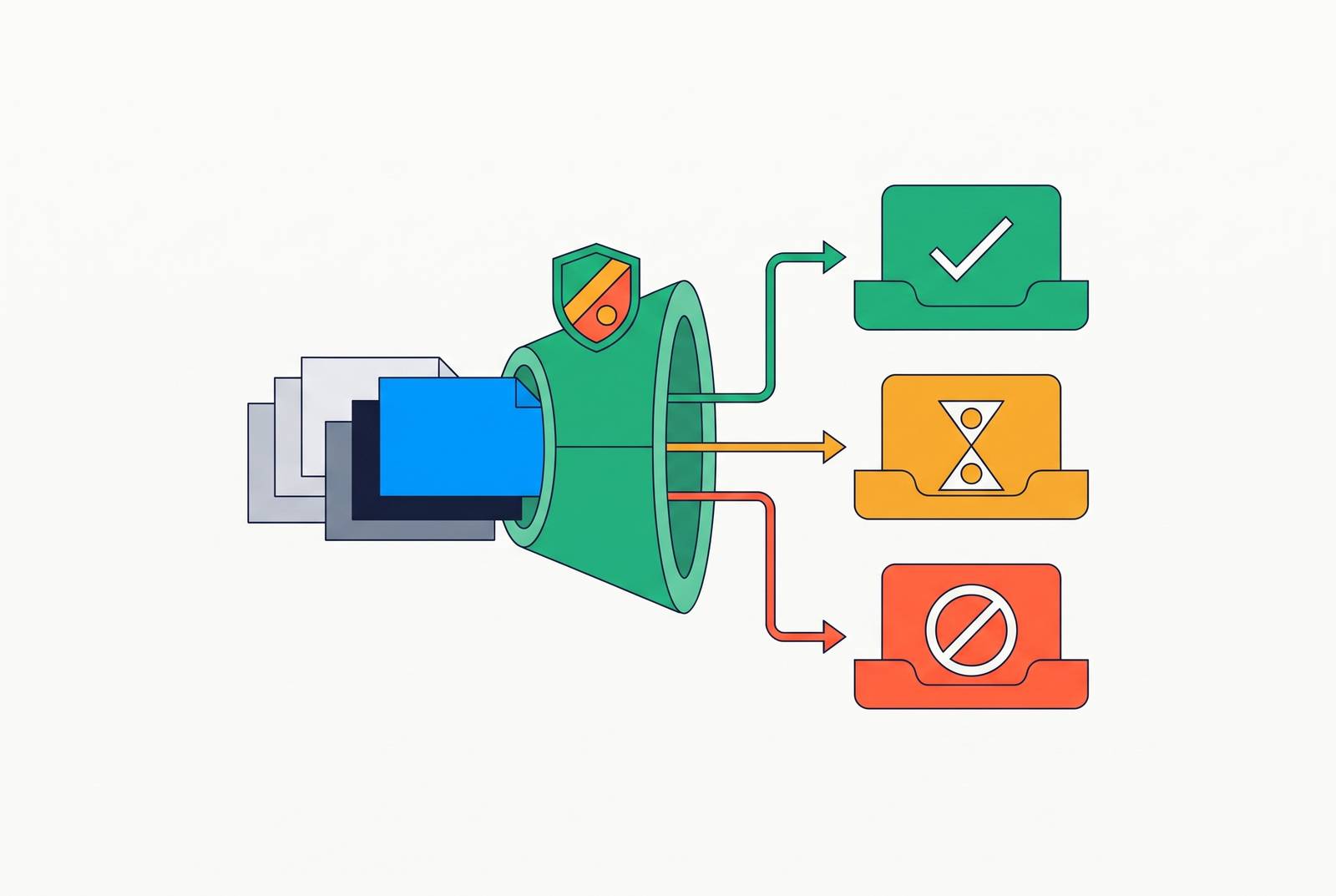
A cleared submission is not necessarily a good fit. The system checks it against the firm’s written appetite, including class of business, geography, revenue band, and loss thresholds. Obvious declines drop out, edge cases go to an underwriter, and clean in-appetite risks rise in the queue.
That ranking changes which risks receive attention first. FurtherAI’s guide describes eligibility checks and appetite scoring within the same agent workflow, with the highest-value risks reaching underwriters first. Simple, complete, in-appetite submissions can go through straight-through processing without a person touching them, while more complex cases come with a structured summary. When capacity is constrained, the order of work influences which accounts reach the quoting stage at all.
Stage five: data enrichment with third-party sources
Enrichment adds context that was absent from the broker’s packet. It can run alongside or after extraction, using third-party and web data to fill gaps in exposure information, location characteristics, and insured details. The submission becomes more than a cleaned copy. For specialty and surplus lines MGAs, incomplete SOVs and missing prior carrier information are examples of gaps this step can address without another follow-up email.
A value flagged earlier may become clear when compared with another source, reducing the need to put that question before an underwriter. Enrichment complements confidence scoring by giving the workflow another way to resolve a gap before the file reaches the person making the risk judgment.
Stage six: hand-off to the underwriter and system write-back
The agent creates a risk summary and writes clean data into the policy administration system, CRM, and rating platforms without anyone having to enter it by hand. The hand-off includes extracted fields, confidence flags, clearance status, the appetite verdict, enrichment notes, and the submission’s ranked position. The underwriter receives an assembled file. Its structure must match how underwriting work is actually done, or the team has reason to work around it.
The buyer’s guide distinguishes workflow software from both the system of record and the pricing engine. Its job is to determine what an underwriter sees, in what order, and with what context. Every agent workflow has a defined checkpoint where a person can approve, adjust, or override, even if straightforward submissions need no individual intervention. Bounded autonomy is the design. The underwriter begins with the facts assembled and the unresolved questions visible, ready to exercise judgment.
Why sequence matters as much as the individual stages
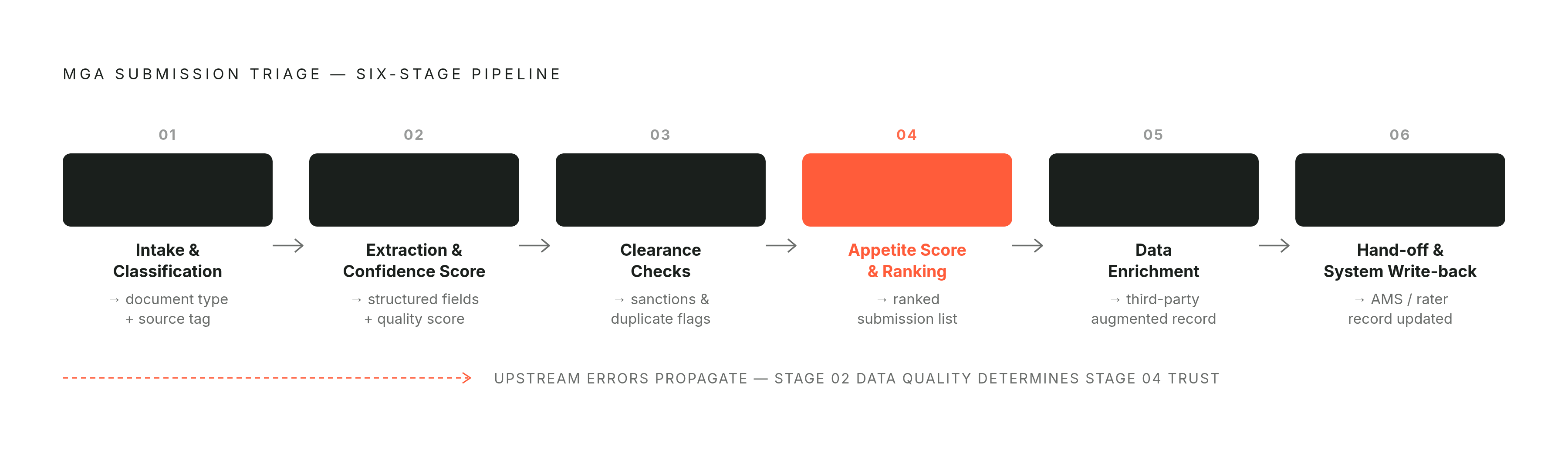
Appetite scoring can be precise and still be wrong. It runs on the fields produced by intake, so an upstream extraction error becomes an input to a downstream decision. Moative’s MGA AI timeline places submission intake before underwriting AI because the latter needs clean data. Upstream extraction errors produce “confident wrong answers,” which can be worse than no scoring at all.
Consider the sprinkler status buried in a footnote. If that detail is extracted wrongly and passed on without an uncertainty flag, later analysis may treat it as a known fact. More sophisticated scoring has a dependency problem because repairing an input requires a reason to question it. The same is true when underwriting data feeds portfolio analytics.
The governance, monitoring, and exception-handling put in place during intake give the team the controls it needs for later stages. Skipping ahead leaves the team with data and a way of working that it cannot yet rely on. Getting intake right therefore supplies more than fields. It establishes how the MGA handles uncertainty before that uncertainty reaches higher-stakes decisions.
What the workflow produces for a small MGA in practice
FurtherAI reports that one MGA cut its average time to clear a submission from several dozen minutes to roughly one minute. The change came from replacing manual re-keying with AI-driven field population. The team no longer spent the same stretch of time assembling each file before clearance. The reported one minute measures clearance time.
Bain & Company estimates that nearly a third of underwriter time is recoverable through AI automation and augmentation. For an MGA with three to five underwriters, that is capacity within the existing team. The estimate is broader than the individual clearance case. Together, they describe two distinct results, namely less preparation per submission and more underwriting time available for risk selection.
How to scope and deploy a triage system without a six-month project
A practical deployment starts with one submission type. A small MGA should run that scope in shadow mode before going live, comparing the system’s work with the team’s existing process. The first deployment needs a named owner and a baseline. Sample documents and written appetite rules make the scope concrete, while the security review and an agreed accuracy threshold define the conditions for launch.
During days 1–30, the team confirms the workflow, supplies those materials, completes the security review, and configures the shadow run. Days 31–60 move to a pilot group, with a person reviewing every output. Oversight reduces only after the team has built trust. After the pilot, the MGA can expand to additional submission types or lines of business using the governance and exception-handling already established.
Resourcing should fit that bounded deployment. Overturn Partners states that insurance organizations often cannot wait six to nine months to build permanent teams, and describes growing use of contract AI engineers, fractional AI architects, project-based consultants, and contract-to-hire specialists. An embedded engagement is another way to reach an agreed goal in weeks. The choice is how to deliver the scoped workflow.
SANSA is one option for that engagement model. It works with insurance, logistics, and accounting firms to diagnose the highest-leverage bottleneck in two weeks, build a production-ready system around it, and stay embedded as it develops. For an MGA considering that route, the same pilot discipline applies. A broader rollout follows a working submission type, demonstrated accuracy, and a team prepared to handle exceptions.