When Good Enough Architecture Beats Waiting for the Right One
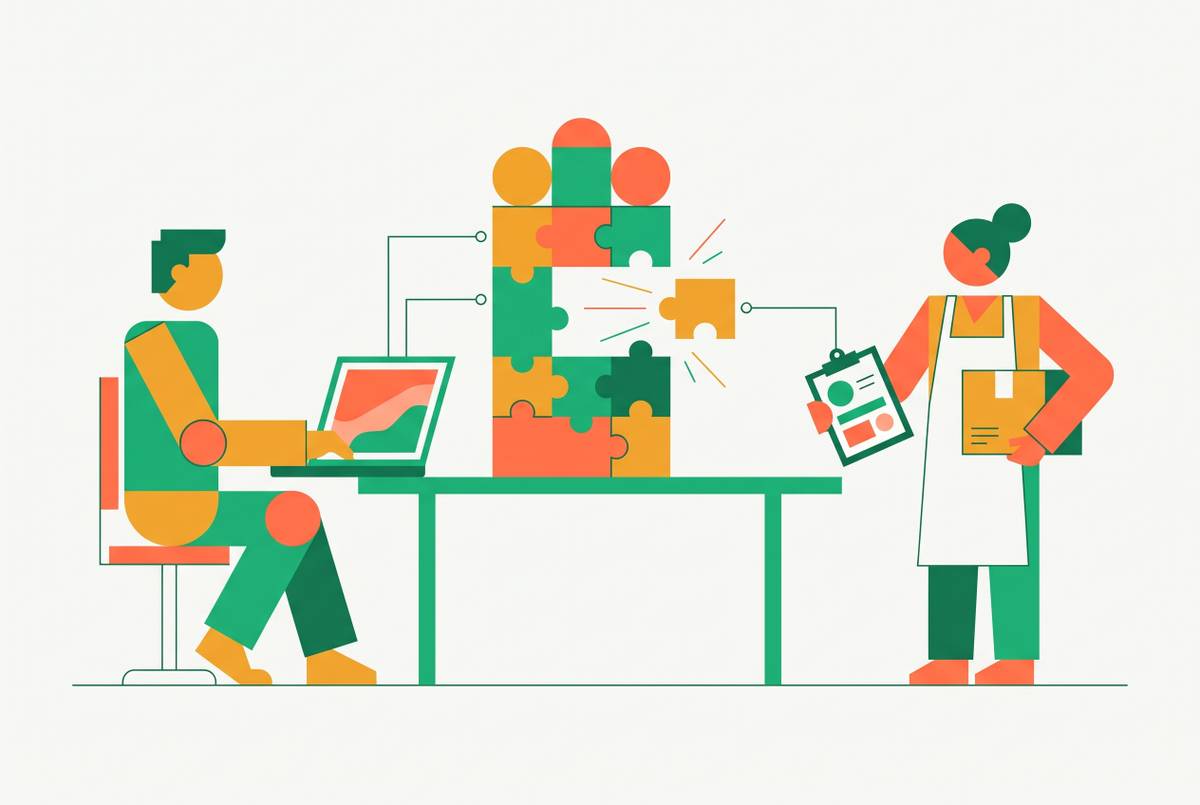
Deploying a limited system now beats waiting for the perfect architecture that may never ship.

For a small or midsize business, AI architecture is a means to better operations. The cost of waiting for the perfect system is usually higher than the cost of deploying a deliberately limited one. A working system starts saving money and helping the team learn and do more while the ideal design is still accepting comments.
Why most SMBs are stuck between casual AI use and real operational impact
Someone writes an email faster, someone else asks a chatbot to explain a document, and the team can fairly say it has adopted AI. Yet the same people still move information between the inbox, customer records, and billing system. The tools help individuals complete isolated tasks. They have not become part of the operation.
The U.S. The U.S. Census Bureau tracks strict integration into core goods and services workflows separately and puts that share much lower. These are different measures. Their distinction is nevertheless important because reporting access to AI says little about whether a business depends on it to complete real work.
That leaves many SMBs in an awkward middle ground. Tools that once required an engineering team are available through low monthly subscriptions, but access does not automatically change a workflow. A standalone assistant can be useful without relieving the bottleneck that limits the business. Operational conversion is the missing step between having AI available and having more capacity.
What actually separates teams that get ROI from teams that stay in pilot purgatory
Businesses repeatedly fail to give AI a bounded, useful job in production. Over-customization, poor workflow fit, and attempts to build internal systems from scratch turn deployment into a moving target. Each unresolved design question becomes a reason to postpone the test that could answer it. The pilot acquires a permanent address.
Documented patterns of pilot failure and abandonment point toward this problem, although they do not prove that every failed project suffered from architectural perfectionism. An ambitious build can fail when it does not fit the workflow, even if the technology works. Specialized vendors and external partnerships give businesses a way to avoid building everything themselves. Their practical advantage is a narrower problem to solve, rather than an obligation to design an entire AI estate before any part earns its keep.
The firms getting more work done with AI connect it to the places where work already happens. Those places include the CRM, calendar, inbox, billing system, and reporting layer. Integration lets the tool help complete work instead of just giving someone advice on how to do it. That distinction explains why a modest deployment can outperform an impressive demonstration.
The objection is understandable, especially when real customer work is involved. Surely the architecture should be right before the business commits to it. But “right” needs a boundary, or the requirement becomes impossible to satisfy. The useful test is whether one workflow can run reliably with clear ownership.
What "good enough" architecture actually means in practice for a 10-to-50-person business
For a 10-to-50-person business, good enough is a deliberate scope decision. It means one workflow, one bottleneck, a production-ready system within weeks, and a clear owner after launch. Automating client intake, service delivery, and billing in a single sprint is a different and much riskier project than proving one workflow end-to-end.
The same restraint applies to the inputs. Data should be clean enough to test the chosen workflow without having to meet the needs of every possible future use. Data quality remains required, with readiness specific to the job, so that cleaning unrelated information does not become a prerequisite for starting anything. A small project should not inherit the entire company’s housekeeping backlog.
Document processing, writing assistance, and FAQ chatbots are the mature categories identified in the notes, with proven ROI and deployment under four weeks in 2026. Their limited scope makes them plausible starting points. A system intended to automate the whole business is not just a larger version of the same assignment.
These three questions need answers before a build starts. Who owns the infrastructure at day 31? How are exceptions handled without human intervention? Does the intelligence compound over time or reset with each new cycle? A vendor unable to answer all three has described a pilot.
The thin-agent architecture gives that discipline a concrete form. It consists of one connector, one system of record, one deployment, and one run-log table. The business keeps the build small enough for a 30-day delivery and simple enough to replace in a week if the stack changes. It is a refusal to make the first useful system depend on the final one.
How a working system compounds from day one while the ideal design stays theoretical
Once a system is live, the business can learn from actual work. The team learns to work with AI in its own operation. The money saved from the first use case can help pay for the second. Knowledge accumulates too, making later decisions less dependent on guesses about adoption, workflow fit, and likely gains.
The concrete examples are deliberately unglamorous. SANSA reports a large reduction in manual data entry for an insurance broker and more than a hundred hours a month saved for a freight company. These are illustrations.
Those results show that the first deployment can earn its keep without changing everything. The second investment can then draw on evidence from the business.
Waiting produces none of that operational evidence. It also fails to preserve the conditions that made the original design seem ideal. Model providers ship updates and the business changes, so even a carefully finished architecture needs to change. Iteration inside a working system is more valuable than iteration on a whiteboard because it has real constraints and real results to work with.
Why the embedded model beats the freelancer build and the tool-nobody-asked-for
A system can launch successfully and still become difficult to maintain when the person who understands it leaves. Model providers release updates every few weeks to months, so the business needs to plan for maintenance from the start. A handoff is not the same as ownership.
The freelancer build can therefore work until a change requires knowledge that has walked out the door. An embedded engagement addresses that risk by keeping the builders involved long enough for the business to genuinely own the system. This is especially relevant for smaller teams. A 15- or 50-person company has no structural reason to have already hired the specialized engineering and operational skills needed to turn an AI concept into reliable production.
Technical continuity is only half the problem. The people doing the work also need to help shape the system. Otherwise, the build can miss the workflow it was meant to improve and fail to gain adoption. The build becomes another orphaned tab. Its existence is easier to demonstrate than its usefulness.
SANSA’s model follows the embedded approach by diagnosing the highest-leverage bottleneck in two weeks, building a production-ready system around it, and staying involved as it develops. A limited first build needs both the expertise to ship and continuity after launch, while the team needs a part in deciding how it will work. Delivery starts the engagement’s operational test.
The real cost of waiting, measured against what a working system costs to run
For an SMB operator, waiting often comes down to an everyday choice about staffing or sales. The team cannot send out quotes any faster, so work waits. A new service line would require capacity the business does not have, or a decision still depends on a specialist’s availability. The choices become hiring, postponing, or turning work away. An unfinished architecture does not relieve any of those constraints.
A new hire costs more than base salary once payroll taxes, workers’ comp, equipment, training, and management overhead are included. A working automation engagement can cost less than a comparable hire, operate around the clock, and ramp in weeks. This changes the economics of tasks that would otherwise consume more staff time.
Accessible monthly tools and no-code options also lower the practical entry barrier. They make a full engineering team unnecessary for many initial deployments while leaving integration, testing, and ownership to be handled. The comparison should therefore be with a scoped system that can run. Architectural ambition can make an affordable first step look like an unaffordable transformation.
Waiting still has a price even when no invoice arrives. Every month of design leaves the current workload and capacity constraint in place, while a working system has at least begun the process of earning back its cost. To justify waiting, the remaining design work must be worth more than the gains being deferred. For a narrow, mature use case, that is a harder argument to make than “the architecture is not ready.”
How to identify the right first workflow and get it into production in 30 days
The practical next step is to examine where the team’s time actually goes. For each workflow being considered, estimate how many hours per week its tasks take, check whether the inputs it needs are there, and work out the likely gain as hours saved multiplied by hourly cost. Rank the candidates by descending estimated gain. Then consider complexity, because the strongest first choice combines a worthwhile return with a manageable build rather than simply promising the largest theoretical saving.
When the choice is unclear, favor the mature categories already described over a new project to automate work across the whole business. The initial commitment should be one workflow, one bottleneck, and one measurable outcome. Diagnosis and scope definition belong in the first week or two. SANSA’s two-week diagnosis fits that stage, provided the result is a clear choice of what to build and what to leave out.
Weeks two through four are for building and testing. No-code and low-code platforms including n8n, Make, and Zapier, coupled with LLM APIs, can handle the majority of practical SMB integration points without custom code. The endpoint is a system live in production. It needs a named owner, a defined exception-handling path, and a baseline measurement against which the business can judge the result.
From there, the planning horizon can expand without expanding the first build. A 12-month target is three to five workflows in production, with the productivity equivalent of one to two additional full-time employees absorbed without hiring. To reach that target, the business needs to choose work that saves time, measure the gain, and keep what has shipped working.
The architecture can be refined once real operations provide the signal. The first system needs to be working, owned, and set up to compound. That is what begins to remove the business’s capacity constraint, while the perfect design remains very good at occupying a document.