AI Freight Forwarding Workflows for Cross-Border Compliance
AI embeds into customs workflows to catch regulatory risks before CBP's algorithms do.

This piece walks freight forwarders through exactly which compliance workflows AI transforms, how, and what a production-ready version of each looks like.
Why 2026 compliance is harder to wing than it used to be
Cross-border compliance in 2026 runs on data, not paperwork. The shift caught a lot of forwarders flat-footed. CBP's Automated Targeting System no longer works off static risk profiles built from paper filings; it runs on machine learning trained against historical seizures, global trade data, and supply chain network mapping. It can spot a pattern nobody on staff would ever notice thinking.inc gocubic.io. That matters because the DOJ's Trade Fraud Task Force has been widening its use of the False Claims Act against importers over undervaluation, misclassification, and false country-of-origin claims, and the FCA carries treble damages on top of penalties assessed per violation. A routine CF-28 request for information can now feed straight into a full FCA investigation once CBP's models flag something DOJ decides to chase.
CBAM and the general churn of daily regulatory change layer on top of that enforcement posture, and the monitoring burden alone would keep a compliance team busy without a single shipment moving. British Chambers of Commerce data puts the scale of the issue at 49% of UK exporters saying they're struggling with cross-border paperwork complexity right now. None of this scales with shipment value the way it used to, either. CBP's models hunt for subtle anomalies in the data itself, so a routine entry on a trade lane a forwarder has run for a decade gets the same algorithmic once-over as a first-time shipment from an unfamiliar supplier. Compliance, in other words, has quietly become a data-integrity discipline. Everything that follows in this piece treats it that way, workflow by workflow.
What AI does inside a compliance workflow versus what it gets sold as
Freight AI spent the last few years mostly watching. The 2025-to-2026 shift moved past that: the operators actually getting value now run agents that take action inside their systems, not tools that just surface another alert to ignore thinking.inc gocubic.io. Gartner's own numbers track the shift in dollars: spending on supply chain software with agentic AI built in is projected to go from under $2 billion in 2025 to $53 billion by 2030 reformhq.com thinking.inc gocubic.io. That's a real cost, compounding with every shipment. That's an entire category of software rebuilding itself around execution.
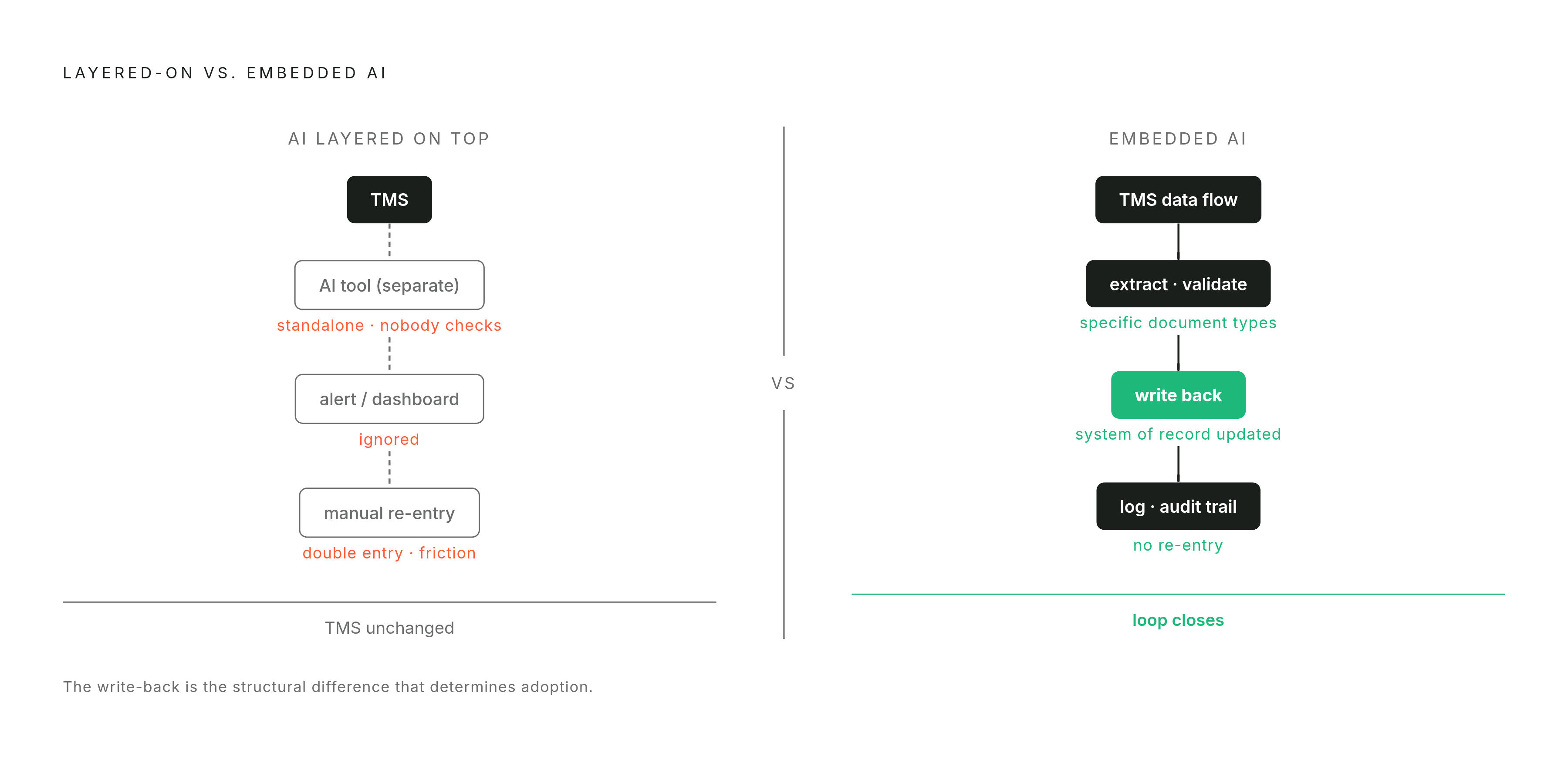
Where the tool sits is the distinction that actually matters for a forwarder evaluating a purchase." It's where the tool sits. A chatbot bolted onto the website, a generic document scanner, a dashboard that gets checked once and then forgotten, all of that is AI layered on top, and it adds friction until someone quietly stops using it. Embedded AI sits inside the TMS data flow itself, feeds validated output back into the system of record, and works on the specific document types and rule sets the forwarder already runs. Standalone tools that don't write back into the system of record create double entry, and double entry is how good software dies of neglect. The strongest deployments through 2025 and into 2026 were narrow and tightly wired into one system, not broad platforms trying to do everything at once thinking.inc gocubic.io.
Human judgment doesn't leave the loop, it just moves. The model drafts, flags, and classifies; the licensed broker or the operations lead is still the one who signs, particularly at the points with real legal exposure: customs filings, claim responses, contract pricing. Research on where the leverage actually sits in 2026 points to five use cases: rate sheet parsing, document extraction, drafting customer communications, HS code suggestion, and quote response automation, with ROI measured in hours saved per shipment and fewer errors, not in headcount removed thinking.inc gocubic.io. Everything from here forward treats each of those workflows as its own build, with its own shape once it's actually running in production.
Document classification and data extraction from unstructured customs paperwork
Somewhere in every freight operation sits a person re-keying data by hand: commercial invoices, packing lists, bills of lading, airway bills, proofs of delivery, all getting typed back into the TMS one field at a time. It's the single largest manual workload in the business. AI's first job is making that job disappear. The extracted fields populate the TMS automatically, creating clean, queryable records.
DODA Smart, launched by Fr8Tech on April 7, 2026, is the clearest production example running right now. It was purpose-built for the electronic dossier requirements under Mexico's amended 2026 Customs Law Reform, and it processes both native PDF and image-based DODA files, extracting and structuring the key fields into a centralized database thinking.inc gocubic.io. The system syncs against SAT's official registry automatically, 24/7, eliminating manual QR-code verification, and AI extracts the integration number and cross-checks it against SAT's official registry, flagging discrepancies proactively. It also generates an Automated Digital Audit File, a complete, time-stamped record that's exportable and ready for audit on demand. Pricing scales from free (up to three DODAs a day) to enterprise subscription tiers.
None of this replaces the TMS a forwarder already runs. The document layer sits alongside CargoWise, SAP TM, Oracle TMS, or Microsoft Dynamics, feeding clean data in without asking anyone to rebuild their workflow or their team. And it has a hard boundary: it won't touch a genuine classification edge case or an origin dispute, the kind of judgment call that still needs a human customs broker. What it does is clear the re-keying grind off that broker's desk so the time goes toward the calls that actually require a license to make.
HS code classification and duty calculation at scale
Getting the HS code wrong used to be an efficiency problem: a slower clearance, maybe a duty recalculation. In 2026 it's a legal exposure problem. CBP's anomaly detection is tuned to flag price deviations inside specific tariff lines, the DOJ's FCA reach extends to misclassification directly, and multi-million-dollar settlements have already come out of what amounts to systemic classification error, not a single bad entry thinking.inc gocubic.io. That reframes what an HS code suggestion tool is actually for.
AI suggests optimal HS code classifications based on product descriptions extracted from commercial documents, then cross-references against current tariff schedules, Section 301 and 232 duty lists, and UFLPA-sensitive commodity categories reformhq.com. Vendor studies show strong accuracy on commodity goods with clear, boring descriptions, and it gets noticeably worse on novel product designs or dual-use items, which happen to be exactly the cases where a senior broker's judgment was never optional in the first place. C.H. Robinson's May 2026 compliance guidance lays out the stakes: when entry data is complete and consistent, CBP's models assign lower risk scores, but missing product detail or an abrupt shift in how something gets classified can bump a company's whole risk profile up and trigger a hold thinking.inc gocubic.io.
The production version of this workflow has a specific shape. AI suggests and flags, the licensed broker reviews and signs off, and the system logs the entire approval chain. That log isn't a nice-to-have. It's the contemporaneous documentation CBP and DOJ now expect as proof that compliance wasn't an afterthought. What AI does here:
Automated regulatory monitoring and alert routing
The list of things that can quietly change the compliance status of a lane a forwarder has run for years keeps growing: CBAM, new sustainability mandates, export controls tightening around dual-use technology and critical minerals, sanctions regimes shifting, ICS2 filing rules, AMS and AES automation requirements. Any one of those can flip a routine shipment into a compliance problem overnight, and the old model of manual monitoring depends on someone remembering to go check. Between checks, changes land, and retroactive compliance failures appear in entries that nobody saw coming until the entry got flagged.
AI monitoring scans global customs databases and regulatory feeds continuously, matches new requirements against the forwarder's actual commodity codes, trade lanes, and supplier list, and routes the alert to the specific person who needs it, with the context to act on it (which shipments, what changed, what the deadline is), rather than dropping it into a shared inbox nobody owns. Every new booking gets automatically screened against denied-party lists and embargoed destinations as a matter of course.
There's a catch. C.H. Robinson's May 2026 guidance flags that these algorithms can misread a legitimate business change, a new sourcing region, an updated product design, as a suspicious pattern thinking.inc gocubic.io. A monitoring system that only pushes alerts one direction misses half the job; it needs a channel back to CBP's Centers of Excellence so a forwarder can proactively explain a real change before it gets treated like a red flag thinking.inc gocubic.io. That two-way channel is becoming less optional by the year freightmynd.com operatorlab.co. Real-time data sharing between supply chain partners and regulators is turning into a baseline regulatory expectation for 2026, not a competitive edge, and monitoring AI is the only realistic way to meet that expectation without adding a full shift of staff to watch feeds all day thinking.inc gocubic.io. What AI does here:
Freight audit and invoice accuracy as a compliance control
Freight audit AI gets sold on cost recovery, and it does recover real money: 2026 figures put it at 1% to 5% of total freight spend, caught through invoice errors flagged before payment goes out, repeat accessorial charges spotted across carriers, and dispute cycles that used to run 90 to 120 days now closing out in the same week in some setups cxtms.com thinking.inc gocubic.io. But the compliance angle gets undersold. A declared invoice value that drifts from the actual transaction value is one of the primary triggers CBP's anomaly detection looks for. C.H. Robinson's May 2026 guidance points out that things which look purely operational, a rounding error, a shipping term that doesn't match the rest of the file, can register in an AI model's eyes as a signal of intentional undervaluation thinking.inc gocubic.io. That's not a comfortable read for anyone who's been treating those mismatches as clerical noise.
CBP now recommends internal reconciliation of commercial invoices, purchase orders, and entry data as standard practice, and that reconciliation is exactly the kind of systematic cross-check AI audit already runs automatically. In practice, it cross-references carrier invoices against contracted rates and accessorial schedules, flags a mismatch for a human to look at before the payment clears rather than after, and builds up a running record of which carrier, lane, or service type keeps generating the same billing error. That record becomes the documentation trail supporting a valuation claim if an audit ever comes knocking. Freight audit AI doesn't happen to help compliance as a side effect of saving money; under the current enforcement posture, it functions as a compliance control that also happens to recover spend thinking.inc gocubic.io. What AI does here:
What production deployment takes for a mid-market forwarder
The realistic clock on a scoped deployment runs 4 to 8 weeks from kickoff to production, and a single well-defined workflow can be live in 2 to 5 days if the scope stays tight; positive ROI tends to appear within 3 to 6 months of going live freightmynd.com operatorlab.co. The place to start isn't the flashiest use case. Automating the document trail, purchase orders, invoices, proofs of delivery, customs paperwork, delivers the fastest visible return and builds the clean data foundation every later workflow leans on. If that step is skipped, every downstream tool inherits the same messy inputs.
Architecturally, none of this replaces the TMS already in place. The AI layer sits beside CargoWise, SAP TM, Oracle TMS, or Microsoft Dynamics, feeding it clean data rather than competing with it. For forwarders already running CargoWise specifically, Value Packs started adding AI document ingestion with more agentic capability rolling out from December 2025 onward, and as of August 2026 transaction pricing runs $12.75 for FCL or FTL export and $8.35 for LCL, LTL, air, or non-FCL export, with imports at $19.95 and $13.30 respectively, a useful reference point for budgeting reformhq.com cargoez.com thinking.inc gocubic.io.
The competitive clock is ticking specifically against mid-market operators. Regional carriers running fewer than 500 trucks sit 18 to 24 months behind the large 3PLs on AI embedding, and that gap is a window, not a permanent condition, open for now but not indefinitely theneuralbase.com thinking.inc singular-innovation.com. What closes it faster than any software choice is whether the people doing the compliance work actually trust the tool. AI dropped on top of a workflow the team doesn't believe in gets worked around, quietly, the same way people route around a broken process. The failure mode is buying a broad "freight AI platform" and never actually deploying any of it. Forwarders that ship one well-scoped use case beat the ones that bought everything and shipped nothing. Logistics companies that under-invest in workforce enablement see 2–3x longer adoption timelines and 40–60% lower realized savings versus business case projections (thinking.inc)
The ROI case and the cost comparison between one model and hiring for compliance roles
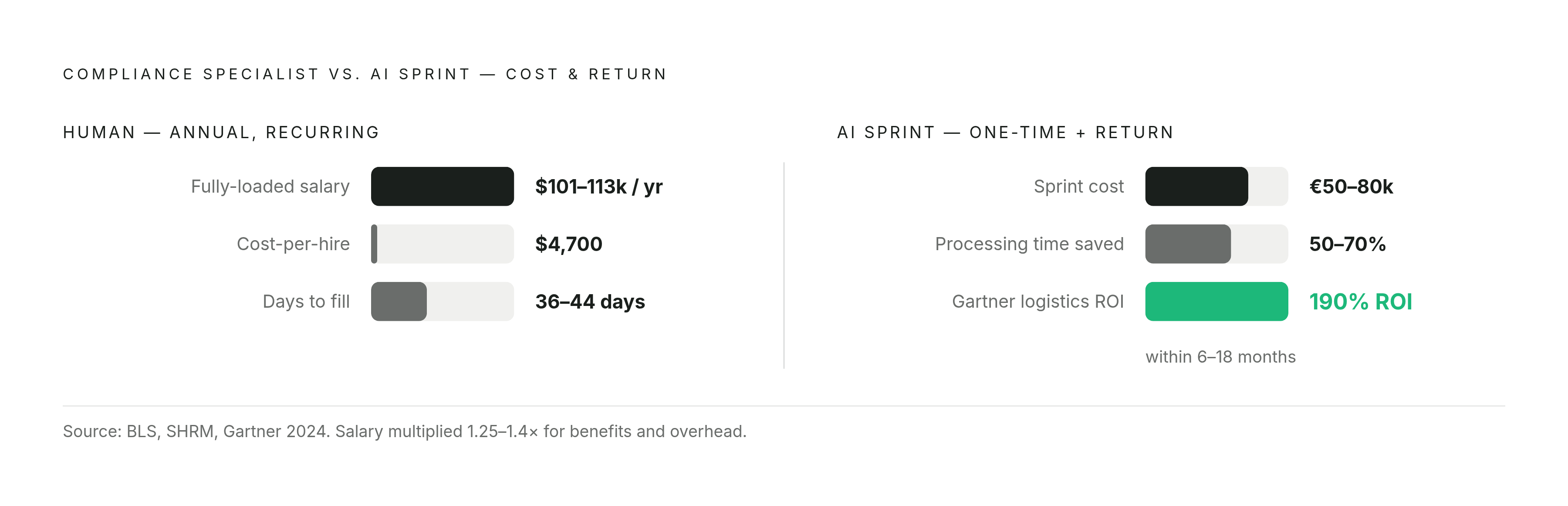
Start with what the alternative costs. AI doesn't replace that hire so much as absorb the repetitive 80% of what the role does: document extraction, customs data validation, denied-party screening, invoice cross-referencing, tracking exception detection, drafting customer updates.
The numbers behind that trade hold up across more than one source. McKinsey research on early freight adopters found 15% lower logistics costs and 65% higher service levels. A mid-market operator putting EUR 50,000 to 80,000 into an AI transformation sprint saw a 50% to 70% cut in customs processing time inside the first 12 months thinking.inc singular-innovation.com. Gartner's Supply Chain Technology Report puts average ROI on logistics AI investment at 190%, with returns typically showing within 6 to 18 months depending on scope theneuralbase.com thinking.inc gocubic.io.
Those SMB productivity gains in that same Upwork data have so far read as incremental, not transformative thinking.inc gocubic.io. The gap between the two isn't about the technology's ceiling freightmynd.com operatorlab.co. It's about whether the tool got embedded inside the actual bottleneck, the document re-keying, the classification review, the invoice reconciliation, or whether it got layered on top as one more dashboard competing for attention. Freight forwarders picking between those two paths in 2026 aren't really choosing a vendor. They're choosing whether the tool touches the work or just watches it. Open with the cost of the alternative: a fully-loaded compliance specialist costs roughly $101,000–$113,000/year all-in (base of approximately $85,273 per Glassdoor 2026, multiplied by SBA's 1.25–1.4× factor for benefits and overhead), plus approximately $4,700 average cost-per-hire and a 36–44 day time-to-fill before the person is even onboarded (SHRM data) (thinking.inc, gocubic.io) 74% of SMBs report AI has improved their productivity (Upwork Research Institute Q1 2026, n=750 U.S. business leaders) (thinking.inc, singular-innovation.com, Upwork Research Institute Q1 2026, gocubic.io)
Sources
- Customs Compliance in the Age of AI | C.H. Robinson
- Freight Technologies Launches DODA Smart, an AI-Powered Customs Compliance Platform for Mexican Trade Operators
- AI-Native Freight Forwarding: The New Standard in 2026 - Blog | Cubic
- 2025 AI breakthroughs in Freight With a Preview of 2026
- The State of AI Within SMBs in 2026 - Upwork
- Freight Technologies Launches DODA Smart, an AI-Powered Customs Compliance Platform for Mexican Trade Operators - Freight Technologies
- Air Freight Customs Clearance Goes Digital: How Pre-Arrival Processing Cuts Clearance Times by 25% | CXTMS