Recurring Task Identification Before Automating a Business Process
Identify recurring tasks before automating to avoid wasting resources on low-impact projects.

Most businesses automate the wrong things first. They deploy tools broadly, expect results in thirty days, and then absorb the quiet embarrassment of a project that touched everything and improved nothing. S&P Global's 2025 survey of more than 1,000 enterprises found that 42% of companies abandoned most of their AI initiatives, up sharply from 17% the year prior. MIT's 2025 research put it more bluntly: 95% of enterprise AI initiatives fail to produce measurable returns. The tools work. The selection fails.
A recurring task is work that happens on a predictable schedule and requires a human to execute the same sequence of steps each time. That definition sounds obvious until you realize how many teams have never actually written their recurring tasks down, which is precisely why this is where the work starts.
The case for beginning here is arithmetic. A task that takes twenty minutes and happens daily accumulates over eighty hours per year per person. A task that happens quarterly accumulates perhaps four hours. Frequency is a multiplier, and that multiplier is what makes automation feel immediate rather than theoretical. Once you see it that way, the better question becomes "what happens most often?"
In every SMB audit I've run, three categories surface the most valuable candidates with reliable consistency. Data movement: copying information from one system to another, whether that is pulling a form submission into a CRM, keying invoice totals into an accounting platform, or transferring email details into a spreadsheet. Notifications and reminders: manually alerting people that something happened, that something is overdue, or that an approval is waiting. Document creation: generating proposals, contracts, invoices, or status reports from templates or existing records. These three categories alone account for the majority of recoverable administrative hours in a small operation.
One distinction matters before moving forward. Consistent tasks, where the steps are identical every time, are ready for this evaluation. Variable tasks, where the steps shift based on context or judgment, are not. That is a sequencing call. Start where the logic is already defined.
Running a two-hour task audit with your team
Leadership sees workflow summaries. Frontline employees see what actually happens: the workarounds, the redundant re-entry, the tasks that exist because nobody ever questioned them. Both views are incomplete without the other. The audit needs a cross-functional group, at least one person from each function the automation will eventually touch, and it needs to run for about two hours.
For every task that surfaces, capture five things: the task name, who performs it, how often it occurs per week or month, how long it takes each time, and whether the steps are consistent or variable. That is the entire capture protocol. It is deliberately thin because the session's only job is to produce a complete flat inventory.
The no-filtering rule is non-negotiable during this session. Pre-filtering kills low-profile tasks that score poorly in casual conversation but rank highly once the math is applied. A task that sounds minor when someone describes it out loud can accumulate forty hours a year once you multiply the duration by the frequency. The ranking happens afterward.
There is also a change management argument hiding inside the logistics. Teams that surface problems are more likely to support the solutions that follow. Poor user adoption accounts for a meaningful share of stalled automation projects, and getting the right people in the room early is the cheapest version of change management available.
Scoring the inventory to find high-leverage targets
A flat inventory is just a list until it is scored. The model that holds up best across every SMB implementation I've seen uses four dimensions: how repetitive the task is, how arduous it is in terms of time and resource consumption, how critical it is to core operations, and how inefficient it already is in its current manual form. Rate each dimension one to five and multiply the four scores together. Maximum possible score: 625. Tasks clustering near the top of that range are first-phase candidates.
For teams that prefer simpler math, frequency multiplied by effort multiplied by criticality, each rated one to five, produces a maximum of 125. Tasks above sixty are strong candidates; tasks above one hundred are first-phase priorities. Both models weight frequency and burden heavily, which is intentional, because those two dimensions determine how fast value accumulates after an automation goes live.
Invoice data entry illustrates the pattern well, and it gets overlooked constantly. It is daily, rule-based, error-prone, and in a small shop it is frequently owned by the person whose time is most expensive. It rarely gets nominated for automation because it feels administrative rather than strategic. The scoring model weighs frequency, burden, criticality, and inefficiency. Invoice entry rates four or five on all four dimensions.
A high score does not mean the task is ready to automate. That question is entirely separate.
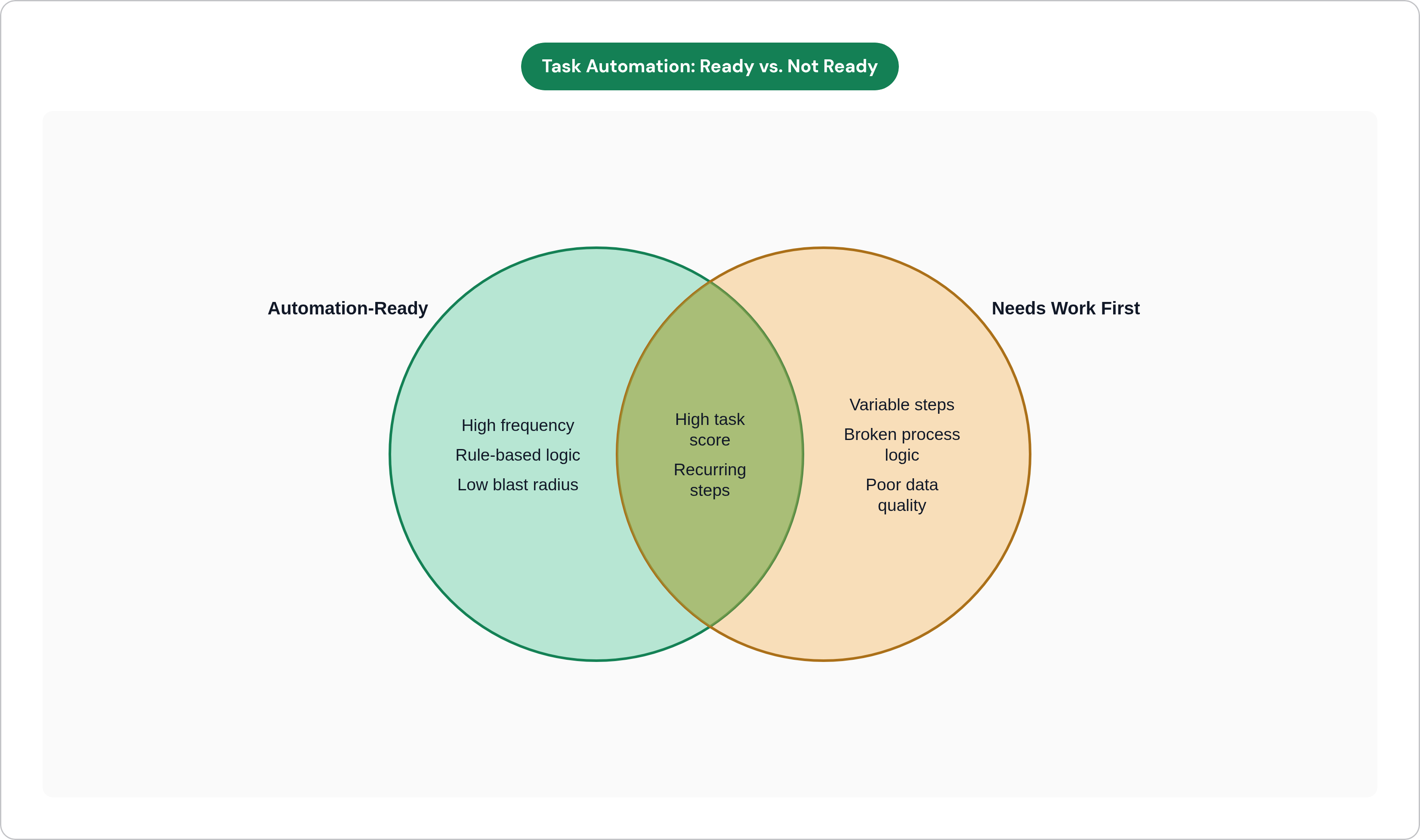
Four characteristics that make a task a good first automation target
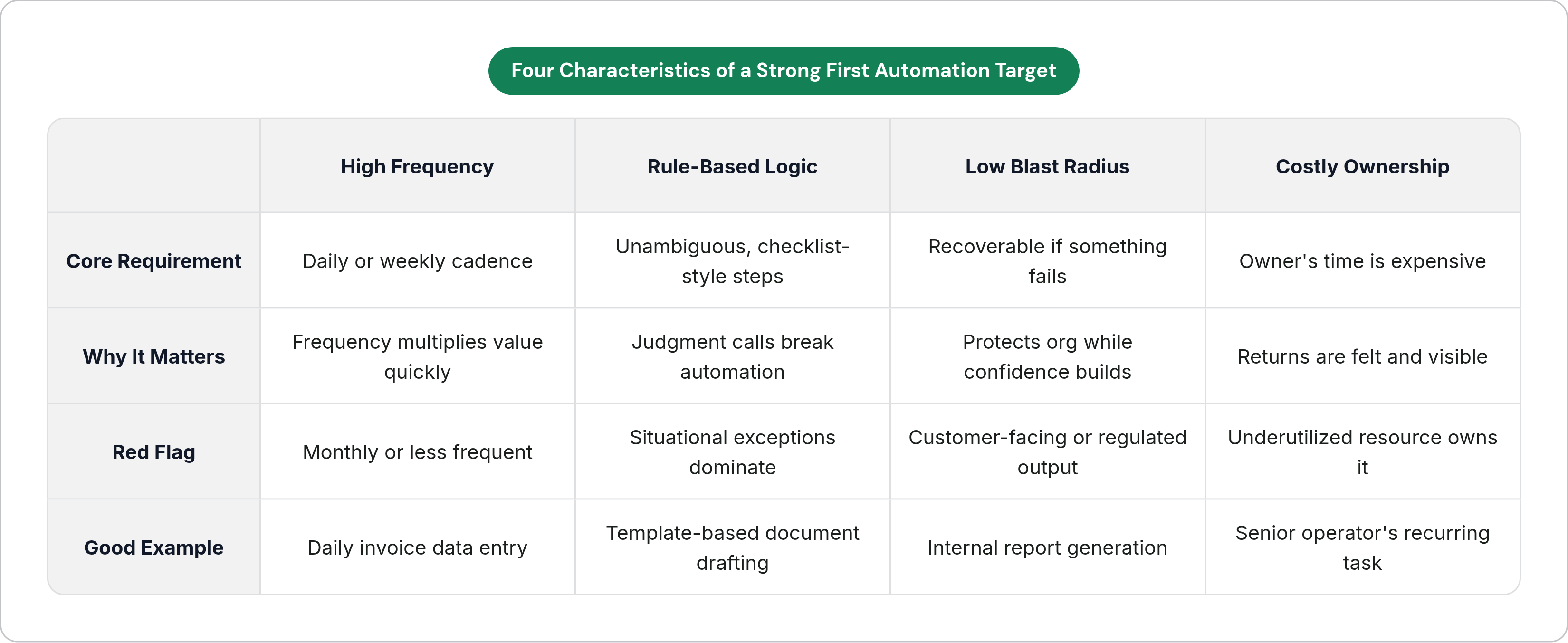
Scoring identifies candidates. These four characteristics determine which candidate becomes the first project.
High frequency is the baseline requirement. Daily or weekly cadence is the threshold. A task that occurs monthly can wait; a task that occurs daily cannot afford to.
Rule-based logic is the second criterion. If you cannot describe the process as an unambiguous checklist, leave it alone for this phase. Exceptions are acceptable as long as they are enumerable and consistent rather than situational. Automation requires defined logic; judgment calls belong to humans, at least for now.
Low blast radius is the characteristic that protects the organization while confidence is still being built. The first automation should be recoverable if something goes wrong. A mistake should mean a minute of cleanup, not an angry client, a compliance violation, or a financial error. Automated meeting summarization, internal report generation, tier-one support email triage, and document drafting from templates are excellent starting points for exactly this reason. Defer mission-critical financial ledgers, regulated records, and anything customer-facing until the automation has been proven on internal workflows first.
The fourth characteristic is ownership by someone whose time is costly: the owner, a senior operator, the person the business can least afford to have keying data. Saving three hours per week for someone billing at a high rate produces a return that is legible and felt. Saving the same three hours from an already-underutilized resource produces a return that is real but invisible, which means it will generate little organizational support for the second project.
Starting small surfaces edge cases before they touch anything that matters.
Checking whether the process itself works before automating it
The core question at this stage is both simple and ruthless: does this process already produce the correct outcome when performed by hand? If the answer is "sometimes" or "it depends," stop the automation conversation until the logic is repaired.
Automation runs a broken process faster, at higher volume, and with less visibility into each individual output. Sales lead routing offers an instructive and embarrassingly common example: geographic assignment rules that were outdated by two years get automated across hundreds of records before anyone notices the logic was wrong. What was a manageable manual error becomes a systematic one, and systematic errors are harder to find and more expensive to unwind.
The corrective step is documentation of the process as it actually runs today, including the workarounds and the exceptions rather than the idealized version from the last time someone wrote it up. Once that documentation exists, identify where the process already fails manually: steps applied inconsistently, rules that no longer reflect current business conditions, handoffs where information drops or gets re-entered from scratch. Fix those failures at the logic level. Then automate the corrected version.
This step also doubles as a second adoption checkpoint. The people who own the work know exactly where the process breaks, and their input at this stage builds the buy-in that prevents the "nobody uses it" failure mode.
Data readiness: the hidden gate between a good candidate and a buildable automation
A task can score high, pass the four-characteristic test, and have clean process logic, and still fail in the first week because the data it depends on is in poor shape. This is the most common source of first-week embarrassment in automation deployments, and it is almost always avoidable.
Three conditions determine whether the data is ready. Completeness: are the fields the automation will use actually populated across all relevant records? Accuracy: are those fields correct, or have they accumulated errors and outdated values over time? Consistency: are values entered in a standard format, or does the automation have to interpret variations, partial entries, and improvised abbreviations?
The follow-up email sequence is the canonical example. An automation pulling first names from a CRM field will send blank greetings or wrong names to every record where that field is empty, truncated, or entered as a company name instead of a person's name. If the field has never been enforced, that is a large edge case, likely affecting the majority of the output on day one rather than a small one.
A data audit is a thirty-minute spot check on the specific fields the automation will touch, far short of a full data governance initiative. If the data is not ready, the task drops in priority until a cleanup sprint happens first, or the cleanup sprint becomes the explicit prerequisite. Either outcome is better than discovering the problem after the automation is live.
What the SMB ROI picture looks like when the right task is targeted
Broad experimentation produces diffuse, hard-to-measure results. A specific, high-scoring workflow produces results that are felt immediately by the people doing the work and visible immediately to whoever owns the budget.
By 2025, 58% of small firms were using generative AI in some capacity, and among those applying it to their most repetitive administrative tasks in a focused way, 66% reported saving hundreds to thousands of dollars monthly. McKinsey's 2025 analysis found that every company achieving meaningful operational cost reductions in the first year did so through disciplined process selection rather than broad tool deployment. Two companies with identical tools routinely get divergent results; the entire explanation is selection.
The returns extend well beyond efficiency gains, and this distinction matters. When the ceiling on what an existing team can handle is lifted, the business can quote faster, take on more volume, or serve a client type it previously could not staff. Salesforce's research found that 91% of SMBs using AI report revenue increases, and the mechanism is bottleneck removal, not hour-counting. Removing the right constraint changes what the business is capable of doing altogether, beyond simply saving time.
Turning the highest-scoring candidate into a first automation project
By the end of this identification process, one task should have emerged with clarity: high frequency, rule-based, low blast radius, clean data, owned by someone whose time is valuable. That task is the first project.
The timeline for a simple task automation runs four to eight weeks from kickoff to production, with the first month consumed almost entirely by setup and configuration rather than building. This is a contained, scoped project with a defined output, not a six-month planning cycle.
The goal of the first automation is organizational confidence: a team that has watched an automation work correctly, trusted it for a few weeks, and now understands how to evaluate the next candidate. That replicable evaluation process is the actual deliverable. Each successful automation produces a team incrementally more capable of running the next one, and the second project is faster to identify, easier to build, and easier to adopt because the first one already happened.
Avoid mission-critical systems on the first pass. Choose an internal workflow that is a known bottleneck. Get one visible win before expanding. The recurring task identification framework is about finding the constraint that, once removed, changes what the business can do with the team it already has. For SMBs without internal AI capacity, an embedded model, where an AI engineer works inside the team's actual operations rather than delivering a disconnected external project, compresses both the identification and the build phases substantially. The diagnostic comes before a single line of automation is written, which means the build targets a confirmed bottleneck.