Guest Check-In and Check-Out Automation for Small Property Managers
Automation handles repetitive guest questions so small teams can focus on revenue-generating work.

Small property managers aren't short on demand. They're short on people, and the math behind that shortage stopped being a labor market blip somewhere around 2023. An industry association's end-of-2024 survey found 65% of hotels reporting staffing shortages, with 71% unable to fill open roles even after raising wages, and properties sitting on 6 to 7 unfilled positions on average. Industry data points to widespread critical shortages across property management companies continuing into 2025. Meanwhile, average hourly pay in leisure and hospitality climbed from $16.84 in January 2020 to $22.53 in January 2025, according to a federal labor statistics agency, outpacing inflation by roughly 8.6 points. For a two- or three-person operation, that amount represents a significant cost. It's the difference between taking on a fourth property and quietly turning it down.
Why adding staff doesn't resolve the underlying problem
Start with where the hours actually go. A single guest question about parking doesn't arrive once. It arrives by email, then again by SMS an hour later, then a third time through the OTA messaging inbox because the guest forgot they already asked. The cost isn't the question itself, it's the context-switching between three disconnected systems to answer something that has one correct answer and hasn't changed in months.
That's the pattern across most guest-facing hours: check-in times, amenity availability, reservation confirmations, the same fifteen questions on a loop. None of it requires judgment. All of it requires attention, which is the one resource a two-person team doesn't have spare.
Lee Chen's analysis, cited in Conduit.ai's research, found that 70% of firms increased technology spending after the pandemic, but only 28% built formal training programs around it. Translation: most operators already bought tools they're using at a fraction of capacity, because nobody had time to learn them properly. Which loops back to the same shortage that created the problem in the first place.
Turnover makes it worse, not better. Annual turnover in property management roles reached 34% in 2025, against a national average of 21%, according to industry data. Every new hire is partly there to replace someone who just left, which means headcount growth is often an illusion: gross additions minus churn nets out close to flat. Hiring another person to answer the same repetitive messages, at a higher wage than the last person made, doesn't change the workflow. It just makes the workflow more expensive. What actually moves the math is removing the repetitive layer, not staffing it harder.
What check-in and check-out automation actually covers end to end
The category has moved well past canned auto-replies. Current systems read the actual guest message, pull the reservation record, check house rules, and respond in a tone that matches the property's voice, not a script.
The sequence runs the full stay. Pre-arrival: quote follow-ups, ID verification requests, parking instructions, check-in codes. At arrival: autonomous answers to check-in questions, paired with smart lock coordination for contactless entry. Mid-stay: Wi-Fi passwords, appliance troubleshooting, local recommendations, and maintenance requests logged and routed to the right person automatically. Near departure: systems that spot an early check-in or late checkout opportunity and offer it at the moment the guest is actually deciding, rather than after checkout when the upsell is worthless. After checkout: review requests sent and drafted automatically, and in multifamily settings, deposit return timelines communicated without a manager having to remember to send them.
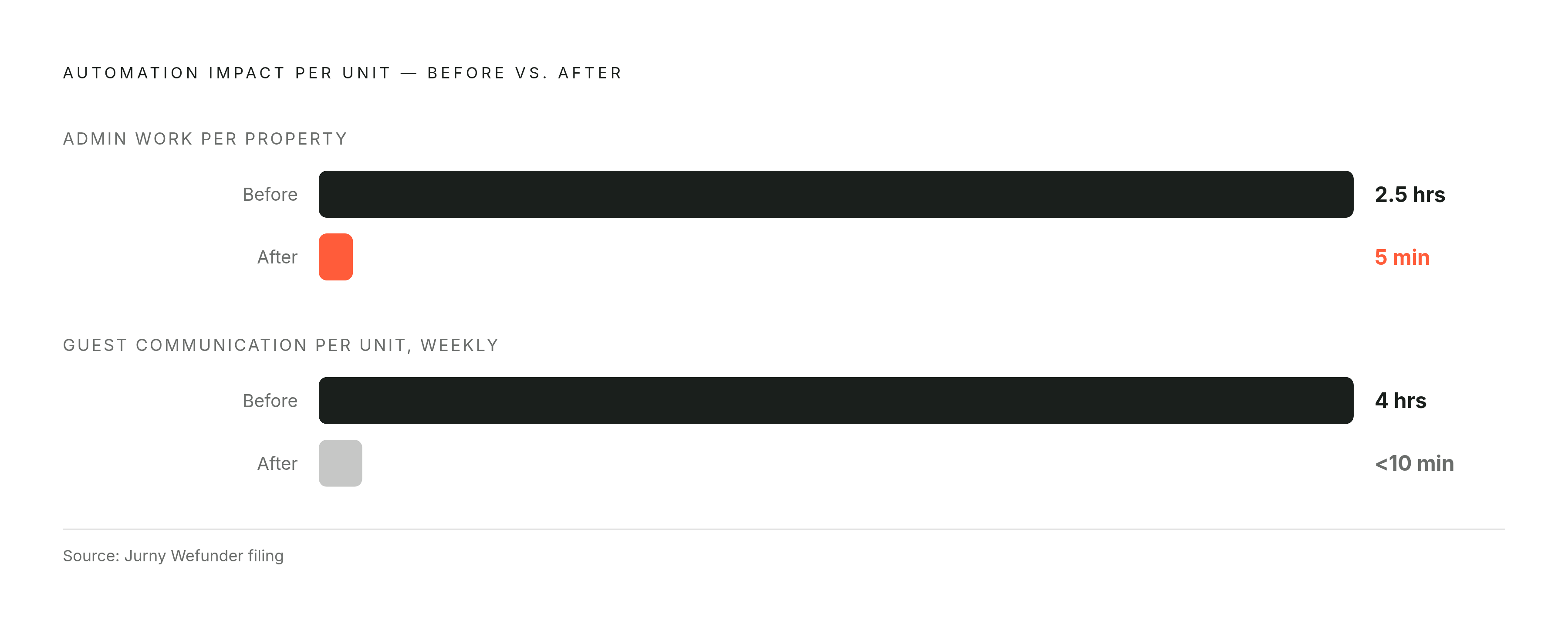
Jurny's self-reported figures, via its Wefunder filing, put the effect in blunt terms: smart locks and connected tech cut administrative work per property from 2.5 hours down to 5 minutes, and weekly guest communication per unit from 4 hours to under 10 minutes. Those are vendor numbers, not independently audited ones, but the direction lines up with what the category is built to do.
The real hours saved aren't in the chat window, they're in what happens after the message. When a guest reports a broken thermostat, a well-built system logs the ticket, assigns it to the right maintenance contact, adjusts the housekeeping schedule if needed, and notifies the front desk, all without a human relaying it four separate times. The guest conversation is one touchpoint. The coordination behind it is where the hours actually get saved.
None of this works without escalation logic. "I'm locked out" needs to route to a live person immediately, not sit in a queue behind a parking question. A system that can't tell the difference between an inconvenience and an emergency isn't an efficiency gain, it's a liability with a good UI. Multilingual handling matters here too: modern tools translate guest messages while keeping the host's tone intact, which means a two-person shop can field an international reservation without hiring a translator or fumbling through a free translation app at 11pm.
The platforms small property managers are actually using
Jurny / NIA runs five specialized AI agents in coordination through a Unified AI Inbox spanning seven channels: Airbnb, Booking.com, Vrbo, Expedia, WhatsApp, SMS, and email. Jurny reports sub-60-second responses across more than 50 languages and says the system handled over 200,000 guest reservations autonomously in 2024, with up to 90% of replies automated, figures that come from the company itself, not a third party. JurnyOS 3.5 shipped April 29, 2025. The catch for very small portfolios: a $400 monthly minimum that prices out operators running a handful of units.
Guesty's ReplyAI sits natively inside the Guesty inbox with direct access to live reservation data, not bolted on as a separate purchase. Its 2025 updates added tone adjustments and rewrites generated with the help of one model, plus conversation summaries. Because it reads reservation data directly, there's no manual syncing lag, which matters more than it sounds like it should.
Hostaway AI connects across a broad range of booking platforms and runs two modes: AI Replies, which drafts suggestions for human approval, and AI Auto-Reply, which sends automatically for categories the operator defines in advance and leaves everything else in draft. Hostaway's own documentation is explicit that Auto-Reply sends without human sign-off, while Draft mode requires it. That split makes it a fit for operators who want a human still in the loop.
Aeve AI is a standalone communications tool that needs to plug into whatever PMS is already running. It self-reports handling 70 to 80% of guest inquiries and 70 to 90% end-to-end resolution with policy enforcement built in, and it pulls its knowledge base automatically from existing conversations, listings, and manuals, cutting setup to a matter of days by its own account.
HostBuddy AI typically lands in the 40 to 50% automation range, with human intervention still needed for anything complex, and setup runs property-by-property, which can take weeks depending on portfolio size. Operators in the small-portfolio range who adopt HostBuddy after outgrowing virtual assistants typically report meaningful reductions in communication overhead, though outcomes vary by portfolio and configuration. HostBuddy also automates upsell prompts for early check-ins, late checkouts, and gap nights, with a potential revenue increase of up to 15% cited by Host Buddy AI via StayFi.
A handful of others round out the field: Lodgify's AI Assistant, which Lodgify itself frames as administrative efficiency rather than revenue tooling; Akia, built around automated check-ins and post-stay surveys; HostAI, focused on guest messaging and operational task coordination; BestyAI, a guest-facing chatbot with PMS integration; and Yada.AI, focused on guest messaging and workflow automation.
The dividing line that actually matters is native versus bolted-on. Tools built into the PMS, like Guesty's ReplyAI or Hostaway AI, pull reservation data live. Third-party add-ons generally require manual syncing, which introduces lag and the occasional wrong answer delivered with total confidence. No platform here fits every portfolio. A $400 monthly floor is a rounding error for a 200-unit operator and a dealbreaker for someone running eight.
How long implementation actually takes and where it breaks down
Property management analysis from Phosailabs puts a realistic benchmark at 30 days to see initial value, 90 days to get full use out of one workflow, and 4 to 6 months to run a multi-workflow program across the business. Individual workflow types vary in how quickly they go live, depending on integration complexity and portfolio size. Kriatix.ai's analysis found organizations working off tight, milestone-driven timelines were 2.4 times more likely to reach full deployment than ones running open-ended roadmaps, which tracks: a deadline forces the scope-narrowing that a lot of these projects skip.
The 30-day pilot that tends to work follows a fixed shape. Pick one workflow that can actually be measured, like pre-arrival messaging. Map how it runs today, before any tool touches it. Draw the line for what the AI handles versus what escalates to a human. Test it against real guests and real edge cases, not a demo script. Then decide, with real data in hand, whether to scale it, revise it, pause it, or try a different workflow instead.
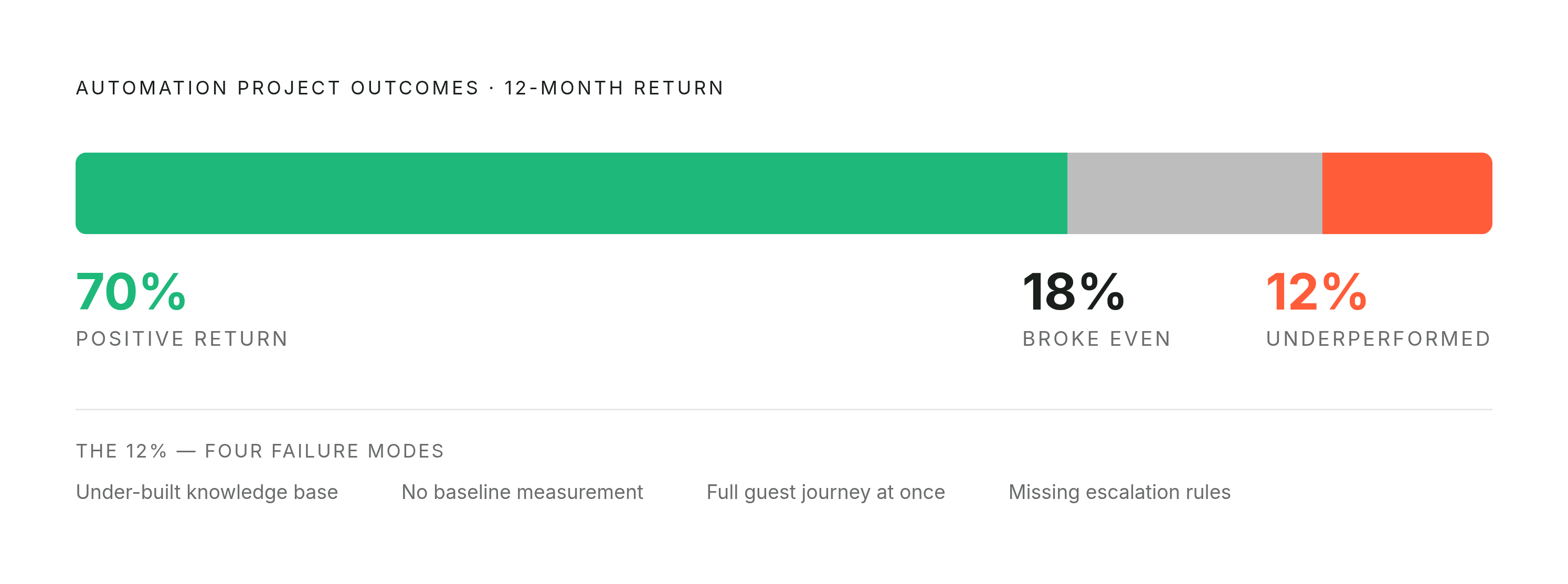
BuiltS AI's analysis of automation projects found several recurring failure modes. Common patterns include an under-built knowledge base, no baseline measurement to prove results, trying to cover the entire guest journey at once rather than one workflow, and missing escalation rules that left the system either automating things it shouldn't have or deferring so often to humans that it saved no time.
Across that same set of projects, roughly 70% delivered measurable positive return within 12 months, 18% broke even, and 12% underperformed or failed outright. Those aren't bad odds, but they're not a coin flip either, and the difference between the 70% and the 12% usually traces back to one of those four failure modes, not to which vendor got picked. Setup friction is the hidden variable worth watching: Aeve's automatic knowledge ingestion gets a system running in days, while HostBuddy's manual, property-by-property configuration can stretch into weeks. That gap is often where a two-person team runs out of steam before the system ever goes live.
What a two- or three-person operation can realistically handle once automation is embedded
Managing 5 properties and managing 50 start to look like the same job once AI is handling the routine messages, because the volume of repetitive communication scales with unit count and the automation doesn't care how many units it's covering. Analysis from Truvi and Hostaway found hosts saving 2 to 5 hours a week on average just from automating routine tasks.
AppFolio's survey of 1,617 property management professionals found AI adoption jumping from 21% to 34% in a single year, and firms that adopted broadly were projecting substantially stronger portfolio growth than firms that hadn't yet implemented anything. That gap is substantial rather than marginal. That's the difference between a team that can say yes to the next property and one that has to say no because the inbox is already full.
The upside also extends beyond fewer hours spent on messages. It's what those messages catch. Systems that flag early check-in and late checkout requests and convert them into paid upgrades turn a cost center into a small revenue line; HostBuddy's self-reported upsell lift of up to 15% is one vendor's number, but the mechanism, catching the moment a guest is deciding and making the offer right then, holds regardless of which tool runs it. Hospitality research on personalization more broadly has linked it to meaningfully higher guest satisfaction scores, and satisfaction is the metric that quietly compounds through reviews and repeat bookings long after the stay ends.
The ceiling on a small team was resources. It was the sheer volume of repetitive messages eating the hours that could've gone toward growth. Once that layer moves to software, the same team that spent its mornings typing out check-in codes spends them instead on the exceptions that need a human, and on the property upgrades and guest relationships that actually build revenue over time.
How small operators get expert implementation without a full-time hire
Here's the part that trips most small operators up: the tools above are available to anyone with a credit card, but building a system that actually works, a knowledge base that's current, escalation rules that don't misfire, channel integrations that don't drop messages, and baseline metrics to prove any of it mattered, takes a kind of expertise a two- or three-person team rarely has sitting around.
That's the gap fractional AI implementation fills. Instead of a full-time hire, an operator brings in someone on retainer who audits the operation, finds the single highest-leverage bottleneck (for most small property managers, that's pre-arrival and check-in messaging), builds a working system around it, and hands off a runbook the team can maintain on its own.
The cost math is stark. A senior AI engineer hired full-time runs somewhere between $340,000 and $470,000 all-in in year one, once salary, benefits, and overhead are counted. A fractional engagement runs $6,000 to $18,000 a month for 8 to 20 hours a week, a savings of 60 to 80%, and it gets a working production system live inside the first month with documentation the team owns by month three. Most small property managers don't need a full-time AI hire. They need someone who can ship a working agent in three weeks, wire it into a real workflow, and leave clear instructions behind, not a permanent seat on the payroll. That model has already shown up outside hospitality too: comparable engagements have reported an 80% cut in data entry time for an insurance and finance client and more than 160 hours a month saved for a freight operator, which suggests the pattern holds regardless of industry, not just in guest messaging.