AI Transformation Roadmap Components for Small Service Firms
Small service firms should solve one bottleneck completely before scaling AI across the business.
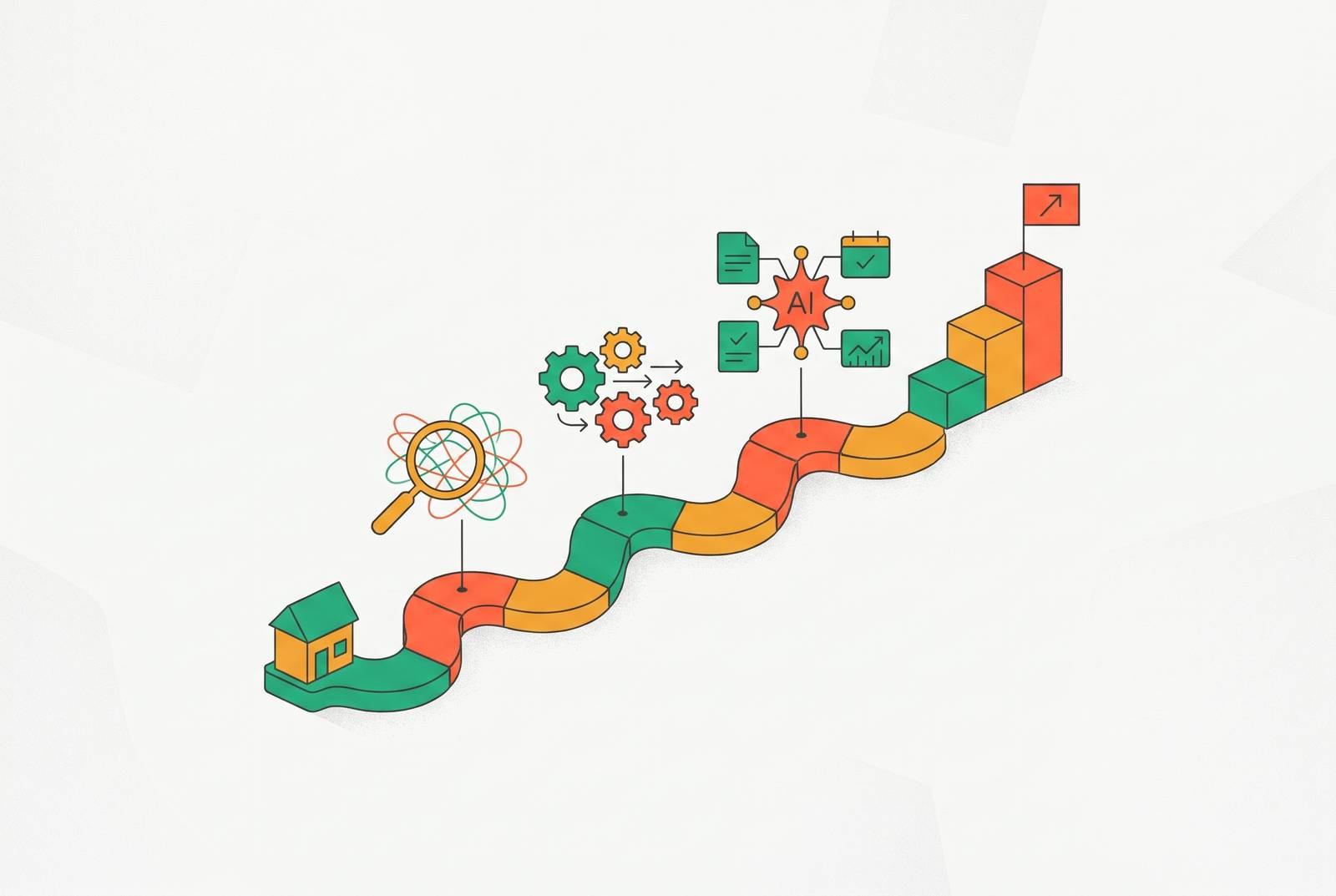
An AI transformation roadmap for a small service firm is not an enterprise blueprint with fewer meetings. It follows a different order: find one bottleneck, solve it fully, and measure the return before taking on more. The components below show how a two-week diagnostic becomes a production system, then a business capability the existing team could not previously support.
Why small service firms need a different AI roadmap than enterprises do
Enterprise AI frameworks assume an organization that can run several workstreams while dedicated teams handle data, governance, and budgets. A service firm with 10–50 people rarely has those teams in place. It can improve a workflow without first adding them. Shrinking the budget without changing the sequence leaves a small firm waiting through preparation designed for a different kind of business.
GrowExx's 2026 guide puts enterprise-wide timelines at 12–24 months and focused initiatives at 6–12 months. Even the shorter schedule assumes organizational layers that small service firms do not have. More importantly, enterprise sequencing puts broad readiness ahead of production. That can mean months of planning before a single process improves, while the people doing that planning still have clients to serve. The invoice queue does not wait for the steering committee.
A better SMB roadmap runs foundation work and quick wins in parallel from week one. Data access, ownership, and operating rules develop around a real workflow rather than becoming an organization-wide entrance exam. Because a small service firm often has only one or two genuine bottlenecks, resolving one can release more downstream capacity than scattering small improvements across the business.
What a readiness assessment looks like when it takes two weeks, not six
A two-week diagnostic answers a narrow question. Where is the highest-leverage bottleneck, and is its data accessible enough to act on now? Its primary output is a prioritized workflow list. Unlocking Tech's SME roadmap calls that prioritization “that's AI strategy work” and warns against buying the solution before understanding the problem.
For each candidate, the diagnostic establishes how frequently the work happens, whether an early error would be tolerable, and whether the necessary data is already accessible in one place. Those answers distinguish a buildable workflow from an attractive idea. Frequency is a useful first filter. Work that happens twice a month does not justify the effort, while a process whose information is scattered across five systems can remain perpetually “almost ready.”
The search usually begins in four areas, namely support and service triage, sales lead qualification and follow-up, repetitive operations such as invoicing and document processing, and internal communication routing. By the end of the diagnostic, the firm should have a ranked set of workflows with clear reasons for their order and a view of which data can be used now. The diagnostic's job is to identify a defensible first build.
How to pick the one workflow that justifies going all the way in on first
Work on one pipeline builds on itself faster than work spread across five, but only if that pipeline suits automation. The selection rule should therefore be strict. The task happens frequently throughout the week, takes a short time on each occasion, produces output with a roughly consistent shape, and already has clean, accessible data. Even with an eager sponsor, a candidate needs all of those traits.
Should the firm not fix its most painful problem first? Pain and leverage are not the same. The work causing the most pain may also have the most fragmented data or depend most heavily on contextual human reasoning. Complex client negotiations, regulatory interpretation, and nuanced pricing are poor first candidates for that reason. When automation falls short of the judgment a task needs, errors build up and savings fall away.
The better choice is often the operations manager's Tuesday morning problem. It is tedious, repetitive, documented, and already produces outputs that can be measured. That may sound unglamorous. It is also what makes a complete solution possible, from receiving the input to producing the output and handing exceptions to a person. Selecting a modest but coherent workflow gives the first deployment a boundary, which makes its cost, quality, and effect easier to evaluate.
What a 30-day first deployment actually contains
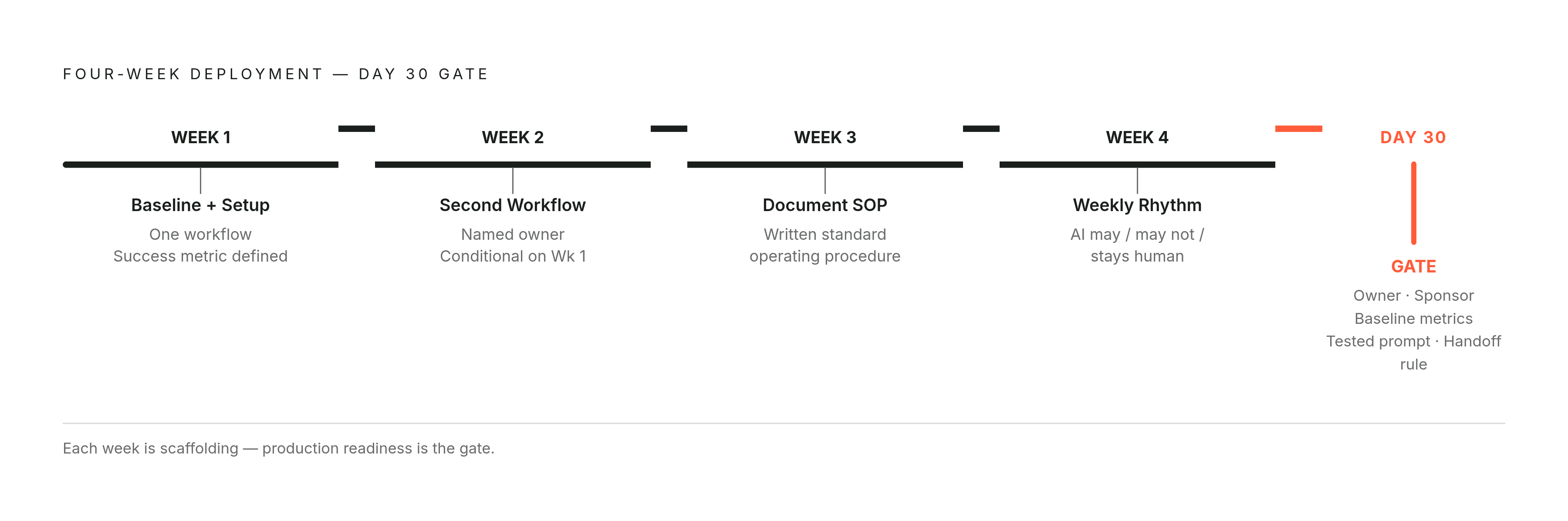
For a tightly scoped workflow, the first month is chiefly a test of governance and measurement. A production AI system can be running within weeks when the task has clear limits. The deployment plan should make those boundaries explicit. Its weekly milestones cover real examples, ownership, documentation, and operating rules, rather than treating a successful demonstration as the finish line.
In week one, establish the baseline before the system runs, complete setup, and put one customer-facing workflow, such as follow-up triage, against real examples. Define the success metric at this point. Week two can extend to a second workflow, such as quoting or proposals, with a named accountable owner, but that milestone is conditional on evidence from the first. If automating three workflows, pick one, run it for a fixed period, and only then select the next.
In week three, document the new process as a written standard operating procedure so that it is transferable. Week four connects the workflows into one weekly rhythm and records what AI may do, what it may not do, and what stays fully human. These rules are part of the system. The same roadmap distinguishes “works in the demo” from “works on Tuesday morning” through error handling, human handoff rules, a cost ceiling per run, and a decision log.
By Day 30, the production-readiness checklist must be complete. It names one AI owner and one accountable business sponsor, and has a short list of which tools are allowed or banned and which data types they may handle. The selected workflow needs a baseline for time, cost, quality, and error rate. Its prompt or automation must also be tested, with clear human checkpoints and a documented handoff rule.
How to measure ROI before deciding to expand
The first deployment earns expansion through measured results. Without that evaluation, the firm cannot distinguish a useful production system from a pilot that consumes less visible forms of effort. The method needs only three inputs. Unlocking Tech's roadmap identifies them as the cost of the status quo, the total cost of the workflow, and the result measured over a defined period with the system running.
The cost of the status quo can be measured in person-hours spent each week or the cost of errors the process lets through. The workflow's total cost includes licenses, subscriptions, compute costs per model call, and labor for building and maintaining it. Maintenance belongs in the calculation. The after measurement then uses the same process and success metric, so that a reduction in manual work can be weighed against the full cost of achieving it.
A common objection is that the firm lacks clean baseline data. That is why measurement begins in week one, before the system runs, rather than becoming an exercise in reconstructing the past at the end. Still, some workflows will fail to show a measurable return. Judgment-dependent tasks, unbounded API costs, and poorly defined scope can each overturn the break-even calculation. A polished output does not cancel an unfavorable result.
Explaining the result also builds internal literacy. A team that understands a measured win has a basis for trusting the next deployment, while a half-finished pilot leaves people inheriting uncertainty. That understanding must reach beyond the builder. Expansion should begin only when the first workflow has documented ROI, a named owner who understands the system, and a handoff protocol that works without the person who built it.
Why the embedded engineer model matters for SMBs that can't hire a full AI team
A successful first workflow does not automatically give a small firm the expertise to maintain and extend it. That access gap is where many roadmaps stop. The business may want to proceed, yet lack people who can connect technical work to daily operations. Hiring a full AI team takes more than approving one automation that helps with the work, especially if hiring means a six-figure cost or a six-month search.
Between May and July 2026, major technology companies pledged large sums to forward-deployed engineering programs that put their own engineers inside customers' operations. The model addresses an organizational barrier. Working inside the customer gives engineering a place in the actual process it is meant to improve. But the enterprise version is priced for enterprise clients. Its value does not remove the access problem for a small service firm.
The SMB-adapted version is an embedded AI specialist who arrives with working systems and deploys them into real business workflows. SANSA works this way through a two-week diagnostic, a first system ready for production, and embedded work that continues after the first win. The ongoing work is the distinction. It gives the roadmap a way to continue after initial deployment without requiring the firm to assemble a full internal AI team.
SANSA points to an insurance broker that cut manual data entry and a paper freight company that saved hours each month. Those examples are presented as outcomes of staying embedded. They connect the delivery model to operational work. For a small firm, access to expertise is useful when it supports a running process and its expansion, rather than ending with a prototype that nobody internally knows how to own.
How the roadmap compounds from one workflow into a new business capability
Once the expansion gate is met, the next workflow is selected through the same diagnostic logic as the first. Enthusiasm and vendor suggestions do not replace that filter. Each production workflow frees up capacity that went into repetitive, time-sensitive tasks. That capacity can then support work the team previously had to delay, turn away, or hire for.
This depends on embedding AI inside defined processes with defined triggers, inputs, and outputs. A browser tab is not an operating model. In an embedded workflow, AI classifies a support ticket when it arrives, writes a meeting summary into the CRM when the call ends, or screens a candidate CV against the job specification when the application lands. The employee's role shifts from operator to editor. Human attention remains part of the process, but it is no longer required to initiate every repetitive step.
Consider a five-person firm that has automated quoting, follow-up, and document processing. It can quote faster and handle volume it would previously have turned away, opening room for work that its old operating model could not support. That is a different business capability. The constraint was not necessarily talent or ambition, but the amount of routine work the team had to absorb before it could use either.
The final test is what would happen if the systems disappeared tomorrow. If nothing structural about the firm's capabilities would change, the transformation has not happened yet. Removing it would require a reorganization because the business has come to operate at a level its previous processes could not sustain.