What Your AI Roadmap Should Answer Before You Spend Anything
Four unanswered questions can doom even a promising AI pilot before it launches.

An AI roadmap should help decide whether to spend money on an initiative as well as set out what happens after approval. For an SMB, that means closing four questions before spending on implementation, namely whether the bottleneck is worth removing, the data is ready, the system fits the real workflow, and success can be measured. If any one goes unanswered, even a promising pilot can fail in ways that better technology cannot fix.
Why most SMB AI pilots fail before the first invoice is paid
An owner approves an AI tool to relieve an overloaded team. The pilot runs, but the queue remains and people keep doing the same manual work. Nothing useful has changed for the business. In this familiar pattern, the failure starts before installation, when enthusiasm turns into tool selection without a defined problem, a data assessment, or an agreed test of success.
The model need not be weak for this to happen. A capable system can address the wrong step, depend on information nobody can access, or produce an answer that people cannot use where they work. These are failures of planning. By the time they become visible, the business has already committed money to assumptions it never examined.
Diagnosis should precede tool selection. A roadmap serves that purpose when it exposes reasons not to proceed, rather than making an already favoured purchase look orderly. A project delayed by an unanswered question is less costly than a build organised around an answer that was never true.
What a roadmap actually is — and what it is not
A project plan tells you when work happens. A roadmap, in this sense, tells you whether the conditions for that work have been met. A list of AI use cases with quarterly labels gives ideas appointments.
For an SMB, the useful version needs neither six workstreams nor an MLOps team. It needs a small set of answers in a fixed order, starting with bottleneck selection, then data readiness, workflow fit, and success criteria. Each is a gate that must close before implementation begins. Closing a gate means resolving its question.
That distinction makes the roadmap something an owner can own. The document may be simple, but the decisions must be specific enough to rule an initiative out. If the data cannot support the proposed work, for example, a launch date does not solve the problem. It merely schedules a collision with it.
Gate one: whether the bottleneck you picked is actually the right one
The business must first identify what it wants to accomplish. Without that anchor, a polished demonstration, a technically interesting idea, or an executive’s latest complaint can set the agenda. Visibility is not the same as leverage. The right bottleneck is high-volume, repeats the same way each week, and restricts capacity in a way that forces the business to hire, wait, or turn work away.
For the owner, closing this gate starts with naming a step. “Operations needs help” is too broad to test. A freight coordinator buried in manual check calls or an insurance broker re-keying the same field across three systems gives the team a clear step to discuss. The team must next determine what removing that work would let the business do that it cannot do now.
Relief can be valuable, but the business case needs a measurable consequence, such as new capacity or the removal of a constraint. The team must also distinguish repeatable rules from judgment calls that nobody has written down. Work that seems to repeat the same steps may rely on choices that someone who knows the job well makes without noticing.
A strong first use case is therefore usually executable. It combines clear pain, enough data, moderate complexity, manageable risk, and visible internal value. Starting with a broad scope is harder when nobody clearly owns the work, as is starting with regulated workflows before governance is ready. Handing autonomous decisions to AI before validating a supervised workflow skips the very evidence a first pilot should produce.
Gate two: whether your data is actually ready to support the use case
A well-chosen bottleneck does not guarantee usable data. The information behind it may be scattered across spreadsheets, legacy software, CRMs, cloud platforms, and disconnected internal tools. A person may currently assemble it all by hand. If that effort is invisible in the roadmap, it will reappear during the build as unplanned work.
The practical test begins with locating the information that feeds the chosen step. The team needs to establish whether it sits in one system or requires manual extraction from several. Next, the team must check whether the information is complete and has a consistent structure, and whether someone must correct it before it can support the proposed task. Having data is not the same as having data the system can use.
Access is another condition. The owner needs to know who controls it and whether legal or compliance restrictions prevent its proposed use. A finished pilot held up by a data agreement shows what getting that order wrong can cost. The agreement should have been identified as a data dependency before the build.
This gate also requires a record of the current state before AI changes the workflow producing it. That baseline will later support an honest evaluation. Meanwhile, the data assessment determines how much preparation belongs in scope and whether a 30-day deployment is realistic. Clean, accessible data can support a narrowly scoped deployment, while fragmented information may make data structuring the first useful result. The pilot cannot teach the business much if its inputs were never ready for the test.
Gate three: whether the AI will fit the workflow as it actually runs — not as it is supposed to run
A technically correct answer is of little help if it arrives somewhere the responsible person does not work, at the wrong moment, or in a form requiring another manual step. Extra friction invites workarounds. The AI can then run in parallel with the real process while nobody keeps it updated.
To avoid that outcome, the people doing the work must help define the change. A team lead needs to know where the output will land, when it will arrive, and what someone must do with it. Those questions are more concrete than asking whether staff are “ready for AI”. They test whether the proposed system belongs in the working day at all.
The same conversation must expose unwritten approvals, handoffs, and exceptions. The people who own the work can identify where human judgment must remain and which surrounding steps can change safely. They can also say whether the process is stable enough to automate. When a workflow changes often, a system built around how it works now may be out of date within months.
The work should be simplified before it is automated. Training does not repair a design that makes the real process harder. SANSA’s embedded approach reflects this distinction by working with the team that owns the workflow. Working with the team helps overcome a limit of planning from afar, because workflow fit depends on knowing how people actually do the work.
Gate four: what success looks like — defined before anything is built
A pilot can produce plenty of activity without improving the business. Unless the owner sets out what success looks like before the build, that activity can become a reason to keep going. A busy system is not necessarily a useful one. The final gate asks which business metric should move and what result would justify continuing.
The metric must describe an outcome the owner already cares about. The business must set a threshold for success, a threshold for stopping or redesigning, and a window over which results will be measured. It must also name the person responsible for measurement. That person needs enough independence from the pilot to report an unwelcome result honestly.
The baseline from the data gate now becomes essential. If finance asks for a return-on-investment justification after implementation, the original workflow may already have changed the data needed for comparison. Capturing it before the change is what lets the business distinguish improvement from a result that simply looks good in isolation.
These decisions also govern the move from pilot to production. The roadmap should specify the number that triggers expansion rather than leaving the decision to a feeling that things went well. If the team cannot name an outcome that matters, it needs to look again at its earlier claims about the bottleneck, data, or workflow. Success criteria are a commitment device. They prevent a failing pilot from being declared a success because stopping feels worse than continuing.
How the four gates work as a sequence, not a checklist
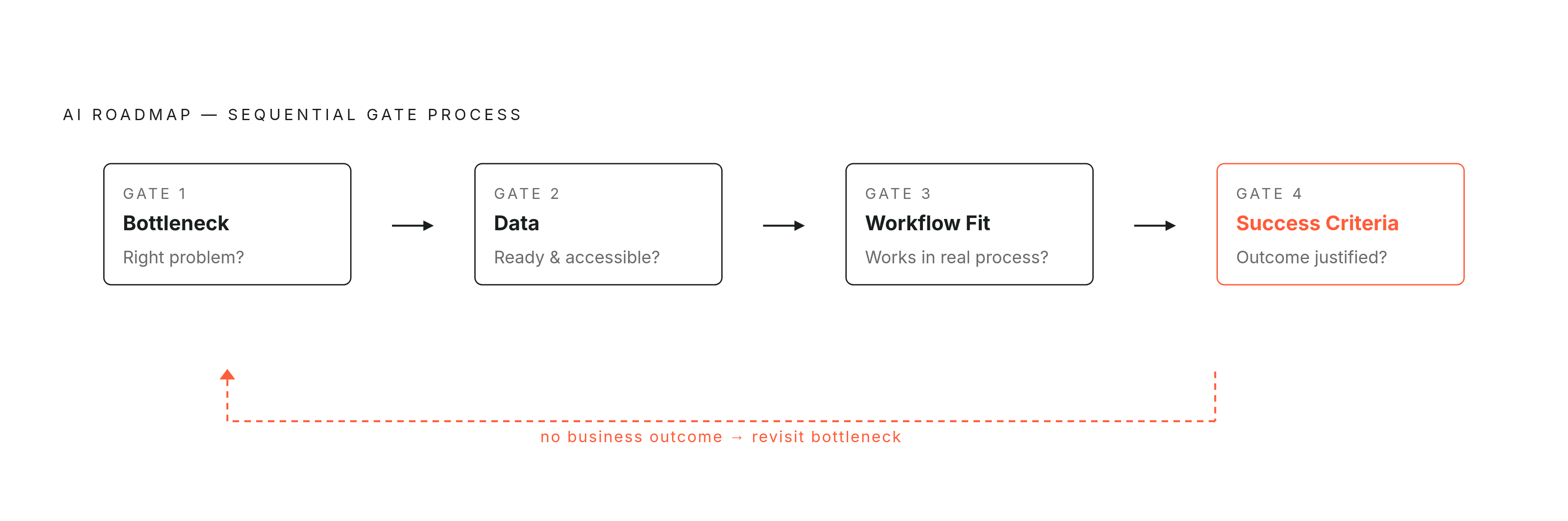
Bottleneck selection establishes which data needs examination, so a general verdict that the company’s data is “good” cannot substitute for the second gate. The data assessment then limits what the proposed system can do and may put a structuring step ahead of automation. That change affects scope and timing. Workflow assessment must address this feasible version of the system.
A workflow discussion may reveal that the supposedly repeatable step relies on unwritten judgment. Setting out what success looks like may show that the chosen bottleneck has no clear link to the business outcome. When that happens, the roadmap sends the decision back for another look, so finishing a discussion leaves room to change an earlier approval.
This is why four ticks are not enough. The answers must fit together, and all four must be resolved before spending on implementation. Where a real bottleneck, accessible data, a stable workflow, and defined success align, the build can start quickly. Where they do not, the owner has learned what must change, or why this initiative should not proceed. Knowing whether to spend at all is the roadmap’s actual value.
Running the gates yourself: what the process looks like in practice for an SMB
For an owner ready to run the sequence, the first week can focus on bottlenecks and data. Map the three to five workflows that consume the most time or create the most friction, using observation of the team’s week. Then name the constraining step in the strongest candidate. Pull the information feeding that step and assess its completeness, structure, access, and restrictions. If it is not ready, determine how long preparation would take and whether that investment is worthwhile for this use case.
The second week turns to workflow fit and measurement. Sit with the person who owns the work and walk through the proposed change step by step, drawing out exceptions, judgment calls, and handoffs. Define the business metric and its baseline before scoping a build. If no baseline exists, capturing it becomes the first deliverable. Write down both the success threshold and the stopping threshold before talking to the vendor.
The output can fit on a single page. It should give a clear answer on the bottleneck, data readiness, workflow fit, and success, with any unresolved condition showing what needs fixing first. The page can change as priorities shift, but its dependency order should hold. For an owner who wants help with the diagnosis, SANSA’s two-week diagnostic is designed to find the bottleneck whose removal would help the business most before building. The decision to seek implementation support should follow the answers.
The first roadmap is the hardest to produce because the business is building clarity from scratch. The next one benefits from what the team has already learned about its data, its handoffs, and the judgment hidden inside apparently routine work. That knowledge makes subsequent initiatives faster and cheaper to scope. The lasting gain is not only an AI system, but a business that understands its own operations well enough to choose the next investment more carefully.