Using a Prioritization Matrix to Choose AI Projects in SMBs
A prioritization matrix ensures your first AI bet targets the real bottleneck, not the loudest idea.

Small and midsize businesses rarely struggle to generate AI project ideas. The struggle is comparing them. A business with five plausible use cases and no method for ranking them will default to picking whichever one got mentioned loudest in the last leadership meeting. Practitioners have a name for that failure mode: HiPPO-driven selection, where the highest-paid person's opinion substitutes for evidence. It produces decisions fast and wrong in roughly equal measure.
Two other habits make the problem worse. The first is technology-first thinking, where a business gets excited about a capability (a chatbot, an image classifier, an agent that drafts emails) before anyone has quantified the business problem it's supposed to solve. The second is the absence of any scoring baseline at all: an automated-invoicing idea and a customer-churn-prediction idea get discussed as if they're on the same axis when nobody has defined what that axis is. Without shared criteria, comparing two AI ideas is comparing a sandwich to a Tuesday.
The cost compounds past the first pilot. A stalled or underperforming AI project doesn't just waste a quarter's budget, it erodes confidence in AI as a category inside the organization, which makes the next proposal harder to fund and harder to staff. Worse, a misaligned first project teaches the team nothing transferable. The second attempt starts from zero instead of building on what the first one proved. Selecting the first AI project is the decision that sets the compounding trajectory for everything after it, so it deserves a method, not a mood, rather than an administrative task delegated to whoever's calendar has room.
What a prioritization matrix does
A prioritization matrix will not tell a business owner which AI idea is objectively best. No matrix can do that, because "best" depends on strategic context the matrix doesn't contain. What the matrix does is force every candidate idea to answer the same set of questions, so the assumptions behind each one become visible and arguable instead of implicit and unchallenged.
The structure is simple. Each candidate use case gets scored across shared dimensions, commonly business value, technical feasibility, data readiness, risk, and strategic fit, then plotted so tradeoffs become visible instead of getting argued in circles. For an SMB without a dedicated governance function or formal portfolio reviews, a stripped-down version works fine. The discipline the matrix enforces is sequencing: deciding what gets built first and what waits, not producing a precise numerical ranking defensible to three decimal places.
The matrix is a living document that deserves a quarterly look, because a use case that scores poorly on data readiness in January can clear that bar by April once the underlying systems catch up.
What it can't do matters more. A matrix cannot compensate for bad data infrastructure. An organization with strong technical talent but weak governance or messy underlying data will watch even its highest-scoring projects stumble once they hit production, because the scoring model assumes the inputs fed into it are honest. If a team overstates its own data readiness (a common move, often unintentional) the matrix produces a confident, wrong answer. The fix is to treat data readiness as a hard gate rather than one input among several: a project that fails it drops to the backlog regardless of how well it scores everywhere else.
A matrix can look rigorous and still get captured by internal politics, especially when the business unit that proposed a project is also the one scoring it, a second structural risk worth taking seriously. Running individual scores independently before the group convenes, and pulling the scoring panel from across functions rather than from a single department, blocks most of that drift before it starts.
Using the matrix as a bottleneck-finder, not a scorecard
The matrix earns its keep when it's run backward. Instead of starting with a list of candidate projects and scoring them, start with one question: what is the single constraint that, if removed, would change what this business is capable of doing? Then use the scoring dimensions to confirm or challenge the answer.
Most AI project lists get built bottom-up, starting from "what could we automate?" That question generates a long list and no priority among its entries. Instead, start from the top: identify the binding constraint on growth right now. For an SMB, that constraint usually has a concrete, nameable shape. It's the process that currently forces the business to hire ahead of demand, make customers wait, or turn work away. That process is the candidate bottleneck, and the matrix's job is to test whether an AI project aimed at it is actually feasible and backed by usable data, not to generate a ranked list of unrelated automation ideas.
This distinction changes which project wins. A contracting business that quotes every job manually may have its real constraint sitting in quote generation, the step where a backlog of unanswered requests caps how much new work the business can take on. Automating delivery or scheduling instead might score well on feasibility, since delivery data is usually cleaner and the workflow better understood, but it leaves the actual ceiling on growth untouched. Compare that to an insurance broker buried in manual data entry: the constraint there is visible, measurable, and sitting on structured forms, which is exactly the profile a high-scoring matrix candidate should show. One of these projects changes what the business can do. The other just makes an existing task marginally faster.
Before the matrix gets run at all, the business owner has to rank strategic objectives, because the same project scores differently depending on whether the current priority is cutting cost, adding capacity, or reducing risk. The matrix can't make that call. It can only test the implications once the call is made.
A useful gut check follows: if the top-scoring project wouldn't change what the business is capable of doing, only shave a few minutes off a task that already works, it's probably a second-phase project, not a first one. Quick wins still deserve a place in the portfolio. The question that separates a good quick win from a wasted one is whether it builds toward the bottleneck or routes around it. A win that bypasses the constraint spends momentum and leaves the ceiling exactly where it was.
Once the bottleneck is named, the next question is mechanical: which dimensions actually decide whether an AI project against it is worth building.
The scoring dimensions that matter for an SMB bottleneck project
Not every dimension on a prioritization matrix deserves equal weight, and SMBs running their first session should know which ones are load-bearing. Data readiness and business value carry the structure. The rest provide useful signal but shouldn't be allowed to override those two.
Business value, in this context, means one specific thing: does the project attack the bottleneck identified in the previous step? A project that removes a capacity ceiling should outscore a project that speeds up a task the business was already handling fine. That sounds obvious, and it still gets violated constantly, usually because the faster-feeling project is easier to greenlight.
Data readiness functions as a gate on every project, not as a weighted input among others. A project without usable, structured, accessible data behind it doesn't proceed, no matter how attractive its projected impact looks on paper. SMBs routinely overestimate this score, because data technically exists, sitting in inboxes, scanned PDFs, and disconnected spreadsheets instead of anywhere a system can read it.
Technical feasibility asks whether the project can get built with the team and budget on hand, or through a short engagement, rather than requiring a multi-quarter buildout. For SMBs this question collapses into something narrower: does this require deep in-house engineering, or can an embedded specialist stand it up in a matter of weeks?
Strategic fit separates projects that open a new capability the business couldn't previously offer from projects that only protect a capability it already has. Both are legitimate. Under compounding logic, the former scores higher, because it changes the business's ceiling rather than reinforcing its floor.
Risk and reversibility ask a simpler question: what happens if this underperforms? A lower-risk first project is one where failure is contained and the team walks away with something useful even if the outcome misses, not necessarily a smaller one.
SMBs should add a sixth dimension most enterprise templates skip: team adoption likelihood. The people who currently own the affected workflow need to be in the room during scoping, because a technically sound system the team quietly routes around on a Tuesday produces exactly zero value on a Friday. It's a score assigned before anyone writes a line of code, built into scoping rather than bolted on as change management after launch.
Sequencing what the matrix surfaces, from first win to compounding build
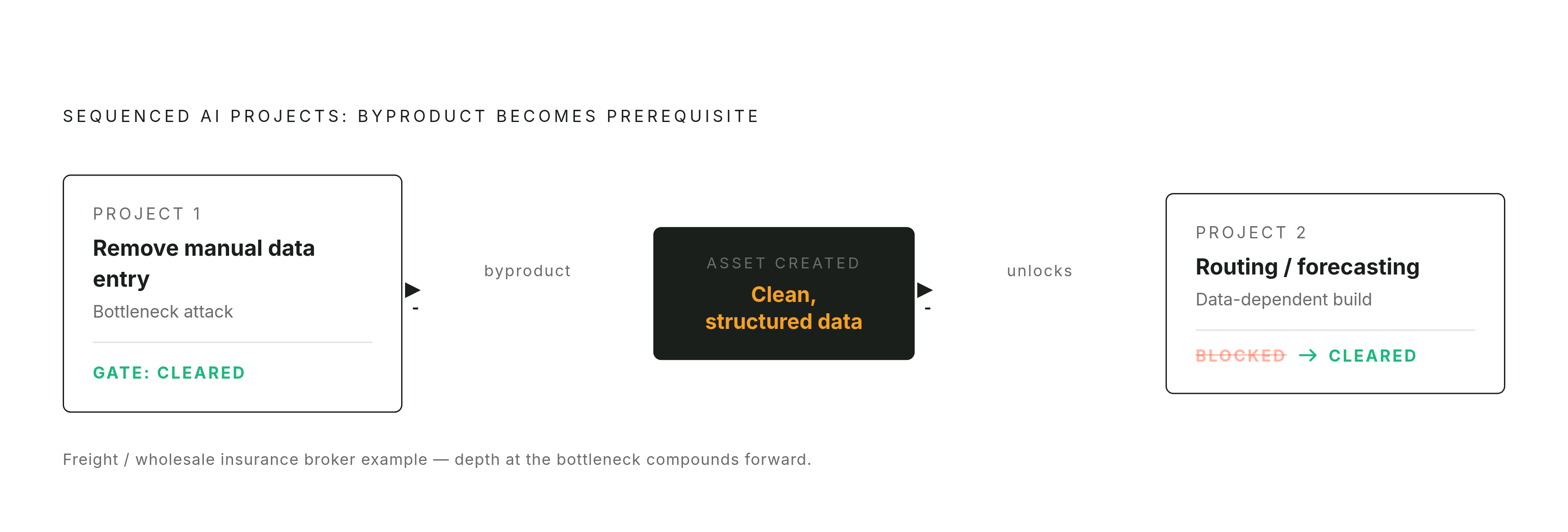
A matrix session done well doesn't produce a single winning project. It produces a sequence, where the first build changes the conditions the second one depends on.
Quadrant logic still applies here. High-impact, high-feasibility projects go first, but the discipline matters as much as the ranking: pick one or two, fully resource them, and communicate measurable outcomes across the team, rather than scattering a portfolio of small pilots across five departments at once. Broad "AI everything" initiatives that spread effort across multiple fronts simultaneously tend to stall at roughly the same rate, because compounding requires depth at the actual bottleneck. Width across unrelated functions just dilutes the same budget five ways.
High-impact projects that score lower on feasibility don't get discarded, they get queued. The data cleanup, the governance groundwork, the team training, all of that can run in parallel preparation while the first project executes, so the second project is ready to move the moment the first one delivers rather than sitting behind another procurement cycle.
The relationship between the two builds is direct, because the first build produces the conditions the second one depends on. A freight company that removes manual data entry from its core operation ends up with cleaner, structured data as a byproduct, data that makes a routing or forecasting project feasible in a way it wasn't before the first build existed. A wholesale insurance broker that cuts manual data entry out of its intake process sees the same mechanism: the first project doesn't just save hours, it produces the data asset the second project needs to clear its own readiness gate.
North Star framing helps keep the sequence honest. If the long-term goal is a service line the business can't currently staff, the roadmap should show each project moving the team toward that capability specifically, quote automation ahead of capacity expansion, for instance, rather than treating the two as unrelated decisions competing for the same budget line. A modular build philosophy supports the same logic: break the larger vision into phases that each deliver measurable value on their own, so the business isn't waiting six months to find out whether any of it worked.
None of this is static. The matrix deserves a quarterly re-run, because priorities shift as early projects generate new data, as market conditions move, and as the team's own comfort with AI systems grows. A project that failed the data-readiness gate in the first session can clear it three months later without anyone having to reopen the whole debate.
Knowing what to build first is one problem. Being able to build it is a separate problem.
The implementation question the matrix doesn't answer: who actually builds it
A matrix that correctly identifies the bottleneck still leaves an SMB with a resourcing decision it may not be equipped to make. Finding the right project is half the job. Executing it in a timeframe measured in weeks rather than quarters is the other half, and it's the half most SMBs have historically lacked a good option for.
The conventional paths each carry a cost that lands differently on a smaller business than on an enterprise. Hiring a full-time AI engineer is expensive on its own, and the hiring cycle alone commonly runs two to three months before anyone writes a line of production code. Once that engineer is on staff, the business often struggles to keep them fully utilized after the first project ships, since one project rarely generates a full-time engineering workload indefinitely. Engaging a large consulting firm solves the speed problem somewhat but introduces its own friction: generic solutions built for enterprise workflows, overhead that assumes enterprise budgets, and fees that assume the same. Freelance developers move fast and cost less, but support after delivery is frequently thin or absent unless it's negotiated explicitly up front, leaving the business without anyone to call when the system needs adjusting six months in.
Speed to a working system affects how fast an SMB's first AI project compounds value, more than architectural elegance does. A system running in production that the team actually uses compounds value faster than a meticulously planned architecture that's still in a slide deck. This is also where the team adoption dimension from the scoring section turns into an implementation principle rather than a scoring checkbox: embedding whoever builds the system alongside the people who own the affected workflow means the system gets built around how the work actually happens, not how it looks in a diagram drawn by someone who's never done the job.
The matrix does its job when it identifies the bottleneck correctly and hands the business a sequenced path forward. The build model does its job when the first project ships fast enough, and gets used consistently enough, to generate the cleaner data and the team confidence the second project will need. Get both right, and the first AI project becomes the first rung on a ladder the business actually climbs, not a one-time initiative.