Prioritizing Operational Investments When Cash Is Constrained in a Small Business
Identify the operational bottleneck choking growth, then invest to remove it.

The pattern never changes across small businesses facing this exact question. Small businesses run on a cash buffer most owners could count in weeks, not months. When money's that tight, the instinct is to cut whatever's visible and defer anything that smells like spending. The move that actually changes a constrained business's trajectory is the one that removes whatever's capping output, even when it costs money the owner would rather keep sitting in the bank. That means targeting the thing that's actually choking growth, rarely the cheapest option on the table.
Growth-stage businesses with longer runways make decisions from a different posture entirely: opportunity instead of urgency. An owner deciding from urgency reaches for the nearest cost to cut. An owner deciding from opportunity asks which dollar spent now returns the most dollars later. Same balance sheet, wildly different decision quality. Profitability doesn't fix this, either, which is the part that trips people up. A business can throw off healthy margins and still have zero room to invest, because the cash is stuck in receivables, tied up in inventory, or sitting in a reserve nobody wants to touch. Scarcity is a cash problem that distorts decisions no matter how clean the P&L looks.
The difference between a cost and a constraint
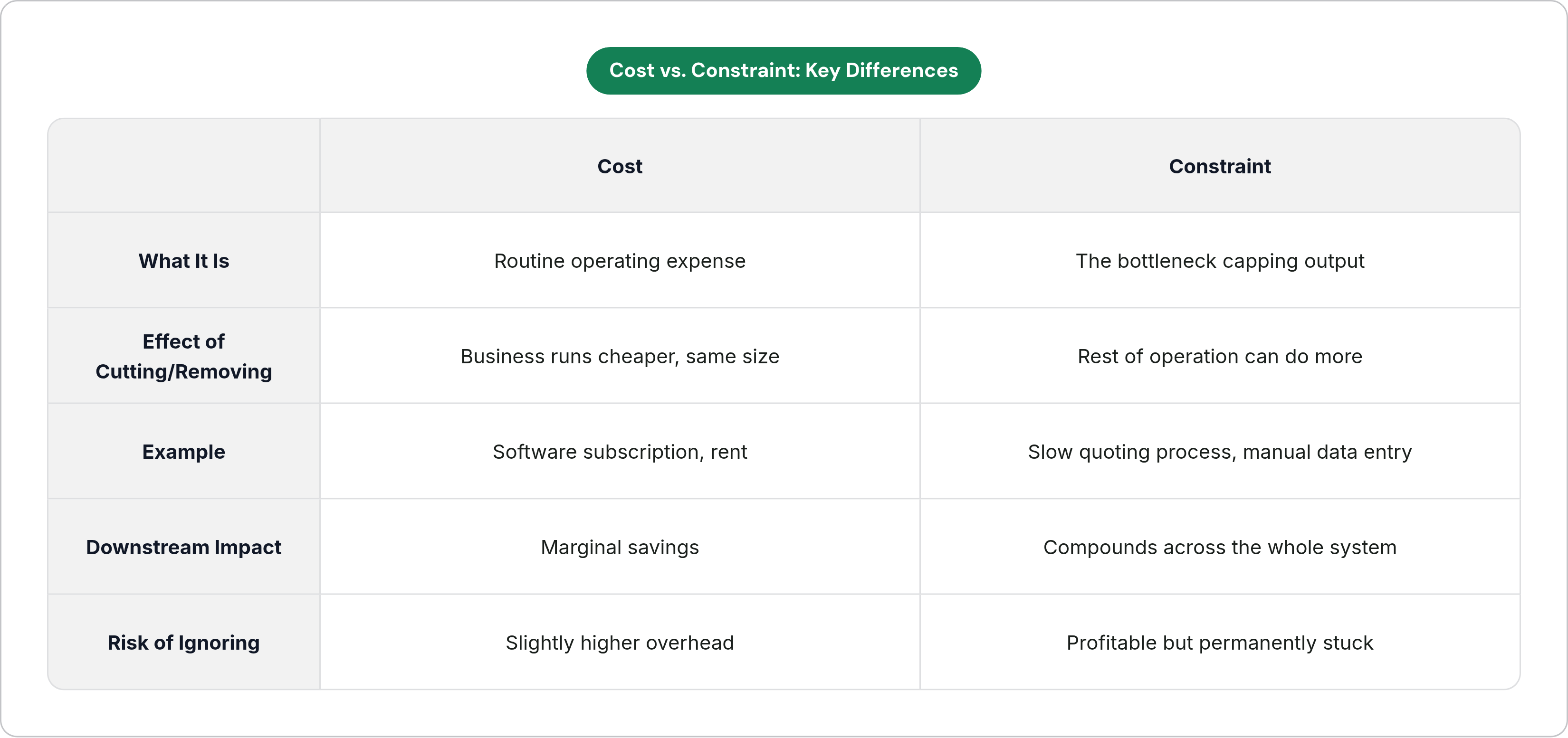
Most of what a small business spends money on is a cost. Rent, insurance, the software subscription nobody remembers signing up for. Cutting those makes the business marginally cheaper to run at the same size. A constraint works differently. It's the one thing that, if removed, lets the rest of the operation do more without spending proportionally more to get there. A quoting process so slow the sales team can only chase a fraction of inbound leads is a capacity problem. Cutting the marketing budget leaves the capacity ceiling intact; you'd just have a smaller, cheaper, equally capped business.
The Theory of Constraints makes the same point, and it's held up because it's correct: the bottleneck governs throughput for the entire system, full stop. Optimizing anything upstream or downstream of the bottleneck before fixing the bottleneck itself amounts to rearranging furniture. For a small business, that bottleneck is almost always a specific workflow that can't scale without breaking, or without another hire to babysit it: manual data entry that blocks the next step, a follow-up sequence that only happens if someone remembers, a report that takes three hours to build and is stale before anyone opens it.
Remove that constraint without adding payroll, and the gain compounds. Same team, same headcount, more work processed, no hiring event attached. That's the whole logic, really. Lifting a ceiling and lowering a floor are fundamentally different questions, and treating them like they are is how a lot of small businesses end up profitable and stuck at the same time.
How to find the bottleneck in your own operation before spending anything
The bottleneck rarely needs a consultant to find it. It shows up where work piles up, slows down, or quietly gets dropped, usually well before anyone gives it a name. Where does the queue build? What task keeps pulling the owner, or the most capable person on the team, back in when they should be doing something else entirely?
Try this: map one week of work by task, time spent, and how often it repeats. The hours pile up on manual, rule-based, repetitive tasks, and the constraint usually surfaces within a single page. The tasks worth investing in tend to share a few traits. They eat significant time every week. They happen on a predictable cadence. They follow clear if-then logic, and they start throwing errors the moment volume spikes. Those are the jobs where a human is doing the work of a system, and a system wouldn't get tired or skip a step.
Watch for the cascade too. The task that runs behind and drags something else down with it, or shows up directly in the customer's experience, usually costs the business far more than its own hours suggest. That downstream cost surfaces instead in a customer who doesn't call back.
Before spending a dollar, get specific. "Invoicing takes six hours a week and holds up cash collection by several days" is a diagnosis you can actually act on; "our operations are inefficient" is just a shrug. Specificity gives you a baseline, and a baseline is the only thing that lets any investment prove, after the fact, whether it worked.
Why most operational investments underperform even when they look reasonable on paper
Here's a pattern that repeats so often across small businesses it should have a name by now. Owner spots a pain point, owner buys a tool, results come back mediocre. The tool usually works fine, but the workflow underneath it stays broken. The tool gets bolted on top of that broken process instead of replacing it, and adoption stalls out at half-hearted because the team keeps running the old process in parallel, just in case.
Most companies that roll out AI or automation tools abandon a majority of those projects within a year, and the postmortems land on the same line almost every time: the software worked but the organization failed to build around it. The same failure shows up outside AI, too. New project management software nobody opens, because the handoff process was never redesigned. A CRM stuffed with customer data nobody looks at, because reporting was never wired into a weekly decision. Different tool. Identical failure.
Tools are inputs; workflows produce output. A tool sitting outside the workflow adds another login to remember without moving throughput. Most leaders who deploy AI admit they struggled to nail down clean ROI metrics before or during rollout, meaning they genuinely can't tell whether it worked, meaning they've got no basis for the next decision. Before spending anything, ask one question: if we use this, what specific step in the workflow changes, and how do we measure it? No clean answer, no investment. Doesn't matter how good the demo looked.
What high-leverage operational investments look like in practice for small businesses
A high-leverage investment removes whatever was forcing the business to cap volume, turn away work, or quietly eat the cost in the owner's own time. Three examples, none hypothetical.
A logistics operation where dispatchers manually keyed shipment data into three different systems eliminated that step and got a lot more than hours back. It killed the lag that delayed invoicing and freed dispatchers to take on more loads without a single new hire. An insurance broker whose renewal outreach happened manually, and inconsistently, automated the sequence so no client fell through a timing gap; retention improved without adding anyone to the roster. A services firm that used to pull quote numbers from three different places by hand compressed that cycle down to something the team could turn around while the prospect was still on the phone, still warm. That's a close-rate change, not a time-savings line item.
Each one removed friction from something the business was already doing, so the same team handled more of it, faster. A tool that nudges something already working fine slightly further along is a nice-to-have. A constraint investment changes what the business can actually take on, and for an owner watching cash closely, the real payback shows up in what the freed-up capacity enables rather than the hours saved on a spreadsheet somewhere. The full impact runs well beyond time saved.
How AI-powered workflow automation fits into the constraint-removal logic
AI adoption among small businesses has climbed fast, and the gap between what a five-person shop can access and what an enterprise can access has narrowed as costs dropped and the tools matured. What needed an enterprise budget three years ago now fits inside a monthly line item smaller than a part-time hire's paycheck.
AI fits the constraint-removal logic where tasks are high-volume, repetitive in structure, and rule-based: data entry, document processing, scheduling, first-draft writing, follow-up sequences. It fits poorly where the work demands relationship judgment, novel decisions, or context that lives outside any database. The hybrid model that's actually working keeps people in the judgment-heavy seats and puts AI on the volume work.
Returns vary a lot. Some businesses see dramatic results in year one, others see something more modest, and the difference usually comes down to whether the AI got wired into the real workflow or just parked next to it as an occasional assistant. One thing worth saying plainly: agentic AI, the autonomous multi-step kind, is getting a ton of attention right now, and it comes with reliability and liability questions that make it a bad default for most small operations. Graduated autonomy, with a human checking output at defined points, is the safer door in.
Why speed to deployment matters more than finding the perfect solution
Constrained businesses fail from evaluation that drags on for six months and produces no working system and no usable data points, far more often than from reckless spending. Thirty days is roughly the window practitioners point to for a first deployment: long enough to get real signal on one workflow, short enough that momentum doesn't evaporate before anyone checks in on it.
A thirty-day pilot should produce three things: a working system running inside a real workflow, a measured comparison against the baseline you documented earlier, and a straight answer on whether the constraint actually moved. Did it? Expand it, and fund the next round from what you just saved. Didn't? Figure out why, narrow the scope, run it again. A failed thirty-day pilot still comes out ahead of six months of planning meetings, on cost and on time.
The compounding part matters most. A working system after thirty days throws off real performance data. That data funds the case for the next investment, and each cycle builds knowledge that doesn't walk out the door when someone quits. Waiting for the perfect hire or the "right" moment carries a hidden cost: every month spent waiting is another month the bottleneck keeps capping what the business can do.
The AI-versus-hiring comparison that most owners haven't run honestly
When capacity runs out, the reflex is to hire. Fair enough, except the true cost of a hire almost never matches what's printed on the offer letter. Benefits, payroll taxes, equipment, a manager's time spent training and correcting, and the months-long ramp before the person actually pulls their weight all sit quietly off to the side of that number, waiting to ambush the budget in Q3.
A fully loaded administrative hire costs most small businesses a lot more, annually, than the salary line alone suggests. New hires typically need several months to hit full productivity, and average tenure for younger workers now sits under three years, so the business often eats that recruiting and ramp cost more than once per role inside a normal planning horizon. AI handling the same class of structured, rule-based work costs a fraction of that figure in year one, less in the years after, with no ramp period and no re-recruiting scramble when someone leaves for a better offer.
Humans stay valuable in relationship-heavy, judgment-heavy, genuinely novel work, and the hybrid model succeeding right now keeps people exactly there. The real comparison is this: if the bottleneck is a slow, error-prone, manual process, do you hire someone to run that same process a little faster, or do you replace the process itself? Replace it, and the constraint disappears for good rather than getting a few more months of borrowed time from one more set of hands. One counterpoint, and it earns real weight, not a footnote: tasks that are visually complex or heavily contextual, requiring judgment at every step, are bad automation candidates, and forcing them into that box wastes money the business needs elsewhere.
What embedded AI implementation actually looks like for a business without a technical team
The forward-deployed engineer model, someone who sits inside a client's actual operation, learns the workflow firsthand, and ships something running against real data, started in enterprise deployments where the budget matched the ambition. Demand for that role has spiked over the past year. The supply of people who combine real applied AI experience with genuine operational fluency hasn't come close to keeping up.
For most cash-constrained small businesses, hiring one of these people full time is out of reach: the fully loaded annual cost runs well into six figures, recruiting alone eats months, and the role demands a payroll commitment regardless of what it produces in the first quarter. The workable alternative is engaging that same hands-on, workflow-embedded expertise on a scoped, fixed-term basis: tied to one bottleneck, one thirty-day proof window, no full-time salary committed before anyone's confirmed the constraint actually moves. For an owner checking the cash position every week, that's the version of this that makes sense from day one.