AI Workflow Automation Examples in Medical Spas
AI agents now handle calls, scheduling, and notes so staff can focus on patient care.
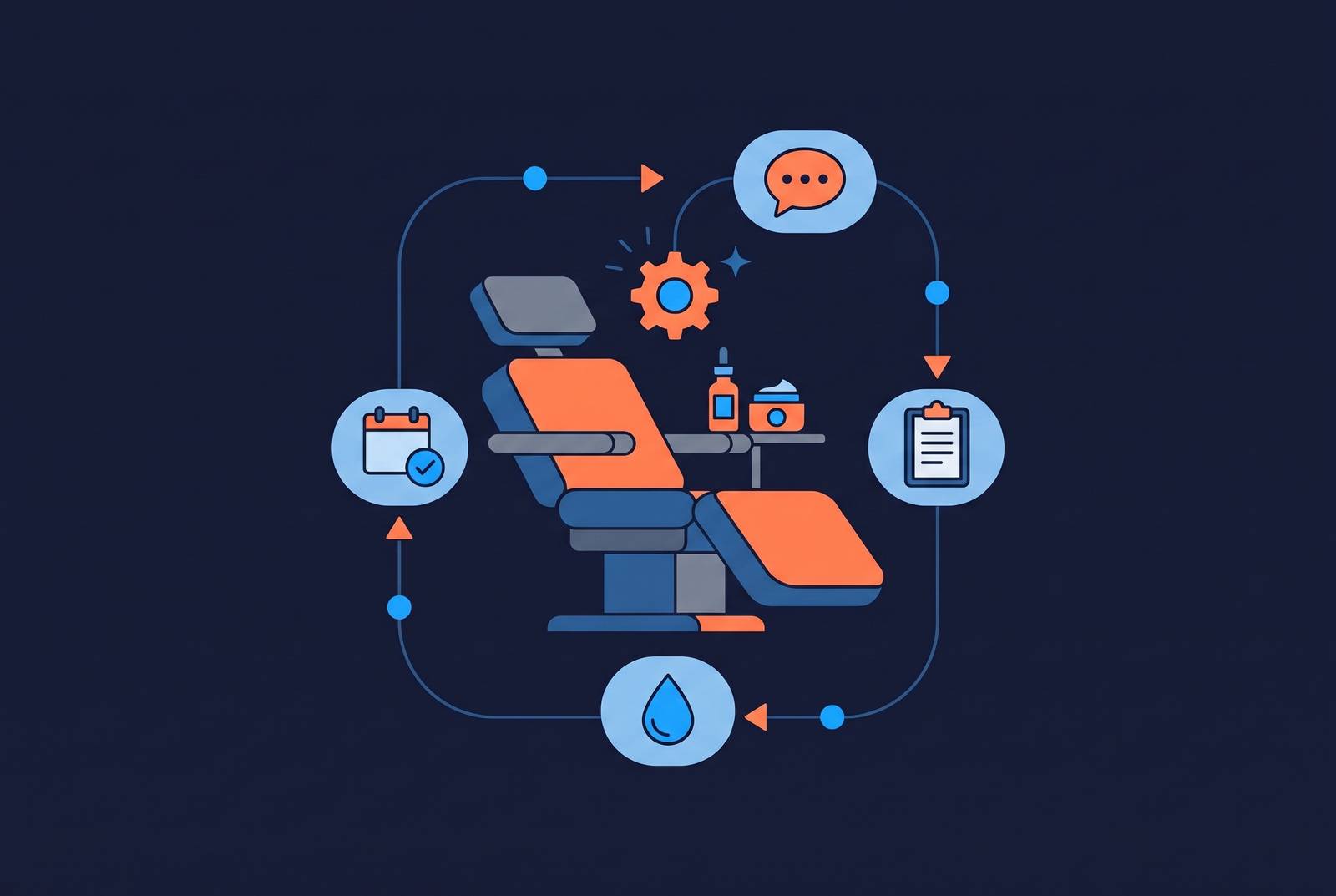
AI workflow automation in medical spas is already handling front-desk calls, scheduling, documentation, lead follow-up, and marketing production. For practices that “have AI”, the useful distinction is between buying tools and connecting workflows that reliably finish a job, while leaving clinical decisions and sensitive exceptions with the people accountable for them.
Why med spas are automating workflows now, not later
A med spa team of around six to ten people can be responsible for almost everything that happens between an inquiry and a completed treatment. Calls arrive while staff are helping patients. Prospective patients ask about services after closing, and a missed call can become a competing spa’s booking before the next business day. Meanwhile, an empty appointment represents a treatment worth hundreds of dollars. These are small gaps with expensive consequences.
Someone must answer, book, remind, follow up, and document, even when everyone is busy doing something else. When tools do not connect, staff have to move work between systems, so paying for another subscription may not lighten the load. In 2026, AI is moving from stand-alone tests into the workflows that teams use to do their work.
What "AI workflow automation" actually means in a med spa context
Workflow automation connects a trigger to an action, with AI handling tasks such as interpreting a caller’s request or drafting a consultation note. Control depends on the task. Workee offers a useful four-level framework. Level 1 covers administrative tasks with clear limits and approved rules, such as showing which times are free and sending reminders. At Level 2, AI drafts material and a person approves it, as with social captions or marketing subject lines. Level 3 reserves policy discretion, money, identity, consent, and sensitive relationships for accountable staff. Level 4 reserves diagnosis, treatment candidacy, contraindications, dose selection, and clinical protocols for licensed clinicians.
The data creates a separate set of boundaries. HIPAA applies when a workflow touches protected health information, and a compliant application does not excuse a noncompliant connection. Keragon provides a HIPAA-compliant automation layer between booking systems, EMRs, and messaging, while Zapier and n8n do not sign business associate agreements, or BAAs, on any plan. Under TCPA, a practice must also have prior express written consent to send marketing messages. HIPAA-compliant messaging services such as OhMD, Klara, Curogram, and Emitrr are not interchangeable with marketing SMS tools such as Textedly and SimpleTexting, which are not appropriate for treatment-related messages.
Front desk: what happens when inbound calls and after-hours inquiries are handled by an AI agent
Before automation, the front desk can start the morning with work left over from yesterday. Staff return voicemails, answer new calls, and book appointments by hand while patients arrive in person. During treatment hours, the phone may go unanswered again. After closing, callers reach voicemail or nobody at all. The coverage gap is structural.
An AI voice agent changes that morning by handling inbound calls around the clock. It answers service and pricing questions from approved information, books appointments or captures appointment requests, and routes sensitive or complex conversations to a person. Response time can shrink from hours to under a minute. Staff then concentrate on escalations, confirmations, and in-person interactions. The practice gains access to booking opportunities from hours it never staffed, without adding headcount.
There are several ways to supply that coverage. Goodcall, Rosie, and Dialzara offer AI voice answering, while Smith.ai layers human receptionists onto AI for complex calls. Abby Connect allows practices to mix human and AI answering on the same plan. An integrated option can reduce the need for a separate vendor, as PatientNow’s Recura AI connects booking responses, reminders, cancellations, and follow-ups within its platform. The choice concerns how work gets completed and escalated.
The handoff boundary must remain explicit. A receptionist agent cannot assess treatment candidacy or answer clinical questions about contraindications, which require licensed judgment. Appointment capture also becomes a privacy issue when the agent logs treatment context. The vendor must sign a BAA, and routing must pass through a compliant layer.
Scheduling and no-show recovery: automating the follow-up cadence that keeps the calendar full
Once an inquiry becomes an appointment, a different kind of leakage begins. Staff manually track which injectable clients are due back, reminders depend on memory, and no-show follow-up competes with whatever is happening at reception. Lapsed patients can disappear from the routine entirely. The calendar simply has more gaps than it should.
Recall automation replaces memory with treatment-specific dormancy windows. A Botox client due back in three to four months can receive a reminder without staff initiating it, while a no-show recovery flow follows up immediately after a missed appointment. Reactivation sequences reach patients who have lapsed. Staff no longer need to track every due date or send every routine message, but they still handle escalations and patients who say they do not want to be contacted.
The company says its revenue grew a lot within weeks. That is a vendor-reported result.
Licensed supervision sets the practical limit on treatment throughput. Right-size the calendar before automating recall, because overfilling it can create a documentation gap and limit usable revenue. Treatment-specific recall also contains PHI and requires HIPAA-compliant messaging. A case study’s technology stack does not, by itself, establish compliance for another deployment.
Clinical documentation: removing the note-writing that follows providers home
More appointments create more notes, and reception cannot simply absorb that work. Before automation, providers write or dictate after each consultation, often catching up after hours. On busy days, documentation depends on what providers remember and how much energy they have left. The backlog follows the provider home. Clearing it takes clinical attention, unlike following up on a missed reminder.
An AI scribe records the consultation, transcribes it, and produces a structured note for review and EHR entry. Pabau Scribe generates organized treatment notes, including aftercare protocols, and writes back to the patient file. Pabau’s Ageless Enhancements case study says a med spa with two locations spent much less time on administrative work per patient after changing platforms. That broader change makes the example different from an isolated test of scribing. For practices keeping their existing management platform, Freed offers a standalone route that listens, transcribes, and formats notes in the provider’s style.
The provider’s job becomes reviewing and approving. Time recovered at each appointment can return to patient-facing work or reduce evening administration. The scribe does not inherit clinical judgment. Pabau also offers an AI prescribing agent that drafts from the client record and flags risks such as allergies or interacting medications, but treatment decisions remain with licensed staff. Consultation recordings are PHI, so scribing requires a BAA and a HIPAA-compliant environment.
Xyonix describes an AI iPhone app built with an early-stage startup to help med spa nurse practitioners sort facial features into categories and spot issues such as changes in appearance over time, product batches that do not work, or how well an injector performs. That is an emerging clinical-adjacent application. Its role is distinct from the clearer documentation workflow, where AI records and formats information for a clinician to approve.
Lead follow-up and patient reactivation: what happens when response time compresses from hours to seconds
NexioBit describes a voice agent named “Kim” deployed for SoCal Slim in Riverside, CA. The example puts a concrete agent behind a workflow often described vaguely as lead nurturing. Its status is vendor-reported. The operational distinction is still useful. Answering an inquiry captures attention, while follow-up turns that attention into a booked consultation.
Before automation, an inquiry from a web form or social channel waits until someone has time to answer. Hours can pass, giving the prospect time to book elsewhere. An automated agent responds within seconds, qualifies the lead, answers questions about services and pricing from approved material, and books a consultation or routes the conversation to staff. Qualification here is not clinical candidacy assessment. The staff member who takes over gets a warmer lead because contact has already begun.
The follow-up cadence then continues without staff initiating every contact. Recura draws context from patient history and activity within the platform, allowing follow-up to be relevant. Staff can concentrate on conversion and relationships, while the practice can gain more bookings from inquiry volume it already receives. Leads that have lapsed also get follow-up. Privacy needs care as the relationship grows, because messages about specific treatment interests may be PHI once someone is a patient, while marketing outreach requires TCPA consent.
Marketing production: compressing the content workload without replacing brand judgment
Marketing has a different bottleneck from answering calls. The work may sit with an agency on retainer or with whichever staff member has time to produce posts, emails, promotions, and video. During busy clinical periods, output becomes inconsistent. The blank page is a surprisingly durable workflow obstruction. AI changes the production burden, while the practice retains responsibility for what appears under its name.
Jasper accelerates drafting for emails, social posts, and promotions, with brand voice customization to support consistency. Birdeye handles reputation management and review responses. Staff review and approve drafts instead of writing everything from scratch, which makes it easier to produce material every week. That can free time for strategy and community management, with faster turnaround for time-sensitive promotions. It can also release production spending for paid media.
Clique Med Spa provides a concrete cost example. Santarpia moved from a traditional agency retainer to an in-house AI marketing program and reduced costs to one-third of the prior rate. That is a reported practice outcome. The practice can pay for finished work or give its own team tools to make and approve it.
The FTC’s standard for health-related claims does not become less demanding because AI wrote the copy. Treatment claims, outcome claims, and testimonial implications must be truthful and supported by evidence. HIPAA also applies when PHI is used to make content, so staff must handle patient information with more care than other drafting material. A polished sentence is not supporting evidence.
How the five workflows connect, and what a practice gains when they run together
The workflows become more useful at their handoffs. Front-desk coverage captures an inquiry, follow-up converts it, and scheduling books and confirms the consultation. Documentation cuts the administrative work that comes with the visit, while recall helps bring patients back and marketing keeps the practice in view between visits. Each function addresses a different delay. Connecting them prevents one team member’s recovered hour from becoming another team member’s backlog.
For a practice ready to act, the starting question is which bottleneck costs the most now. Unanswered calls after 6pm point toward a receptionist agent, while evenings consumed by notes point toward a scribe. When no-shows and lapsed clients leave gaps in the calendar, recall automation can help. When leads go cold before anyone answers, automated follow-up can help. The first deployment needs a connection to the patient record from day one.
A practice can take a self-serve path or use an embedded specialist when it lacks an in-house AI engineer. SANSA’s approach for SMBs begins by diagnosing the highest-leverage bottleneck, typically over two weeks, then building a production-ready system and remaining embedded as further opportunities emerge. The purpose is not headcount reduction. Within licensed supervision limits, recovered time can support higher patient volume, an added service line, or more attention to clinical quality. The lasting capability is a team able to do more without every additional appointment creating another chain of manual work.