Freight Company Staffing Decisions When Volume Grows Faster Than Margin
Automating routine freight tasks lets brokerages handle volume growth without hiring proportionally.

It gets harder to decide whom to hire in freight when volume grows faster than margin. Adding people can keep loads moving while making the underlying cost problem worse. The better test is what the next dollar of capacity buys, whether that is human judgment or more hands moving the same information. Workflow changes can absorb growth, but only when the data and the work are ready.
Why freight volume growth is turning into a margin problem, not a revenue opportunity
More loads do not automatically mean a healthier brokerage. Freight brokerage runs on thin spreads, and labor typically accounts for the majority of operating costs. When headcount has to grow at roughly the same pace as volume, the bill grows with the business. Revenue rises, but the way the business runs leaves little room for margin to improve. The extra business can become an expensive way to stay in place.
The 2026 State of Logistics Report, released June 16 by CSCMP, authored by Kearney and presented by Penske, describes volatility as a permanent feature of the operating environment. That creates an awkward mismatch for staffing. Costs hold while rates stay disciplined, so a brokerage cannot count on better pricing to cover the people it hired to handle a volume spike. Tens of thousands of carriers have left the market since 2022. For survivors, the contest turns on how efficiently each load moves.
More volume also brings work along with revenue. It brings quotes, tenders, appointment requests and check calls, all of which need attention before the load is complete. These high-volume tasks are also among the most repetitive and lowest-margin parts of the operation. They consume the next employee’s time first. The economic trap is that a brokerage can become busier without becoming better at earning from its busyness.
What adding a person actually costs a freight operation in 2026
The salary line understates the cost of that response. Search fees, onboarding, ramp time and fixed overhead all belong in the calculation, even though the new employee cannot immediately handle a full workload. The loads do not wait for orientation to finish. Existing staff still have to cover the gap while the new person learns systems and lanes.
Once that person is productive, the next question is what fills the day. If the answer is routine coordination, the hire adds another unit of capacity without changing how much work each load requires. A fixed annual load limit per operator becomes a limit on what each headcount dollar can support. When the desk fills again, the same decision returns.
That does not make every hire a mistake. Exceptions, carrier relationships and shipper escalations genuinely require human attention, and adding capacity in those roles can be the right response to growth. The distinction is between buying judgment and buying information transfer. A broker rep who resolves difficult coverage problems is not interchangeable with a coordinator whose day disappears into routine status requests. The case for hiring should weigh those needs separately before combining them in one job.
Where the actual work hours go on a freight desk, and which of them scale badly with people
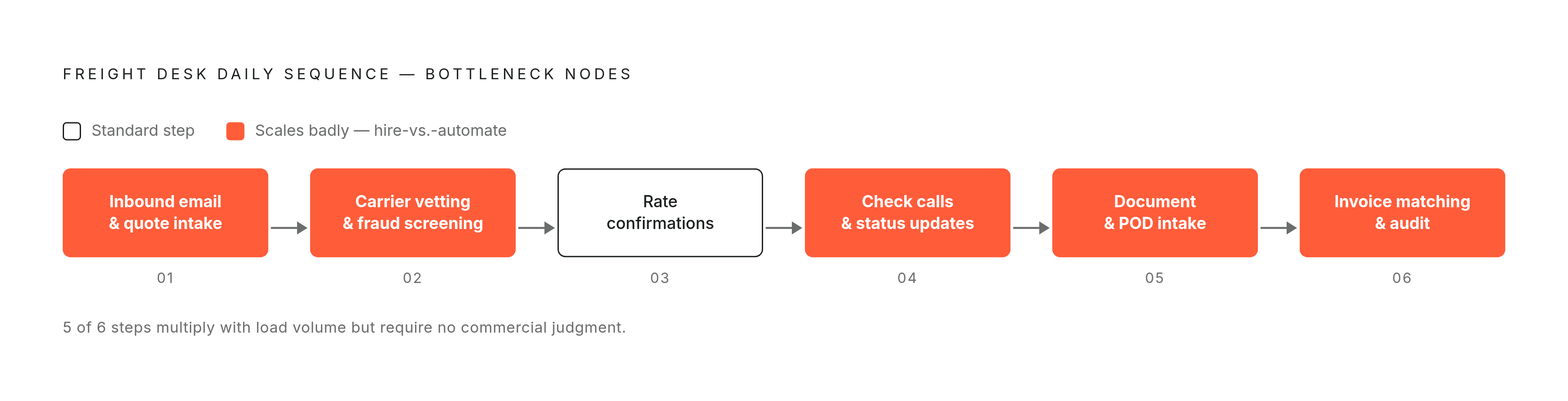
A freight desk is largely an information-routing operation. The day begins with reading load tenders and pricing lanes, then moves through finding and vetting carriers, negotiating rates and building loads in the TMS. Rate confirmations follow, then check calls and shipper updates. After delivery come document collection, invoice approval and payment follow-up. Some steps call for a commercial decision, while others pass information between people who already have it.
The inbox puts both kinds of work in the same queue. A mid-sized brokerage can receive thousands of emailed rate requests and tender offers in a day, much of it unstructured text. Someone has to read each request, work out what it asks for, price it and reply before the shipper turns to a faster broker. C.H. Robinson’s October 2024 announcement noted that shippers often choose to email a price request.
Within that daily sequence, repetitive work concentrates in five workflows. They are inbound email and quote intake, check calls and status updates, document and POD intake, carrier vetting and fraud screening, and invoice matching and audit. Each new load can bring more to read, chase, match and reply to. That is why these tasks scale badly with people. More volume brings more touches, even when the decisions behind them barely change.
Those touches also expose the operation to risk. Highway’s Q2 2026 Freight Fraud Index classified half of all fraud vectors as communication-based, including compromised inboxes, spoofed emails, account takeovers and impersonation calls. So real loads and fraudulent messages reach the same desk. The desk is deciding which information deserves to be trusted while trying to keep freight moving.
The prerequisite most operators skip before any workflow change will hold
That trust depends on the records beneath the workflow. A rate confirmation in one inbox, a POD in a text thread and three versions of the same customer in the TMS do not form a dependable operating record. Automating that arrangement can mean updating the wrong load or paying against a rate renegotiated by phone. A stalled first attempt is often a data problem.
The prerequisite is one load record containing the customer, carrier identifiers, rate confirmation, BOL, POD, accessorials and carrier invoice. This is days to a few weeks of cleanup that can be done with the existing TMS. Tracking data also need not be invented from scratch. Samsara, Motive, project44, FourKites, Descartes MacroPoint and Trucker Tools expose location and status data through APIs or file feeds. The discipline is to define what “clean data” means for the operation before building workflows on top of it, rather than leaving integration until something goes wrong.
How brokerages that absorb volume growth without proportional hiring actually restructure the work
With that foundation, the operating change is straightforward to describe. Routine work no longer goes straight to a person. Email and quoting agents classify inbound messages, distinguish quote requests from status checks and POD requests, and respond or route automatically. Production deployments at mid-sized brokerages are automating the majority of inbound carrier emails and cutting quote response times from roughly 47 minutes to under 5.
Appointment booking shows the same shift in a concrete form. C.H. Robinson reports that its own generative AI books thousands of pickup and delivery appointments a day across tens of thousands of locations, each in under a minute. Check-call agents address another recurring queue through phone, email and SMS, logging answers directly into the TMS and surfacing genuine exceptions to dispatchers.
The sequence of adoption follows the dependencies in the work. Status updates and check calls come first, followed by document and email intake, carrier vetting, invoice audit, exception management, and then pricing and routing. Each layer depends on data quality from the one before. A more ambitious workflow does not become more useful merely because it is harder to build.
Once the records support it, load matching can use lane history, acceptance rates, on-time performance, equipment type and time-of-day patterns to rank carriers by their likelihood of accepting a target rate. The output is a shortlist that can spare the broker 40 calls in descending order of desperation. Cross-referencing carriers’ future positions against the open board also makes two-load packages possible at a scale that is nearly impossible manually. These backhaul and continuous-move opportunities can improve margin and carrier relationships together. The same person can then manage more trucks, loads and lanes because the role centers on exceptions, relationships and agent outputs.
What an honest hire-vs.-absorb evaluation looks like for a freight operator right now
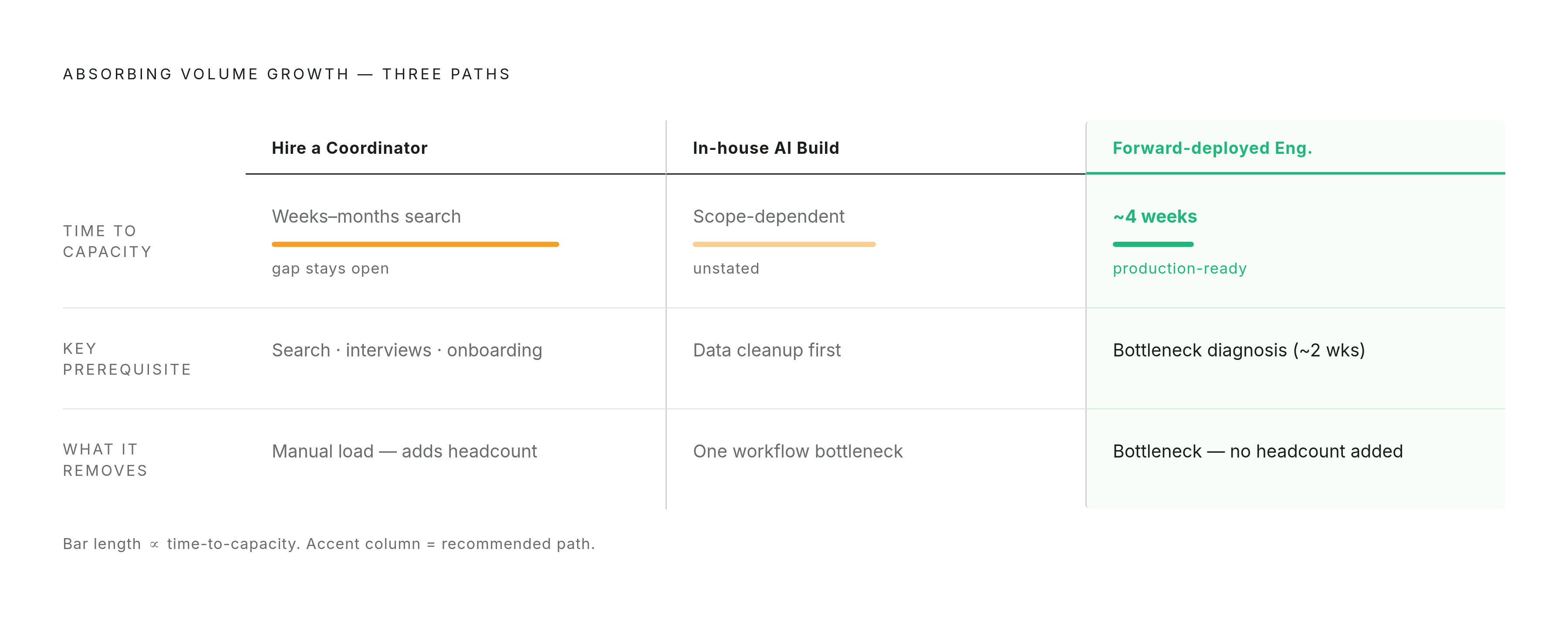
For an operator making the decision, the starting question is what proportion of the additional workload is routine and what proportion requires judgment. A surge in repetitive status requests presents a different case from a surge in complex, exception-heavy loads. Thin technical infrastructure also changes what can work immediately. For some roles and some operations, hiring remains the right answer.
The practical comparison has three paths, namely hiring a coordinator or broker rep, building AI automation in-house, or embedding an outside AI engineering resource for a fixed engagement. Each has a different route to usable capacity. Hiring takes weeks to months of search, interviews and onboarding, and the new person then spends the early weeks learning systems and lanes. The capacity gap remains open through that period. The evaluation therefore needs to compare the full hiring cost, including salary, and ramp time with the software bill.
An in-house build starts with the same data prerequisite already described. Its scope might be a single workflow, such as status updates and check calls or rate-confirmation and POD intake, rather than a connected system covering the whole desk. The comparison should treat that smaller build separately from one that links status, documents, carrier checks and invoice matching. They do not buy the same capacity. The operator needs to weigh which scope would remove the work that prompted the plan to hire.
A forward-deployed engineer works inside the operation’s existing tools, including Slack, Teams and the TMS, on a retainer or fixed cycle. Working this way can produce a production-ready logistics agent within roughly four weeks without adding someone to the payroll for good. SANSA fits this category, diagnosing the highest-leverage bottleneck within roughly two weeks, building a production-ready system around it and staying embedded as results develop. SANSA reports that a freight company saved 160+ hours a month, though that result does not guarantee the same saving elsewhere.
An agent handling routine intake does not substitute for someone managing a difficult carrier relationship or a shipper escalation. Adding another employee to work through the same queues also leaves the cost of that work unchanged. A useful evaluation identifies the work each option would remove, the time before that capacity becomes available and the human work that remains. That is a more demanding comparison than “hire or automate,” but a considerably more useful one.
What operators who automate early actually gain over those who wait
The longer-term advantage is a lower operating cost per load alongside a cleared inbox. Brokers that automate can handle materially more volume per person at roughly the same gross margins. C.H. Robinson’s public reports show that headcount fell sharply over eight quarters while freight volumes grew.
Speed expands the advantage beyond labor cost. A broker that clears quote and tender backlogs in seconds can get attention before anyone discusses price, while another broker still spends the day booking appointments by hand. For a five-person brokerage, restructuring workflows can open lanes the team could not previously staff and support coverage decisions that once required an unaffordable specialist. The opportunity is broader than doing yesterday’s work cheaply. It changes which work the team can take on.
Spend caps, approval steps and a full audit trail make agents trustworthy enough for production. Agents that move money or approve carriers need a human in the approval loop until the operator has verified the error rate. Removing routine handling does not remove accountability. The operation still owns the consequences of the decisions it delegates.
Production deployments establish that freight automation can work, but its success at an operator depends on the operator’s data, workflows and engagement model. A two-week diagnostic can reveal the first useful signal without turning the decision into a six-month RFP. The operator can then decide whether the next dollar should fund another person, a cleaner workflow or the human judgment that growth genuinely requires.