How Freight Companies Are Using AI to Reduce Back-Office Headcount Costs
AI agents are automating routine freight coordination work and shrinking back-office teams.
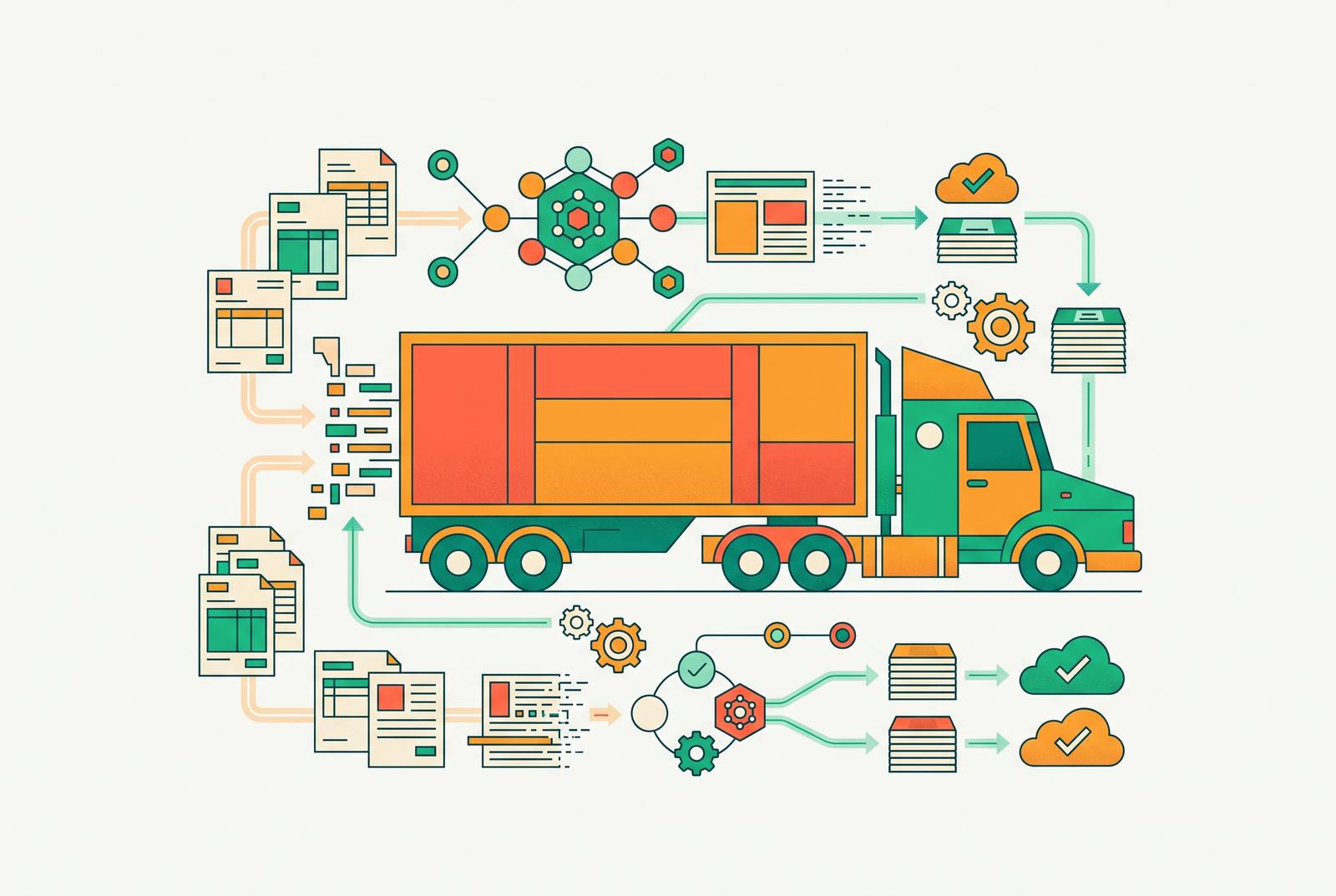
AI automation for freight and logistics SMBs now follows a clear pattern: companies route high-volume, repeatable coordination work (quoting, check calls, document parsing, email triage) into AI agents embedded directly in the transportation management system, rather than hiring more people to keep pace with growth. This piece documents that structural shift using one large freight brokerage's own reported numbers: a back office that processes more freight without adding headcount.
Why freight back-office costs are structurally different
A freight broker owns no trucks, holds no inventory, and never touches the freight itself. The entire product is coordination: reading a load tender, pricing the lane, finding a carrier, booking it, tracking it to delivery, and closing out the paperwork. That makes brokerage, almost uniquely among logistics businesses, an information business wearing a transportation costume, and its cost structure reflects that: labor spent coordinating, not labor spent moving anything.
Gross margins in truckload brokerage run around 15 percent of the freight bill. Most of that net revenue goes right back out the door as salaries, technology, insurance, and bad debt. On margins that thin, a small cut in the cost of handling each load changes what the brokerage is worth as a business, not just how smoothly it operates day to day. And because the bottleneck in brokerage was never a physical asset but human throughput (how many emails a rep can answer, how many check calls a dispatcher can make in an afternoon), removing that coordination burden removes the constraint on growth itself. Asset-based trucking doesn't work this way: the truck is still the limiting factor there, no matter how good the software gets. Brokerage is where AI hits first because brokerage is where the entire cost base is clerical work waiting to be absorbed.
AI Agents in Freight Operations
An AI agent in freight is a system that reads unstructured input, decides what to do about it, and acts inside the TMS without a human clicking "approve" first. Tenfold's 2026 analysis draws the line between this and the rule-based automation freight companies have used for a decade: older automation follows a fixed script, while agents perceive the data in front of them, reason through the context, and execute without someone typing out each step.
Debales AI's 2026 guide describes the mechanics in plain terms: the agent reads structured and unstructured input (emails, PDFs, voice calls, TMS records), figures out the right next move, acts on it (sends the email, updates the load record, places the call), then checks whether that action actually worked. In practice, this shows up as five kinds of agents already running in production. Email and inbox agents sort inbound messages, separating a quote request from a status check from a genuine problem, and either answer directly or route it to a person. Quote agents read the request, pull live rates, check carrier capacity, and send a priced reply without a human drafting it. Check-call agents run the routine status loop by phone, email, and text, log the results straight into the TMS, and only flag a dispatcher when something is actually wrong. Document parsing agents read a rate confirmation PDF the moment it lands, pull out the fields that matter, and write them into the system of record. Load matching agents weigh carrier location, available trailers, route history, time of day, and seasonal demand to find the right carrier in seconds, instead of a dispatcher scrolling load boards by hand. GoFreight's 2026 guide names exception detection as another live use case: AI copilots flag shipments where the milestone chain has stalled, a booking sitting without shipping instructions, a vessel gone without the container ever gated in, so an operator reviews a short list of real problems instead of every file in the queue.
These architectures (reading unstructured input, reasoning through context, acting inside the system of record without a human prompt) describe the same approach AI transformation firms apply across other SMB industries: find the highest-leverage bottleneck, build a working system around it, and put it directly into the workflow instead of layering a tool on top and hoping someone opens it.
What C.H. Robinson's numbers prove about the headcount-to-agent trade
The clearest evidence that this isn't theoretical comes from the largest freight brokerage in the country. According to figures reported by industry analysts, a leading freight brokerage cut headcount by nearly a fifth over seven quarters while freight volumes grew and operating margins improved, a combination that doesn't happen by accident and doesn't happen through belt-tightening alone.
The workflow-level detail backs up the top-line number. Two agents now handle missed LTL pickup checks across thousands of shippers, automating the vast majority of that work, cutting a significant chunk of manual effort per day, and reducing unnecessary return trips in the process. Quote requests that arrive by email get a priced response in seconds, at a volume of thousands of quotes per day. Load tenders that used to take up to four hours to turn into a shipment order now take about 90 seconds, also at a volume of thousands per day. None of this reflects a company in distress or a market in collapse. Robinson removed a meaningful share of its own workforce because the agents absorbed the coordination work that workforce used to do, which is the headcount-to-agent trade stated as directly as the numbers allow. That outcome, achieved at large-enterprise scale, rests on the same principle available to a much smaller brokerage: when agents absorb enough of the coordination load, the business needs fewer people to handle more freight, and that math doesn't require enterprise size to work.
The five back-office workflows where AI produces measurable ROI for freight companies
Not every AI use case in freight pays off equally, and the ones that do share a specific shape: high volume, low variance, conducted mostly over email or phone, and tied directly to a load record sitting in the TMS. Five workflows fit that shape well enough to show up as measurable returns.
Email triage is the first, and Tenfold's guide calls it the biggest bottleneck most brokerages underestimate: a rep's inbox fills with quote requests, status checks, and problems all mixed together, and sorting that by hand costs hours that never appear on a timesheet. Once an agent classifies and routes those messages, the labor spent just managing the inbox drops sharply, freeing reps to spend their time on the exceptions that actually need judgment. Quoting is the second, and it matters beyond the labor saved on drafting a reply: every slow quote is a chance for a shipper to book with someone faster, so cutting response time affects win rate directly, not just headcount. Debales AI's guide notes that automated quoting closes the response-time gap for brokers of any size: a ten-person brokerage can answer as fast as a national one. Check calls and status updates are the third: the volume is high and the variance is low, so an agent running the loop by phone, email, and text can log results straight into the TMS and only wake up a dispatcher when something is genuinely off. Document parsing and rate confirmation intake make up the fourth workflow, and GoFreight's guide names this as one of the clearer revenue-relevant uses of AI in 2026: bills of lading, commercial invoices, packing lists, and arrival notices get read and logged the moment they arrive, instead of sitting in a queue for someone to type up later. Invoice reconciliation and billing round out the fifth, and the stakes here run deeper than convenience. Manual document handling and backed-up exception queues stretch out the billing cycle. A fleet is effectively lending its own working capital to its customers for free every time an invoice sits unresolved. Platforms that automate invoice scanning and validate order data the moment it's captured close that gap at the structural level rather than fixing it one load at a time, and shaving even a few days off the invoicing lag on real volume frees up cash that was otherwise stuck in the pipeline.
The order matters as much as the list. Status updates come first because the risk is lowest, the agent only reads and reports. Document automation follows and tends to show results within the first month. Tracking automation and check-call reduction come next and typically pay off within weeks of going live. Each build feeds the next, because the data generated by the first system becomes the input the second one reasons over.
Hiring more people is not a neutral alternative to building these systems
When freight volume grows, the reflex is to hire. That reflex is expensive, slow, and runs into a hard ceiling that AI systems don't share: a new hire adds a fixed amount of capacity, while an embedded AI system scales without one.
A human works a set number of hours a week, no matter how good they are at the job. An AI system runs around the clock, and handling ten more loads costs essentially nothing extra once it's built. That's a different cost curve entirely, not a faster version of the same one. Hiring also costs time before it costs anything else: a recruiting cycle that drags on for weeks, followed by onboarding and ramp-up, produces nothing while freight keeps moving and competitors keep answering their emails faster. For a small brokerage, the math tilts even further in favor of building rather than hiring, because a smaller team usually has a larger share of its total cost locked up in coordination work than a company with a full operations department to spread that load across. That means the ratio of cost removed to the cost of the system is better from a smaller starting point, not worse. And the capacity that gets freed up doesn't just vanish into savings: back-office automation typically frees the equivalent of several full-time roles that a brokerage can redeploy into sales or account management instead, expanding what the existing team handles without growing the org chart.
For a brokerage without the budget or the need for a full-time AI hire, a consultancy like Sansatech offers a middle path: diagnose where the coordination bottleneck actually sits, build a working system around it, and leave it embedded in daily operations.
The strongest objection to AI headcount reduction
The best argument against AI-driven headcount cuts in freight is that automating a task hands time back to the person who used to do it rather than eliminating their job outright, and that the work still left on their plate is the kind that resists automation.
The reasoning goes like this: automating a short load-build task doesn't get rid of the dispatcher who used to do it manually. It gives that dispatcher back a chunk of the day, which they can spend chasing new business, managing a relationship, or sorting out an exception that actually needs a human's judgment. Tenfold's analysis backs this framing, describing the human role shifting to the person managing exceptions, relationships, and a fleet of agents. What gets automated is the overhead, check calls, data entry, document chasing, invoice matching, first-pass carrier screening, while negotiating with a carrier holding better offers elsewhere, talking a shipper through a service failure, and pricing a weird lane with no clean rate history stay firmly in human hands.
That objection holds up at the level of an individual job. It falls apart at the level of the organization, because that large brokerage's results show that once agents absorb enough of the coordination load across the whole workflow, the total number of people needed to handle that coordination drops even as volume climbs. For an SMB, the individual-level version of the objection is actually good news rather than a caveat: a five-person brokerage that gets back hours previously spent on check calls and document entry can take on more freight, add a new service line, or say yes to a client it would have had to turn away before. Both things are true at once, and for a small operation, the version where time gets returned rather than a job gets erased is the more useful outcome, not a consolation prize.
Compounding Returns from Embedded Deployment
Two freight companies can buy what looks like the same AI tool and get completely different results. The gap between a system that saves a few hours a week and one that changes how much freight the company can actually process rarely comes down to the technology itself. It comes down to whether the system sits inside the actual bottleneck and whether someone is accountable for whether it keeps working.
GoFreight's guide is specific about which forwarders got real value from AI copilots in 2026: the ones who installed them inside the operations platform they already used, so the AI acted on the live shipment file, gave it access to real rate and contract data, and trained their own ops team to check its output. Debales AI's guide names the opposite failure mode just as clearly: if an agent can't read from and write to the TMS cleanly, it ends up running as a separate tool nobody fully adopts, and the payback period doubles. For a freight company without an in-house AI team, the model that tends to work is one where an outside engineer builds a connected system, status tracking, document handling, carrier checks, and invoice matching all talking to each other, rather than a pile of separate point tools that each need their own training and their own habit change to stick.
Sansatech's three-stage engagement follows this logic directly: diagnose the highest-leverage bottleneck in two weeks, build a production-ready system around it, then stay embedded as it compounds. It's built for operations running anywhere from 10 to a few hundred employees, at a price point well below a six-figure consulting contract or a full-time AI hire. The payoff compounds in a specific order: the first build removes the coordination ceiling on the volume a company already handles, the second extends capacity into a service line the team couldn't staff before, and the third enables decisions that used to require bringing in a specialist. The team doing the work hasn't grown. What it's capable of handling has, and that's the actual measure of whether the investment paid off.