Freight Forwarding Client Profitability Segmentation for Small Brokerages
Know which freight accounts actually make money after factoring in the labor they demand.
J.B. Growth, on its own, tells you nothing about whether a brokerage is getting healthier or just busier. Whether an account makes money once the real costs are counted is the only question that matters, and most small brokerages can't answer it.
The trap of revenue growth for small freight brokerages
J.B. Hunt's numbers matter here because they expose what revenue growth hides at any size: moving more freight and making more money are not the same event. Industry net profit margin at the median hasn't trended upward in years. The average brokerage is already running with close to zero slack for carrying unprofitable accounts on the backs of profitable ones. That sliver is the whole game. A brokerage operating on a few points of net margin has no room to let three or four bad accounts quietly eat the margin earned by the good ones, and most small brokerages have no way of knowing which accounts those are because nobody is tracking profit at the account level. Revenue keeps climbing on the income statement while the business underneath gets structurally weaker, and the owner finds out only when cash gets tight or a slow season arrives with no buffer left to absorb it.
Where the margin disappears inside a small brokerage
Margin doesn't vanish all at once, and it doesn't vanish in one place. It leaks out through personnel cost, billing leakage, and the float cost of slow invoicing, three mechanisms that stay invisible until someone looks at the numbers account by account.
Personnel and payroll eat the large majority of gross margin on an average load, leaving a thin slice of actual operating margin before the brokerage even pays for software, office space, or insurance. That means one high-maintenance account, the kind that generates constant re-covers and check calls, can wipe out the entire operating margin earned on several well-behaved ones. Billing leakage adds a second cut: uncollected invoices, missed accessorials, and absorbed demurrage can run 0.5 to 2% of revenue, and it's one of the most controllable cost lines in the business precisely because it's also the one most consistently ignored. Float costs money too. Carriers typically get paid faster than shippers pay the broker, so every day of invoicing delay is a day the brokerage is financing someone else's freight out of its own pocket, and tightening that lag on meaningful volume frees up real cash permanently. Pricing structure compounds the timing risk further: a carrier may demand current fuel recovery immediately while the brokerage is still billing its customer off an older fuel index, which quietly transfers cost from the carrier straight onto the broker's margin line.
The gap between quoted margin and realized margin per account is wide in most brokerages and goes unexamined, and closing that gap is the first and fastest return a segmentation discipline produces. Without account-level data, there's no way to tell which client relationships are actually funding payroll and which ones are quietly draining it.
What client profitability segmentation measures and ignores
Client profitability segmentation ranks accounts by realized margin per load, adjusted for how much operational effort that load actually required, not by revenue and not by how many loads moved. That distinction is what makes the output something an owner can act on instead of just admire. Revenue is close to meaningless as a ranking tool in this business: a shipper running dozens of loads a month at thin margin while demanding constant hand-holding from ops can be one of the worst accounts on the entire client list, dressed up as one of the best.
Four variables determine what an account is actually worth. Realized gross margin per load counts actual carrier cost against customer revenue, not the spread quoted at booking. Ops time per load, measured in calls, re-covers, exceptions, and check-calls against a baseline for that lane, captures the labor the account consumes. Billing and collection friction tracks days sales outstanding by account, how well accessorials get captured, and how often disputes come up. Revenue predictability looks at the mix of spot versus contract volume, seasonality, and tender acceptance rate.
Two numbers do the actual work here: gross profit per load and gross margin percentage. Gross profit per load tells you the dollars; gross margin percentage tells you how efficiently those dollars were earned. Neither one alone tells the full story, so both get tracked side by side. Contribution margin, gross margin minus the variable costs tied directly to that shipment, is the figure that actually pays for shared overhead, and it's the most honest read on what a single account is worth to the business.
What this framework deliberately leaves out matters just as much. Revenue rank doesn't factor in. Relationship tenure, on its own, doesn't count as a reason to keep an account. Load count doesn't either. All three get used constantly to protect accounts that are quietly losing money, and segmentation is built specifically to strip that cover away.
A four-tier client ranking a small brokerage can build in a spreadsheet
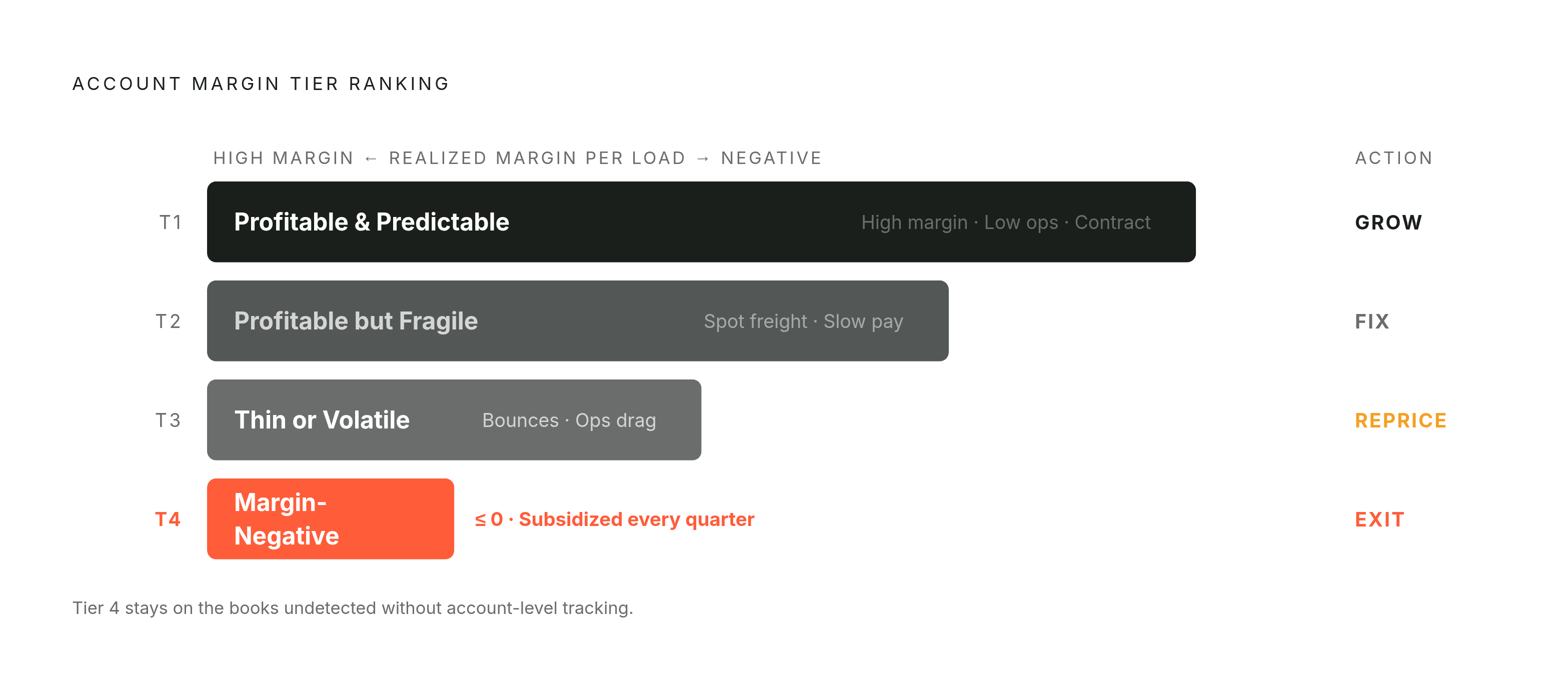
A simple four-tier sort, built entirely from load-level data a brokerage is probably already sitting on, is enough to show which accounts deserve more capacity, which need fixing, and which need to go.
Tier 1 accounts are profitable and predictable: high realized margin per load, low ops intensity, contract or recurring volume, and fast payment. These get priority capacity, better service, and active attention aimed at growing them further.
Tier 2 accounts are profitable but fragile: the margin is good, but the account leans heavily on spot freight, spikes seasonally, or pays slowly. The job here is to lock in contract terms or fix the billing lag before the account slides.
Loads move, revenue shows up on the books, but contribution margin after ops time is thin or bounces around unpredictably. These need a repricing conversation or a change in how they're serviced, not necessarily the door.
Realized margin after ops time and billing leakage is at or below zero, and every quarter the account stays on the books is a quarter of subsidized service. The decision is exit, or reprice with a hard deadline attached.
Most TMS or accounting systems already contain the inputs needed for a first pass: customer invoiced amount, carrier cost by load, load count, and average days to payment.
The step that makes this stick is tying sales commission to gross margin instead of revenue. Once a rep gets paid on the margin an account actually delivers, the incentive to go chase more Tier 4 volume disappears on its own. Segmentation without that change is a report somebody reads once a quarter. Segmentation with that change is how the sales team starts behaving differently without being told to.
ArcBest's pricing discipline over the volume chase
ArcBest's Q3 2026 mid-quarter guidance update raised its profitability outlook while August shipment counts stayed flat year over year, which runs directly against the instinct that growth requires adding more loads. Pricing discipline on margin per shipment was the mechanism behind it. Same client base, managed with more discipline, produced a better financial result, not a bigger one.
The lesson scales down cleanly. For a small brokerage, growing a Tier 1 account from 10 to 15 loads a week at the same margin is worth more than signing three new Tier 3 accounts at half the margin and double the ops burden. More clients and more loads feel like progress, but they're only progress if the margin per load holds up under the added weight.
Set this next to J.B. Hunt from the opening and the contrast runs the opposite direction: more loads, higher revenue, worse margin. ArcBest ran the opposite playbook, holding volume flat and tightening pricing, and came out with the opposite result. Two large companies, two outcomes, and the variable that separated them wasn't how much freight moved. It was whether margin per shipment was managed on purpose.
The highest-value accounts a small brokerage is most likely to misread
Two kinds of accounts consistently fool small brokerages: the large-revenue account that's secretly bleeding the business dry through ops cost, and the small shipper that looks unprofitable but is actually one of the fastest-growing, most margin-accessible segments in the market.
The large-revenue trap appears consistently once someone actually runs the numbers. An account putting up strong top-line figures while demanding constant re-covers, repeated check calls, slow payment, and frequent billing disputes can be deeply margin-negative once ops time gets properly costed, and the segmentation exercise almost always turns up at least one of these sitting in the top five accounts by revenue. It's the account everyone assumes is the crown jewel because of the size of the invoice, right up until someone adds up the hours spent babysitting it.
The small-shipper opportunity runs the other direction. Growth is forecast at a 10.19% CAGR between 2026 and 2031 for small businesses in this space, as self-service portals strip away booking minimums that used to lock small shippers out. Small brokerages have a real edge here that large platforms can't replicate: relationship and responsiveness, the kind of service a small shipper notices and a mega-platform has no incentive to offer. Small shippers will often pay a higher per-load margin in exchange for someone who picks up the phone, and that premium is earned.
The obvious objection is that small shippers are operationally intensive and risky on credit. That's a fair description of the small shippers nobody has bothered to segment. With a profitability framework running, a brokerage can see which small accounts have clean payment histories and simple freight profiles well before putting growth dollars behind them. Segmentation here is about finding the small accounts worth building around, a different exercise from culling a client list.
How ops data, not intuition, makes the segmentation durable
Data quality is the actual gate here. Bad assumptions baked into load records defeat any downstream analysis, and cost data that was never captured in the first place means no AI tool, however well built, can surface accurate per-account profitability. Are accessorials getting invoiced consistently on every load? Is carrier cost recorded at the load level against the customer who generated it? Is ops time being tracked, even roughly, by account?
Most brokerages running a decent TMS already have the first two covered. The third, ops time by account, is the most commonly missing piece and the most valuable one for spotting which accounts are eating up disproportionate staff time. Fixing it is a process change, not a software project. It's a process change: a checklist run at file close, a rule that every re-cover gets logged with a note, a billing review triggered on any account whose DSO crosses a set threshold. Once the data is clean at the source, the segmentation can be refreshed every quarter instead of rebuilt from scratch every year, which is what turns it into something that compounds rather than a one-off spreadsheet exercise that gets run once and forgotten.
Where automation earns its place in the segmentation workflow
Automation doesn't replace any of the work above. It enforces the discipline at a speed and consistency manual review can't match, and the place it earns its keep first is the shared inbox and the quoting workflow, not a wholesale platform swap.
Email and quoting are where margin gets set in the first place, and where the gap between quoted and realized margin opens before a load ever moves. Automating structured quote responses while keeping a human sign-off on every rate is the first win worth taking. C.H. Robinson's generative AI reads an emailed quote request and replies with a price in seconds instead of minutes, handling thousands of quotes a day. The scale isn't what matters for a small brokerage. The principle does: pricing response time is a competitive variable, and the technology that improves it is increasingly priced within reach of smaller operators. Parade's CoDriver automated carrier communication across phone and email and converted every one of those interactions into structured, usable data, a shift Parade's 2026 reporting ties to doubling loads booked per rep without adding headcount. That data exhaust feeds an accurate per-account profitability view over time.
Echo Global Logistics found that productivity gains came from redesigning tasks around what AI actually does well, applying automation to workflows that functioned, rather than to those that were already broken. That distinction matters for a small brokerage deciding where to start: automation bolted onto a messy process just makes the mess move faster. Exception management is where this compounds fastest, since margin bleeds there invisibly and every resolved exception becomes training data for handling the next one. Brokerages that build this muscle early keep widening the gap on the ones that don't. None of it works without the data audit from the previous section done first. Automated quoting and tracking systems only produce better per-account profitability numbers when the load records underneath them are already clean.
For a small brokerage weighing how to get there, the realistic path isn't hiring a full-time AI engineer to build something from scratch. SANSA's embedded model offers an SMB-accessible path built around a 30-day first-win timeline, built into existing workflows rather than requiring a standalone build. The segmentation does the thinking. Automation just makes sure the thinking happens every week instead of once a year.