Automating Freight Invoice Reconciliation for Small Brokerages
Automation catches billing errors small teams miss, recovering thousands monthly in overcharges.
A brokerage moving 300 loads a month generates hundreds to thousands of document comparisons for reconciliation alone, and every one of those comparisons has to happen before an invoice gets paid correctly. That volume isn't a busy season — it's a routine Tuesday. Freight invoice reconciliation, the process of checking a carrier's bill against what was actually agreed to, is a mathematically unsustainable manual task at small-brokerage scale. The fix is about removing a ceiling that caps how many loads a lean team can competently process, no matter how good they are at their jobs.
A billing coordinator handling four to six documents per invoice, at roughly 12 minutes each, hits a wall long before load volume does. Time consumed scales with load count. Staff don't. So corners get cut, and the corners cut first are accessorial charges, because a $40 detention fee looks small next to a $1,800 linehaul rate, even when forty of those a month add up to real money. Per CSCMP's 2025 State of Logistics Report, logistics companies manually audit fewer than 40% of freight invoices. That figure reflects a rational response to volume no human team can fully cover by hand, a constraint of capacity, not a failure of process. The other 60% get paid on faith.
What the financial leakage from unverified invoices actually looks like
IOFM's 2025 data puts freight invoice error rates at 22%, with an average correction cost of $53.50 per invoice, and here's the part nobody likes to say out loud: those errors don't split evenly between shipper and carrier. Most favor the carrier. This is a description of incentive; when one party writes the invoice and the other party is too stretched to check it, drift happens in a predictable direction.
Accessorial charges are where most of that drift lives. A 2024 supply chain study found average accessorial line items per truckload shipment rose from 2.1 in 2019 to 3.4 in 2023, meaning more surface area for something to go wrong on every single invoice. Laneproof's analysis of 8,400 broker invoices found carriers overbill accessorials on roughly 3.8% of them; run that rate against a brokerage moving 1,000 loads a month at an $1,800 average load value, and you land near $68,400 a year in overbilling nobody caught. Three categories, delivery condition charges, detention and layover, and dimensional weight, account for most of it, and all three share a common flaw: they depend on someone's judgment call about location or condition, and judgment calls made by the party getting paid tend to break their own way.
Fuel surcharges are quieter but just as reliable. Errors tied to using the wrong DOE index week show up on roughly 1 in 12 carrier invoices, averaging $28 to $60 per load; across 500 loads a month that's $1,400 to $3,000 in monthly overbilling from a single, well-documented error type that a spreadsheet formula could catch in the time it takes to read this sentence.
All of this becomes concrete when you look at the margin. Personnel and payroll eat roughly 79% of gross margin on an average $189-per-load shipment, leaving about $40 of actual operating margin. Recover even a sliver of that leakage and the unit economics move. Companies without systematic auditing lose 3 to 5% of annual freight spend to billing errors; on a $5 million freight program, that's $150,000 to $250,000 a year, gone quietly, invoice by invoice, to nobody's benefit but the party writing the bill.
The four-to-six-document verification loop automation replaces
Reconciliation, at its core, is simple: match the carrier's invoice against the rate confirmation signed before the load moved. Agreement means approval. Divergence means the invoice goes to a dispute queue, and somebody has to notice the divergence first.
The manual loop touches a rate confirmation, a carrier invoice, a bill of lading, a proof of delivery, whatever accessorial documentation exists (detention logs, redelivery receipts, fuel surcharge tables), and finally the AP system or TMS record where it all has to land. Six documents, one invoice, and a coordinator holding all of it in their head or across six browser tabs.
Here's the useful narrowing: three fields, linehaul rate, fuel surcharge, and accessorial list, cover 91% of discrepancy types in truckload freight. Most of the problem lives in a small, well-defined space. Industry audits put the discrepancy rate between carrier invoices and rate confirmations at 12 to 18% across truckload freight, and complex or multi-stop loads push manual review time to 22 to 35 minutes each, meaning the manual ceiling is hardest exactly where the freight is hardest to move.
Even a caught discrepancy doesn't resolve itself. Routing it to the right person for dispute resolution is its own manual step, and disputes pile up as a backlog rather than moving through a queue. That's the picture worth holding onto: document intake to AP posting, entirely by hand, entirely dependent on one person's attention span and how many other fires they're putting out that day.
How an automated reconciliation pipeline handles the same workflow
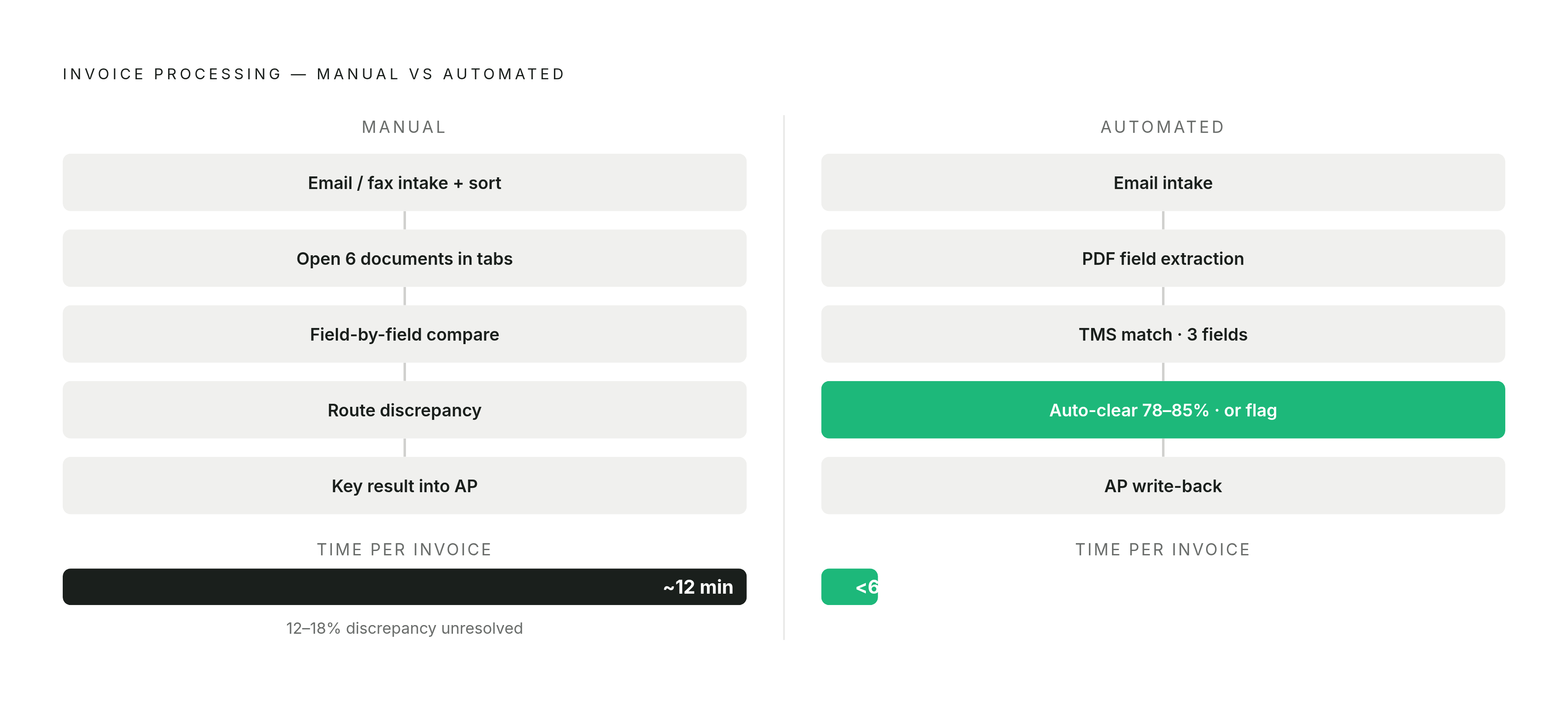
Run the same invoice through an automated pipeline and the shape of the work changes completely. Email intake captures the invoice with no manual sorting. PDF extraction pulls linehaul rate, fuel surcharge, accessorials, and load reference number as structured fields. The system matches that load reference to its rate confirmation in the TMS, then runs a field-by-field comparison against the three fields that account for 91% of discrepancies. Invoices that match clear automatically. Invoices that don't get flagged and routed to a dispute queue with the discrepancy already identified, so staff work exceptions, not full reviews. A dispatch step notifies the relevant carrier or internal contact. Then, the step most implementations skip: approved invoices post directly to QuickBooks, NetSuite, or a TMS-integrated AP system, with no secondary data entry.
That write-back step matters more than it sounds like it should. A tool that approves invoices but still requires someone to manually key the result into AP solves only half the problem.
Automated matching resolves 78 to 85% of invoices with no human involved at all, which flips the entire staffing equation: attention concentrates on the exception slice instead of spreading thin across full volume. Back-office time per load drops from around 12 minutes to under 60 seconds, and field extraction accuracy in the mid-90s or better is table stakes now, not a selling point.
One documented case: a 12-person brokerage processing 180 loads a week cut 14 dispatcher-hours of manual reconciliation down to under 3 by automating the invoice match. Rate confirmation errors fell from 8 to 14 a month down to 0 to 2. Carrier payment disputes dropped from 5 to 9 a month to 0 or 1. Average days to carrier payment fell significantly from the 30 to 45 days typical of manual dispatch. Faster payment also functions as a carrier relationship asset, the kind of thing that gets a brokerage priority capacity when freight tightens.
Where to start when the whole workflow feels too large to automate at once
The 91% figure is also the scoping answer. Three fields cover almost all discrepancy types, so the first automation build should target the core use case, because trying to solve every edge case on day one is how these projects die before they ship.
Start with a single carrier or lane, ideally the highest-volume or highest-dispute one. Automate the linehaul rate and fuel surcharge match first; they're the most structured fields and the easiest to extract reliably. Route accessorial exceptions to a human queue for now; accessorial classification can be tackled in a later sprint. Connect to the AP system from the start, even if it only handles the clean-match subset, because the write-back habit is the pattern you're actually trying to establish.
Starting narrow gets you a working system in days, and a working system generates real data about where the remaining exceptions cluster, which is what should inform the next build. Long timelines are where AI projects go to die quietly: deployments stretching past six months rarely reach full production, not because the technology fails but because budgets shift and stakeholders lose patience waiting for a result. A first sprint aims for a live system, processing real invoices, so iteration is based on actual exception patterns instead of guesses made in a conference room. Done, at the end of sprint one, looks like a defined share of invoices clearing automatically, an exception queue with discrepancies pre-flagged, and AP posting happening without a manual entry step tacked onto the end.
Why most small brokerages haven't automated yet, and what has changed
Most small freight brokers still use a TMS for load entry and handle carrier communication and billing by hand, which means the biggest productivity gains available to this industry sit in the gap between basic load visibility and a real reconciliation pipeline — right where most small brokerages are stuck.
Three reasons explain the lag. Enterprise audit tools were built for shippers running tens of thousands of invoices a month; minimum contract sizes and implementation timelines priced small brokerages out before the conversation even started. TMS modules handle load visibility well but rarely ship with a production-grade reconciliation pipeline and AP write-back baked in. And building it internally requires engineering time small teams don't have; Internal logistics AI projects are widely known to stretch well beyond initial estimates before reaching production for mid-market companies, which is an eternity when the invoices keep arriving daily regardless.
What's changed is the middle path. Agentic workflow tools have compressed configuration-to-production timelines significantly, turning a build that used to take months of custom engineering into something configured and tested in a fraction of that time. A growing share of brokers are adding AI and machine learning tools to boost productivity, which means those who haven't are falling behind at a compounding rate as the adopter group scales faster per headcount. Brokerages that automate reconciliation free ops staff to move more loads with the same team. The ceiling lifts. The ones that don't stay capped by the same document-matching bottleneck no matter how much freight the market hands them.
How to evaluate whether to use existing software, build custom, or bring in an embedded partner
Three real paths exist here, and each comes with a real cost attached.
Standalone freight audit software is purpose-built for exactly this kind of discrepancy detection, and it's often good at it. But most of these tools were designed for shippers running high invoice volumes, not brokerages, and AP integration tends to be an afterthought, requiring a manual export and import that reintroduces the exact bottleneck you were trying to remove. Configurability for brokerage-specific accessorial logic is usually limited too.
Custom internal builds offer the most control. Field logic and integrations are yours to shape exactly as you need them. But Gartner's 18-to-36-month timeline for mid-market internal projects is a real risk, not a worst case, and without ongoing engineering support the system drifts the moment carrier billing formats change, which they will.
Then there's the embedded partner model: someone who configures and deploys into the actual workflow rather than selling a tool and walking away, who understands the pipeline and the brokerage's operational context well enough to keep the system current as accessorial complexity grows. Weigh that against the cost of hiring a billing coordinator, and the embedded engagement often pays for itself without a recruiting cycle or a salary that compounds every year regardless of performance.
The real decision variable is whether an internal person exists who can own the system's ongoing iteration, or whether that ownership needs to sit with whoever built it. Frame the choice as who owns the outcome, because having someone accountable for the pipeline running correctly in production matters more than which tool they use, month after month, as conditions change under it.
What compounds once the reconciliation bottleneck is gone
The first-order effect is time back. Back-office hours per load fall from minutes to under 60 seconds, carrier disputes drop toward zero, and AP posting stops requiring a second manual step; staff attention moves from document-matching to exceptions and to actual load growth.
The second-order effect is capacity. A team bottlenecked by reconciliation time can only process as many loads as the manual pipeline allows, full stop. Remove that constraint and the same headcount handles meaningfully more volume without a new billing coordinator hire.
The third-order effect is data, and this one compounds the longest. An automated pipeline leaves a structured record of every discrepancy by carrier, lane, and accessorial type, and that record turns carrier negotiation from a gut-feeling conversation into a documented one: which carriers overbill systematically, which accessorial categories deserve pushback at contract renewal, which lanes generate the most disputes. Per the CSCMP 2025 State of Logistics Report, manual freight invoice auditing results in an estimated 1.5 to 3% margin leakage from overpayments — leakage that automation can systematically surface and recover as the system identifies patterns a manual process never caught consistently in the first place.
The document-matching ceiling is an artificial limit on what a lean brokerage team can handle, one that looked permanent only because it had always been there, the same way a low doorway looks like a wall until someone points out you can just duck. Take it away, and the question stops being how many invoices a team can process this month. It becomes how many loads the business actually wants to move, which is the only question a growing brokerage should be asking.