Customer Churn Signals in Small B2B Service Firms
Behavioral clues buried in emails and meetings predict client departure weeks before it happens.

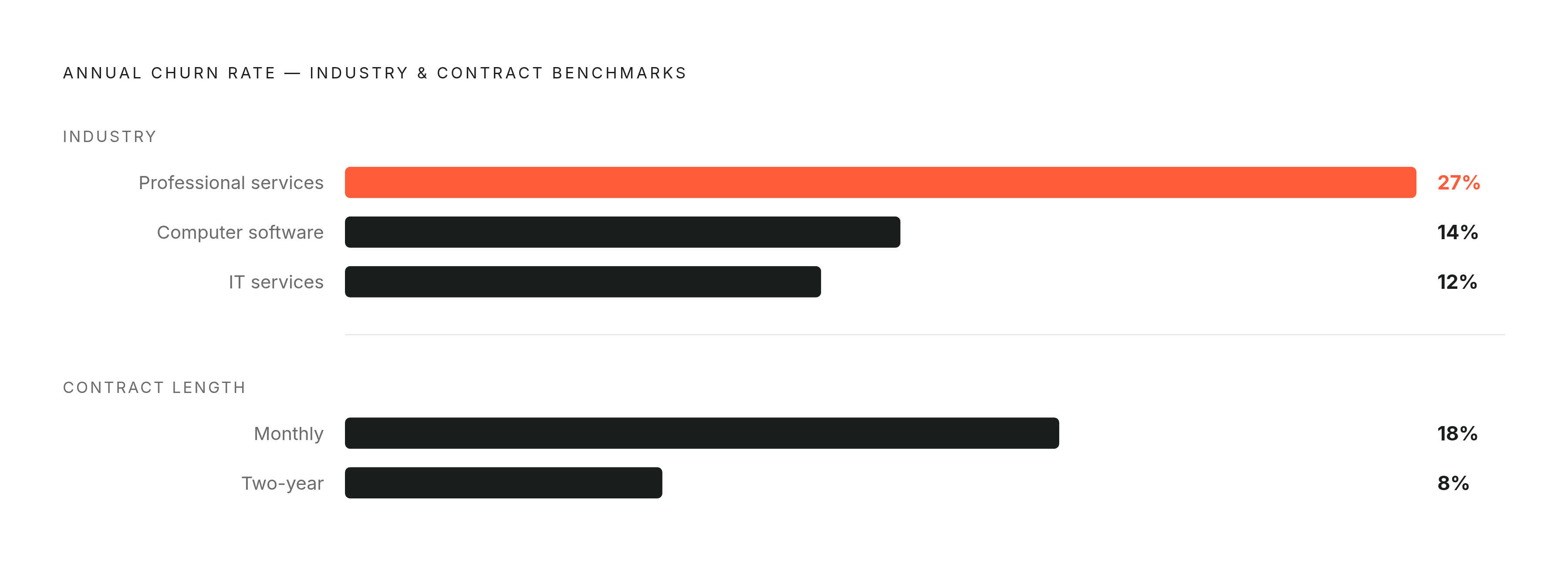
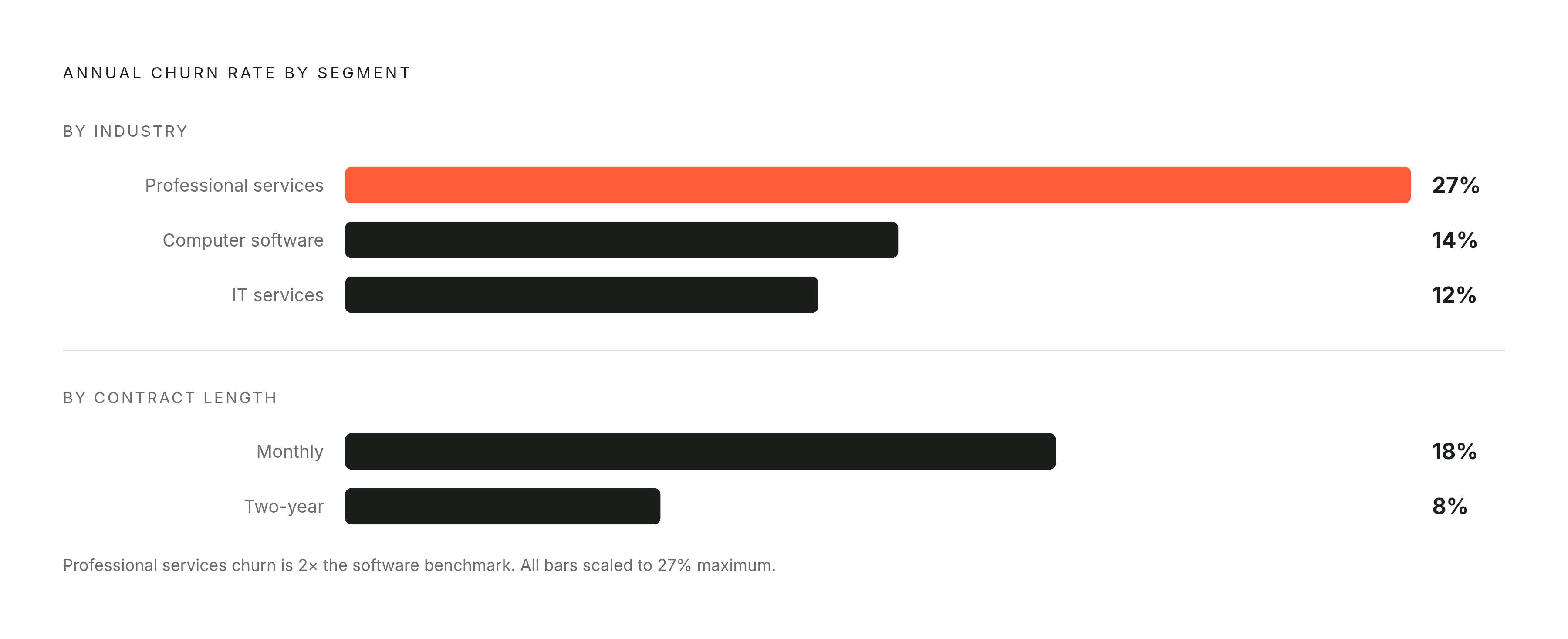
Small B2B service firms lose clients they could have kept. Professional services firms churn 27% of their client base every year, according to CustomerGauge; compare that to 12% for IT services and 14% for computer software, and it's clear services firms sit at the exposed end of the spectrum. Monthly engagements churn at 18%, versus 8% for two-year contracts; short-term deals mean clients re-evaluate constantly, with almost no friction to walk. For a firm running ten to fifty clients, losing one anchor account isn't a rounding error. That's a quarter of revenue, gone, often to a competitor who simply called at the right moment.
Most firms measure the wrong things. They track revenue, utilization, headcount, the numbers that show up on a P&L. Churn predictors live somewhere else entirely: in behavior, sentiment, and engagement patterns that never make it into a spreadsheet. This piece is about finding that data before the client finds the exit.
Why the warning signs are almost always there before clients say goodbye
Churnbuster found that 70 to 80% of churned customers showed identifiable risk signals at least 30 days before they canceled. Sit with that for a second: if the signals existed, why didn't anyone catch them?
Kantar calls this the "silent signals" problem. Warning signs get buried in support threads, half-answered emails, and meetings that got skipped and never rescheduled, scattered across systems that nobody reads together. A small firm rarely has a customer success team dedicated to watching for this stuff. The account manager is also running delivery, chasing invoices, and trying to land the next deal. Nobody has the bandwidth to connect four data points sitting in four different tools.
B2B churn is slow. Clients don't wake up one morning and cancel on a whim; they drift toward the decision over weeks or months, and the drift has a recognizable shape once you know what you're looking at. The absence of an alert in your CRM doesn't mean the account is healthy. It means nobody built a system to watch it.
So what does that shape actually look like? It starts earlier than most firms think, often in the first few weeks of the relationship.
The onboarding window where most churn is actually decided
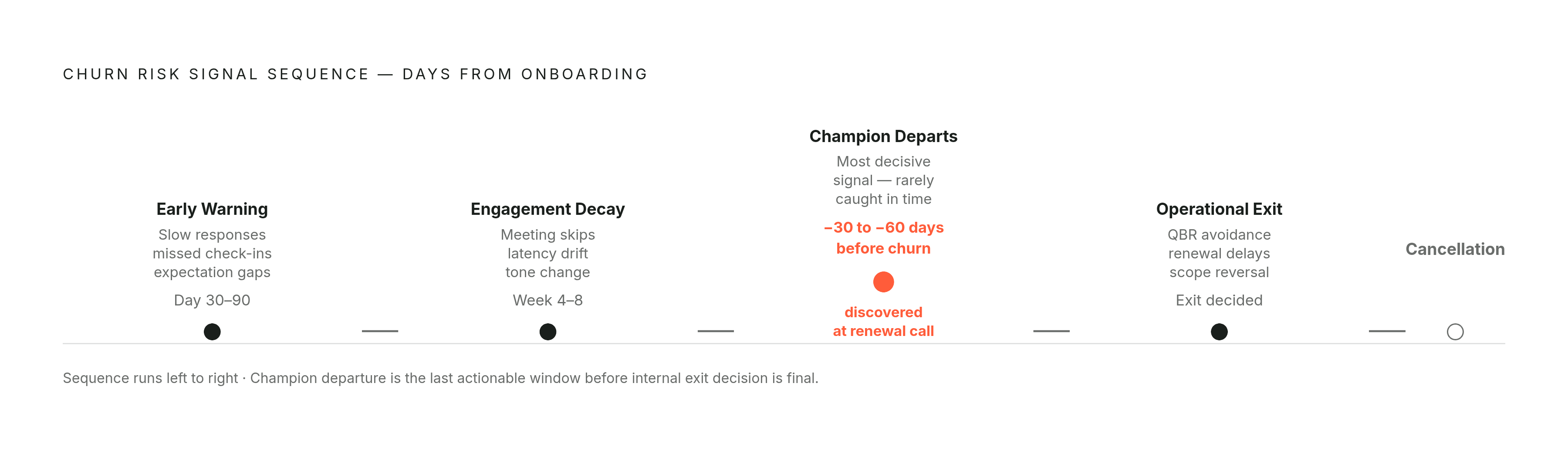
The first 30 to 90 days after signing set the trajectory for the entire account. Friction here, a slow start, unclear deliverables, no visible early win, plants a seed of doubt that grows quietly in the background while everyone assumes things are fine.
An "early win" means the client's team actually feeling competent using what you built or delivered. A client whose people can use the thing without calling you every day is genuinely onboarded; a client satisfied only with the vibe is not.
Most of this traces back to a mismatch between what sales promised and what delivery actually does. LeadForensics found that 70% of churning customers cite unhelpful staff and slow service as their top complaints, and both of those impressions get formed in the first 90 days, long before anyone says the word "churn" out loud. Watch for slow responses to onboarding tasks, low engagement on shared documents, a missed first check-in, or questions from the client that reveal they expected something different from what you're delivering.
Small firms tend to skip formal onboarding and just call it "getting started." That gap, the absence of a structured first 90 days, is where a huge share of first-year churn actually gets born.
Engagement and communication signals that show a client is mentally checking out
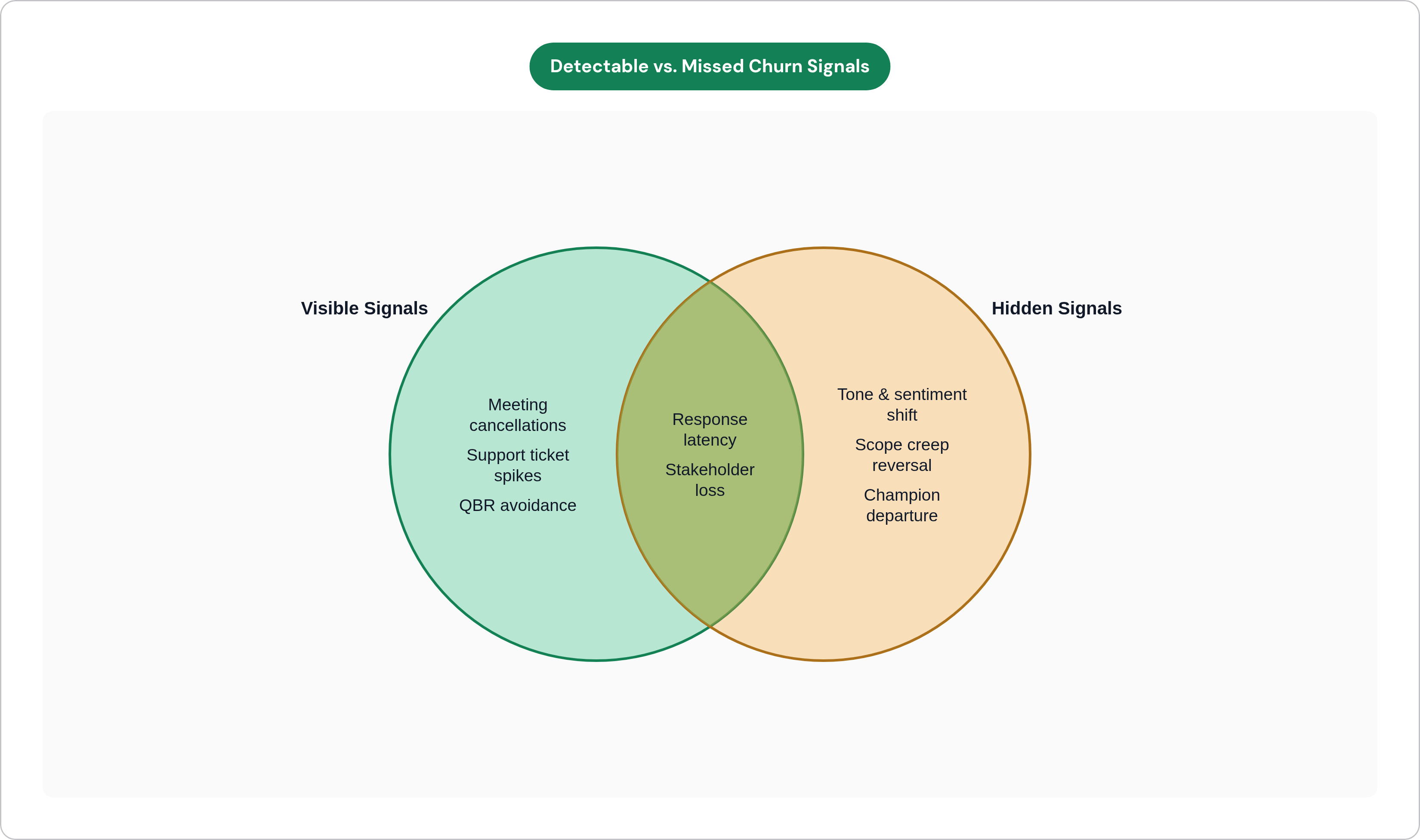
Meeting attendance is the easiest signal to spot and the easiest to rationalize away. When a primary contact starts sending a delegate or canceling check-ins without rebooking, the relationship has already slipped down their priority list. Four skipped meetings in a row signal a decision, even if nobody's told you yet.
Response latency drifts the same way. Emails that used to get same-day replies start taking three days, then a week. Track it as a trend line, not a one-off annoyance.
Stakeholder access is another tell. Getting rerouted to a junior contact, or losing access to the person who actually signs off on renewals, is an organizational signal. And the single highest-risk event in this category is champion departure: the person who bought your service leaves the company or changes roles, and their replacement inherits a contract with none of the context or goodwill that came with it. Champion turnover typically precedes churn by 30 to 60 days, and most firms don't discover it happened until the renewal call, which is roughly the worst possible time to find out.
Then there's tone. Shorter replies, fewer questions, the disappearance of the small talk that used to open every email. These are symptoms of emotional disinvestment, and reading them carefully, or running email and call transcripts through sentiment analysis, surfaces relationship decay long before a usage dashboard would. The mistake most small firms make is reading each interaction on its own. One skipped meeting looks like nothing, but the pattern across eight weeks looks like an exit.
Operational and contract signals that mean the exit conversation has already started internally
Scope creep in reverse is a strange one. A client who used to ask for more suddenly stops asking. That usually signals disengagement, or that they're quietly piloting a competitor.
Support ticket patterns tell a two-part story. A rising volume usually means frustration building. A sudden drop after a spike can mean something worse: the client has stopped bothering to invest effort in fixing the relationship at all.
QBR avoidance deserves its own line item. Declining a quarterly business review two quarters running is an operational signal that the client wants to dodge an accountability conversation. Renewal timelines tell you something similar: delays in scheduling the renewal talk, unusual requests to review contract language, or procurement suddenly getting looped in earlier than normal, all mean the deal is no longer assumed to close.
Budget questions are worth watching closely too. Line-item scrutiny that wasn't there a year ago, or a contact citing "budget pressure" when the business looks unchanged often means someone above them is asking why this line item exists. A client asking about integrations or features you don't offer is frequently scoping a competitor.
No single signal here is decisive on its own. The real warning shows up when two or three of these converge from different categories at the same time.
What makes these signals so hard to catch without a deliberate system
In a small firm, the person managing the relationship is the same person delivering the work. They're too close to it to read the pattern objectively; they're living inside it. There's also no centralized view: the signals sit in an inbox, a calendar history, a project tool, and a billing system, and nobody's job is to read across all four.
Confirmation bias does the rest of the damage. The owner who built the relationship over three years wants to believe the missed meeting was just a busy week, because the alternative is uncomfortable. Larger firms solve this with customer success managers, health score dashboards, and NPS cadences. A ten-person shop has none of that infrastructure, and clients on monthly contracts are re-evaluating on a 30-day cycle that most small firms simply aren't built to match.
Fixing this requires a habit, applied consistently, which turns out to be the harder thing to build.
Building a basic signal-tracking practice that a small team can actually maintain
Start with a client health log. One spreadsheet, one row per account, updated weekly, tracking last contact date, open issues, and champion status. That's the whole system on day one.
Define what "at risk" means before you need the definition. Two missed check-ins, a support ticket unresolved past a set number of days, a champion change: write these down in advance so nobody's deciding in the moment, under pressure, with a relationship they're emotionally attached to.
Set a review cadence and stick to it: monthly for stable accounts, weekly for anything already showing a signal. The review itself is the point: it forces someone to read the pattern rather than just check a box. Champion tracking should be non-negotiable: every account needs a named champion and a named backup, and any change in either one triggers immediate re-engagement, not a note for later.
Periodically reread the last 30 days of correspondence for tone and response-time drift. No tooling required, just deliberate attention. For firms handling more accounts than one person can watch by hand, this is where AI tools start pulling real weight: scanning threads for latency drift, flagging sentiment change, doing at portfolio scale what a customer success manager would do at a bigger firm. The goal is giving the account owner enough lead time to have a real conversation before the client's already made up their mind.
How to respond when signals surface — the conversation before the cancellation
Once two or more signals converge, waiting for the next scheduled check-in is waiting too long. Reach out that week.
Frame it around their outcomes. "I want to make sure we're delivering what you actually need" opens a conversation, while "I noticed engagement has dropped" puts the client on the defensive before they've said a word.
Ask directly. Most clients who are weighing an exit will tell you why if you ask plainly, because they either want to be talked out of it or they want to feel heard before they decide anything. Go back and audit what was promised during the original sales conversation against what delivery has actually looked like. If there's a gap, name it yourself first; that builds more trust than waiting for the client to bring it up and feeling caught out.
Champion departure has its own playbook. When the internal advocate leaves, the first move is a direct introduction request to the replacement within the first week, not the first month, because whoever reaches that new contact first tends to define the relationship going forward.
Some churn just isn't preventable: a client's budget gets cut from above, or their whole strategy shifts, and it has nothing to do with your work. Cutting out the losses that were actually preventable, which, per the numbers above, is most of them, matters far more than chasing a 100% save rate. Firms that build this habit describe a real shift, from reactive "why are they leaving" conversations to proactive "what do you need next" ones, building a fundamentally different relationship in the process.
How AI signal-monitoring changes what a small firm can realistically track
A five-person firm with thirty clients cannot read every email thread for tone drift or track every response-latency change by hand. The math doesn't work; there aren't enough hours in the week, and the person who'd do it also has client work due Friday.
This is what AI is actually good for here: scanning communication sentiment across email and call transcripts, tracking response latency trends over time, flagging keywords like "evaluating other options" or "legal to look at," and mapping engagement cadence across an entire portfolio at once. Sentiment analysis run this way surfaces relationship decay earlier than any revenue or usage metric would show it, giving a small team a head start they couldn't generate manually no matter how organized they are.
A tool that gets used is wired into the workflows the team already runs, rather than sitting as a dashboard someone has to remember to open. A firm evaluating this seriously should look for an approach that starts with a short diagnostic period, identifying which monitoring gap is actually costing them clients, then builds something connected to the specific signals their accounts produce, rather than bolting on a generic AI layer and hoping it fits. Sansatech, a custom AI automation consultancy for small and mid-sized businesses that diagnoses a firm's real bottleneck and builds a production-ready system around it, is one firm doing exactly this kind of scoped, embedded work.
Small client portfolios are actually an advantage here. The AI doesn't need to process millions of data points; it needs to reliably surface three to five accounts worth a conversation this week. That's a tractable problem at ten or thirty clients in a way it isn't at ten thousand.
This means a small team can pay real attention to every account on the roster, including the quiet ones.