Thirty Day AI Implementation Timeline for a Small Business
Small businesses can ship working AI in thirty days if they pick one bottleneck and stick to it.

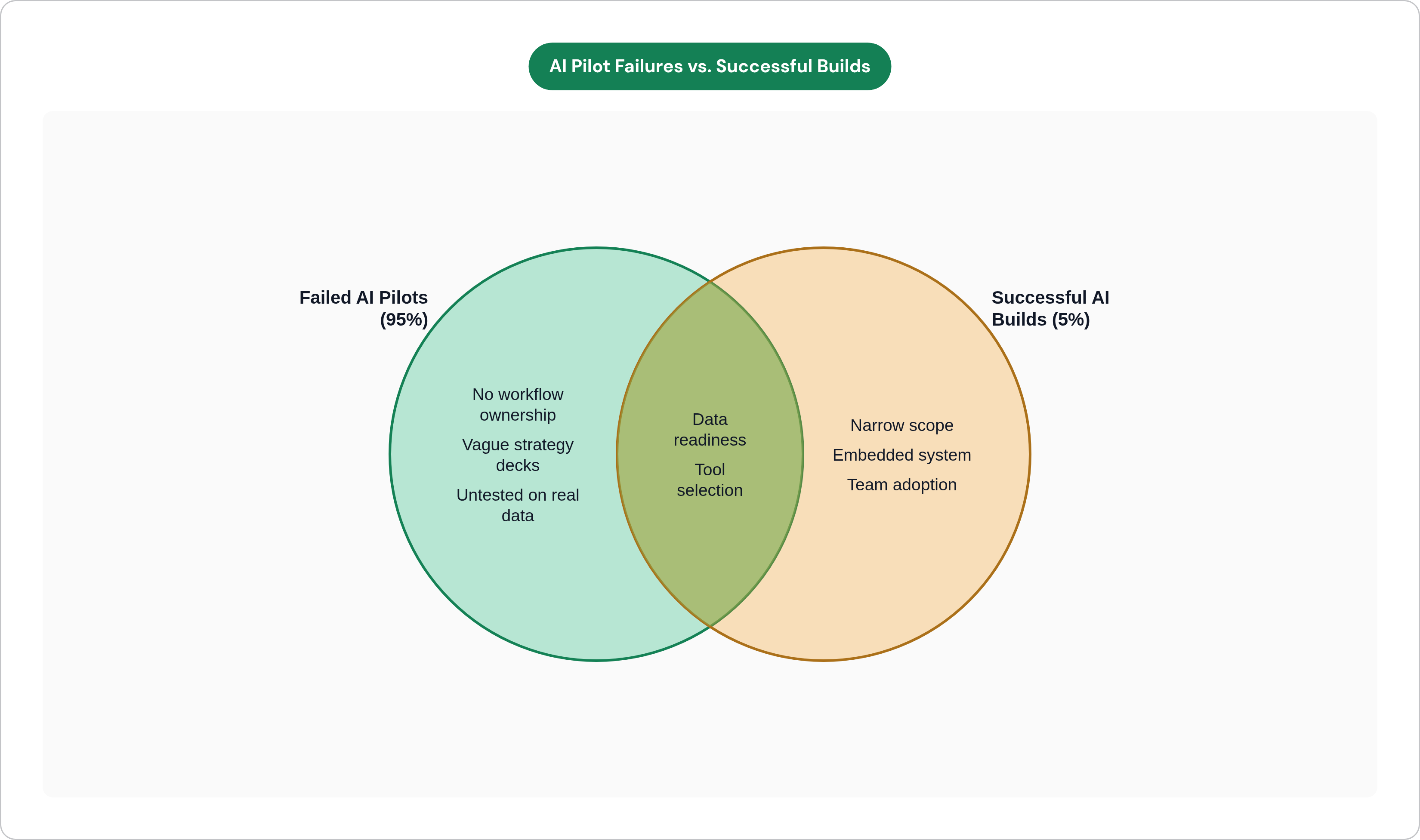
A 30-day AI build follows a sequence that sounds obvious until you watch someone skip a step: find the real bottleneck, write a spec around it, ship something that runs, then make sure the team can't quietly drift back to the old spreadsheet. MIT's summer 2025 research put the failure rate of generative AI pilots at 95%, meaning they never produce measurable business impact. Gartner had already projected something similar, guessing at least 30% of these projects would get abandoned after proof of concept, mostly over bad data and unclear value. The usual failure mode is organizational: someone hands over a strategy deck, nobody owns what happens next, and the tool never touches an actual workflow. Given that 76% of small businesses are already using AI or kicking the tires on it this year, the operative question is whether you land in the 95% or the 5%.
What makes a 30-day timeline realistic, and when it isn't
Thirty days works when scope stays embarrassingly narrow: one workflow, one bottleneck, and a first version that's allowed to be a little ugly. Scope creep is what makes it fall apart. The firms that try to deploy more than two tools in their first quarter stall, spread thin across systems nobody's actually learned yet.
The selection logic isn't complicated. You want the workflow burning the most admin hours with the least damage if version one has rough edges. "Working system" means something running in production, touched by real humans doing real work. Payback on these builds averages 6 to 9 months industry-wide, so getting something live by day 30 puts you ahead of that curve instead of watching a pilot die quietly in a shared drive somewhere nobody checks.
Who runs the month matters almost as much as what gets built. An internal champion runs out of bandwidth by week three, a fractional specialist runs out of context if nobody briefs them properly, and an embedded partner runs out of scope if nobody's managing them. Full-time senior AI engineering talent costs more than most SMBs can justify for a single workflow, which is the entire reason fractional and embedded models exist: they're sized for exactly this problem.
Week one: finding the bottleneck worth building around
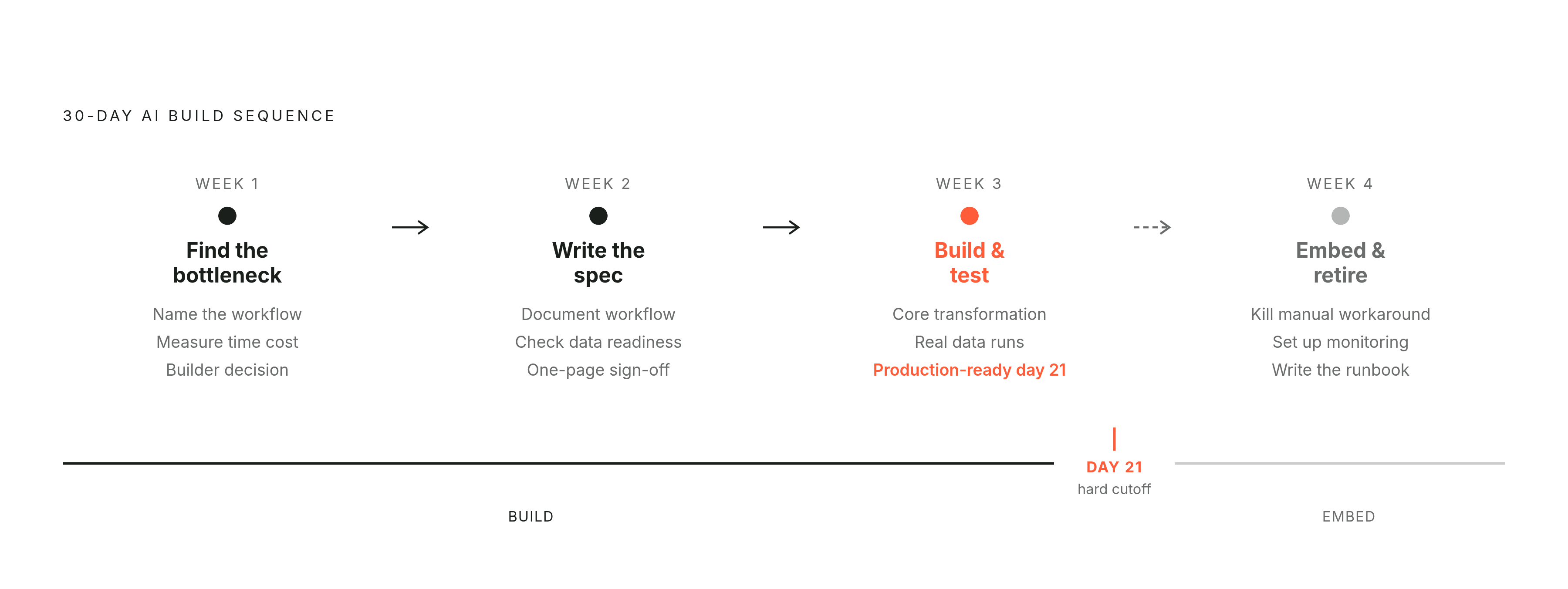
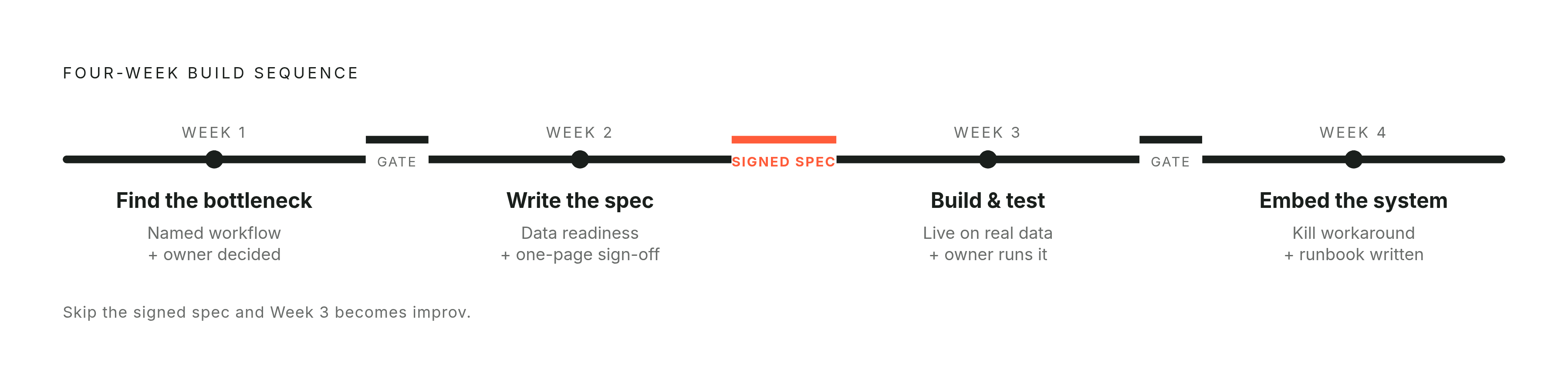
Week one has one job, and it's not a list. It's a single, specific answer to "which workflow, and why here first."
Start by mapping where admin time actually disappears, not where people guess it disappears. Ask five employees where their time goes and you'll get five confident answers that mostly contradict the calendar, so check the calendar instead. Look for work that repeats, follows rules, and generates data, because that's the profile current AI actually handles. McKinsey's 2025 data points to meaningful shares of tasks as automatable with today's tools, though that framing is trivia until you know which tasks in your shop qualify.
The sharper question is what the bottleneck is stopping the business from doing. Take a freight coordinator buried in manual shipment tracking: she isn't just slow, she's capped, unable to take new lanes because there's no room left in her day. That's a ceiling and a fundamentally different problem from friction, and the two require different fixes.
By Friday of week one you need three things nailed down: a named workflow with a time cost the team can put a real number on, a rough picture of what "done" looks like at day 30, and a decision on who's building it. Diagnosis by committee kills this step, and so does picking the flashiest use case over the most tractable one. Skip the "what does this prevent us from doing" question and you'll spend a month automating something nobody was actually blocked on. Take an insurance broker losing hours a week to manual data entry across intake forms as an example. Week one proves the cost, in writing, and locks it in as the target.
Week two: turning the diagnosis into a build specification
Week two takes a diagnosis and turns it into instructions specific enough that a builder could start on day 15 without asking a single clarifying question. That's the bar.
Document the workflow as it's actually run, warts included. Every workaround, every manual patch, every "we just email Karen about that one" gets written down. Then map inputs (what data feeds this, where does it live, how clean is it, really), outputs (what does finished look like, who acts on it), and hand-off points, where a human still needs to stay in the loop, at least for now.
Data readiness gets checked here in week two, because the single most common way these builds die is discovering, mid-build, that the data lives in three formats across two systems with no bridge between them. Catching it in week two costs a conversation; catching it in week three costs the build.
Bring in whoever actually does the work. They know the exceptions and the informal rules nobody wrote down; cut them out and you'll ship a system the team distrusts on sight regardless of how well it performs. Tool selection happens now too, once you actually know whether this is document extraction, a routing agent, or a form-to-database pipeline.
Set the ship bar at useful. Accuracy in the high 80s on the main task is often plenty for a team to adopt something daily, because the real alternative is zero automation. Close week two with a one-page spec both the builder and the workflow owner sign off on. That page is the contract, and it's what keeps week three from turning into improv.
Week three: building and testing a system the team can actually use
Week three is the technical stretch, but judge it against one question only: does it do what the spec said, on real data, inside the environment the team actually works in?
Build the core transformation first, the one thing the workflow genuinely needs. Chasing edge cases before the main path works is reinforcing a roof before you've poured the foundation. Use real data from day one; synthetic test cases buy you false confidence and nothing else. Build the human review step into version one on purpose, aimed at cutting the manual transfer work while preserving the judgment call itself.
Test against last month's actual cases, known inputs against known correct outputs, and have the workflow owner run it herself rather than just watch a demo. Usability failures hide from technical tests and show up the second a real user gets stuck on a confusing button. When something breaks, sort systematic errors (bad logic, fix the logic) from edge cases (weird input, decide whether to handle it or flag it for a human).
"Production-ready" at day 21 means the system runs reliably on the common case, flags a human on the rare one, and the owner can run it without the builder hovering. Specialist-built or purchased systems succeed at materially higher rates than internal builds, which is the whole argument for going embedded: it brings that success rate to teams that lacked the staff to build it themselves. Back to the broker: this is where intake extraction and routing goes live, manual entry drops sharply, and she's suddenly processing more submissions instead of retyping them into a form.
Week four: embedding the system so it compounds past the first win
A pilot runs next to the old workflow as a hedge. An embedded system replaces it, full stop, with the manual path retired entirely, and that distinction is the entire game in week four.
Train the full team on real cases, not a feature tour. Kill the manual workaround on purpose, because deadline pressure sends people straight to whatever is one click away. Set up monitoring on whatever metric named the bottleneck back in week one, error rate, time per task, volume handled, whatever it was. Write the runbook: what got built, how to adjust it, how it keeps running without the original builder on speed dial.
Here's the part that actually justifies the month: the system saves time and frees attention, and that attention goes somewhere. The freight coordinator who's no longer buried in tracking takes on more lanes, and the broker with automated intake quotes faster and carries more accounts. That's a ceiling lifting, a qualitatively different outcome from the same work arriving slightly faster.
Full payback averages 6 to 9 months across the industry. By day 30 you will have a working system with measurable time savings and a team that actually knows how to run it without hand-holding. Close the month with a short, ranked list of the next two bottlenecks, because build one teaches the diagnostic method and buys the trust needed to move faster on build two. Growing SMBs adopt AI at 83%, against 55% for companies in decline, and by day 30 you're not just on the right side of that gap, you have something running to show for it, instead of another subscription nobody opens.
What to watch for when the 30 days don't go according to plan
Week one drags when nobody can agree on the bottleneck, and you'll spot it because the diagnostic conversation keeps generating new candidates. Force a call by day 5 even if it's imperfect, since a committed imperfect decision beats an open-ended one every time.
A vague week-two spec shows up when the builder and the workflow owner describe "the finished thing" differently over coffee. Fix it by writing the spec down and reading it out loud to each other; the simplicity of the method is precisely what makes it work. Scope creep hits week three right around day 18, the moment someone says "while we're in there, can it also handle...". Hold the line on version one, write every extra request down for version two, and keep the build on track.
Adoption stalls in week four specifically when the old process stays available as a safety net; you'll know it's happening because the new system only gets used while the builder is standing in the room. Kill the fallback on purpose and early.
Data problems remain the most common technical blocker, which is the entire reason the week-two readiness check exists: finding messy, siloed data before the build is always cheaper than finding it in the middle. On ROI, calibrate honestly. BCG's 2025 survey found median AI ROI sitting around 10%, with a third of leaders reporting limited or no gains at all, so treat the 30-day system as a foundation for gains that compound over months, not a finish line. Not every task deserves the attempt in the first place, either: a 2024 MIT study found automation made financial sense in only 23% of roles heavily reliant on visual tasks. That's exactly why week one's selection criteria exist, to point you at high-automability work. An embedded partner improves these odds materially too, since the embedded model exists precisely to close the gap between strategy delivered and execution owned.
How to know the first system worked and what comes next
Three questions at day 30, nothing more: Is the team using the system independently? Is the metric named in week one actually moving? And has the freed-up capacity gone somewhere real?
Success looks like a workflow that used to eat serious manual hours now running on oversight instead of labor, a team that trusts the output enough to act on it directly, and time savings you can actually point to on a calendar. Flawless accuracy on every edge case, full payback already banked, and three more systems magically running in parallel are later-quarter outcomes, if they show up at all.
Ninety-one percent of SMBs using AI report it boosts revenue, per Salesforce's December 2024 SMB Trends Report, but that statistic belongs to businesses where AI got embedded into how work actually happens. The 30-day process is what produces the embedded version, which is the kind of build Sansatech, an AI automation consultancy that diagnoses bottlenecks and deploys custom systems inside small and mid-sized businesses, runs for its clients.
Build two moves faster than build one, because the team has lived through the diagnostic method, the spec process, and the deployment pattern once already, and because the data groundwork from the first build often carries over. Judge the first system by more than hours saved. Ask what the business can now do with the capacity it has gained, since a team that previously lacked bandwidth for a new service line might suddenly have room to breathe. That's the actual return on the month, and it's why the bottleneck you pick in week one outweighs any tool you pick after it.