Workflow Handoff Failures Between Operations and Billing in Small Firms
Revenue leakage from ops-to-billing breakdowns costs ten to fifty thousand annually.

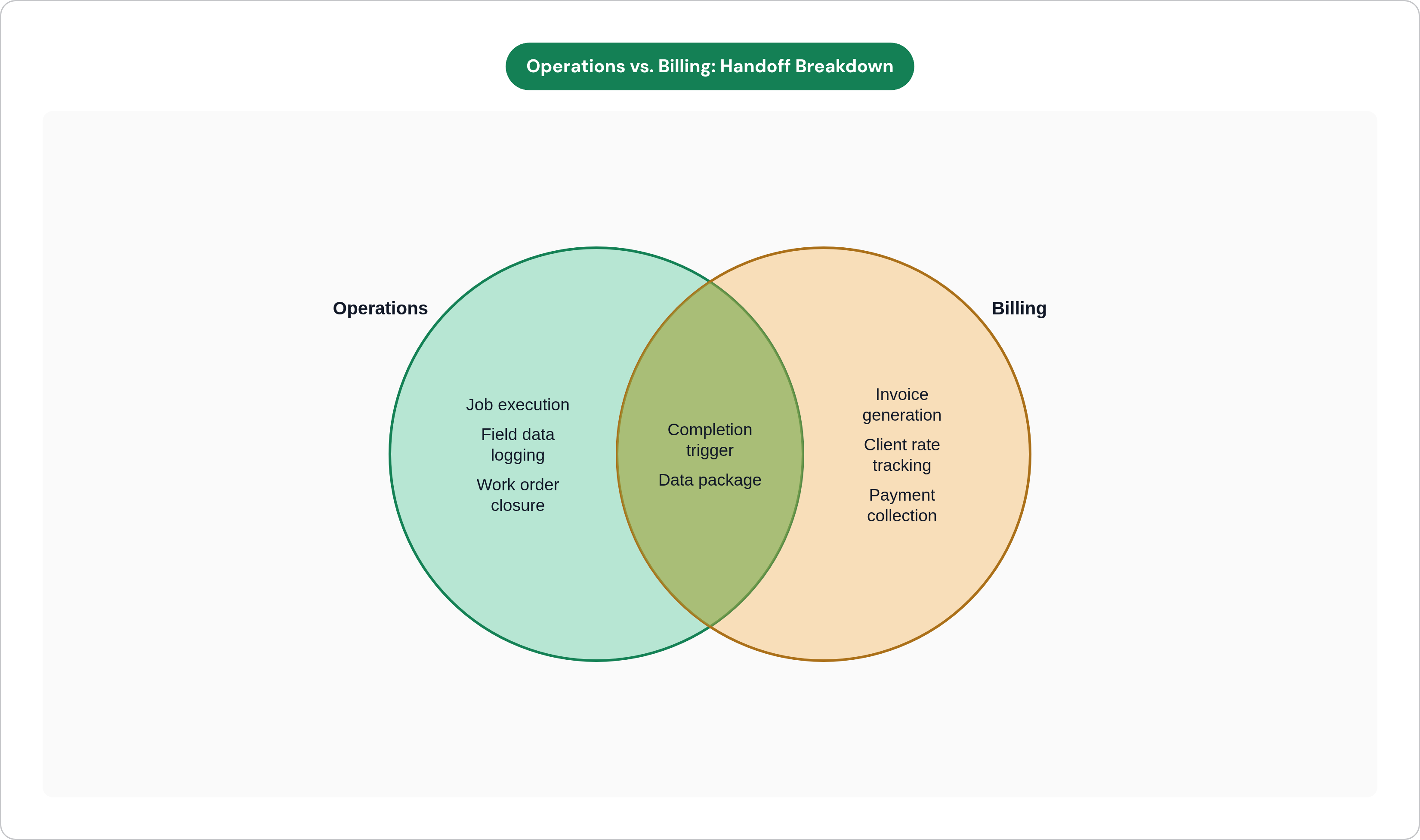
A handoff is the moment responsibility transfers from one person, team, or system to another. In a small service firm, it looks like this: operations scopes and delivers the work, then someone has to tell billing it's done, what was done, and what to charge. That phrase, "someone has to tell," is where the money goes.
The failures form a cluster of distinct breakdowns that mask each other, and once you've watched enough billing cycles implode, they're almost comically predictable.
Completion signals that never get sent. Work finishes in the field or inside a project tool. Billing is waiting for an email, a status change, a phone call. It doesn't come. The work order closes; the purchase order stays open. Nobody owned the handoff explicitly, so nobody noticed it didn't happen. The baton quietly hits the floor.
Manual data re-entry between systems. Operations logs work in one place. Billing re-keys it into another. Every manual transfer introduces an opportunity for error, and those errors compound through the entire billing cycle. Anyone who has watched a billing coordinator squinting between two screens will recognize this immediately — a billing coordinator squinting between two screens and a stack of job reports, trying to reconcile numbers that almost match.
Missing or incomplete information at handoff. Billing receives confirmation that work is done. What it doesn't receive: what was done, at what rate, or under which client contract. Raw delivery data, hours logged, materials consumed, tasks completed, must be transformed into billable line items before an invoice can go out. When that transformation step is missing or wrong, billing chases operations for the missing pieces, and the delay begins compounding.
Timing gaps. The handoff happens three days after the job closes. In a firm billing on net-30 terms, that delay can push payment receipt into the following month. That is a cash flow problem with a concrete effect on the owner's checkbook.
No one owns the gap between functions. Operations assumes billing will follow up. Billing assumes operations will send the trigger. Both wait. This failure mode is the hardest to see because it produces silence. Dignified, expensive silence.
These failures compound each other. A timing gap often reveals a missing completion signal underneath it, which reveals a data re-entry problem underneath that. Pull on one thread and the others follow.
One dynamic makes this especially pernicious in small firms: the same person frequently owns both sides of the handoff. The operations manager who closes the job also queues it for billing. In practice, it makes the gap invisible, because no one is standing on the receiving end noticing that the transfer didn't happen cleanly.
What These Handoff Failures Actually Cost
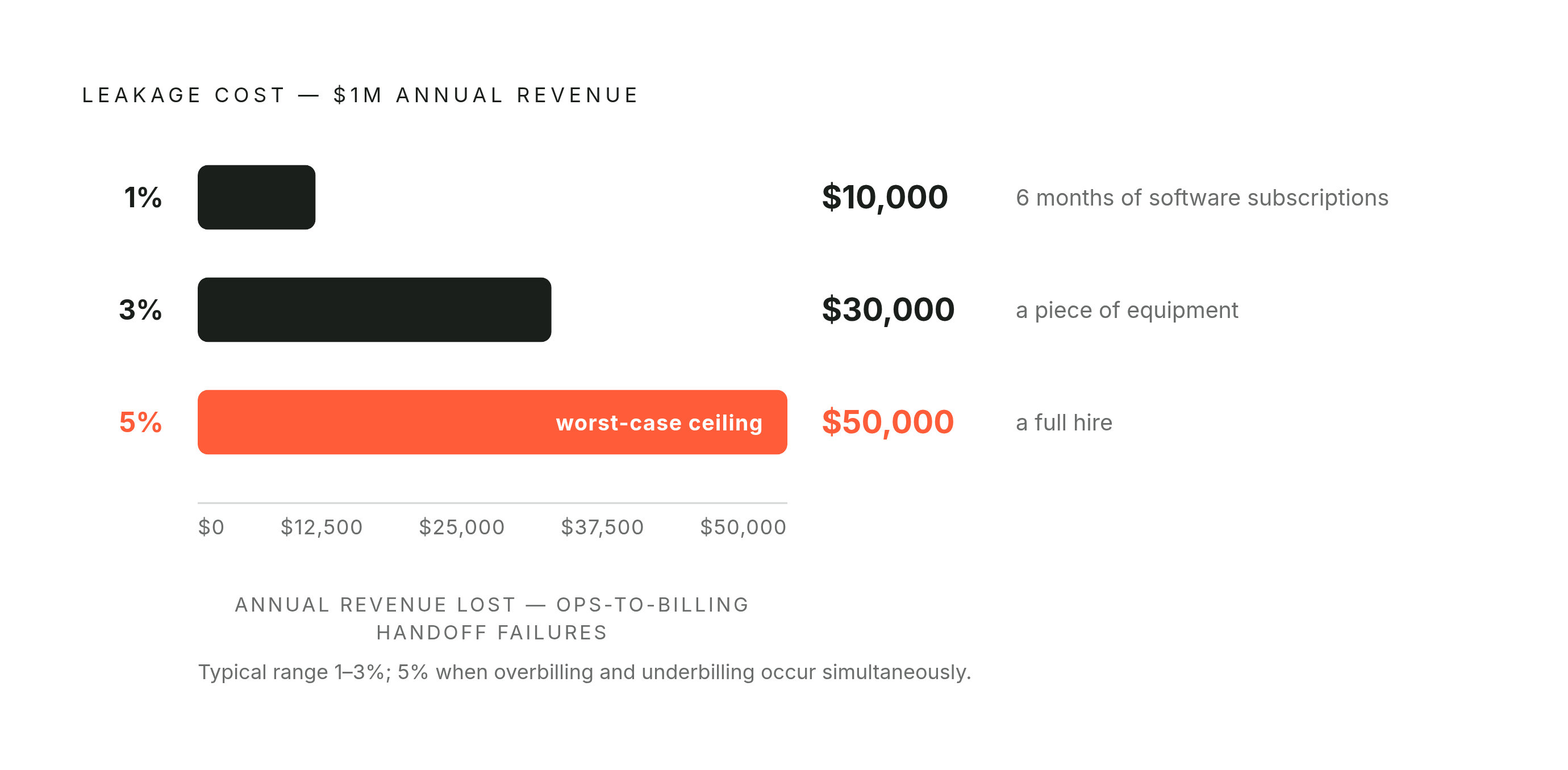
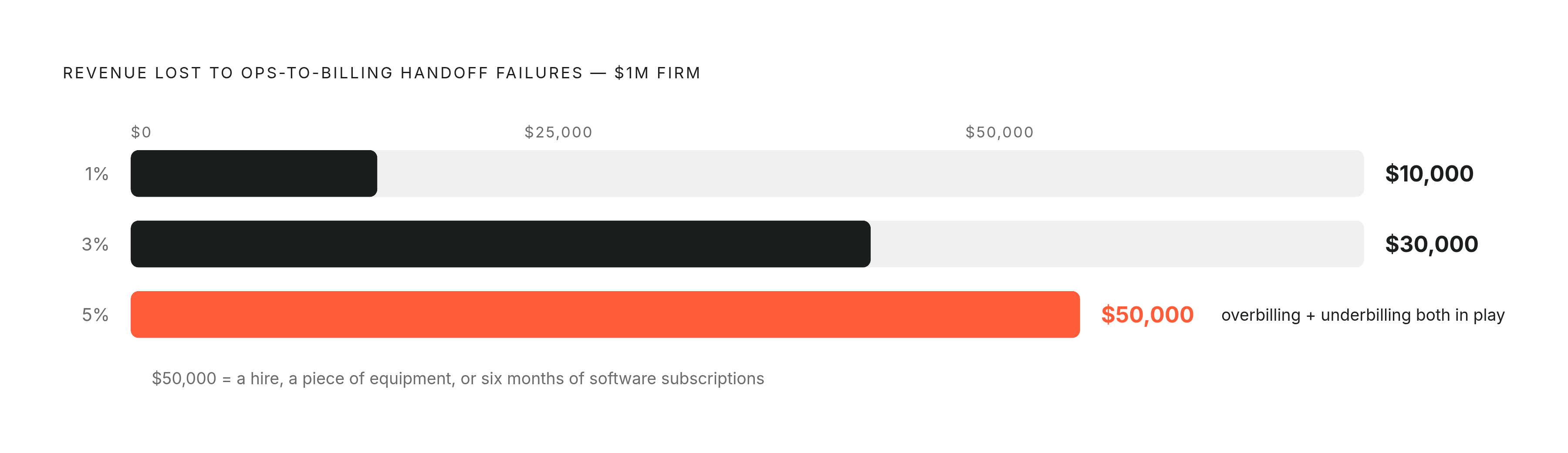
Revenue leakage from handoff errors between operations and billing runs somewhere between 1 and 3 percent for a typical service business, with the ceiling closer to 5 percent when overbilling and underbilling are both in play. Run the arithmetic on one million dollars in annual revenue: that's ten thousand to fifty thousand dollars, depending on how bad things are. That figure buys a hire, a piece of equipment, or six months of software subscriptions, gone quietly.
The cash flow consequences are distinct from the revenue loss and more disruptive. The Intuit QuickBooks Business Owner Report found that 54 percent of business owners have skipped or reduced their own pay at least once in the past year to keep bills or payroll covered; a single late payment threatened payroll or bills for 39 percent of owners. Twelve percent reported that a late payment of less than one thousand dollars was enough to cause serious financial trouble. The threshold for damage is lower than most owners want to admit, and a three-day handoff delay can be the difference between a payment arriving this month or next.
There is a downstream consequence that rarely surfaces in these conversations: a broken ops-to-billing handoff affects how the firm appears to its own vendors. According to bill.com, 31 percent of small and mid-size businesses cited internal workflow issues as a reason they don't always pay their own bills on time. The broken handoff radiates outward into relationships the firm depends on.
The most insidious cost is invisible by design: work that was never invoiced, jobs underbilled because the handoff data was incomplete, client disputes traced back to an invoice that didn't match what operations delivered. All of this hides in write-offs, adjusted invoices, and client attrition that gets attributed to something vague, usually some version of the relationship having "gone sideways."
Why the Usual Fixes Don't Hold
The first instinct is to buy a tool: a new CRM, a project management platform with better reporting, a billing system that promises integrations. Understandable. Almost entirely wrong. Tools solve storage and visibility problems, and they solve handoff problems only after the handoff itself has been redesigned. The sequencing matters more than the software.
The most common failure in ops-to-billing automation is that teams forget to log data, log it incorrectly, or log it too late. A better tool receiving incomplete or delayed data produces better-formatted incomplete invoices. The formatting improves while the accuracy stays broken.
The second instinct is to add a rule. "Operations must notify billing within 24 hours of job close." Rules without enforcement mechanisms degrade under pressure, and when operations is at capacity, the email slips. Billing stays blind to gaps it was never told about. Process discipline handles the first 70 percent of the problem; the remaining 30 percent requires systems designed for end-to-end workflows, not department-level tasks.
Adding automation too early is its own failure mode worth naming explicitly: it speeds up the broken process. Automated invoicing triggered by incomplete data sends wrong invoices faster. AI-assisted escalation workflows route 30 to 50 percent of cases back to humans when the underlying data is ambiguous. The AI renamed the handoff problem rather than fixing it.
The structural issue underneath all of this: operations and billing are measured on different things, operate on different timelines, and use different systems. Without a deliberately designed connection between them, every fix is a workaround that breaks at the worst possible moment. The umbrella that only breaks on the rainiest day is still a broken umbrella.
What a Well-Designed Ops-to-Billing Handoff Actually Requires
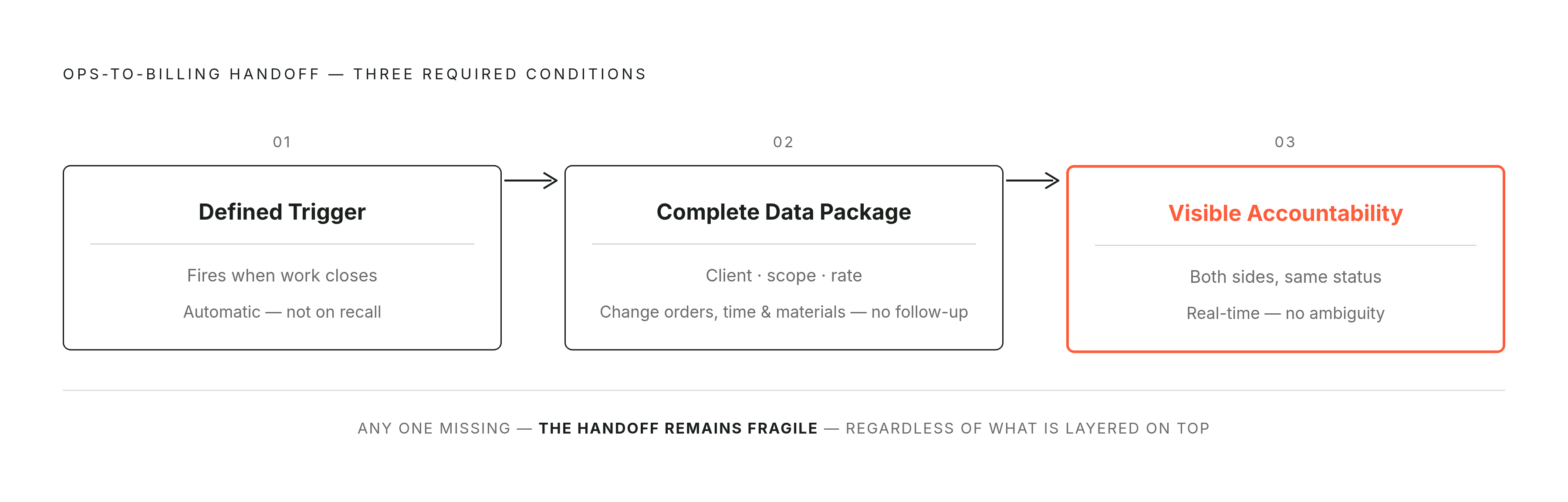
Three things must all be present. Any one missing and the handoff remains fragile, regardless of what gets layered on top.
A defined trigger. The handoff must fire automatically when work closes, not when someone remembers to initiate it. The trigger can be a status change in a project tool, a form submission, a checkbox in a field service application. The format is irrelevant; the automaticity is essential. If the handoff requires a human to decide to send it, the handoff will eventually fail to be sent. This describes how cognitive load works under operational pressure.
A complete data package. Billing needs to receive everything required to produce an accurate invoice without asking a follow-up question: client identity, scope completed, applicable rate, any change orders, time or materials consumed. If billing routinely chases operations for missing information, the handoff was designed without a defined data package. The chase is the evidence.
Visible accountability. Both sides need to see the same status. Operations should know when billing has received and processed the handoff. Billing should know when a completed job is waiting. Invisible handoffs, a sent email, a closed ticket, a verbal confirmation, create genuine ambiguity about whether the transfer actually occurred. That ambiguity is where the delays live.
A practical test: if a new person joined billing today, could they invoice every completed job from last week without asking anyone a question? If not, the handoff is improvised, and the firm depends on institutional memory that walks out the door with whoever holds it. That test is blunter than most process audits, and it produces an uncomfortable answer quickly.
Every step in a handoff chain appears manageable in isolation. Together, they create delays and duplicate data entry that no single tool was designed to prevent. The mapping has to come before the tooling, and that sequencing is exactly what most firms skip, often because the urgency of the immediate billing cycle makes deliberate design feel like a luxury.
Where Automation Fits Once the Handoff Is Mapped
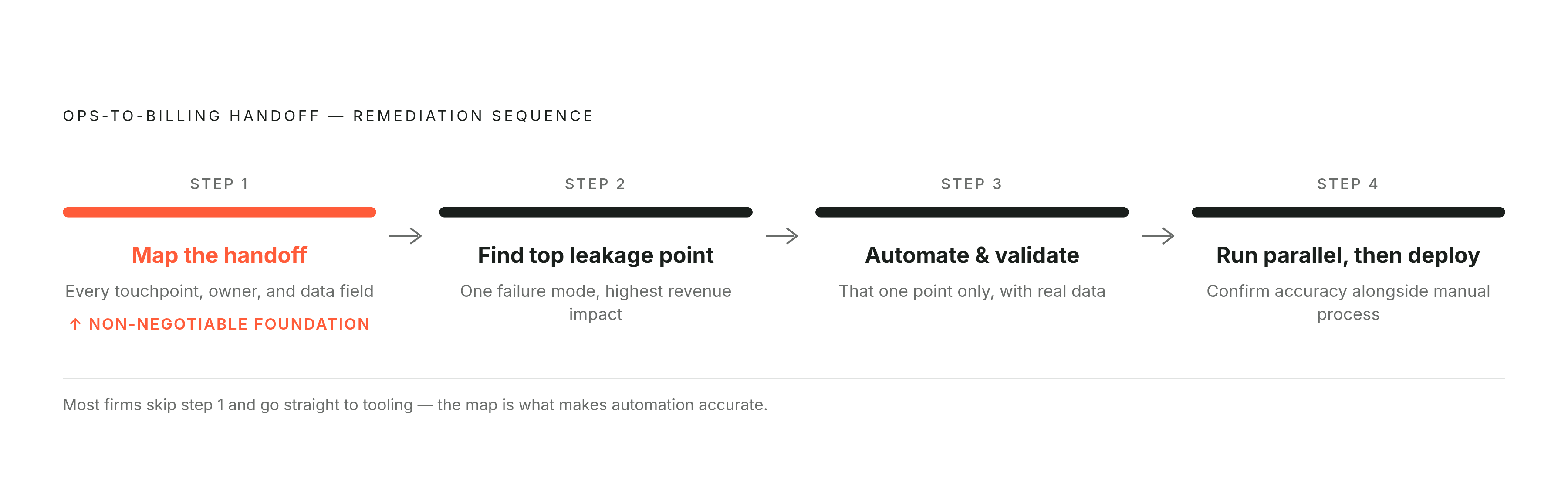
Automation earns its value when it's placed at a handoff that is already well-defined. It converts a reliable manual process into a reliable automatic one. Applied to an undefined handoff, it converts an unreliable manual process into an unreliable automatic one, which is worse because it looks like it's working.
The highest-leverage automation points in an ops-to-billing context are specific and, frankly, boring: a status change in a field service or project tool automatically pushes complete job data to billing, eliminating the forgotten notification; raw delivery data gets mapped to billable line items without re-keying, eliminating the transcription error; jobs that close with missing data get flagged immediately rather than surfacing the gap at invoice time, eliminating the surprise. Boring interventions tend to be the most durable.
Automating payment and invoicing processes can save 500 or more hours per year and meaningful cash annually. That savings is real, and it depends entirely on the underlying handoff data being clean and complete before automation touches it.
The sequencing that actually holds: map the handoff, identify which failure mode is causing the most leakage, automate that one point first, then validate with real data before expanding. Run the first automation in parallel with the manual process to confirm accuracy, then deploy fully. This is slower than most owners want, and considerably faster than recovering from an automated billing error sent to a hundred clients.
Small firms specifically benefit from implementations where someone who understands both the workflow and the tools does the configuration, rather than internal staff who understand one side but not both. The ops-to-billing gap spans at least two systems and two functions; misunderstanding either side produces a configuration that solves the wrong problem with great confidence. Speed also matters: contract-to-billing handoff delays cause the most frequent billing issues in service firms, and every billing cycle that passes with the same leakage is a quantifiable cost, not an abstraction.
How to Find the Worst Handoff in Your Current Ops-to-Billing Flow
The goal is to find the single handoff point causing the most leakage or delay, and fix that one first.
Three questions locate it: Where does billing most often have to chase operations for missing information? That's an incomplete data package. Which jobs are most likely to be invoiced more than a week after completion? That's a trigger failure. Which invoices generate the most client disputes or correction requests? That's a data accuracy problem, almost always traceable to re-entry.
A simple approach: pull the last 30 completed jobs and trace each one from job close to invoice sent. Note the date gap. Note who touched the handoff. Note any follow-up messages required to complete it. Patterns surface quickly. In practice, they're almost always the same two or three job types, the same two or three people, the same two or three days of delay, repeating with dispiriting consistency.
Once the finding is in hand, name the failure mode specifically before deciding on a fix. Naming it correctly determines what gets fixed. Then fix the process design first: add the trigger, define the data package, assign ownership. Layer automation on top only after the process holds manually.
A firm unable to identify where its leakage is coming from has an invisible handoff. When the transfer lives inside someone's head, quite a lot stays invisible and therefore unfixed.
The ops-to-billing gap is what happens when a firm grows past the point where everyone knows everything and has yet to build the structure to replace that informal coordination. In the early days, the owner knows every job, every client, every rate; the handoff exists only as shared memory. As the firm grows, that internalized coordination has to be externalized into designed processes. Most firms skip that step because the early version worked fine and nobody noticed exactly when it stopped. The gap is the evidence that the transition happened. The missing structure is what makes it a problem.