AI Process Audit for a Five to Fifty Person Business
A structured examination pinpoints your single highest-leverage automation opportunity.
An AI process audit is a structured examination of how work actually moves through the business: where time goes, where handoffs break down, where the same task gets repeated by someone who has better things to do. You are looking at what people actually do on a Tuesday afternoon, which frequently diverges from the org chart.
It is worth being explicit about what the audit is not, because several well-intentioned activities get mislabeled as one. A vendor comparison, an IT security review, a productivity survey handed to employees, and a checklist downloaded from someone's Substack all fall outside its scope.
A structured audit covers four things in sequence: a scan of current operations (what the business actually does, step by step), an assessment of where inefficiencies and missed automation opportunities concentrate, an evaluation of which tools and capacity genuinely fit those gaps given what the business already has, and a ranked implementation roadmap with a clear first move. Not a list of interesting possibilities. A sequenced set of next moves.
The goal is one answer: the single highest-leverage starting point, the bottleneck where an AI deployment will compound rather than just trim time at the margins.
That distinction matters more than anything else in this piece. Saving two hours a week on a low-stakes clerical task is a fine efficiency gain. Removing the constraint that currently forces the team to hire, wait, or turn work away is a capability change, a different ceiling entirely, the difference between trimming the hedges and knocking down the fence. Audit data from 102 small and mid-sized businesses found that 87% had significant waste attributable to AI tools, with median annual waste of $18,000. Most of that waste came from deploying tools in the wrong places, not from overspending on the right ones. That is precisely what a proper audit prevents.
Where to look first: the three categories of high-leverage bottlenecks
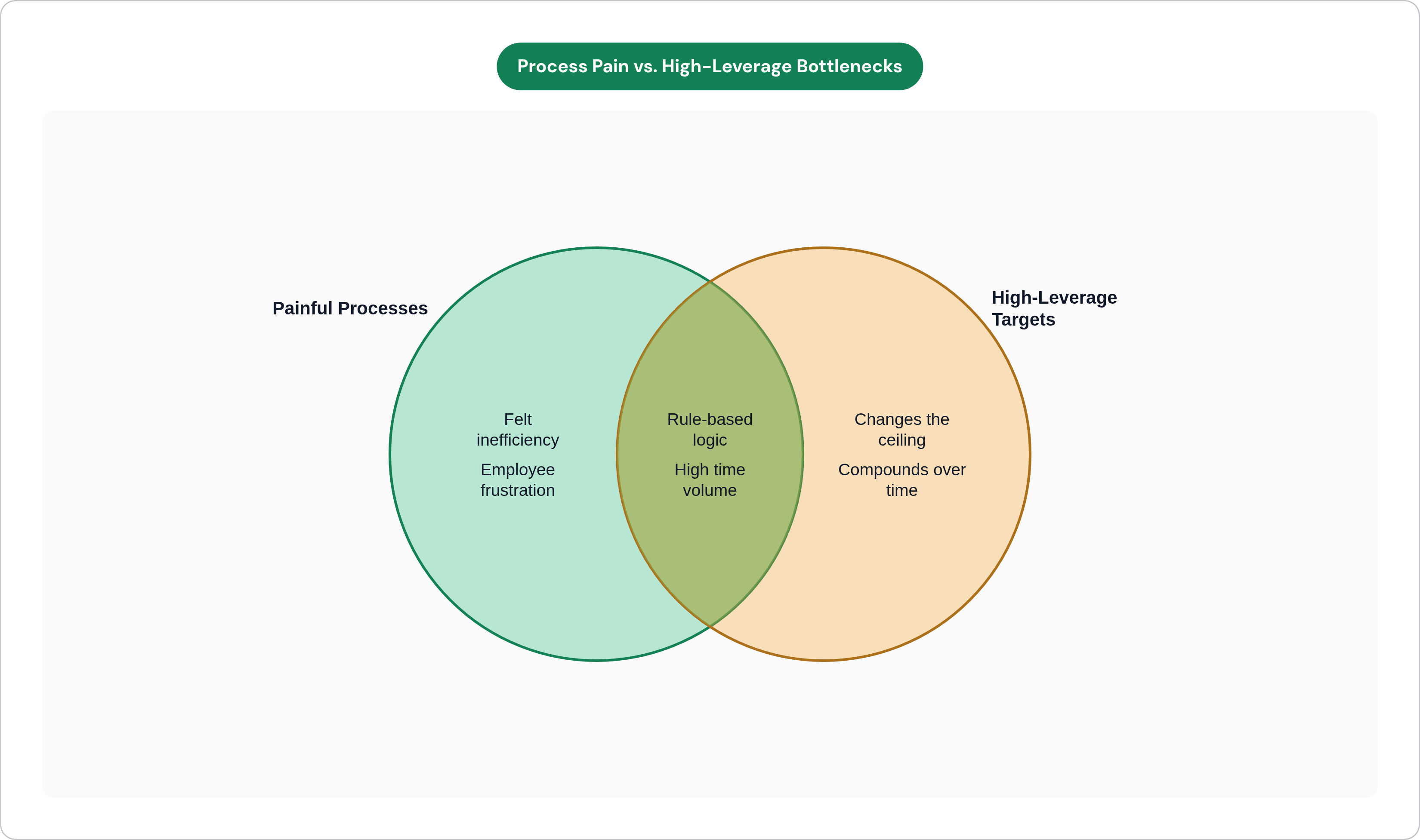
Most owners think they know their biggest inefficiency. Time audits reliably surface something different. The felt pain and the actual drain are often separate problems sitting in separate parts of the business; conflating them produces automation of the wrong thing, with considerable enthusiasm and negligible return.
High-leverage bottlenecks in small businesses concentrate in three territories.
Repetitive, structured back-office work
Data entry, invoice processing, document routing, status updates: rule-based tasks with clear inputs and defined outputs. These are easiest to automate, fastest to deploy, and most measurable in the near term. An insurance broker manually keying data between systems is a canonical example; deployments in that category have demonstrated reductions in manual data entry time on the order of 80%.
The risk is starting in the back office when the throughput constraint lies elsewhere. Freeing up hours that feed back into neither revenue nor client-facing capacity produces leaner operations and leaves the ceiling where it was. Lean is good. A different ceiling is better.
High-volume customer communication
Inquiry routing, appointment scheduling, order status, standard troubleshooting: tasks where the question is predictable even when the customer is not. AI-powered handling can cover 40 to 60% of routine inquiries without human intervention. For businesses without a dedicated support function, this can remove a ceiling entirely. The team stops choosing between answering messages and doing billable work, which is a genuinely different operating condition.
Knowledge work that bottlenecks output
Quoting, proposal drafting, report generation, content production: tasks where a skilled person's time is the actual limiting factor on revenue. HubSpot's 2025 State of Marketing report found small businesses saving five to fifteen hours per week on marketing tasks alone after embedding AI into relevant workflows. The leverage here is about increasing throughput without adding a payroll line.
A team that can produce a quote in hours instead of days competes for work it was previously too slow to win — you could say they finally stopped losing races they never signed up for. A freight company that recovered more than 160 hours per month through targeted automation did so because the identified bottleneck sat inside a high-volume, repetitive process directly constraining throughput, not a peripheral administrative task. That scale of recovery is diagnostic: it tells you exactly what category of problem they were solving and confirms the territory was right.
The category narrows the search before you apply scoring criteria, which is the actual work.
Five signals that tell you a process is worth targeting
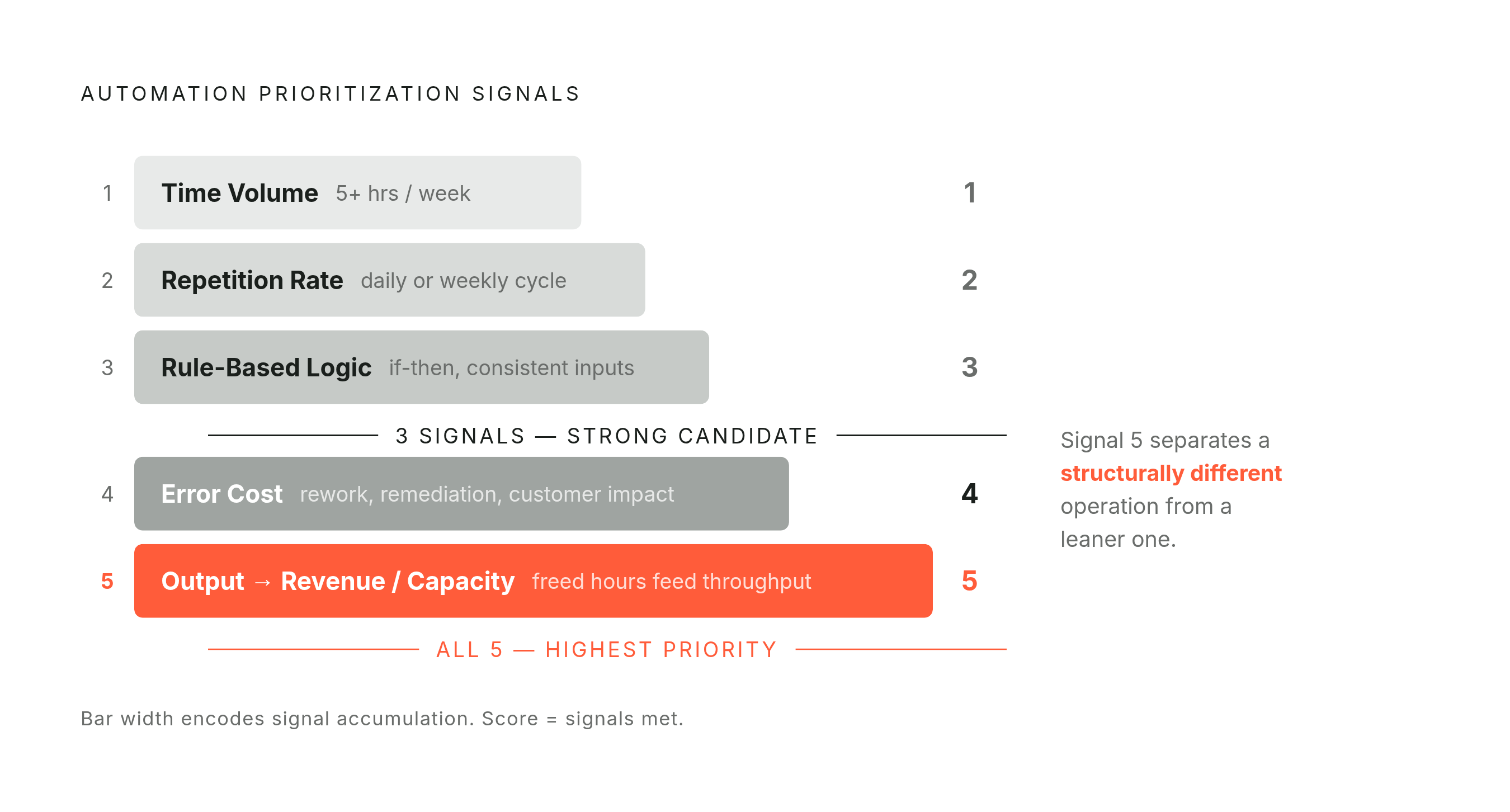
Not every painful process is the right starting point. Pain is necessary but not sufficient. The five signals below, taken together, identify a strong candidate with reasonable precision.
Time volume. The task consumes five or more hours per week across the team. Below that threshold, automation rarely justifies the deployment friction.
Repetition rate. The task runs daily or weekly on a predictable cycle. Irregular or seasonal work is harder to build reliable systems around, and the ROI calculus rarely pencils out in the short term for tasks that appear four times a year.
Rule-based logic. Clear if-then structure, consistent inputs, defined outputs. The less judgment the task requires, the faster and more reliably AI performs it. Judgment-heavy work is automatable, but a worse starting point when you are trying to prove the model quickly.
Error cost. Manual mistakes in this process are expensive, whether measured in rework time, customer impact, or downstream remediation. Accuracy improvement has real economic value beyond time recovery, and it is considerably easier to quantify for stakeholders who remain skeptical of AI ROI arguments.
Output connection to revenue or capacity. The process, if freed up, directly feeds throughput, client delivery, or a service line the team cannot currently offer.
A process meeting three or more of these criteria is a strong candidate. A process meeting all five is the highest-priority target in the building.
The fifth signal is the differentiator. A business that recovers hours in a process disconnected from output has leaner operations; a business that removes the constraint on a revenue-driving process has a structurally different operation, a distinction that compounds significantly over six months.
The practical exercise is straightforward: map your five most time-consuming recurring tasks against these five signals and write the scores down. The ranking becomes self-evident before you finish. When two processes score equally, default to the one with clearer rule-based logic. It will deploy faster, prove out the model sooner, and give the team a concrete win to build from.
How to run the audit in a business without dedicated ops staff
The audit does not require a consultant or a dedicated analyst. It requires a few hours of structured attention from whoever actually knows the work, which in a five-to-fifty person business is usually the owner or a department lead who has been around long enough to know which processes are quietly eating the company.
Step one: time mapping before touching any tool. Ask every team member to log how they actually spend their time for one week. What they actually did, regardless of what their job description says. The gap between what owners believe takes the most time and what the log reveals is frequently the first useful finding, and it tends to be humbling in proportion to how confident the owner was going in. Look specifically for tasks that appear on multiple people's logs; shared bottlenecks are higher leverage because solving them multiplies across the team.
Step two: map the process, not just the task. For each candidate, walk the steps end to end: input, handoffs, decisions, output, and what happens when something goes wrong. Identify where time actually concentrates. A task that "takes two hours" is often twenty minutes of real work surrounded by ninety minutes of coordination, chasing approvals, and reformatting data from one system into another. AI can eliminate the ninety minutes of coordination and reformatting, leaving the twenty minutes of real work untouched. That distinction determines whether the deployment produces a meaningful result or a marginal one.
Step three: score against the five signals. Write the scores down. Do not hold them in your head. The act of writing forces precision, and precision is the audit's entire purpose.
Step four: identify the one process with the highest score and the clearest rule-based logic. This is your pilot candidate. One process, chosen precisely because a single focused experiment proves the model where a scattered portfolio cannot.
One practical constraint deserves explicit acknowledgment: a significant share of SMBs hit implementation roadblocks because of insufficient technical expertise in-house. This is why the pilot should begin with one internal power user who understands the process deeply, not a company-wide rollout with training decks and a change management plan that gets read by no one. Small, fast, and working beats ambitious, slow, and stalled in essentially every documented case.
The audit is a diagnostic: its output is a ranked list and a clear first target. Scoping what "built and working" looks like for that one process in thirty days is a different document and a different conversation.
What a useful audit output looks like (and how to avoid the common mistakes)
A finished audit should produce three things, and only three things: a ranked list of candidate processes scored against the five criteria; a clear first-priority target with a written description of the current process, the specific bottleneck within it, and the measurable outcome that would signal success; and a realistic account of what deployment actually requires, which tools, whose time, and what a working version looks like in thirty days.
A finished audit stops well short of a list of ten AI tools to evaluate, a sweeping transformation roadmap, or a recommendation destined for a slide deck referenced once and never revisited.
The most common audit mistake is picking the most painful process rather than the highest-leverage one. Pain and leverage overlap frequently but not always. A painful process disconnected from output or throughput is a comfort improvement: the team feels better while the business performs the same. Conflating the two is expensive.
The second common mistake is waiting for a perfect process map before starting. The audit needs to be good enough to identify a clear first target, a bar most businesses can clear in two focused weeks if someone treats it as a priority rather than a background project that gets done when things slow down, which they never do.
The third mistake is measuring too early. Early utilization signals typically become visible within sixty to ninety days. Attributable impact on throughput and quality generally requires six months after workflow integration and proficiency ramp. Every audited business that forced an ROI verdict at thirty days was measuring adoption friction, not return. The verdict was wrong, and the conclusion drawn from it was costly and occasionally irreversible.
The audit's purpose is to compress the decision about where to start from months of scattered experimentation to a defensible answer in two weeks. After that, the job is simply to move.
What happens after the audit: from first win to compounding capability
Most small businesses have a prioritization problem, and the proliferating tool landscape is making it considerably worse: use is scattered, ownership is unclear, and returns are not compounding. According to the U.S. Chamber of Commerce, 58% of small businesses used generative AI in 2025, up from 40% the year prior, but most of that use is ad hoc. Someone drafting an email. Someone summarizing a meeting. No system, no owner, no measurable throughput change. What separates businesses seeing real returns from those accumulating subscriptions is whether they have identified the right place to apply the tools.
The audit identifies the first target. The initial deployment proves the model. The first win creates conditions for the second. This mechanism operates like compound interest — slow and invisible at first, then suddenly obvious, and structurally difficult to reverse once it starts moving.
The path follows a recognizable shape. The first system removes the most acute bottleneck: hours recover, errors drop, one process runs reliably without manual intervention. The second system is usually adjacent, because the team capacity freed by the first deployment can now address the next-highest-leverage constraint. Over six to twelve months, the business's capability profile changes because the ceiling on what the existing team can handle has shifted.
For a five-to-fifty person firm, that shift has concrete expressions. Quoting fast enough to compete for work that previously went to larger, better-staffed competitors. Taking on a service line the team was previously unable to staff, because a person's time was freed from a task AI now handles. Making decisions that previously required a specialist the business could not justify keeping on payroll.
The same dataset of 102 audited SMBs found that after systematic optimization, average ROI increased 3.5 times, and 60% achieved AI investment break-even within three months. The through-line in that data is sequencing: deployment landing in the right place because someone did the diagnostic work first. The tools are widely available and largely undifferentiated at the category level.
The businesses that reach this point started with one honest look at where their time actually went, identified the highest-leverage target from what they found, and built something that worked. Then they did it again.