Guest Complaint Escalation Workflow for Small Property Managers
A tiered system that routes complaints by urgency, not attention.
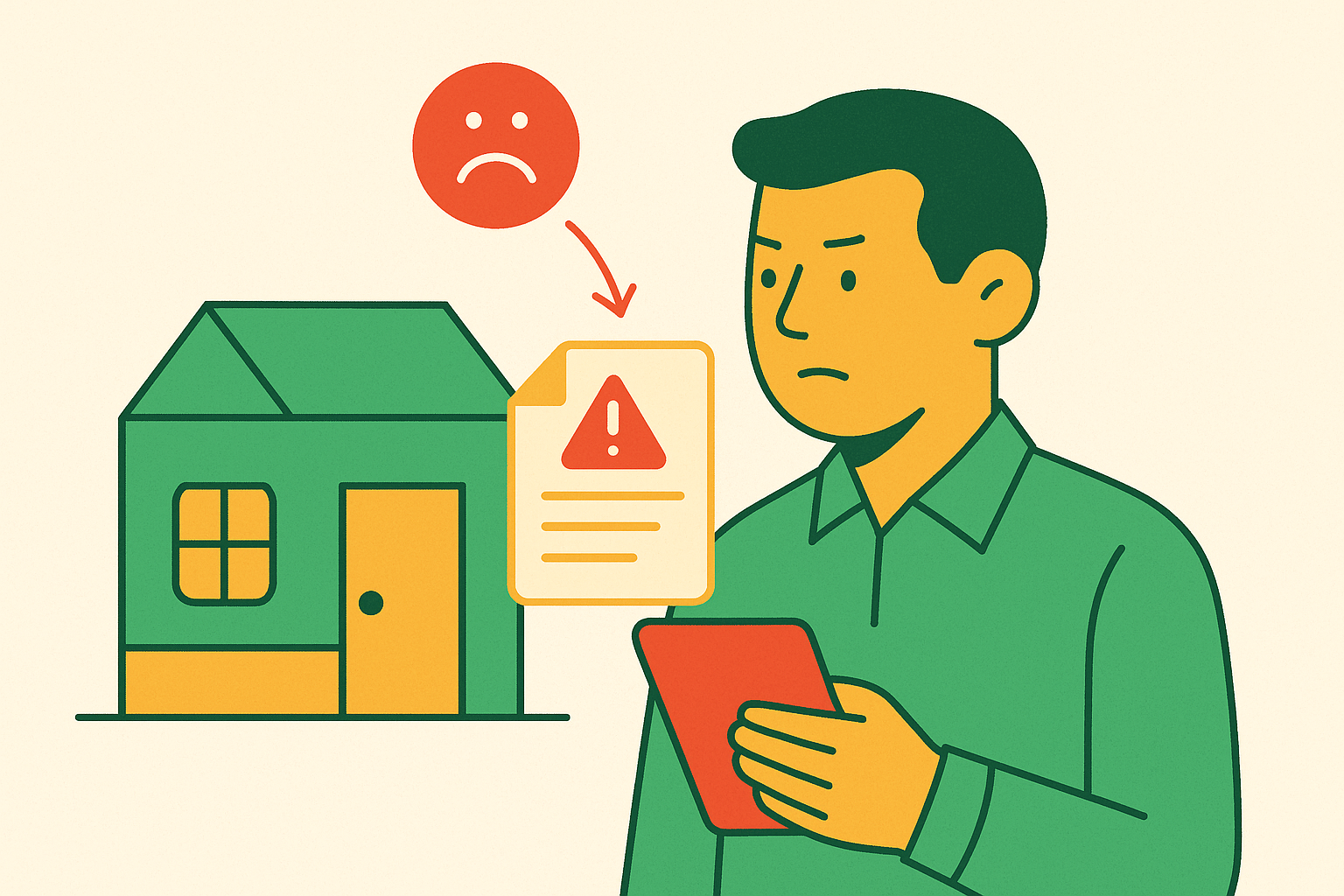
Start with the complaint itself. Not all of them carry the same weight, and treating a broken thermostat the same as a burnt-out lightbulb runs small operators' staff into the ground.
Tier 1 covers the immediate stuff: no heat, flooding, a safety hazard, structural damage, anything that stops a guest from functioning in the space they paid for. These need acknowledgment within minutes, and they need to hit the manager and the relevant vendor simultaneously. Tier 2 is same-day territory: noise complaints, a unit that's too hot or cold for comfort, missing amenities, a cleanliness issue that isn't dangerous but isn't acceptable either. Whoever's on messaging duty handles the first response and pushes updates as the fix happens. Tier 3 is everything else: billing questions, checkout feedback, minor preferences. That gets queued for the next business window and logged for later review.
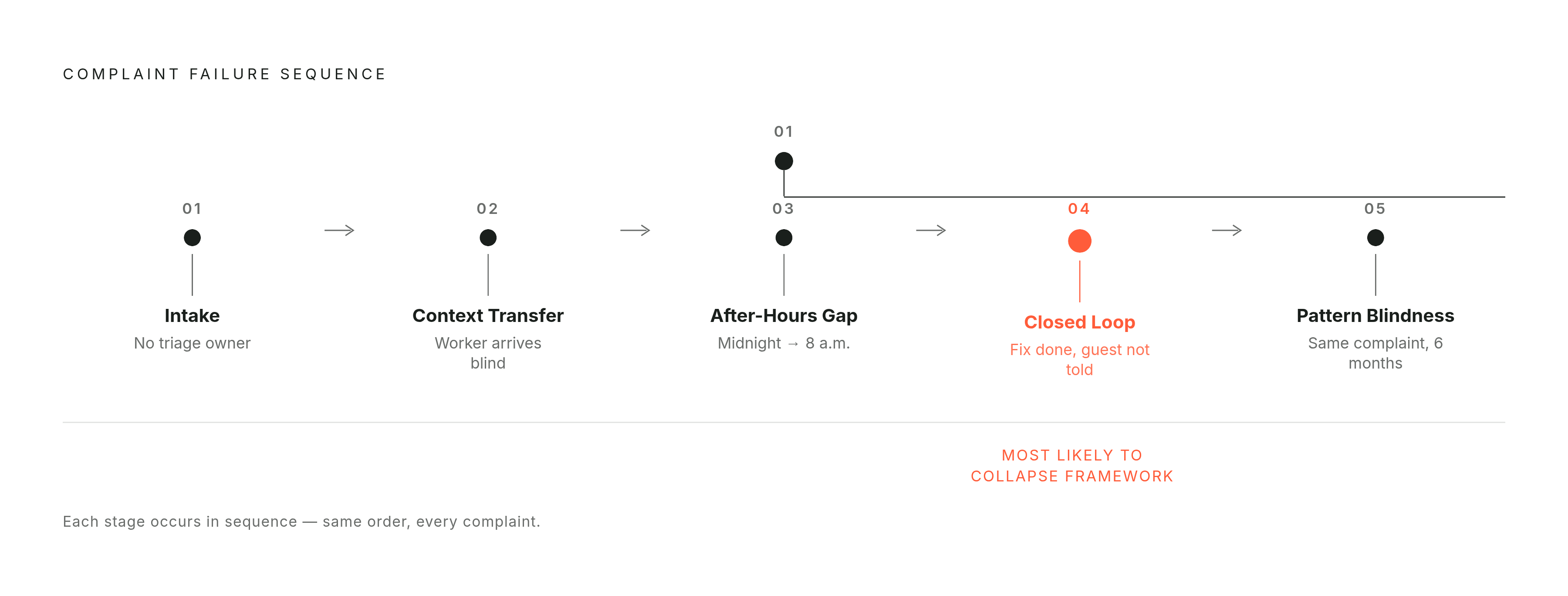
None of this works without naming names. Who receives the complaint, who confirms they've received it, who tells the guest it's handled: all three roles need an owner before the system goes live. Operators routinely complete the fix and then fail to inform the guest, treating those as one event when they are two. Skipping the confirmation step collapses the whole framework into good intentions.
Every complaint gets logged with a timestamp, a tier, the action taken, and the outcome. Legal cover is a side benefit; pattern visibility is the primary reason. A log is the only way anyone finds out the same HVAC unit has failed four times this year instead of once, memorably, last week.
Here's the limit, though. This entire framework runs on human attention, and human attention is finite. Spread it across a five-property portfolio managed by three people, and something gives. Usually the thing that gives is the guest who complained politely, because the system rewards whoever escalates loudest, leaving polite complainers behind.
Where the manual chain drops complaints and why it happens predictably
Watch a typical complaint move through a small operation, and the failure points show up in the same order every time.
First, intake. A complaint lands in a group chat, an email, or a phone call, and triage across all three goes unowned. Something submitted by email at 11 p.m. sits there until someone happens to check it, which in practice means it sits there until morning. Second, context transfer: the cleaner or maintenance worker who shows up has no booking details, no guest history, no idea the guest already sounded furious in the original message. They walk in cold, fix what's visible, and miss what the guest actually complained about.
Third, after-hours gaps. Tier 1 issues arrive at any hour; the manual chain is confined to business hours. The inbox goes unwatched at 2 a.m., so a no-heat complaint at midnight gets a response at 8 the next morning, by which point the guest has already found the one-star review button. Fourth, the closed loop breaks. Maintenance fixes the issue and the guest hears nothing, reading the silence as being ignored. Fifth, pattern blindness: the aggregate goes unreviewed, so the same complaint about the same unit recurs for six months before anyone recognizes it as a pattern rather than bad luck.
This is the predictable output of a system that routes by attention instead of by rule, and the same five gaps show up in nearly every small operator's workflow regardless of how good the individual staff are. A bad system produces bad outcomes regardless of the quality of the people running it. That is where AI earns its place: as a patch for the five gaps that exceed what human attention can hold shut.
How AI slots into each stage of the escalation chain without replacing the human judgment it still needs
Start at intake. AI reads incoming messages across channels, assigns a tier, and routes the complaint, which removes the single biggest point of attention dependency in the chain. Sentiment matters as much as keywords here: a system that pattern-matches on the word "broken" while missing that the guest sounds one bad night from a scathing review causes more harm than it prevents. Returning guests get recognized, intent gets parsed (no heat reads differently than a noise complaint), and escalation rules apply the same at 3 p.m. as they do at 3 a.m.
When something does need a human, the handoff matters. AI hands the staff member a full summary: booking details, prior messages, tier assigned, whatever's already been tried. The person picking up the phone starts informed, which fixes the second failure point directly.
After-hours coverage follows the same logic. AI answers, triages, and routes Tier 1 issues overnight; Tier 2 and Tier 3 complaints get queued with full context intact so the morning team starts with everything it needs. For responses, AI drafts a first pass and a human reviews and sends it, which keeps the manager's voice in the message and eliminates the blank-page delay that stretches a five-minute reply into a two-hour one. Once a fix gets logged, AI triggers the confirmation message automatically, closing the loop that humans most often drop when relying on memory.
There's a hard line. Decisions about what counts as an emergency, what a habitability standard requires, what carries legal exposure, or whether a repair meets code remain human calls, full stop. Damage disputes and formal complaints always route to a person who receives the entire conversation history.
One more function runs quietly underneath all this: pattern detection. AI aggregates the logs and surfaces what's recurring by property, by vendor, by complaint type, which is the insight the manual chain lacks the time to generate. Cross-referencing six months of maintenance tickets by hand is beyond what a three-person team can spare time for.
How far small property managers have actually moved on AI adoption
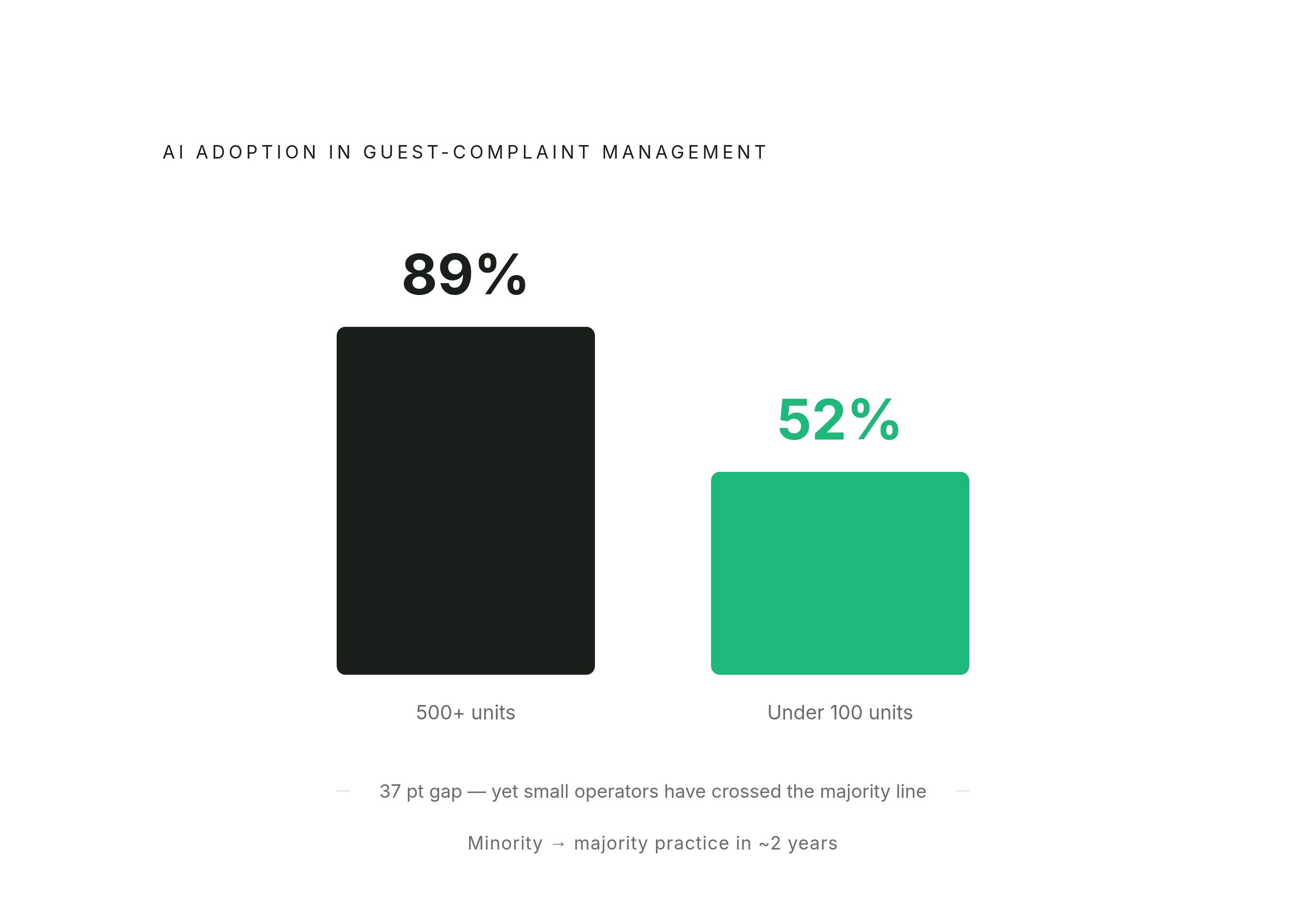
The adoption curve moved fast here. AI use in property management shifted from a minority practice to a majority one in roughly two years, one of the steeper adoption curves in any small-business category.
The portfolio-size split tells the more interesting story. Managers running large portfolios, 500-plus units, report AI adoption around 89%. Operators under 100 units sit at 52%. That's a real gap, but 52% still clears the majority line; guest-complaint AI has moved well past the early-adopter niche, whatever the vendor pitch decks imply.
What's getting automated first varies by operator, though routine and high-volume tasks tend to lead adoption. Operators moving on guest complaint escalation now are likely ahead of most peers still at the tool-adoption stage rather than the system-deployment stage. One caveat matters more than the adoption number itself: most of what counts as "AI adoption" industry-wide remains at tool-stage rather than system-stage. Using an AI feature bolted onto existing software differs substantially from running an agentic, end-to-end deployment, and most operators, in most industries, sit on the tool side of that line.
What the AI actually does inside the workflow matters more than being in the 52%. A chatbot dropped into an existing group chat that nobody asked for leaves all five failure gaps open and adds a sixth thing to check.
What the ROI actually looks like for a small operator who implements this correctly
Property-management-specific AI implementations report average annual ROI around 287% within 18 months of deployment. That number is worth anchoring to, and worth interrogating, because the gap between implementations that hit it and the ones that fall short comes down to preparation over tool selection.
Customer support automation can pay back relatively quickly, because the labor hours recovered are immediate and countable: hours not spent manually triaging messages, hours not spent drafting replies from a blank screen. That puts it in a different category than something like predictive maintenance, where the payoff is diffuse and arrives later.
Here's the counterweight, stated plainly: many AI implementations deliver limited or no measurable gain. Strong returns follow when AI sits inside an actual bottleneck; disappointing ones follow when it gets layered on top as a nice-to-have. For property managers, the bottleneck is specific and nameable: complaint intake, triage, after-hours coverage, closed-loop confirmation. Four functions, all currently running on finite human attention, all failing in the same predictable order.
The return includes hours saved and the ability to take on a sixth or seventh property without the failure rate climbing in step. That part resists clean capture in a spreadsheet built around hours-per-week.
AI versus hiring a dedicated guest-response person: the honest comparison
Here's the actual math small operators run in their heads before deciding whether to hire a person or build a system.
A full-time U.S. hire for this function carries costs well beyond the salary line. There's benefits, onboarding time, the ramp period before that person is fast and confident on the job, and the standing risk they leave in year two and the ramp starts over from scratch. AI subscription costs vary with feature set and ticket volume, but across a multi-year horizon, that cost falls well below a full-time salary.
AI covers what a single hire structurally cannot: availability at 2 a.m., simultaneous coverage across five properties at once, and identical application of escalation rules regardless of who is on duty that night. A tired night-shift hire cuts a corner eventually; the routing logic stays consistent, holds up through bad nights, and runs indefinitely.
AI still hands off the same territory flagged earlier to humans: Tier 1 emergencies requiring judgment calls, damage disputes, and guest situations needing actual empathy and negotiation rather than a templated reply. The right structure is a hybrid built as one from day one: AI owns intake, triage, drafting, after-hours routing, and closed-loop confirmation, while a human owns escalations, relationship repair, and anything carrying legal or safety weight.
Run that hybrid out five years, and the automation side costs a fraction of a full-time hire, even after setup, subscriptions, and an ongoing maintenance retainer. The math keeps compounding in favor of the system for the tasks it's built to own, and it reverses the moment those tasks shift to judgment calls beyond the system's design. Operators who ignore that boundary end up with an AI that mishandles a damage dispute at 3 a.m. and a guest who now wants a refund and an apology.
How a small property manager actually gets this built and running without a dedicated tech team
Sequencing matters more than scope. Diagnose the single handoff failing most often, usually after-hours intake or the closed-loop confirmation step, and build around that first.
A realistic 30-day build looks like this: intake classification and routing live in week one. The draft-and-confirm loop and after-hours coverage come online in weeks two and three. A pattern-detection dashboard ships in week four. Each stage goes live working and gets refined once it's handling real complaints rather than test cases.
For operators without an internal technical team, a fractional or embedded engineer is the practical route: someone who builds the production system, wires it into the existing property management software, and hands over runbooks the team can actually run without calling back every time something changes. That cost structure fits the actual size of the problem rather than overbuilding for it.
Initial setup for a system covering intake, routing, drafting, and closed-loop automation tends to fall in a range most small operators recover from labor savings within a few months. Ongoing maintenance retainers are real, and they belong in the budget from day one, planned rather than discovered six months in.
This remains a living project after it ships. A working escalation system generates its own pattern data, and that data points to the next thing worth fixing: a vendor underperforming across three properties, or a complaint type that keeps recurring in one specific unit. The team running the system day to day ends up informing what gets built next. That's the whole point of logging any of it.
The ceiling on a small property management operation has always been the absence of systems that let a small team operate with the consistency and coverage that would otherwise require a much larger one.