Market Research for Small Business on a Minimal Budget
AI tools and low-cost methods replace expensive market research for small businesses.

Most small businesses either skip market research entirely or spend money they don't have on firms charging $15,000 for a study they'll need to repeat in three months. Both are avoidable. What a small business actually requires is directional intelligence: enough signal to make a better pricing call, sharpen a positioning message, or decide which service to build next. AI tools and a disciplined sequence of low-cost methods can now deliver the bulk of that intelligence for a fraction of what a traditional agency charges. This article maps out how.
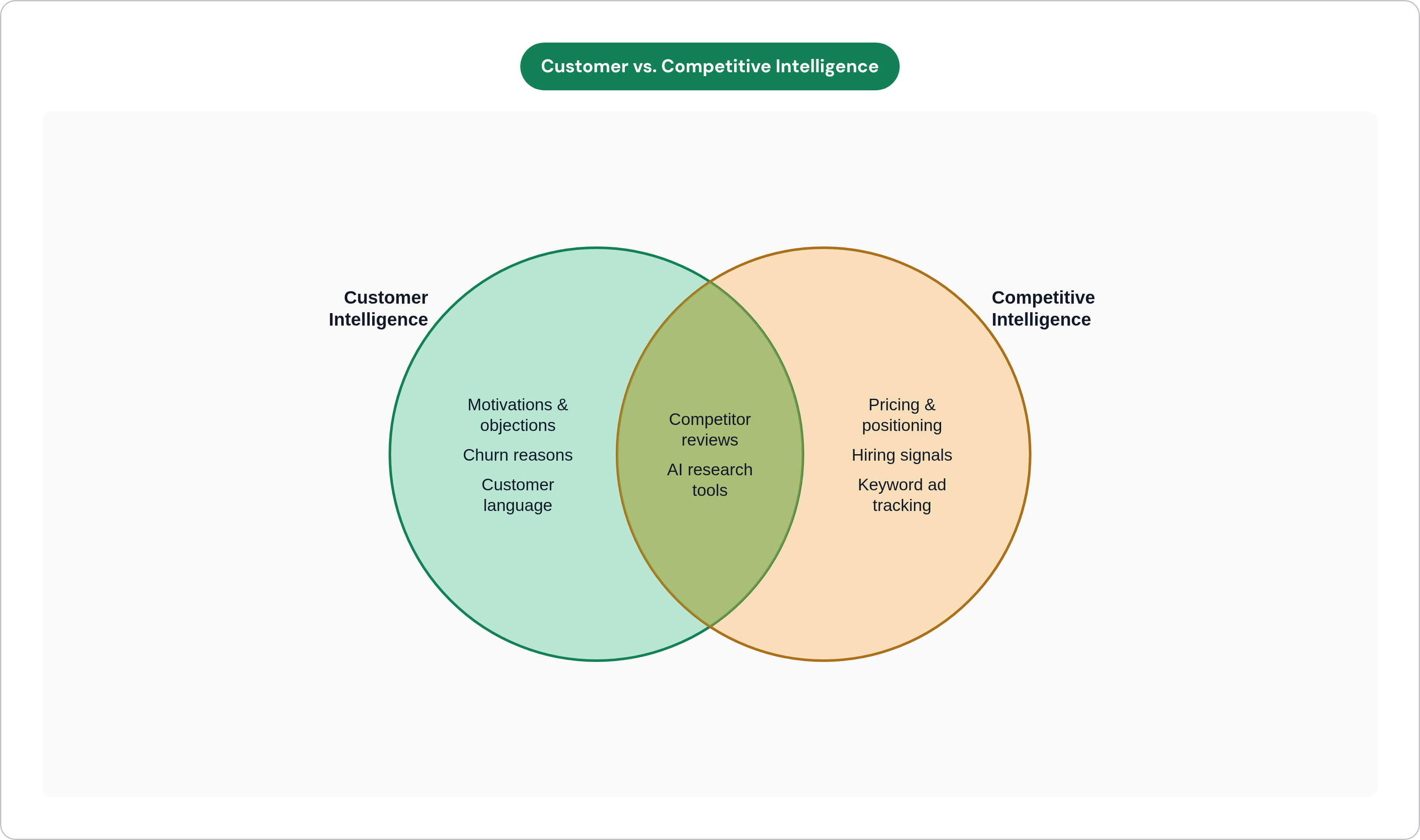
The working mental model is market research as a standing habit of listening: a practice embedded in daily operations rather than a PDF delivered once and left unread on a shared drive. Two distinct modes serve different purposes. Customer intelligence covers motivations, objections, the language customers use, and how satisfied they actually are. Competitive intelligence covers how rivals position themselves, how they price, and where they're winning. Most small businesses are, by virtue of their size, closer to their customers than any research firm from a distance. The methods below exploit that proximity instead of trying to circumvent it.
Almost every consequential small business decision traces back to one of three questions: Who buys from me, and who doesn't but could? Why do they choose me over alternatives, or alternatives over me? What are competitors doing that I'm not? That is the full scope of what most SMBs need to know. Nationally representative samples, longitudinal panels, and brand-tracking studies are instruments built for companies with millions of customers and research departments to interpret them. A small business owner without either should resist the impulse to replicate that apparatus.
Start with what you already have: mining existing customers for signal
Before spending time or money on new research, interrogate what already exists. The richest, most overlooked sources for most small businesses are: past customer emails and support conversations, sales call notes and documented reasons for lost deals, repeat-versus-one-time purchase patterns in a point-of-sale system or CRM, and the accumulated body of testimonials and reviews on Google, Yelp, or wherever customers are vocal.
What you're looking for is recurring language. The exact phrasing customers use to describe their problem before they found you is worth more than any demographic breakdown, because it is the raw material of effective positioning. Pull the last few dozen customer interactions and tag each by theme: pricing concern, competitor mention, feature request, timing issue. Patterns surface within an hour.
Competitor reviews deserve particular attention as a research instrument. One- and two-star reviews of your competitors are, functionally, a wish list: they describe what those customers wanted and didn't get, which is a direct input for your own positioning. Five-star reviews of competitors reveal what those customers value most, useful for benchmarking your messaging against what the market actually rewards. The whole exercise costs nothing except the discipline to treat it as structured analysis rather than a casual browse.
Low-cost customer interviews and surveys that produce real answers
A handful of customer interviews, conducted well, will surface more usable insight than a 200-person survey. This is not conjecture; it reflects how qualitative research works. Surveys validate themes at scale. Interviews generate them. Running the survey first, before you know which themes matter, produces data that confirms the survey designer's existing beliefs.
The right people to interview are recent buyers, recently churned customers, and people who requested a quote but didn't convert. Each group answers a different question. Recent buyers explain what made you credible. Churned customers explain what broke the relationship. Non-converters explain what alternative seemed safer, and why. The single most useful question to ask any of them: "What were you doing or using before you found us, and why did that stop being enough?" The answer almost always reveals the job the customer is hiring you to do, in their own words.
Keep the conversations conversational, roughly 20 to 30 minutes, and record them with permission. Otter.ai transcribes automatically and is available at a modest cost. After interviews, surveys become useful for testing whether what you heard is broadly true or idiosyncratic. Free tiers of Google Forms and Typeform handle most SMB survey needs without issue. Keep surveys under ten questions; response rates decline sharply beyond that. One well-crafted open-ended question, something like "What almost stopped you from buying?", consistently yields more insight than five multiple-choice items.
Incentives matter more than most owners expect. A small discount code, a gift card drawing, or simply a personal note explaining why the feedback is genuinely useful will move response rates. Once data is collected, AI tools can cluster and summarize transcripts and survey responses quickly, compressing analysis time without requiring a dedicated analyst.
Using AI tools to accelerate secondary research without a research budget
Secondary research (the process of reviewing existing reports, publications, industry data, and competitor materials) has historically consumed a disproportionate share of total market research time, which most small business owners cannot spare. AI tools have changed the calculus.
Perplexity operates as a research librarian that reads hundreds of sources simultaneously and returns cited, synthesized summaries. Its free tier handles basic queries adequately; its Pro plan unlocks a Deep Research mode that autonomously scans hundreds of sources and produces a structured report, at a monthly cost comparable to a few cups of coffee. ChatGPT Plus and Claude Pro run at similar price points and can analyze uploaded documents, PDFs, and spreadsheets, which makes them useful for processing trade reports, competitor pricing pages, or any external material already collected.
Practical tasks AI handles well at minimal cost: summarizing industry reports the owner doesn't have time to read in full, identifying pricing patterns across a category by ingesting publicly available pricing pages, pulling themes from a batch of customer reviews across multiple platforms, drafting a survey instrument based on a described research objective. The honest limitation is that AI secondary research reflects only what is publicly available and already published, missing unpublished competitor plans and unspoken customer motivations. The interview methods described above cover those gaps.
Competitive intelligence on a small budget: what's observable and how to track it
A meaningful share of what a small business needs to know about its competitors is observable without any proprietary tool or budget. Pricing is listed on websites or extractable by calling as a prospective customer. Positioning language lives in website headlines, Google Ads copy, and social bios. Service gaps appear in FAQ sections and in review complaints. Hiring activity, visible through job postings, signals where a competitor is allocating resources: a new operations hire suggests scaling capacity; a new sales hire suggests a push into different segments.
Free and low-cost tools make tracking these signals systematic and consistent. Google Alerts on competitor names and relevant category keywords provide persistent, automated monitoring at no cost. SimilarWeb's free tier offers rough traffic estimates on competitor websites. SpyFu and Semrush both have free tiers that surface the keywords a competitor is bidding on in Google Ads. LinkedIn headcount and hiring trends are observable without a premium subscription.
Every sales team I've spoken with that adopted structured competitive intelligence reported meaningfully higher win rates, consistent with Klue's 2025 data. For an SMB, one hour per month reviewing a few key competitors across pricing, positioning, and service lines is sufficient to catch meaningful moves before they become surprises. Translate competitive findings into a simple positioning map: where do competitors cluster, and where is the uncrowded space? That question, answered honestly, is worth more than most market research reports.
Search and social listening as a continuous, free feedback loop
Search behavior is a window into customer problems that updates in real time and costs nothing to access. Google's "People also ask" boxes and autocomplete suggestions reveal what real customers are actually typing. Google Search Console shows which queries are already directing traffic to your site and which pages are underperforming relative to their potential. Keyword tools like Semrush and Ahrefs both have free tiers adequate for identifying high-volume terms in a niche.
Social listening without a paid tool is more tractable than most owners assume. Reddit communities and Facebook Groups organized around a business category are where customers describe their problems in unfiltered language, often with candor they wouldn't bring to a formal survey. Searching a category keyword on Reddit and reading the highest-rated threads from the past year reliably surfaces objections and competitor comparisons that no questionnaire would have prompted. TikTok and YouTube comments on category-relevant content reveal what resonates with potential customers and what confuses them. Industry forums and association publications frequently publish free research summaries, pricing surveys, and trend reports: niche-specific intelligence that no general-purpose analyst report will provide.
The critical discipline is consistency. Treating these sources as a standing weekly practice produces a compounding picture of how customer language and competitor behavior are shifting over time.
How to sequence these methods and what to prioritize with limited time
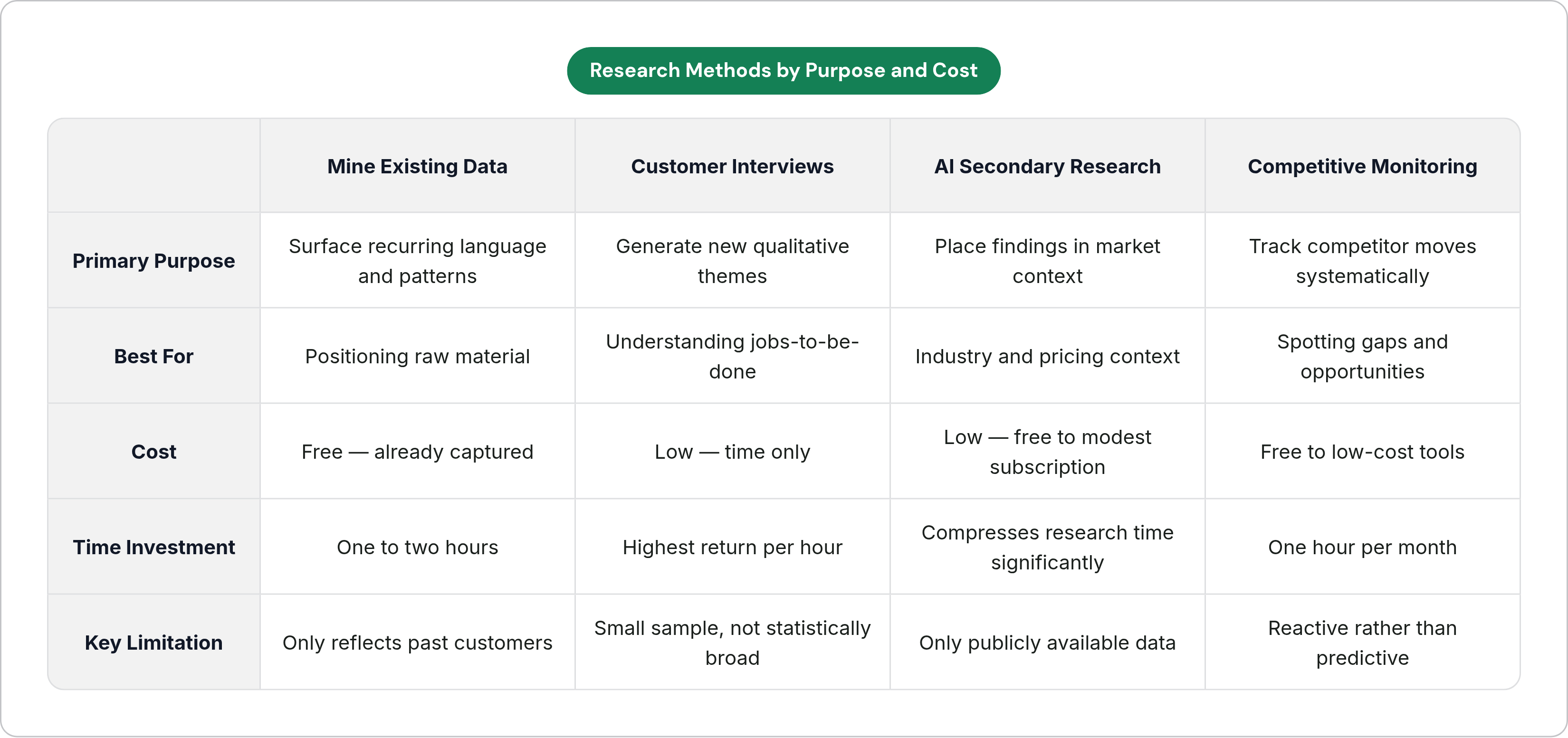
The right sequence deliberately exploits the highest-signal sources first, before incurring any recruitment cost or tool expense.
Start by mining existing customer data: reviews, emails, lost deal records. This is free, immediate, and requires no scheduling. Then conduct customer interviews. This is the highest-quality insight per hour invested in the entire process. After interviews, use AI secondary research tools to place what you heard in broader market context and to map competitor positioning. Finally, establish standing monitoring: Google Alerts, one or two social listening checks weekly, and a monthly Search Console review. Put the monthly competitive intelligence hour on the calendar before the week ends.
The prioritization logic is straightforward: start with methods that tap already-captured data, then generate new primary insight, then validate against secondary sources. The most common and costly mistake is jumping to surveys or secondary research before talking to actual customers, then constructing strategy on data shaped by existing assumptions.
The full sequence can be completed in roughly eight to twelve total hours of actual work spread across a month. The output should be a single page: a handful of customer insights, two or three competitive observations, and one positioning hypothesis worth testing. That document is enough to drive better decisions on pricing, messaging, or service development. Research sharpens judgment.
When it makes sense to go further: adding AI-powered workflow to a research process that's working
The sequence above is a starting point, not a ceiling. Businesses that run it repeatedly begin to encounter a different problem: the research habit is producing signal, but synthesizing it into decisions still consumes more time than it should. Competitive monitoring catches competitor moves too late to respond. Customer data sits scattered across a CRM, an email inbox, a review platform, and a set of call notes, and no one has the bandwidth to pull it together coherently.
This is the threshold where a more embedded approach becomes worth evaluating. An integrated AI system connects data sources that currently live in silos and surfaces patterns automatically, eliminating the manual extraction a tool stack demands on a recurring schedule. It converts a standing research process into a live operational input: pricing decisions, proposal language, and service development informed by what customers are actually saying, in close to real time.
This is also the distinction between market research as a periodic project and market intelligence as an embedded organizational capability. The latter requires the right system built around the actual bottleneck in the existing process, with no new hire or materially larger budget. SANSA's approach involves diagnosing the highest-leverage constraint first, building a production-ready system around it, and remaining embedded as that system compounds value over time. Start with the manual habit described above. When that habit is working and the ceiling becomes visible, the path to removing it is already clear.