Using AI to Synthesize Customer Interview Transcripts for Small Teams
AI tools cut interview analysis from weeks to hours, letting small teams research continuously.
The real bottleneck in customer research for small teams is processing interviews, not running them. A single 45-minute conversation demands roughly eight hours of a trained researcher's time to properly synthesize, which means a 12-interview study can consume two full working weeks before a single decision gets made. According to ProductPlan's State of Product Management 2025 report, 73% of product managers say their team's customer insights are trapped in call recordings that are never re-analyzed. AI synthesis eliminates that tax, and this article explains precisely how to do it.
The real cost of that backlog is the decisions deferred or made entirely without customer evidence. Teams keep sample sizes artificially small because that is all one person can hold in working memory. Interviews pile up faster than synthesis can keep pace. Eventually, teams stop interviewing entirely to "catch up," and often never restart. The trap compounds quietly until the product team is steering by intuition and calling it instinct.
What AI Synthesis Actually Does to a Transcript
AI reads, codes, and synthesizes interview transcripts into themes, representative quotes, and decision-ready summaries in hours instead of weeks. That sentence sounds simple, and the simplicity is the point.
The meaningful capability is cross-transcript pattern detection: finding what recurs across many conversations, not just what one customer articulated particularly well. A single respondent saying "the onboarding feels overwhelming" is anecdote. Fourteen respondents independently navigating to the same metaphor is a finding.
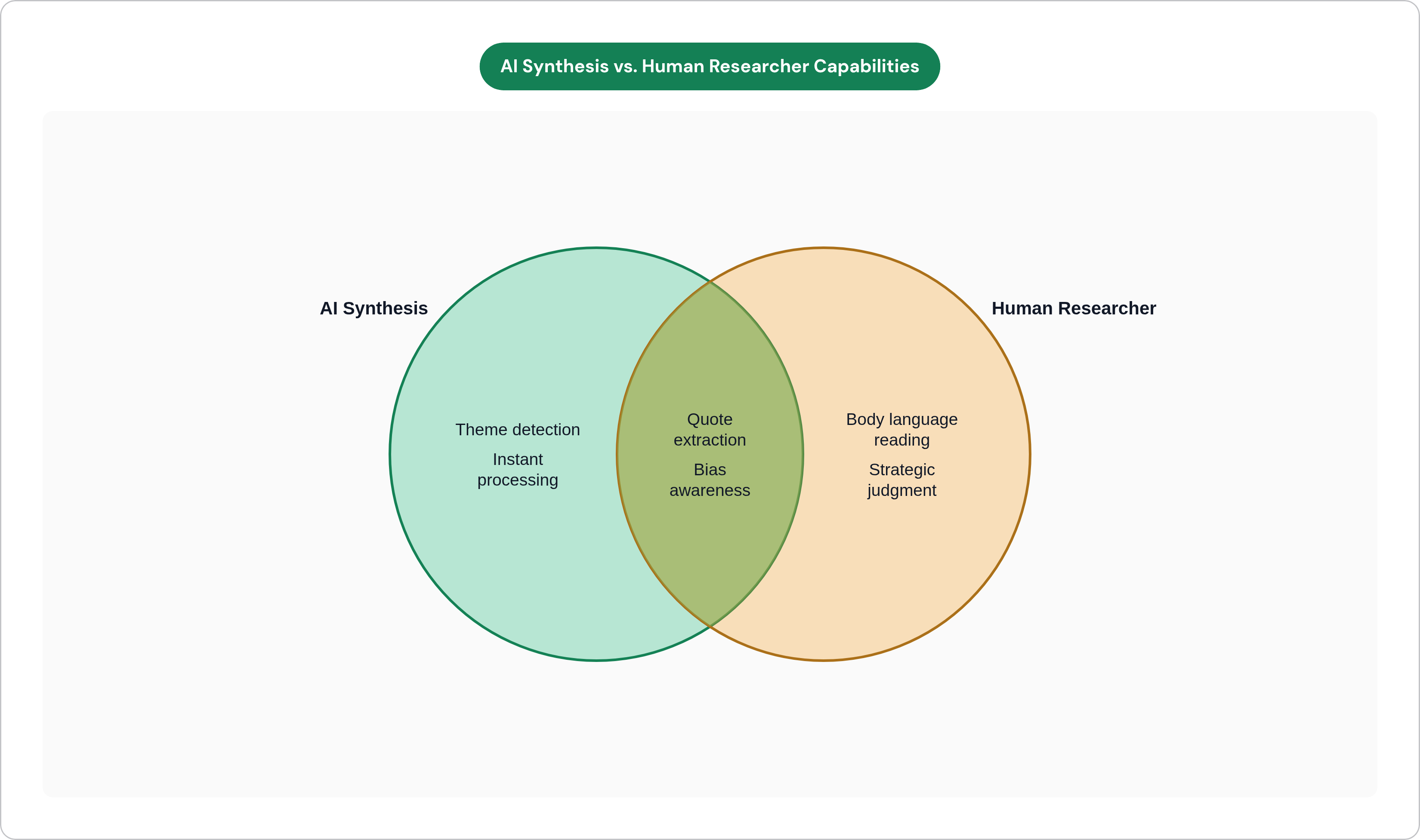
Practically, AI synthesis handles: pulling verbatim quotes that illustrate a theme, grouping responses by topic, sentiment, or customer segment, flagging outliers and contradictions a human skimming quickly would miss, and producing a synthesis brief a non-researcher can act on before lunch. When the interview itself is AI-moderated, the transcript, summary, and quote extractions arrive simultaneously with the conversation record. There is no separate processing step.
AI synthesis leaves intact the judgment about which question to ask next, whether a finding is strategically material, and how to present an uncomfortable truth to a skeptical stakeholder. The researcher's leverage moves up the stack. Teams that conflate synthesis automation with research automation will eventually make a bad call and blame the tool.
The Workflow a Small Team Can Run Without a Researcher on Staff
The design principle here is straightforward: AI takes over the sequential, time-consuming steps so the person running research can be a founder, a PM, or an ops lead rather than a trained qualitative analyst.
Step 1: Capture clean transcripts. Source from existing call recordings, prior interview notes, or purpose-run sessions. A backlog of old, unprocessed transcripts is a perfectly usable starting point. Transcription accuracy matters before synthesis begins; tools like Otter and Rev AI consistently reach 95% or better word accuracy on clean audio, but noisy recordings warrant a manual spot-check before you run synthesis on them.
Step 2: Load into a synthesis tool or paste directly into a general LLM. The tool options are mapped in the next section. The choice between them depends on volume and budget at the small-team scale, where fundamental capability differences are negligible.
Step 3: Prompt for what the team actually needs, not a generic summary. Most teams under-invest here and then blame the output. Good prompt targets include: recurring objections, unmet needs by customer segment, specific moments of friction, and the exact language customers use to describe the problem. Always ask for verbatim quotes, not paraphrases. The precise customer language is frequently the most actionable output, especially for messaging and positioning work.
Step 4: Run cross-transcript synthesis once individual transcripts are processed. Feed multiple summaries back into the tool and ask explicitly: what patterns appear across these conversations? Where do customers contradict each other? What did customers say they want that the product does not currently offer? This step is where the compounding value lives, and most teams skip it.
Step 5: Produce a one-page decision brief, not a research report. The format that actually gets used: top three themes with supporting quotes, one clear recommendation, and the open questions that require follow-up. The goal is a document someone can act on in ten minutes, not archive for later reference and never open again.
The cadence shift this enables is underrated. Instead of stopping interviews to process, teams can run continuously, reviewing AI-generated summaries weekly and synthesizing across a rolling set of conversations. Research becomes a continuous operating rhythm, a heartbeat rather than a fire alarm.
Which Tools Fit a Small Team's Budget and Workflow
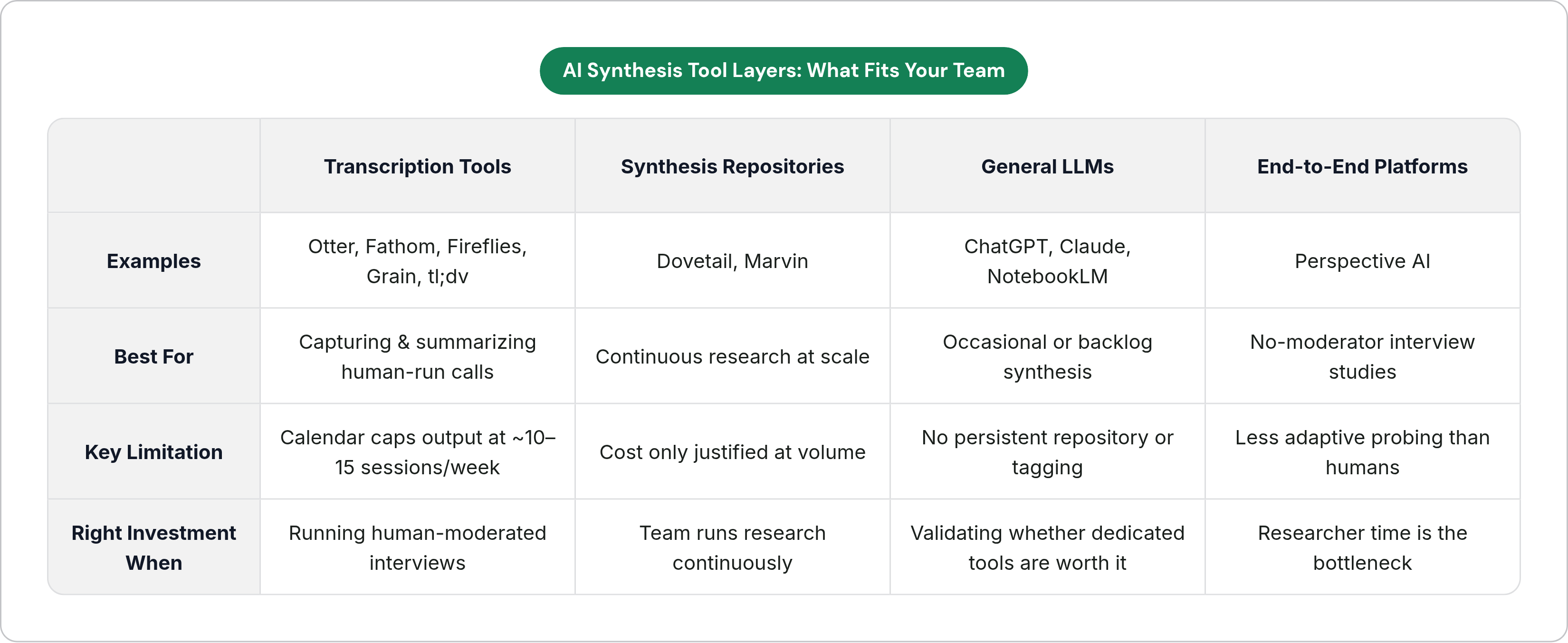
There are four functional layers, each with different tradeoffs.
Transcription and Capture
Otter, Fathom, Fireflies, Grain, and tl;dv all transcribe and summarize calls a human conducts. The practical ceiling here is the calendar, not tool capability. A solo researcher running human-moderated interviews tops out around 10 to 15 sessions per week before scheduling becomes the constraint again. For budget, Otter and Fathom are the sensible defaults. Fireflies earns its place for teams that need CRM connection. Grain is the right call when shareable video clips matter for stakeholder buy-in. tl;dv serves multilingual teams particularly well.
Synthesis and Repository Layer
Dovetail is a qualitative research repository offering tagging, codebooks, AI-assisted theme detection, and a coherent interface for teams that run research continuously. Pricing runs roughly $20 per user per month on the Standard plan and $30 on Team. Marvin is a competitor with native AI synthesis and tag-on-the-fly functionality; the Standard plan starts at $6,000 per year, which is worth benchmarking against actual research volume before committing. Both are purpose-built for the job and meaningfully outperform a general LLM when the team is running research at scale and needs a persistent repository.
General LLMs as a Lightweight Entry Point
ChatGPT, Claude, and Google NotebookLM let teams paste transcripts directly and prompt for themes and quotes, with zero additional tooling required. NotebookLM in particular is worth considering for early-stage synthesis: upload research documents, get summaries, theme identification, and even audio briefings, all without cost. The limitation is the absence of a persistent repository and cross-study tagging, requiring a manual process each time. For teams doing occasional research, or for teams validating whether AI synthesis is worth a dedicated tool investment, this is the correct starting point.
End-to-End AI Interview Platforms
Here the math changes most substantially. Platforms like Perspective AI conduct the interview itself, with no human moderator required, and every conversation arrives already transcribed, themed, and quote-extracted. The cost comparison warrants scrutiny and will vary by provider and context: published figures for AI-conducted interviews and human-moderated sessions differ widely depending on the vendor, researcher experience level, and study design, so teams should obtain current quotes before budgeting. For teams that previously could not run research without a dedicated researcher, this layer makes it feasible as part of standard project preparation rather than a special initiative.
Choosing the right layer comes down to volume. A general LLM covers the occasional backlog. A synthesis repository earns its cost at scale. An end-to-end platform is the right investment when the bottleneck is researcher time, not the number of transcripts waiting to be processed.
How Much Faster Decisions Actually Happen When the Synthesis Tax Disappears
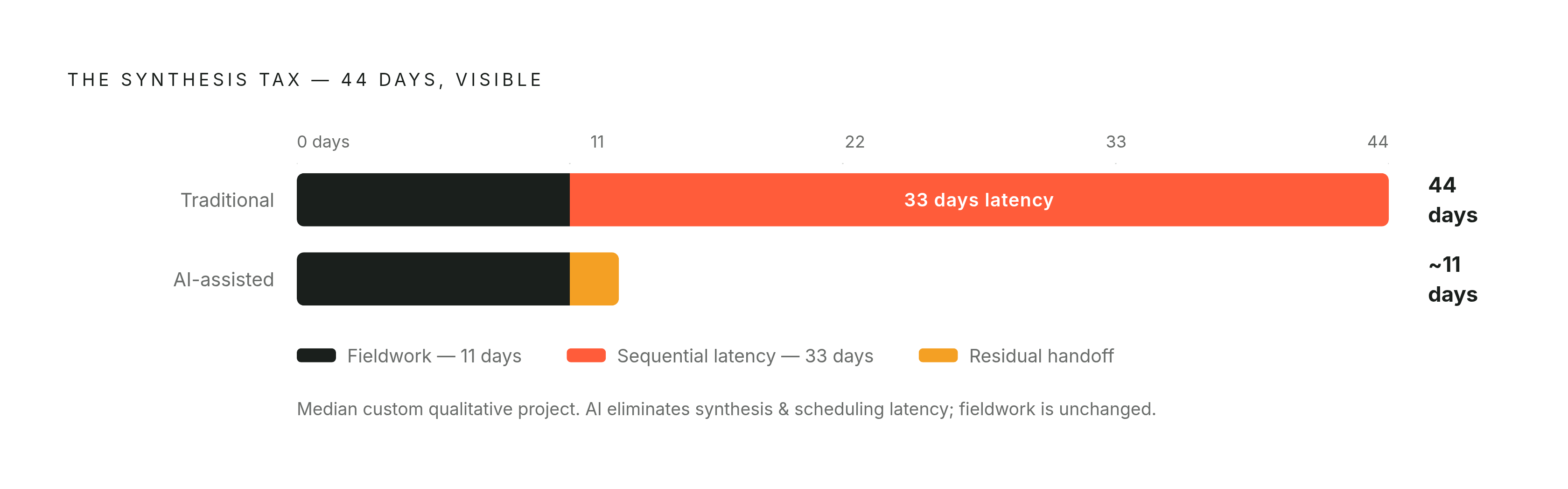
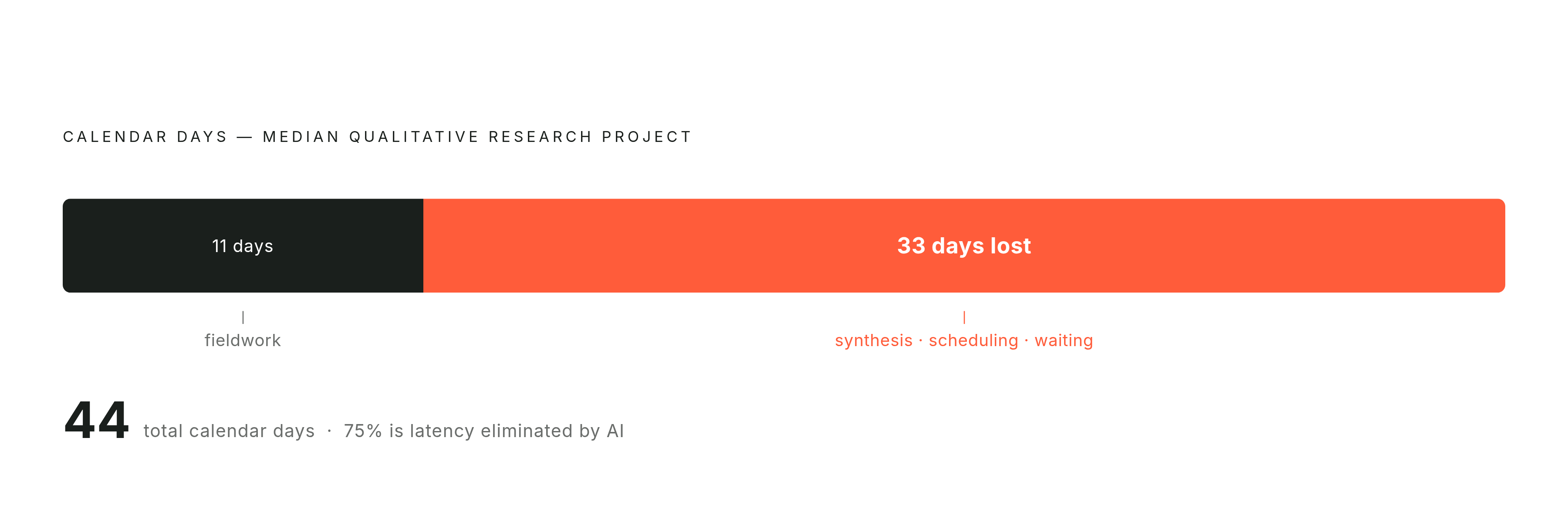
ESOMAR's benchmarking found that the median custom qualitative project took 44 calendar days from kickoff to readout, with only 11 days in actual fieldwork. The remaining 33 days were consumed by sequential workflow latency: synthesis, scheduling handoffs, and waiting. AI compresses or eliminates precisely those 33 days.
Greenbook's GRIT 2025 report documents improvements in research turnaround time for AI-moderated studies. Teams should consult the published report directly for current figures, as specific benchmarks are subject to revision.
What this means for a small team: a question that surfaces in a Monday meeting can have customer evidence behind it by Wednesday. Feature decisions, pricing changes, and messaging pivots no longer wait for a research cycle to close. The compounding effect is visible in adoption patterns as well. Roughly 41% of insights teams now run at least one always-on study, a continuously open conversation with a rolling sample, up from around 4% just two years prior — a figure cited by Greenbook's GRIT 2025 report. Small teams can replicate this model with minimal overhead.
Individual session review accelerates too. Looppanel reports teams spending 80% less time reviewing transcripts; what used to take an hour runs in 10 to 15 minutes.
Speed of synthesis still requires speed of action. The decision brief has to reach the person who can act on it, which is a workflow design question. Automating synthesis while leaving the distribution problem unsolved just moves the bottleneck downstream.
Where AI Synthesis Falls Short and What to Do About It
The quality-input problem is foundational: AI synthesis quality depends entirely on the transcript it processes. Poor audio, cross-talk, and vague interview questions produce vague outputs, and the synthesis engine will render those vague outputs with the same confident formatting it applies to strong data. Garbage in, garbage out — except the garbage arrives in a beautifully structured summary.
Leading questions are a specific failure mode worth naming. AI will faithfully synthesize what customers said, including what they said because they were asked to agree. Confirmation bias persists when AI handles synthesis and simply arrives better formatted. Very short or fragmented transcripts may not contain enough language for meaningful theme detection. The tool will produce output, but that output will be thin.
The hallucination risk is real and underacknowledged. LLMs can generate plausible-sounding themes untethered from the actual transcript, particularly when the prompt is vague or the underlying data is ambiguous. The mitigation is simple and non-negotiable: always require supporting quotes for every theme the AI names. Every theme the AI names requires a supporting quote; without one it is a claim without evidence and should be treated accordingly.
AI misses body language, hesitation, what a customer conspicuously chose not to say, and the emotional texture of a conversation. A skilled interviewer carries contextual information out of the room that does not live in the transcript and cannot be reconstructed from it. Synthesis tools permanently lack access to that information.
The small-sample caution deserves explicit emphasis. AI can synthesize three transcripts as easily as thirty, but three transcripts is still three people. The fluency and structure of the synthesis output can create a false sense of evidentiary weight. The tool makes a thin sample look polished while leaving it statistically thin.
In AI-moderated interviews, probing may be formulaic without a human reading the room. Very technical users, very reserved individuals, and non-native speakers tend to receive more productive follow-up from an experienced researcher than from an AI moderator. A human still needs to validate synthesis output against a sample of raw transcripts before using findings to drive significant decisions. That step is mandatory.
What the Team's Job Becomes When AI Handles Synthesis
The reallocation of attention is the actual value proposition, and it is more interesting than it first appears.
Time freed from coding, tagging, rereading transcripts, and writing up summaries shifts to deciding which questions matter most before interviews run, challenging the AI's interpretation of themes, and translating findings into product or business decisions. The judgment that does not automate includes: which customer segment's feedback should weight most heavily right now, whether a pattern across eight interviews is signal or noise, and how to present a finding to a skeptical co-founder or client.
The cadence change this enables is structurally different from anything a small team could previously sustain. Instead of a discrete research project every quarter, two or three interviews per week becomes viable. Review AI summaries on Friday; flag anything that changes what you are building or selling. That loop closes in days, not months.
For SMB teams specifically, this is the difference between research as a one-time investment and research as an ongoing operating habit. The kind of habit that once demanded a dedicated researcher to maintain. A founder, PM, or account manager who spends 30 minutes per week reviewing AI-generated synthesis briefs is doing more useful customer research than most teams conducting formal quarterly studies, because proximity to the customer is continuous rather than ceremonial.
The ceiling this removes is worth naming directly: small teams can now move on customer evidence without adding headcount, a shift that previously required research bandwidth they did not have. For teams that want to go further, embedding a repeatable AI synthesis workflow, connected to the tools the team already uses and with prompts tuned to the specific decisions the business keeps facing, is where one-time setup compounds into permanent capability. That is the kind of scoped, practical build that SANSA designs in weeks rather than months, and it is worth considering once the workflow has proven its value at the lightweight stage.
The synthesis tax was always a workflow problem, and workflow problems have solutions.