Operational Decision Management for Small Businesses
Systematizing recurring decisions is finally feasible for small businesses.

Small businesses stall because the decision layer, the dozens of recurring judgment calls made every week about who gets credit terms, which jobs to quote, how to price a rush order, when to escalate a service issue, remains unsystematized. Operational decision management is the discipline that addresses that, and AI is what finally makes it practical at the scale most small businesses actually operate.
ODM is a practice of taking recurring decisions, ones made often, by rule or by judgment, and building explicit, consistent logic around them so they can be handled consistently every time a similar situation arises.
What qualifies as an operational decision? It recurs. The same type of situation surfaces repeatedly. It follows some logic, even when that logic is currently implicit, inconsistent, or held by a single person. And it carries real consequences: pricing, customer experience, compliance, resource allocation. Get these calls wrong often enough, and the business feels it.
ODM is about consistently executing the policies the business already has. A lot of owners conflate the two and then treat every operational call as though it demands fresh strategic thinking. Most operational calls require consistent execution, not fresh strategy. That conflation is expensive.
Traditionally, ODM was an enterprise discipline. Rules engines. Decision tables. IT infrastructure, dedicated teams, six-month implementation timelines. The tooling was built for organizations that could absorb that overhead. Small businesses couldn't, so they kept making decisions the manual way, which meant the owner kept making decisions the manual way, forever.
What's changed is what AI can encode. A rules engine says: "If credit score is below X, decline." An AI-informed decision says: "Given payment history, order size, industry, and the length of the relationship, here's the risk-adjusted recommendation." That's the shift that makes ODM viable at the small business scale in a way it simply wasn't before.
Where operational decisions actually live in a small business
If you've had to answer the same question twice, you've already paid the price of having no system.
Quoting and pricing: when to discount, how to price a non-standard job, whether a prospect is worth a custom proposal. Credit and payment terms: which customers get net-30, when to flag an account, when to escalate a late payment. Scheduling and resource allocation: which jobs to take when capacity is tight, how to sequence work, when to bring in a subcontractor. Customer triage: which service issues get escalated, which can be resolved by staff, what warrants a callback from the owner. Supplier and inventory decisions: when to reorder, which vendor to use under which conditions, how to respond to a supply disruption.
Every one of those decisions is made frequently. Every one currently depends on someone's memory of how it's been handled before. And every one produces different outcomes depending on who's in the room when it comes up. That last part is the real problem.
Sector-specific texture makes this more concrete. In insurance, it's coverage recommendations, renewal triage, document review routing. In logistics and freight, it's load acceptance, carrier selection, exception handling. In accounting and professional services, it's client onboarding prioritization, deadline escalation, scope change handling. The vocabulary changes by industry. The underlying structure doesn't: high-frequency decisions with real consequences, currently handled through a combination of memory, relationship, and whoever happens to be available.
Why these decisions stay manual longer than they should
Most owners can name the bottleneck immediately. They know exactly which decisions are eating their week. The decision layer stays manual for structural reasons, driven by a few compounding pressures that don't resolve on their own.
The logic is tacit. The owner knows how to make the call. They've made it hundreds of times. But they've never had to articulate the underlying rules, because doing so always felt like more work than just making the call. Extracting that judgment requires sitting down and thinking analytically about something that currently happens intuitively. That's genuinely uncomfortable, and it gets deprioritized every single time something more urgent appears, which is always.
The stakes feel too high to delegate. These decisions carry real financial consequences, a wrong call on credit terms or a mis-priced job hits the bottom line. So owners hold on because they don't trust that anyone or anything else will weigh the factors the way they do. That's often a reasonable instinct, but it limits growth.
And until recently, the tooling simply didn't fit. Enterprise decision management systems were built for organizations with IT teams and data infrastructure. According to SBA Office of Advocacy data from September 2023, large businesses were adopting AI at measurably higher rates than small businesses as recently as early 2024. Part of that gap is exactly this: the tools built for systematizing decisions assumed resources that most small businesses don't have.
What's narrowing that gap is a new generation of AI tools that work with existing data, emails, spreadsheets, and CRM records, plugging directly into what small businesses already have. Any workable approach to ODM has to address both the owner's reluctance to have every decision funnel through them and their reluctance to hand off decisions to a system they don't trust, or it won't stick.
How AI makes ODM practical at the SMB scale
Rules engines were deterministic. You gave them structured inputs, defined the rules, and they executed. The moment a situation fell outside the defined parameters, the system was useless and the decision went back to a human. Which, in a small business, is most situations.
AI changes the picture in a few ways that actually matter at this scale.
It handles unstructured inputs: an email, a PDF, a voice note, a customer complaint written in plain language. AI can read those, extract the relevant information, and feed it into a decision process. Rules engines required extensive pre-processing that most SMBs couldn't support.
It also encodes judgment. AI can weigh multiple signals simultaneously and produce a recommendation alongside a confidence level, moving beyond the binary outputs of traditional rules engines. That confidence level matters more than it sounds. It gives whoever's reviewing the recommendation a calibrated sense of how much scrutiny the case actually needs.
AI-informed systems also improve over time, a capability static rules engines lack entirely. As the business accumulates data about what good decisions actually look like, the logic sharpens.
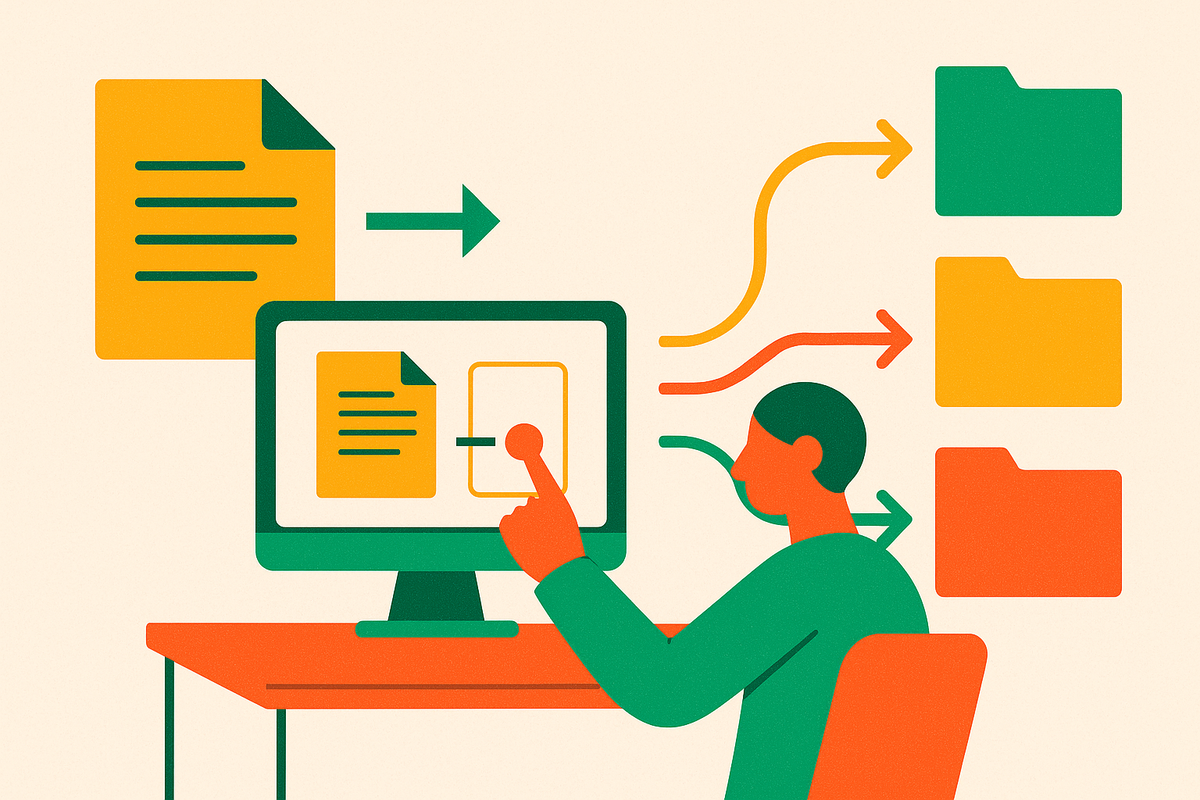
The practical architecture for SMBs doesn't require a data warehouse. There's an intake layer, where AI reads the trigger event, whether that's an incoming request, a document, or a flagged account, and extracts the relevant information. A decision layer, where the business's logic, rules plus learned patterns, generates a recommendation or an action. And a routing layer, which outputs the decision, flags exceptions for human review, and logs the outcome.
The emergence of agentic AI is worth noting here. These systems can now execute multi-step decision workflows autonomously, taking action directly instead of surfacing a recommendation for a human to act on. That's the architectural shift that moves ODM from advisory to genuinely operational.
One design principle overrides everything else: the human stays in the loop on exceptions. ODM at the SMB level is about reserving human judgment for the cases that actually require it. On supply chain and inventory decisions specifically, McKinsey & Company has reported that AI-driven forecasting can reduce forecast errors by 20 to 50%.
Finding the right decision to systematize first
Start with the highest-frequency, highest-drag decision you have.
The right first decision meets a few conditions. It happens at least weekly; the more frequently it recurs, the faster the system compounds value. Current outcomes vary depending on who decides, because inconsistency is a reliable signal that the underlying logic hasn't been made explicit yet. And it's currently consuming time from someone whose attention is genuinely worth more than the decision itself.
The diagnostic questions are practical. What decisions do you or your senior people make every week that you wish you didn't have to? Where do you find yourself correcting a team member's judgment on the same type of call, repeatedly, while the underlying logic stays undocumented? What's the last thing that forced you to stop what you were doing and handle it yourself?
The data usually confirms the same story. High email volume around a specific question type. Recurring items on meeting agendas. Tasks that bounce between people before resolution. Those patterns indicate decisions still waiting for a defined home.
Common first wins in SMB contexts are customer credit decisions, quote approval routing, and service escalation triage. High-frequency, articulable logic, recoverable downside if a call is occasionally wrong. The business can learn from mistakes without catastrophic consequences.
Avoid starting with decisions that require deep relationship context, regulatory interpretation, or genuine creative judgment. Those are legitimate human territory. ODM should be built to respect that boundary.
Building the decision logic before touching any technology
Getting the logic right is the actual work, and it happens before anyone opens a software platform.
Start with the person who currently makes the decision. Not one conversation; several. Walk through real recent examples with them. Ask what information they looked at. Ask what made a particular case straightforward and what made another one hard. Pay close attention to the factors they weigh implicitly: customer history, relationship age, order size, the risk signals they've learned to read over years. Those implicit factors are exactly what needs to be surfaced, because that's the judgment the system is being asked to replicate.
What comes out of this process is a decision map: the inputs, the weights, the thresholds, the exception cases. This document delivers value on its own, independent of any AI implementation. Making implicit policy explicit improves consistency immediately, whether or not a system ever executes it. Some businesses stop here and find that's already worth the effort.
AI-specific preparation builds on that foundation. Identify where the data the decision depends on actually lives: CRM, email, spreadsheet, accounting system. Define what a correct output looks like, whether that's a recommendation, a routing action, a drafted response, so the system has something concrete to be evaluated against. And explicitly identify the exception cases that should always go to a human, then design that boundary into the system from the start, before you're surprised by an edge case in production.
This preparation step is where most implementations fail. The AI handles the work once businesses understand their own logic well enough to encode it — the step most implementations skip.
What a working ODM system looks like in practice
It helps to see what actually changes, at the level of specific steps.
Consider a credit and payment terms decision. A new customer requests net-30 terms. Currently, the owner reviews manually, checks payment history if they can find it, makes a call based on intuition and memory. This takes a day, sometimes more, and the result varies depending on the owner's workload and, honestly, what else is happening that afternoon. With a systematized process, the system pulls account history, invoice aging, order size, and industry classification and generates a recommendation with a confidence level. Standard cases resolve in minutes. Edge cases, the ones with conflicting signals or unusual relationship history, get flagged for owner review with the relevant context already assembled. The owner still decides those, reserving their attention for cases that genuinely warrant it.
Or take service escalation triage. Right now, every customer issue routes to a senior person to assess, because junior staff lack the authority or the framework to resolve things independently. Senior time gets consumed by issues well within a junior staff member's capability. With a decision layer in place, AI classifies the incoming issue against defined criteria. Standard cases route to staff with a suggested resolution and the relevant account history attached. Only the cases that meet specific exception conditions escalate.
Freight and logistics load acceptance works the same way. A dispatcher currently reviews each load manually, weighing margin, lane history, and carrier availability. The outcome varies by dispatcher, sometimes significantly. A scored recommendation system, working against margin thresholds, lane data, and current capacity, produces accept, decline, or negotiate calls. The dispatcher focuses on the ones that need actual negotiation, the work their judgment is genuinely suited for.
What these examples share is that the human is redirected to the cases where their judgment adds the most value. And as the system handles more decisions, the log of outcomes becomes data that can improve the underlying logic. Organizations that have systematized decision-heavy workflows have reported substantial reductions in manual processing time, with the specific results depending on how well the logic was defined upfront.
How quickly a first ODM system can be operational
The honest range: a single-workflow decision system can be live in two to four weeks. Most single-workflow automations, including the decision layer itself, can be live in five to fifteen business days, including testing. Multi-workflow implementations that change several operational areas take months. The variability is real and comes from identifiable causes.
The longest step is almost always extracting and documenting the decision logic. The technical work of connecting data sources and building the workflow is often faster than getting clear on what the system is supposed to decide. The data the decision depends on is sometimes scattered across systems that were never designed to talk to each other. Testing takes longer when the business hasn't yet defined what a correct output looks like with enough specificity to evaluate one.
A two-week diagnosis period at the start, focused entirely on identifying the highest-leverage decision bottleneck, prevents most of these delays. Build only once that decision bottleneck is clearly identified.
In the first iteration, speed is the priority. A working system that handles 80% of cases correctly and flags the rest for human review delivers more value than a six-month project aimed at 99% coverage. The first system in production teaches the business more about what the decision logic should actually be than any amount of upfront design work.
What "done" looks like at 30 days is modest by design: one decision workflow systematized, a human review layer for exceptions, a log of outcomes being built.
The ROI case for systematizing decisions, and where it actually comes from
The return on investment from ODM comes primarily from capacity unlocked, with cost reduction as an additional benefit.
When the highest-frequency decisions in a business are systematized, the people who were handling them get their time back. Time to do the things that actually require their judgment, their relationships, their expertise. The owner who was reviewing every credit decision can focus on the accounts that warrant strategic attention. The senior technician who was triaging every service call can go deeper on the cases that genuinely need them. The sheer volume of recurring decisions that didn't need a senior person but kept getting one anyway was limiting the team.
Consistency is the second source of return, and it tends to be undervalued until something goes wrong. When decisions run through a systematized process, the outcomes become predictable regardless of who is available. Customers experience a business that behaves the same way regardless of who they interact with. That consistency builds trust, reduces disputes, and lowers the cost of customer management over time.
The third source is organizational learning. A manual decision process leaves the logic in the owner's head alone, with nothing durable recorded. A systematized decision process logs every outcome. Over time, that log becomes a genuine asset: a record of what the business decided, under what conditions, and with what results. That data improves the decision logic. It also reduces the business's reliance on any single person's continued presence, a meaningful return in its own right.
The value of the first workflow is modest. The value of the third and fourth, built on the foundation of the first, is substantially larger, because each one draws on everything the business learned from the ones before it. That accumulation is what distinguishes businesses that systematize early.