Royalty Statement Ingestion and Reconciliation Workflow for Small Firms
AI-powered parsing and contract-aware validation replace manual royalty reconciliation.

Small firms don't have a royalty reconciliation problem. They have a general ledger that was never built to answer the question they keep asking it: who is owed what, under which clause, at what tier. A ledger records what happened, blind to whether a licensee's contract carries a lower rate up to a certain unit threshold, a higher rate after that, a minimum guarantee that resets every fiscal year, and a retroactive adjustment clause nobody's read since 2021. That gap between "what happened" and "what's owed" is where a structured intake and reconciliation workflow, built with AI and checked deterministically at every stage, replaces what used to be a spreadsheet and a prayer.
The three format problems that defeat template-based tools
Statements show up as PDFs, Excel files with three macros nobody dares touch, legacy EDI feeds, CSVs, plain text dumps, and the occasional binary format that looks like it was designed to be difficult. Template-based tools lack the range to survive that variety. A template ties an extraction rule to a fixed spot on a page: column four, row twelve, always. The moment a licensor adds a column or renames "net receipts" to "adjusted net," the template quietly pulls the wrong number.
That's schema drift, and it's the real killer. A parser that worked fine last quarter produces garbage this quarter, with no warning, because the source changed its layout and nobody told the tool. The accuracy gap this creates isn't small: AI-based parsing on complex documents runs around 99% accuracy, against roughly 60% for traditional OCR.
The other trap is the chat-wrapper problem. Plenty of vendors have bolted a conversational interface onto a general-purpose language model and called it a royalty tool. Ask it to extract a statement and it will confidently hand back a number that doesn't exist anywhere in the source document. That's a hallucination, and schema enforcement and domain-aware checks underneath it are what catch hallucinations before they hit the ledger. Worse, royalty statements are full of terms that mean different things depending on the contract: "distribution fee" in one deal is a flat percentage, in another it's a tiered deduction applied before the minimum guarantee kicks in. A generic model has no idea which contract it's reading. Extraction has to be semantic, meaning the system reads what a field actually means rather than where it sits on the page. Then every value it pulls needs a deterministic check before it goes anywhere near the books.
Stage one: intake and format normalization
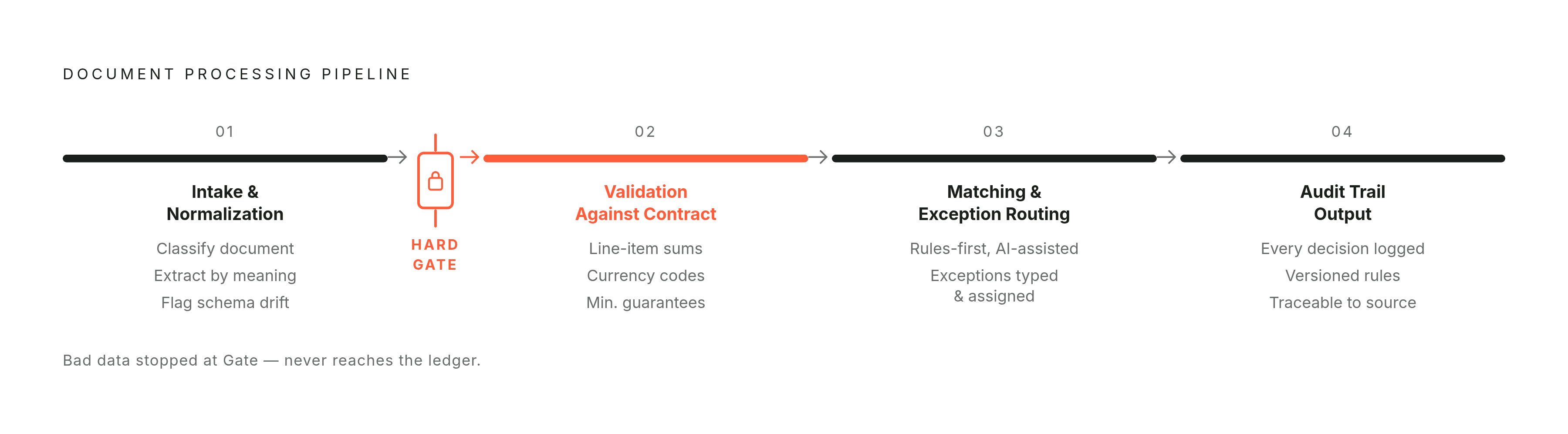
Everything starts with data acquisition wide enough to catch whatever shows up: API uploads, email parsers, cloud storage drops. Firms that have done this by hand for years know the pattern already: statements arrive through multiple channels, often without coordination or advance notice.
Before extraction can happen, the system has to classify the document. Is it a multi-tier licensing statement, a flat-fee summary, a multi-page bundle covering six territories at once? Get that wrong and everything downstream is wrong too, so classification runs first, every time, no exceptions.
Once classified, extraction pulls content by meaning rather than by fixed position, which is the actual shift away from old template parsing. Behind that sits a versioned schema registry, a running record of what format each provider has used historically. When a provider changes its layout, the registry catches the drift and flags it instead of letting bad data slide through quietly.
The output at this stage is deliberately unglamorous: a clean, structured record, every value tagged back to its source field and source document. The output is extraction with a paper trail attached, nothing more. To get here, a firm needs a library of past statements per provider, the contract terms governing each one, and someone whose job it is to own the exception queue this stage generates. That last part gets skipped more often than it should.
Stage two: validation against contract rules before reconciliation begins
Validation and reconciliation are distinct steps, and collapsing them is where a lot of homegrown systems fall apart. Validation is the gate: it decides whether an extracted record is arithmetically sound and contractually coherent enough to even enter the ledger.
A deterministic validation engine checks a handful of things without exception. Line-item sums have to match the reported totals. Currency codes have to match what the contract specifies for that territory, not whatever the statement happens to say. Minimum guarantees, holdbacks, and advance recoupment thresholds get tested against the actual ruleset instead of assumed to be fine. Retroactive adjustments get flagged for a person to look at, not waved through on faith.
Records that pass go into the reconciliation ledger. Records that fail go to an exception queue with a typed reason code attached, sparing someone the work of reopening the source document to figure out what went wrong. Human review at this stage serves as the mechanism that pushes accuracy from a mediocre baseline into the mid-90s and above for the calculations that carry real financial weight. Every contract's validation logic lives in a versioned rules registry with effective dates attached, so when a contract gets amended, the old rules stay intact and auditable for the periods they governed. And this stage has a habit of surfacing something firms didn't expect: contract language that seemed airtight in negotiation turns out to support two or three valid readings once it meets real sales data.
Stage three: matching, anomaly detection, and exception routing
Matching happens in layers. Rules go first: amount, period, territory, contract reference. AI-assisted matching runs on top, picking up patterns a purely rules-based engine would miss, the kind of thing an experienced reconciler would notice by feel but never write down as a rule.
Anomaly detection runs alongside, not after. A territory reporting zero sales during what's normally a high-volume stretch, a rate applied at the wrong tier: these get flagged before a payment goes out the door, while there is still time to act.
The bigger shift here is operational, and it's the one most firms undersell. Reconciliation automation earns its keep by moving a team from checking every single line to reviewing only the exceptions. That's the whole point: get people looking at the right five items rather than the same five hundred. Each exception needs a type (timing difference, amount variance, missing entry, rate mismatch), an assigned owner, a resolution deadline, a commentary field for whoever picks it up next, and an escalation path if it goes stale. Skip any of those pieces and the queue turns into a graveyard nobody wants to open.
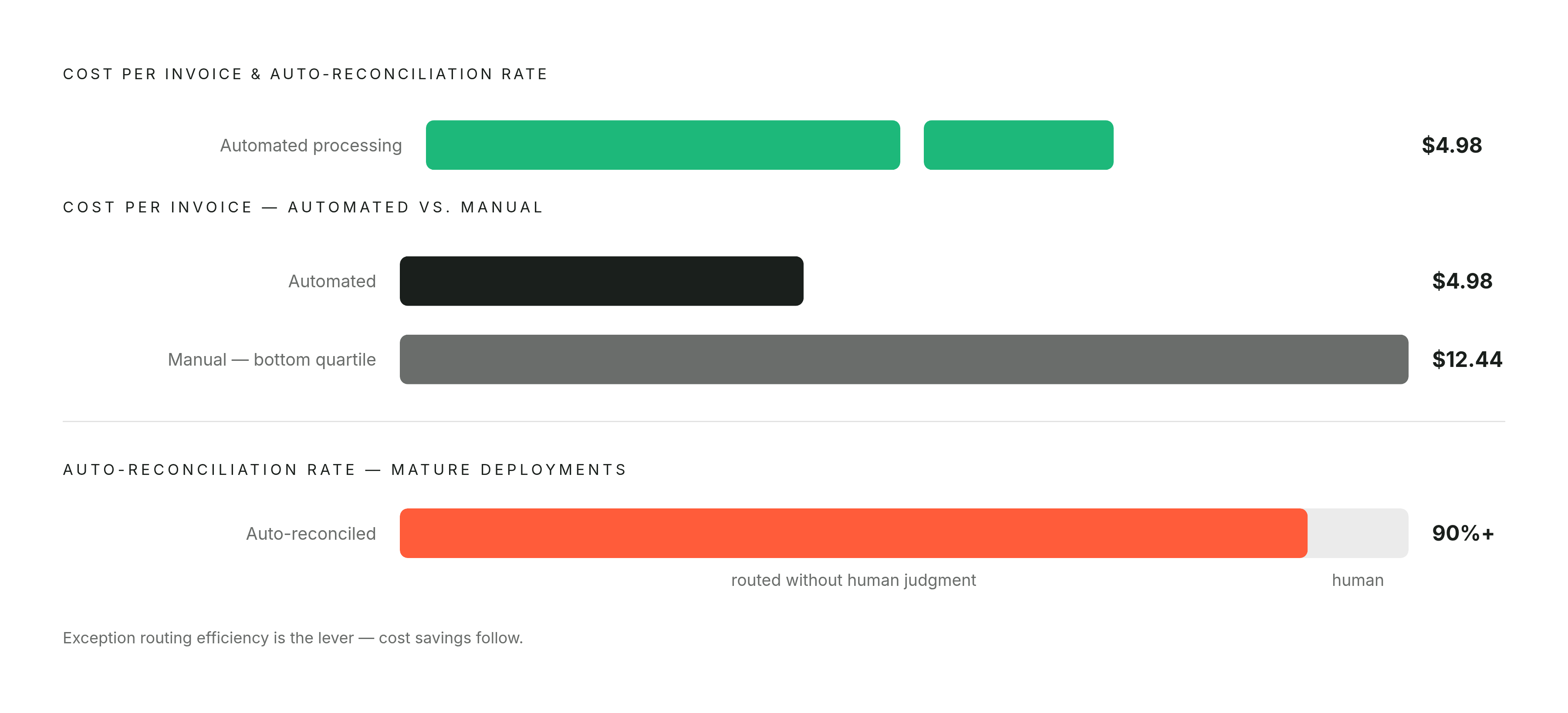
The AP world offers a useful comparison. Automated invoice processing runs close to $4.98 per invoice, against $12.44 for bottom-quartile manual teams. Royalty reconciliation has more moving parts than an invoice ever will, but the direction of the arithmetic holds. Mature agentic deployments achieve auto-reconciliation rates above 90%. What's left over is the handful of cases that actually need a person with judgment, and routing them cleanly is what makes that judgment worth paying for.
Stage four: the audit trail as a functional output, not a compliance checkbox
Every stage above leaves a trace: the source document, why the extraction pulled what it pulled, the validation result, the match decision, how an exception got resolved, who signed off, and when. That audit trail is what makes the previous three stages defensible.
An unbroken log means a reviewer can see, at a glance, what got matched automatically, what got matched on a suggestion a person confirmed, and what's still sitting open. The history is already there, complete, without reconstructing six months of email threads and a folder of spreadsheets named "final_v3." Because the contract rules are versioned too, a historical period stays reconcilable against the terms that actually governed it back then, even years after the contract's been amended twice.
The clearest payoff shows up during an audit or a payment dispute. A rights holder audit that used to eat a week of digging through spreadsheets turns into a few hours, because every number traces back to a specific rule version and a specific source document. And when a recipient claims a statement shortchanged them, the system produces the actual calculation path, tier by tier, traceable to a deal signed three years ago.
What platforms are doing with this pipeline today
The vendor landscape has started building toward this pipeline, in pieces. Rightsline, exhibiting at IBC 2026 in the Future Tech Hall, is one of the more complete examples: Statement Ingest replaces email-based statement chaos with a partner portal that checks data in real time, catching errors before they enter the system, aimed at licensors juggling hundreds of global partners. AI Contract Ingest reads contract terms, territories, and payment schedules automatically, which Rightsline's own August 2026 release said cuts setup time by up to 95%. AI Contract Analysis lets someone ask a plain question, like which territories are restricted, and get an answer without paging through a 40-page PDF. There's also an Intelligent Rights Explorer for querying available inventory, self-service reporting built on Snowflake and Sigma for catching royalty variances before payments go out, an Advanced Financials module handling multi-currency FX and audit-ready reporting, and a Data Share product giving firms real-time access to their own royalty data inside their own Snowflake environment. Rightsline is also running a panel at IBC 2026, "What's Your IP Worth? Monetizing the Content Hierarchy," with speakers from its strategic accounts and customer success teams.
Elsewhere, MetaComet focuses on royalty calculation and reporting. Schilling Publishing provides royalty settlement and rights management for publishers. FranConnect ties royalty calculation to franchise operations and compliance. RoyaltyZone focuses on contract management and compliance monitoring for licensing teams. Kobalt Music Group handles global publishing administration and royalty processing for songwriters, though it runs more as a service-plus-platform hybrid than pure self-serve software.
All of these still struggle with the small-firm case: mismatched statement formats, non-standard contract structures, and no dedicated IT department sitting behind any of it. These platforms tend to assume cleaner inputs than most small royalty operations actually produce. The gap is implementation. The four-stage pipeline above still has to get built around a firm's actual contracts, actual exceptions, and actual data sources before any of these platforms produces output anyone can trust.
How quickly a working system can actually be in production
Start with whatever statement type generates the most volume and the most manual pain, the one eating the most hours in exception-chasing right now. The bread-and-butter one.
A two-week diagnosis is usually enough to find which statement source and which specific contract clause account for the largest share of manual work. That's the build target, and it's narrower than most firms expect going in. Speed matters here: a system that reconciles the top source accurately and routes exceptions cleanly starts compounding immediately, while a six-month plan to handle every format on day one just delays the point where the system starts learning from real data.
Deloitte's 2026 Finance Automation Benchmark found finance teams spending more than 60% of their time on transactional work saw processing time drop by 52% after automating it, and royalty reconciliation sits squarely in that category. Broader workflow automation research (Aparna Pradhan, writing on Medium in November 2025) put ROI at 340% within 18 months, with most businesses breaking even in three to five months.
The risk in moving fast is moving carelessly, and this is where most vendors quietly cut corners. Plenty of development shops will ship something that performs well in a demo and leave the audit trail, the human-review gates, and ongoing monitoring for the firm to bolt on later. A system without those controls is a liability wearing a production system's clothes. The right pace: find the bottleneck, build the fix with validation and exception routing baked in from day one, then expand outward. Build with validation and exception routing baked in from day one, then expand outward.
Why a dedicated embedded engineer compounds where a tool subscription does not
This pipeline demands sustained, skilled work across four disciplines. It needs data engineering for the ingestion connectors and schema registry, model work for extraction and anomaly detection, integration with whatever ERP or royalty platform the firm already runs, and ongoing design of the review process itself. That's four separate disciplines, and a small firm can't hire all four, pay for all four, and keep all four fully occupied at once.
A full-time senior AI engineer in a major US market runs $200,000 to $252,000 in base salary alone, before the fully loaded Year 1 cost, which climbs beyond that once additional hiring expenses are counted. And that's assuming a firm can even find someone senior enough to have shipped production AI work before, a search that takes months on its own.
A tool subscription is the wrong instinct here, and firms keep reaching for it anyway because it feels lower-risk. A subscription delivers features. The contracts, exception patterns, specific licensees, and the ongoing adjustments as those things change require someone embedded in the work. The subscription charges the same fee whether the tool fits the firm's mess of formats or not, and most fall short. An engineer embedded in the work, building around the firm's actual data rather than a generic schema, produces a system that catches layout drift, flags it, and keeps running.