Business Process Mapping Before Adopting AI Tools
Mapping your actual workflows reveals hidden constraints before you spend money deploying AI.

Process mapping, in this context, is the specific act of seeing how work actually moves through your organization before you decide where a machine should enter it. Most teams skip this step, deploy something, and spend the next several months confused about why it is failing. The confusion is expensive and entirely avoidable.
A useful map has four components: the trigger, the sequential steps, the output, and the time cost at each stage, including where time accumulates. You build two versions. The current-state map captures what the process actually does today, including the human workarounds that never appear in any official documentation, because those workarounds are precisely where the real constraints live. The future-state map describes what the AI-supported version should do, and it names explicitly where the handoff between human and system occurs at every transition point.
That last part is mandatory. When no one has named a human owner for each step after the AI finishes its portion, the workflow collapses. The machine produces something and then nobody is quite sure who reviews it, approves it, or acts on it. The process stalls in a new and more confusing way than it did before, which poisons team confidence in the whole initiative faster than any other single failure.
Most growing businesses can document their top three to five workflows in a single focused session, somewhere between two and eight hours of owner or team time depending on complexity. Whiteboards and sticky notes come before any tooling. What a useful map reveals: the step where volume accumulates and creates a bottleneck, the workaround that signals a broken handoff nobody has formally acknowledged, and the decision that currently requires a human only because no one has written the rule down yet. Writing the rule down turns out to be more than half the work, more often than not.
How the Choice of Which Process to Map Determines the Ceiling on ROI
The instinct is to automate what is easiest to automate. This instinct reliably misdirects effort and costs real money.
Think of process selection as a heat map: complexity on one axis, impact potential on the other. The target is the intersection of high impact and manageable complexity. Complexity without impact wastes build time. Impact without manageability creates brittle deployments that break the moment they encounter live, messy inputs, which happens immediately.
The right candidate for a first AI build is narrow, repetitive, genuinely painful, and reviewable. A human should be able to look at the output and know within about five seconds whether it is wrong. If verification requires specialist knowledge or extended review, the scope needs to be tightened before anyone writes a line of code or signs a vendor contract.
For a small team, high-impact means the process whose slowness forces a hire, caps the number of clients you can serve, or makes you turn work away, each of those is distinct in ways that matter when you are deciding where to focus.
I watched this play out at an insurance brokerage. The operations lead was convinced their quoting turnaround time was the problem, and that was where they wanted to apply automation first. When we actually mapped the workflow, document intake was the constraint. Submissions were arriving in six different formats, routed inconsistently, and a senior person was spending roughly three hours each morning manually sorting them before quoting could even begin. Three hours, every morning, before any actual work happened. Fixing intake changed how many submissions the same team could process in a week, and how quickly they moved through a single one. Automating quoting would have made a non-constrained step marginally faster and left them spending the next quarter wondering why the business felt exactly the same.
Why Workflow Redesign Correlates with AI Financial Returns More Than Model Choice Does
Most SMB owners spend the majority of their pre-deployment energy on vendor selection, which is the wrong priority at a stage when the deeper structural work still dominates.
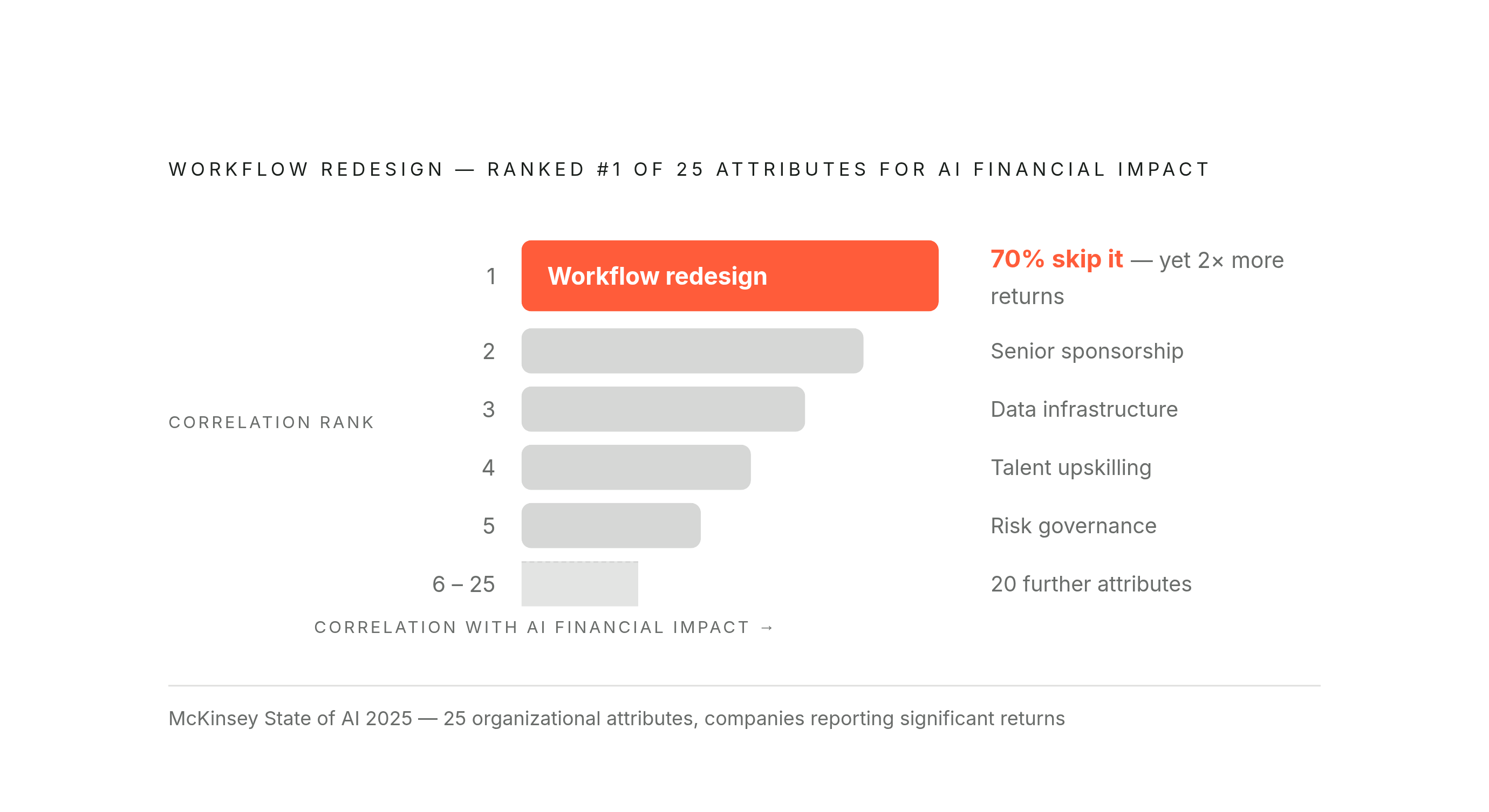
McKinsey's 2025 State of AI research found that companies seeing significant financial returns from AI were twice as likely to have redesigned end-to-end workflows before selecting technology. Of 25 organizational attributes evaluated for correlation with AI financial impact, workflow redesign ranked first. Seventy percent of companies skip it entirely.
The reason this happens is straightforward: workflow redesign is hard, slow, and unglamorous. Selecting a vendor is concrete. You can schedule a demo, compare pricing tiers, read case studies, and feel productive. The redesign work feels slow by comparison, and it determines whether the deployment produces anything worth measuring.
A mediocre tool applied to a well-mapped, well-owned process will consistently outperform a sophisticated model dropped onto a fragmented workflow. The structure around the model drives returns more than the model itself. This runs counter to how most vendors pitch their products, which is worth noting.
There is a corollary most vendors omit: when the workflow remains unredesigned, the hard part, the part that determines whether you see returns, still lies entirely ahead.
Data Readiness as the Hidden Prerequisite Inside Every Process Map
Process mapping is frequently the first moment a team discovers that their data is fragmented, inconsistent, or distributed across three systems that have never meaningfully communicated with each other. This discovery is uncomfortable and immensely useful, because it surfaces before deployment, while it remains a planning problem rather than a production crisis.
For an SMB, the data question is one focused question: is the information the AI will act on clean, consistent, and accessible at the precise point in the workflow where the AI needs it? If the answer is no, the deployment will fail in ways that are difficult to diagnose and easy to misattribute to the AI itself. Teams do this constantly, blaming the model when the actual problem is that the inputs are a mess.
Workflow redesign for AI requires three structural changes, each of which is fundamentally a data problem in disguise. Processes must become machine-readable, meaning inputs and outputs need defined structure rather than informal human interpretation. Human workarounds must be eliminated or formalized, because a workaround is an instruction the machine will quietly skip. Explicit handoff protocols between systems must be created, not assumed.
That last one surprises most teams. There is almost always someone manually reconciling what two systems should be exchanging automatically. They have been doing it so long it feels like part of the job, masking evidence of a broken interface. The map surfaces it. Fixing it is what makes automation hold up over time rather than degrade quietly until someone shuts it down in frustration.
What a 30-Day Mapping-to-Deployment Sprint Actually Produces
Process mapping is day one of the sprint, before any code, before any vendor evaluation, before any tool purchase.
The sprint's purpose is one governed workflow that real users run on live inputs, with an adoption metric attached and a deliberate decision at the end: scale it, fix it, or stop it. That decision structure matters enormously. A demo runs once on cleaned data with the founder at the keyboard. A workflow runs 40 times a week on messy live inputs with a team member who will abandon it the first time it confidently produces a wrong answer. Building for a demo and deploying into production is the most common structural failure in SMB AI projects.
The failure modes that recur most frequently: insufficient knowledge base preparation before the AI encounters real inputs; no baseline metrics captured before deployment, so there is nothing to compare against afterward; scope too broad for a first build; and no escalation path for when the AI gets something wrong. The AI will get things wrong. The question is whether that is a recoverable event or whether it quietly erodes trust until someone shuts the workflow down and the team avoids AI for the next six months.
Baseline metrics are a mapping output, captured during the mapping itself. Measuring ticket volume, response time, and processing time before deployment is what makes ROI provable afterward. You will be unable to defend the investment when someone senior asks whether it is working, and they will ask. Governance decisions, specifically who owns the workflow once the builder leaves and what happens when an output is wrong, must be made during the sprint, well before the first failure.
At a company with 10 to 200 employees, the right first sprint is narrow by design. The operational slack for broad transformation in 30 days simply does not exist at this scale. The achievable goal is converting the productivity potential of AI into a specific, defensible number that applies to one specific workflow in your business. That number is what earns the next sprint.
How ROI Compounds from the First Workflow Outward
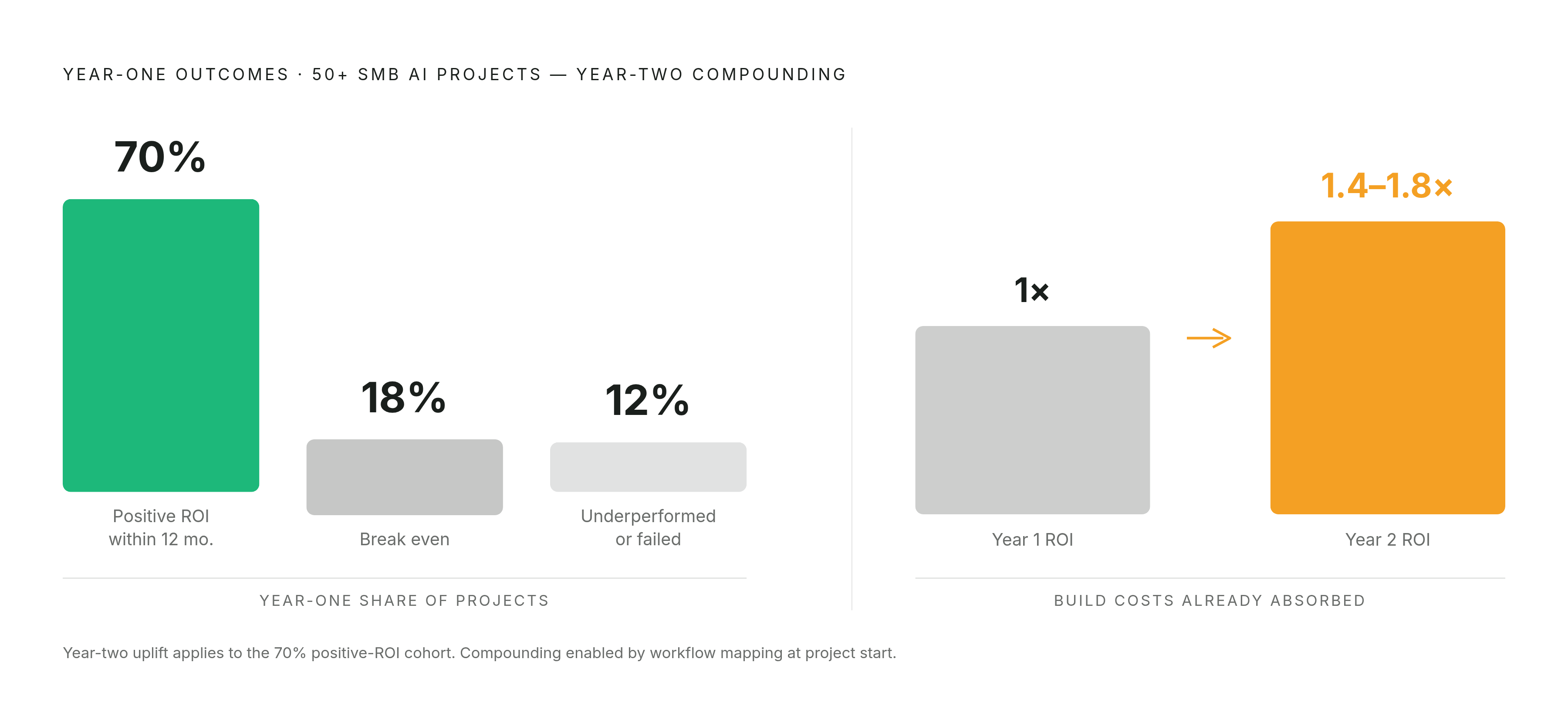
Across more than 50 SMB AI projects, roughly 70% delivered measurable positive ROI within 12 months, 18% broke even, and 12% underperformed or failed. The spread tracks closely with whether substantive process work preceded tool selection.
Year-two ROI typically exceeds year-one by 40 to 80%. The build costs are already absorbed. A project delivering strong first-year returns often reaches multiples of that in year two as prompts are refined, knowledge base coverage expands, and scope extends into adjacent workflows. This compounding follows directly from the first workflow being properly mapped, clearly owned, and governable. A workflow needs clear ownership to extend without recreating the original confusion. A workflow needs measured performance to be improved or defended, because the baseline is what enables reasoning.
What a well-mapped first deployment actually makes possible is concrete. The same team can quote faster, take on a service line they previously could not staff, or make decisions that previously required a specialist they could not afford to retain full-time. AI that recaptures a few hours weekly is useful. AI that removes the ceiling on what a team can take on is a different category of outcome entirely.
The difference between those two is determined weeks before deployment, when someone sat down with a whiteboard and asked the question most organizations skip: how does this work actually move, and where does it stop?