AI Carrier Rate Negotiation Workflow for Small Freight Brokerages
Automate carrier rate talks to let small brokers move faster without hiring extra staff.
Freight brokerage runs on a single number: 15% margin, give or take, on the freight bill. Subtract salaries, insurance, tech, and the bad debt that's just part of the business, and a single point of margin erosion stops being a rounding error. It becomes the gap between a decent quarter and a bad one. Brokers who keep hiring to match freight volume, one more person per however many more loads, are betting against math they can't win. That's arithmetic, and the rest of this piece is about the workflow that makes the arithmetic work.
Most brokerages still think the fix for a slow desk is a faster desk: more calls, more hustle, more coffee. The fix is removing the sequential phone-and-spreadsheet grind entirely. Chasing speed from the same human process is why so many desks stay slow. Xeneta tracked Asia to North Europe spot rates spiking more than 300% between December 2023 and January 2024, as carriers rerouted around the Red Sea. A brokerage that takes 24 hours to react to a move like that isn't slow, it's already out of the conversation, and no amount of hustle closes a 24-hour gap on a rate that moved that fast.
Post to the load board, run the same rate by three carriers one at a time, wait for someone to bite. That was just what people did while waiting for the phone to ring back. This piece maps the five-stage workflow that replaces it, a build that lets a small brokerage negotiate carrier rates faster and cheaper than a phone-and-spreadsheet operation, without hiring a single extra person to do it.
What an AI-assisted rate negotiation workflow actually looks like, stage by stage
"AI-assisted" means software agents living inside the TMS that read a situation, pick an action aimed at a goal, carry it out, and adjust based on what comes back, without a human clicking approve on every step.
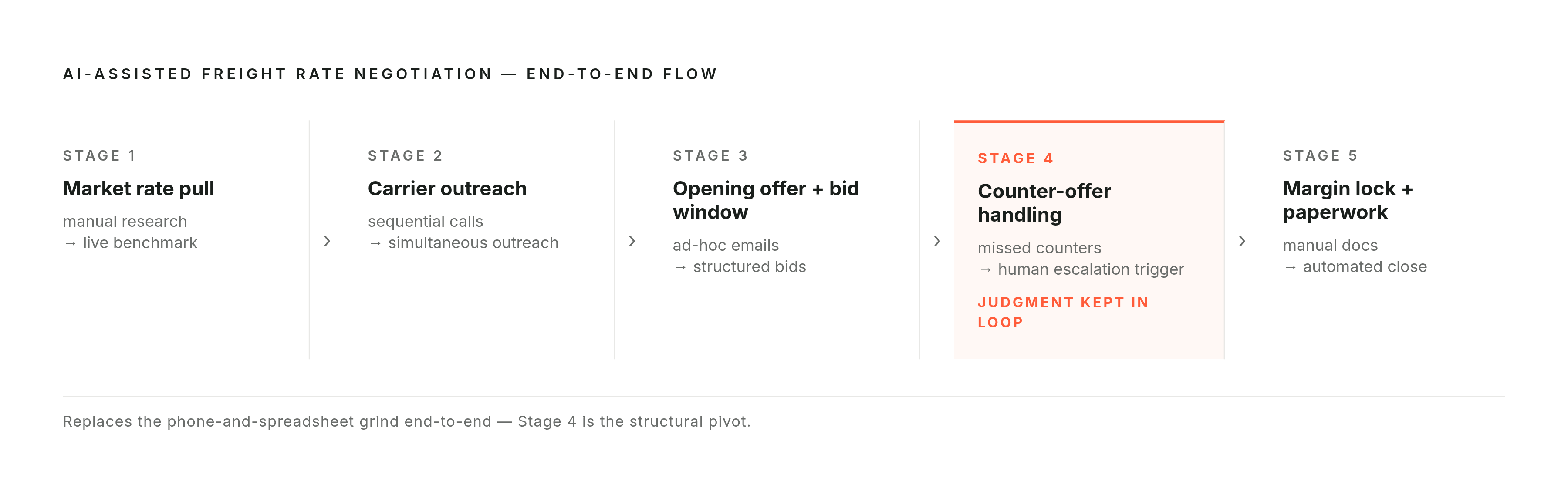
The workflow runs five stages, and each one removes one specific time sink. First, an automated market rate pull that tells the broker what the lane should cost before anyone dials a phone. Second, carrier matching and outreach that runs in parallel instead of one call at a time. Third, an AI-drafted opening offer with a structured bid window and automatic follow-up. Fourth, counter-offer handling, where the system holds firm, adjusts, or kicks the decision to a human. Fifth, locking in the margin and automating the paperwork that used to eat the back office's afternoon.
The workflow handles the mechanical part, leaving the judgment a broker applies to a carrier who bailed them out last week, or the decision to eat a little margin for a partner worth keeping. Fifth Wheel Freight's VP of Technology makes the point plainly: rate negotiation carries history, trust, urgency, and relationship context that a bot simply doesn't have access to, so judgment gets spent where it actually counts. Stacked together, the five stages change how much freight one person can realistically cover. That's the whole argument in one sentence.
Stage 1: Pulling a defensible market rate before the first call goes out
The old method was gut instinct, calibrated by whatever the last load on that lane happened to settle at. Useful, but only as reliable as the broker's memory and only as current as the last deal. That's a guess with a good track record, until the lane shifts and it fails.
AI rate benchmarking pulls from a wider set of inputs in real time: historical lane rates, current spot conditions, and other market signals that a broker relying on memory alone can't track simultaneously. Agentic systems running inside a TMS see the brokerage's own contracted carrier rates, live spot indices, and past win/loss history on that exact lane, so the benchmark that comes out the other end belongs to that brokerage's book. The benchmark belongs to that brokerage's book, drawn from its own lane history and contracted rates.
What the broker gets out of Stage 1 is a defensible rate position — anchored to the brokerage's own lane history and live market data — established before a single carrier gets contacted. The broker enters every conversation with a position grounded in data rather than instinct and memory. Bake the benchmark in before outreach even starts.
Stage 2: Running parallel carrier outreach instead of sequential phone calls
The average broker spends more than four hours a day on outbound carrier calls alone, before counting inbound calls and the follow-ups that never stop coming. All of it sequential: one carrier, then the next, then the next. It's the freight version of running dial-up in a fiber-optic world: technically functional, painfully outdated, and everyone downstream is waiting on you to finish loading the page.
Parallel outreach breaks that chain. AI carrier sourcing weighs a carrier's history across several dimensions at once (lane preferences, equipment availability, service record, pricing behavior, safety scores, past relationship with the brokerage) and surfaces the carriers most likely to accept at target rate. Structured bid requests then go out over email, text, and voice, simultaneously, to dozens of qualified carriers, and responses get parsed as they land, whatever format they arrive in. Anyone who hasn't answered inside the response window gets an automatic nudge.
Compliance checks run in parallel too: MC and DOT verification, insurance, safety scores, embedded in the same outreach cycle. Carriers that don't clear the bar get auto-declined before they ever reach booking. A source-to-book cycle that used to run hours compresses to minutes, and the broker sees a wall of responses land at once instead of waiting on each carrier to call back before dialing the next number.
Stage 3: Structuring the opening offer and managing the bid window
The opening offer isn't improvised, and it shouldn't be treated like it is. The rate position established in Stage 1 feeds directly into the bid request, so every carrier who touches that lane gets the same structured position, not whatever number the broker happened to type that morning between coffee and the second phone call.
An AI-drafted bid request pulls the lane specifics straight from the load record: equipment and timing requirements, an opening rate anchored to the benchmark, and a defined response window that triggers follow-up automatically once it closes. Carriers who go quiet get a nudge without anyone having to remember to send it. Responses come back in every format imaginable, a structured email, a text message, a forwarded PDF, and the system pulls the offered rate and availability out of whatever it gets without anyone re-typing it into the TMS by hand.
What lands on the broker's screen is a ranked list, each carrier's offer sitting next to their compliance status and their track record of actually following through on past acceptances. Ranking by follow-through alongside rate is the detail that surfaces carriers who actually show up on pickup day.
Stage 4: How the system handles counter-offers, and when it hands off to the broker
A Chicago-to-Dallas dry van load makes the mechanism concrete. Initial recommendation from the system: $1,875. Carrier counters at $2,200. The negotiation agent holds at $1,900, based on that carrier's own history of accepting rates around that level on that lane. Three message exchanges later, the carrier takes $1,900. A manual process working the same load would likely have settled higher, simply because the broker had less data to hold a position and less time to wait the carrier out.
What the system weighs when it decides to hold, adjust, or kick the decision upstairs: the carrier's own acceptance history at this rate level, how far the counter sits from target versus the walk-away ceiling set back in Stage 1, how much time is left before the load has to move, and whether other carriers already responded inside target range. The system runs rules the broker defined ahead of time, over email or voice, whenever price, timing, or service terms fall outside the target band.
Escalation is visible and deliberate. When an offer hits the ceiling, or a carrier's behavior falls outside the parameters the broker set, the system flags a human and hands over the full message history, so nobody inherits a cold thread with zero context. What stays human: knowing which carrier bailed the desk out last week, deciding to flex on rate for a long relationship, reading pushback as a real capacity crunch instead of a bluff. That principle holds up here. Freight carries history and trust and urgency tangled into every deal, and the workflow runs the mechanics while judgment stays with the broker exactly where it needs to.
Stage 5: Locking the margin and automating confirmation intake
After a carrier accepts manually, the broker types the agreed rate into the TMS, generates the rate confirmation, sends it, waits on the signed copy, pulls the data fields back out, and updates the load record. Call it 12 minutes of paperwork per load, done by hand, every time, all of it overhead.
Automation collapses most of that. The agreed rate writes straight back to the TMS with no re-keying. The rate confirmation gets generated and sent without the broker touching it. Inbound rate cons, PDF or plain email, get read by OCR and AI extraction that pulls the relevant fields and writes them to the load record directly, and document routing fires automatically instead of waiting for someone to remember to forward it to the back office. Brokerages that have deployed this automation report significant reductions in back-office time per load, compressing what was once a multi-step manual process into seconds. Call it the smallest miracle in logistics or the most obvious one, depending on how many rate cons you've typed by hand.
Margin tracking closes the loop. The agreed rate, the original benchmark, and the shipper's rate all live in the same system, so the brokerage gets a real-time margin figure per load, available the moment each deal closes. For a team running 200 loads a week, this stage alone hands back dozens of hours a month, hours that go toward covering more lanes instead of retyping the same fields into the same records.
What the full workflow produces in measurable terms for a small team
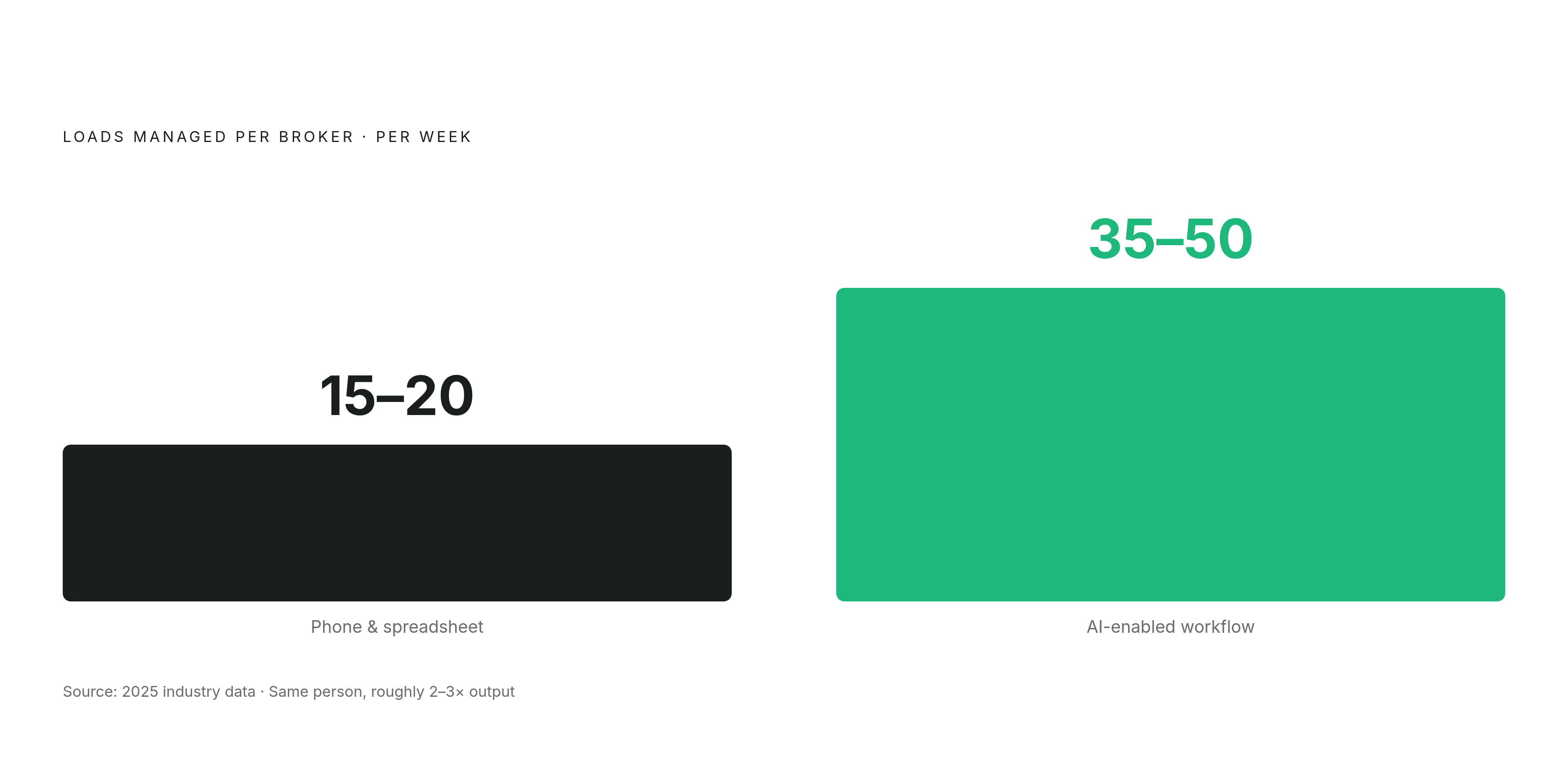
Per-broker load capacity is the number that matters most here, and it isn't close. AI-enabled brokers manage something like 35 to 50 loads a week, versus 15 to 20 before, according to 2025 industry data. Same person, roughly double or triple the freight moved, and that gap widens every quarter. It compounds, because the broker still working 15 loads a week loses ground every quarter the other side pulls further ahead.
Brokerages running this workflow in production have reported meaningful reductions in load matching time alongside margin improvements, reflecting real operational gains rather than pilot-deck projections.
These numbers understate one gain: ceiling removal. A lean team that can suddenly cover more lanes without adding a seat can take on a shipper relationship it would have had to turn down before, or quote a lane it never had the bandwidth to work. That's the part spreadsheets miss: capacity that materializes this quarter, with no new hire attached to it.
Where the human broker still creates irreplaceable value in this workflow
Everything AI handles well here is exactly the stuff that used to crowd out relationship work: sequential calls, tracking who responded, typing rate con data into the TMS, chasing follow-ups. All of it rule-based, all of it time-consuming, all of it mechanical.
The human list is shorter, but heavier. Deciding to flex on rate for a carrier who reliably shows up on the ugly lanes nobody else wants. Reading pushback correctly, telling a real capacity shortage apart from someone testing where the floor sits. Managing the carrier who saved a load last week, and knowing exactly when the system's escalation rule shouldn't apply to that relationship. And the sales conversations with new shippers, where the human side of the relationship is the entire product being sold, not a feature of it.
The brokerages that pull ahead will be the ones who know precisely what to automate, what to protect, and how to run both side by side without losing the judgment that made the desk good in the first place. That's a bet on knowing the difference between a rule and a relationship, and building a workflow that honors both.