When Business Process Automation Fails in Small Businesses
Most small businesses automate before fixing what's actually broken.
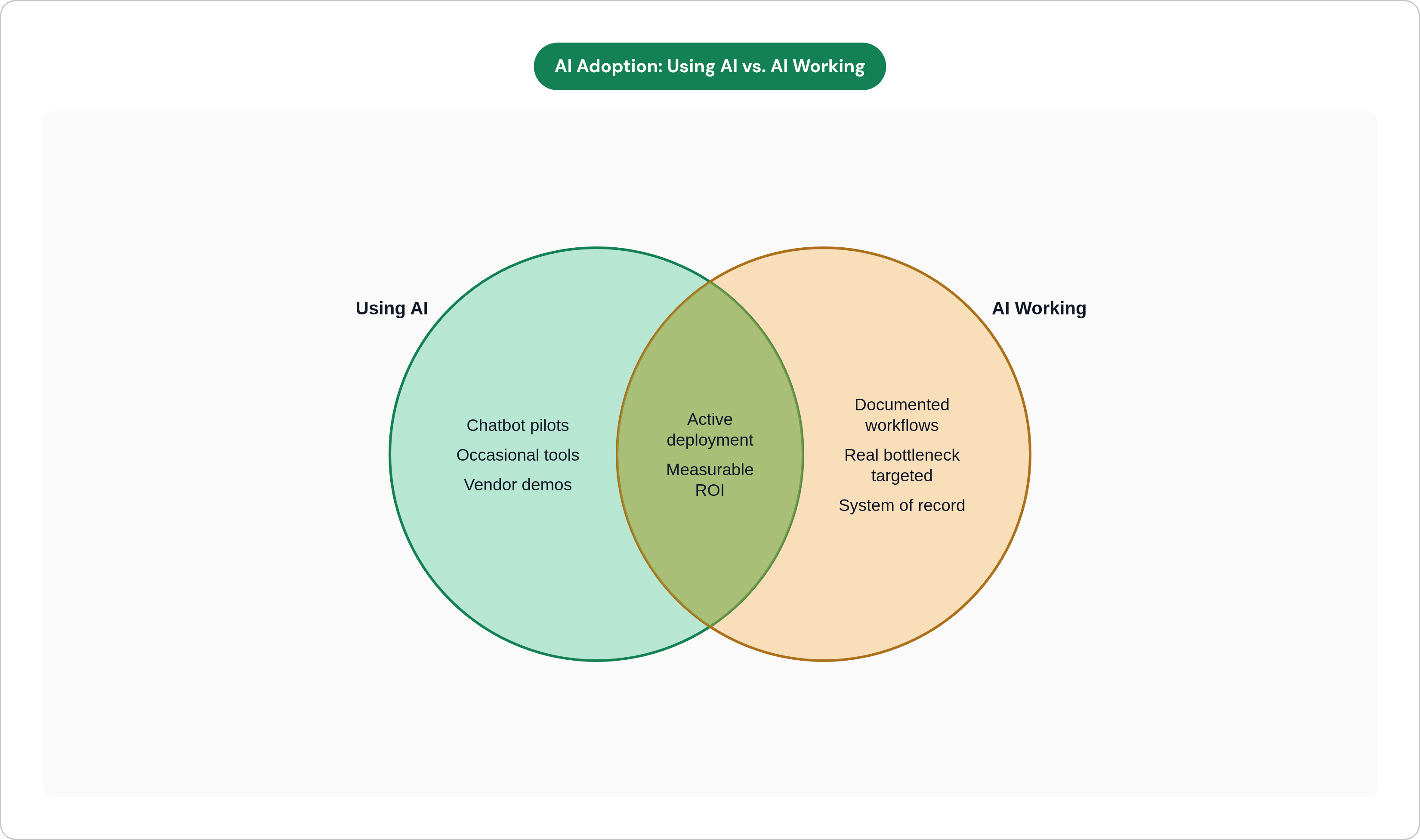
A Goldman Sachs survey found that 76% of small businesses were using AI and 93% reported some positive impact, but only 14% said AI was fully embedded in core operations. Sit with that 14% for a moment. The rest are running pilots, using a chatbot that handles one narrow question, or paying for a subscription one person on the team occasionally remembers to open. The gap between "using AI" and "AI working" is where most small businesses live, and it is not a technology gap.
The structural difference between a small business and an enterprise is not scale. It is risk topology. Shorter procurement cycles and fewer stakeholders mean a small business can move fast when something works, and absorb almost nothing when it doesn't. No IT governance committee. No change management budget. No dedicated team to catch a tool that performed beautifully in the vendor demo and fell apart in production. Enterprise AI ROI data is built on a fundamentally different financial calculus, one with payback mechanics, experimental tolerance, and course-correction capacity that small businesses simply do not share. Applying those benchmarks to a twelve-person operation and wondering why the outcomes diverge is a category error, not a coincidence.
There is also a perception problem at the other end. Research suggests a significant majority of firms under five employees believe AI does not apply to their kind of work. That is an education gap, not a real limitation. The failure modes below are not about inadequate technology. They are about the conditions under which technology gets applied, and those conditions are almost always the part nobody talks about.
Automating a Process Nobody Has Ever Written Down
This is the most common failure, and it is nearly invisible until the damage is done.
In most small businesses, the critical judgment calls live entirely in the founder's head. The business has always been small enough that writing every decision step down felt bureaucratic and unnecessary. The owner just knows. The problem is that "I just know" is not a workflow, and it is certainly not a training input for any system that needs to replicate that judgment reliably.
When a process gets automated without prior documentation, the AI is working from a vague description of a decision someone makes intuitively, under shifting conditions, with exceptions that were never articulated because they never had to be. The SmallTech Fabrication case is instructive: the business lost a substantial sum over 18 months. The AI model did not fail. The ground was never prepared. Technicians were still working from paper; the underlying decisions had never been made explicit enough to serve as a real foundation for anything.
Practitioners who work on these implementations keep arriving at the same conclusion: meaningful returns appear only when the workflow has been documented beforehand. The documentation is not a formality or a compliance box to check. It is the actual design input. Skip it, and the automation reflects an assumption about how the work gets done rather than how it actually gets done. That discrepancy compounds quietly until it becomes expensive.
There is also a more useful way to frame this. The automation project is a process-documentation forcing function. Recognize that going in, and the exercise is valuable regardless of what gets built. Skip it, and the automation reflects a fiction that felt plausible during the scoping call. If you cannot hand a new employee a written description of every decision step in the process, the process is not ready to automate.
Layering Automation onto a Process That Was Already Broken
Suppose the process is documented. That is necessary, not sufficient.
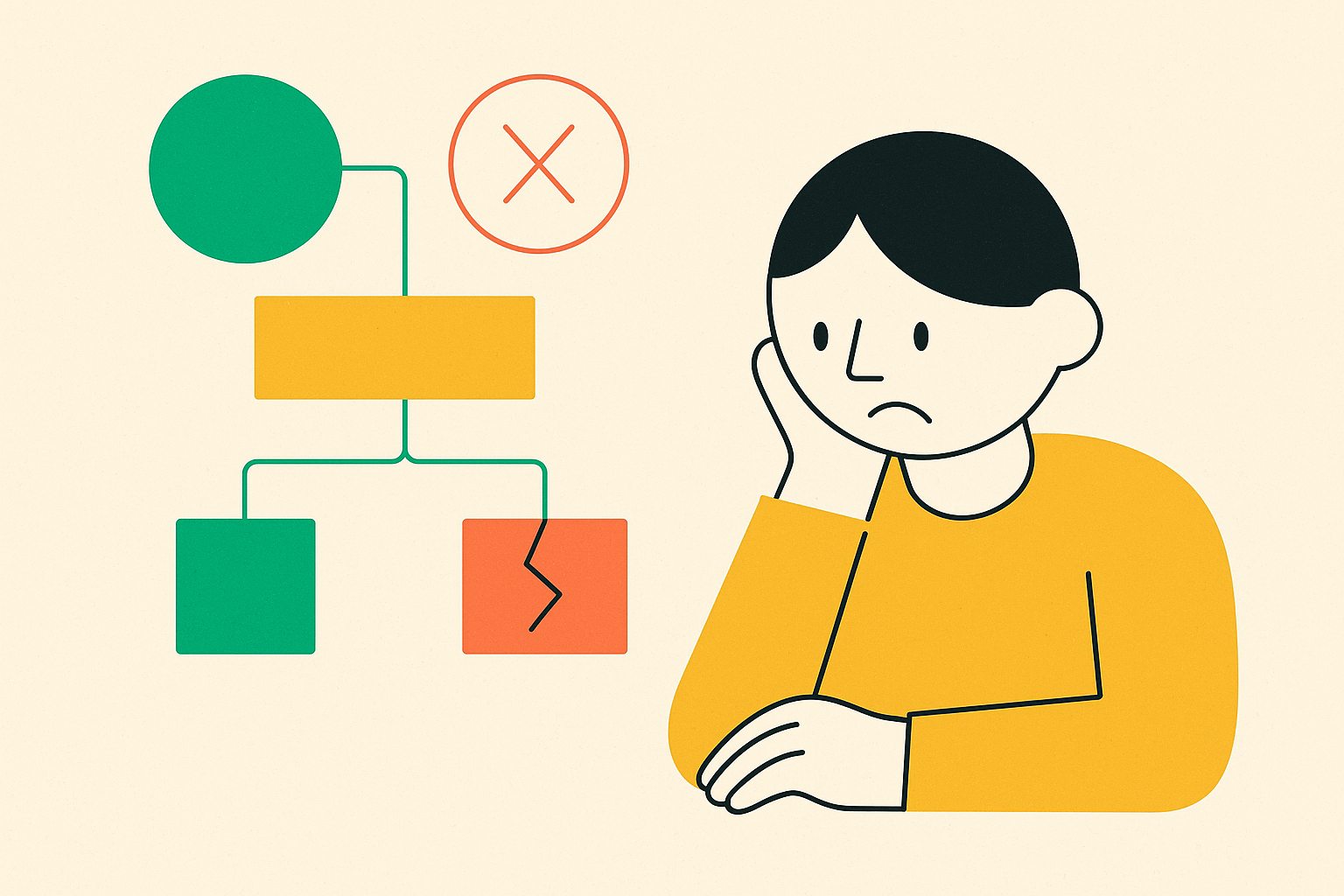
The second failure pattern is wiring automation onto a process with undefined decision rules, inconsistent steps, or unresolved exceptions baked in. Automation does not fix broken processes. It accelerates them. A broken outcome that used to happen at human speed now happens at machine speed, at scale, with fewer people watching closely enough to catch it. Practitioners call this automating chaos, which is an accurate description and also, unfortunately, a very common one.
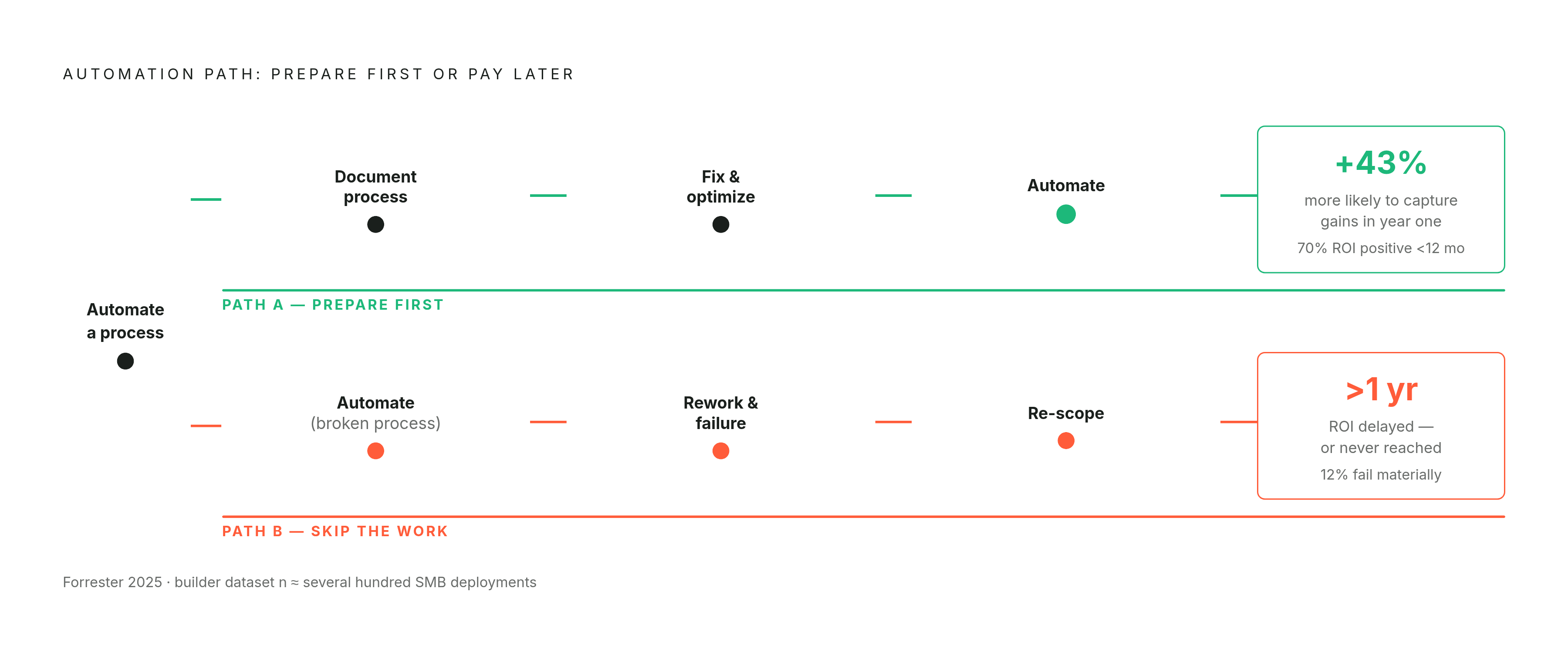
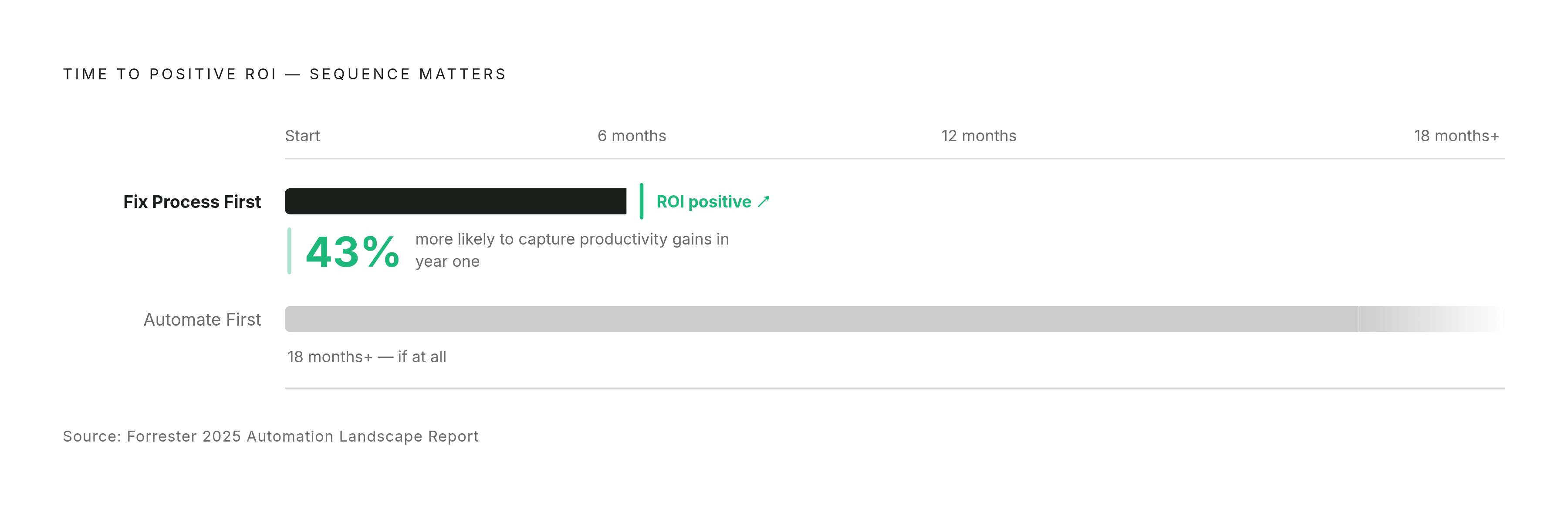
Forrester's 2025 Automation Landscape Report found that organizations that optimized their workflows before deployment were 43% more likely to capture productivity gains in the first year. The ones that skipped optimization were disproportionately represented in the cohort reporting that automation had underdelivered. The timeline data reinforces this: businesses that fix the process first typically reach positive ROI within months; businesses that automate first often wait more than a year for the same outcome, if they reach it at all.
If running the process manually produces inconsistent results, automation will not make it consistent. It will make it consistently inconsistent, faster and at higher volume than the manual version ever managed. Garbage in, garbage out, just at a considerably faster rate.
Picking the Wrong Bottleneck to Automate First
Even with a documented, functional process, a business can fail by selecting the wrong thing to automate first.
The trap is choosing based on what looks technically feasible, or what landed well in a vendor demo, rather than what is actually constraining output. BCG's 2025 survey found a median ROI of only 10% across AI initiatives, with a third of leaders reporting limited or no gains. That figure is consistent with automation applied to non-bottleneck processes: the work gets slightly smoother, but the constraint limiting growth remains untouched.
The logic works in both directions. When automation hits a real bottleneck, gains propagate downstream through processes that were previously waiting on that constraint. When it misses the bottleneck, nothing downstream changes, because the limiting factor is still in place. A common version of this: automating invoice formatting while the actual constraint is quote turnaround time. The business runs somewhat tidier. It still cannot take on more work.
BCG attributes a significant share of the 70% failure rate in AI transformation efforts to organizational misalignment on what the real constraint actually is. The question worth asking before any automation scoping conversation: which process, if you removed its friction, would let the team do something they currently cannot do? Not the same thing with less effort. Something new. That is the bottleneck worth targeting.
Tool Sprawl and the Absence of a System of Record
Small businesses tend to add tools reactively, one per pain point, rather than building around a central source of truth. The result is a tangle of overlapping subscriptions that each do one thing, store their own data, and communicate with each other only imperfectly, if at all.
The cost dynamics are treacherous in a specific way. One practitioner watched a modest monthly automation bill cross into hundreds of dollars per month within 90 days because a single new workflow began firing on every CRM update. Operational cost surprise arrives consistently before the ROI does, and in small businesses, that timing alone is enough to kill the initiative.
The deeper problem is structural. Many small businesses build automations on top of spreadsheets or tool-native storage. When the tool gets swapped out or the subscription lapses, the automation and the data it depended on disappear together. The next implementation starts from scratch because there was never a system of record to build on.
This fragility also makes measurement nearly impossible. Research consistently finds that a majority of companies struggle to establish ROI metrics for AI initiatives. That is partly a symptom of distributed data: when information lives across five disconnected tools, generating any meaningful performance view requires manual assembly, which is exactly the work automation was supposed to eliminate.
No Team Buy-In, No Governance, and the AI Review Overhead Trap
BCG's research identifies organizational culture, not technology, as the root cause of most AI initiative failures. Their data puts a number on it: organizations that invested at least 10% of their AI budget in training and change management were one and a half times more likely to succeed than those that did not. Only 3% of leaders, by their own assessment, are actually prepared to manage AI-enabled teams. Three percent is not a rounding error. It is a structural condition.
The governance failure has a clarifying example. In 2025, an AI system running a café's operations autonomously over two months ended up over-ordering inventory because suppliers had figured out how to manipulate it on pricing. Nobody had ever specified what the system could decide independently, what required a human to review, and what should trigger an alert before any action was taken. The model was capable. The rules around it were nonexistent. Deloitte's research finds that only one in five companies has mature AI governance in place, which explains why so many pilots end after a single high-profile error rather than being corrected and continued.
The review overhead trap deserves its own attention because it is easy to underestimate. An automation saves five hours a week. A human then spends three hours reviewing and correcting its output. The net gain is real but narrow, while the operational complexity has increased. The World Economic Forum's 2025 Future of Jobs Report found that 63% of employers cite the skills gap as their primary barrier to business transformation. For small businesses, that gap is felt acutely: there is no dedicated team to absorb new tooling. The person reviewing the AI's output is also the person who was supposed to benefit from not doing that work.
Genuine buy-in looks like this: the people who own the work are involved in designing how the automation is built. Not consulted afterward. Involved from the start. They know where the edge cases live. No specification document will surface those if the people holding the knowledge were out of the room when it was written.
What the Businesses That Avoid These Failures Actually Do Differently
The businesses that make automation work share a sequence, not a set of tools.
They document the process before automating it, treating that documentation as the real design input rather than an administrative exercise. They fix the process before wiring automation to it, which sometimes means the first deliverable is a cleaner manual workflow rather than a deployed system. That is not a failure; it is the correct sequence. The businesses that resist it are the ones populating the abandonment statistics.
They identify the real bottleneck by asking what is stopping the team from taking on more work or delivering something new, rather than what looks most automatable. They build on a system of record from the start, so automations survive tool changes and lapsed subscriptions. They define governance before deployment, not after the first incident.
From one builder's dataset, roughly 70% of projects delivered measurable positive ROI within 12 months when these preconditions were in place. The 12% that failed materially shared the failure patterns named above. Year-two ROI typically exceeds year-one ROI by a meaningful margin because build costs are already absorbed. The businesses that reach year two are the ones that did not automate their way into a worse process in year one.
What Embedded Implementation Changes About the Failure Rate
The failure patterns above share a common root: they are information problems.
The implementer does not know the real workflow. They do not know the real constraint. They do not know the edge cases that will break the automation three months after deployment. A vendor showing up for a demo and a scoping call certainly does not know. The specification document the client submits reflects how the process is supposed to work, not how it actually works when the business is under pressure on a random Tuesday.
Embedded AI engineering addresses this by placing the engineer inside the team that owns the work. That proximity is how undocumented decisions get surfaced, how a broken process gets diagnosed before automation is layered on top of it, and how buy-in gets built through participation rather than requested after the fact. AWS's Forward Deployed Engineering model operationalizes this logic at scale: compress timelines, work from inside the team, transfer knowledge so the organization can operate and expand the system independently rather than remaining dependent on the vendor.
For a small business, the arithmetic is direct. A well-scoped support deflection build can pay back in roughly ten weeks when it is built on the right process, with the right team, targeting the right constraint. The same build on a broken process with no buy-in produces the outcomes populating the 42% abandonment statistic. SANSA's embedded model follows this sequence: diagnose the actual bottleneck first, build with the team that owns the work, stay embedded as the system compounds. An 80% reduction in manual data entry for an insurance broker and over 160 hours a month recovered for a freight company are not outputs of superior technology. They are outputs of hitting the right layer.
The technology is rarely the variable. Where it gets aimed, and by whom, is.