Signs Your Small Business Has Outgrown Its Current Team Size
Automate your bottleneck before hiring another person to work through it.

Small businesses that have outgrown their current team size handle it in one of two ways: hire into the strain, or find the workflow that's creating it and fix that first. The better answer, for most SMBs facing a capacity wall, is to embed AI directly into the bottleneck, whether that's data entry, scheduling, approvals, or client follow-up, before adding payroll. This piece lays out how to tell a headcount problem from a workflow problem, and what a 30-day deployment targeting the right bottleneck actually looks like.
The classic "we need to hire" feeling is a capacity signal
The founder is approving invoices at 9 p.m. The proposal that should have gone out Tuesday goes out Friday, after the prospect has already taken a call with someone else. Nobody did anything wrong. The team is just full, and the feeling that follows, the gut sense that "we need to hire," appears right on schedule.
That instinct is almost always right about the diagnosis and wrong about the prescription. Growth produces more demand than the current structure can serve, and the resulting friction is a normal byproduct of things going well, not a sign of mismanagement. The mistake is skipping straight from "we feel it" to "we need a body," without asking whether the constraint is a shortage of people or a workflow that wastes the people already there. A business that identifies the actual bottleneck has choices: automate it, restructure it, or hire against it with confidence. A business that hires before understanding the bottleneck adds a salary on top of the original constraint and often slows down further, because now there's one more person routed through the same broken process.
What Output Degradation, Slow Response Times, and Missed Deadlines Signal
The earliest signs of an overextended team appear in the work itself, long before they show up in a headcount report. Individually, each one is easy to wave off. Together, they form a pattern that's hard to miss once named.
Quality degrades first. Work that used to clear the bar without a second look starts arriving with errors, formatting problems, or requests for revision, because there's no longer enough time to apply the same care to each task. Response times stretch next: a client who once heard back in an hour now waits half a day for an answer that hasn't gotten any more complicated. The delay just reflects how many threads one person is holding at once. Deadlines slip, or get renegotiated more frequently, because there aren't enough hands to hit the original schedule.
A useful way to see this in practice: a five-person professional services team whose client roster doubles over two quarters, with the same headcount and the same process. Nothing about the team changed. The structure simply ran out of room, and the work showed it before any one person visibly failed. The temptation is to call this a temporary rush and wait it out. Rushes end. Structural shifts in what the business now requires do not, and treating the second as the first just delays the fix.
The founder bottleneck: when the person running the business becomes the ceiling on it
The most expensive version of this problem sits at the top of the org chart. When a founder or department head is still doing work that should have been handed off months ago, the business hasn't just hit a capacity ceiling. It built that ceiling out of its most expensive resource.
The rationalization is always the same, and it's always partly true: it's faster to just do it myself. In the moment, that's correct. Over months, it means strategy, business development, and the judgment calls only that person can make get crowded out by scheduling, data entry, invoice chasing, and first-pass work that someone else could have handled at a fraction of the cost. Bottlenecks form wherever one person becomes the sole point of approval or decision. Every contract that waits on a signature, every client issue that waits on a call back, turns that one overloaded leader into the ceiling on everything the organization could otherwise do.
Leadership distraction doesn't trip an alert; it just compounds, quietly, until the cost is already substantial. A fair self-audit asks one question: how much of the week goes to tasks a well-placed hire, or a well-built system, could own completely? For most founders who ask that question honestly, the answer is uncomfortable. Identifying the bottleneck before hiring into it is the harder move, and often the one that reveals the ceiling is workflow. Consultancies including Sansatech work from that diagnosis outward, embedding AI into the specific constraint, whether it's data entry, approvals, scheduling, or client follow-up, that's consuming the team's capacity, which can lift the ceiling without adding to payroll.
The missed-opportunity cost that never appears on a P&L
Capacity gaps don't only produce visible failures. They produce silence: the things that never happen at all, and that cost is larger and harder to see than any missed deadline.
Inbound leads sit uncontacted because nobody has the hour it takes to follow up. Proposals go out late enough that the prospect has already moved on. New service lines get discussed in three meetings and launched in none. Partnerships that needed regular attention lapse for lack of it. None of this appears as a line item anywhere; it is visible instead as revenue that was never booked and growth that never happened, which is much harder to notice than a client complaint.
One useful internal signal is the volume of "not yet" decisions a team accumulates month over month. When deferred priorities pile up, that's a structural staffing signal, not evidence of weak planning. If a high-value initiative has sat untouched for multiple quarters, team capacity is almost certainly the reason, not a lack of ambition or strategy. The systems and tools that got a firm from five employees to twenty were not built to get it to one hundred, and that mismatch compounds missed opportunity over time. None of this means the business did anything wrong. It means the business is growing faster than its infrastructure.
The real cost of capacity constraints is visible not in what breaks, but in what never gets built, the proposal delayed past relevance, the service line discussed but never launched, the partnership that atrophies for lack of attention. When a small team removes even one high-leverage bottleneck through embedded AI, the compounding effect is often not just efficiency. It's the ability to say yes to work the business has been quietly turning away.
Systemic overload and team burnout are organizational problems, not personal ones
Systemic overload rarely announces itself as a structural problem. Individual complaints accumulate, absenteeism here, a flat affect there, and leaders often treat each one as a personal matter, missing the connections between them. That misreading delays the fix that would actually work.
Individual burnout is personal. Systemic overload is organizational. When overload drives burnout across an entire team rather than one person, the fix has to be structural, not a pep talk or a wellness stipend. The patterns are observable: absenteeism climbs during the busiest stretches, initiative drops off as people shift into pure execution mode, staff start absorbing tasks outside their job description without anyone noticing, and morale flattens into a heads-down grind that looks like stability but isn't. Chronic overwork correlates closely with disengagement, and the longer the overload runs, the higher the turnover risk climbs.
The people most likely to leave first are usually the strongest performers, because they have the most other options and the least patience for an unsustainable workload. Losing them doesn't just hurt morale. It compounds the original capacity problem and stacks replacement and ramp-up costs directly on top of it. Turnover, in that light, is an expensive way to discover a structural problem that could have been diagnosed much earlier. Once the signals, output, deadlines, the founder's calendar, the team's energy, are all named and visible, the only real question left is what to do about them.
Hitting the ceiling is not always a call to hire
Hiring is the default response to every signal described so far, and it's the right one only when the bottleneck is genuinely a shortage of people. Many of the most common capacity signals point to something else.
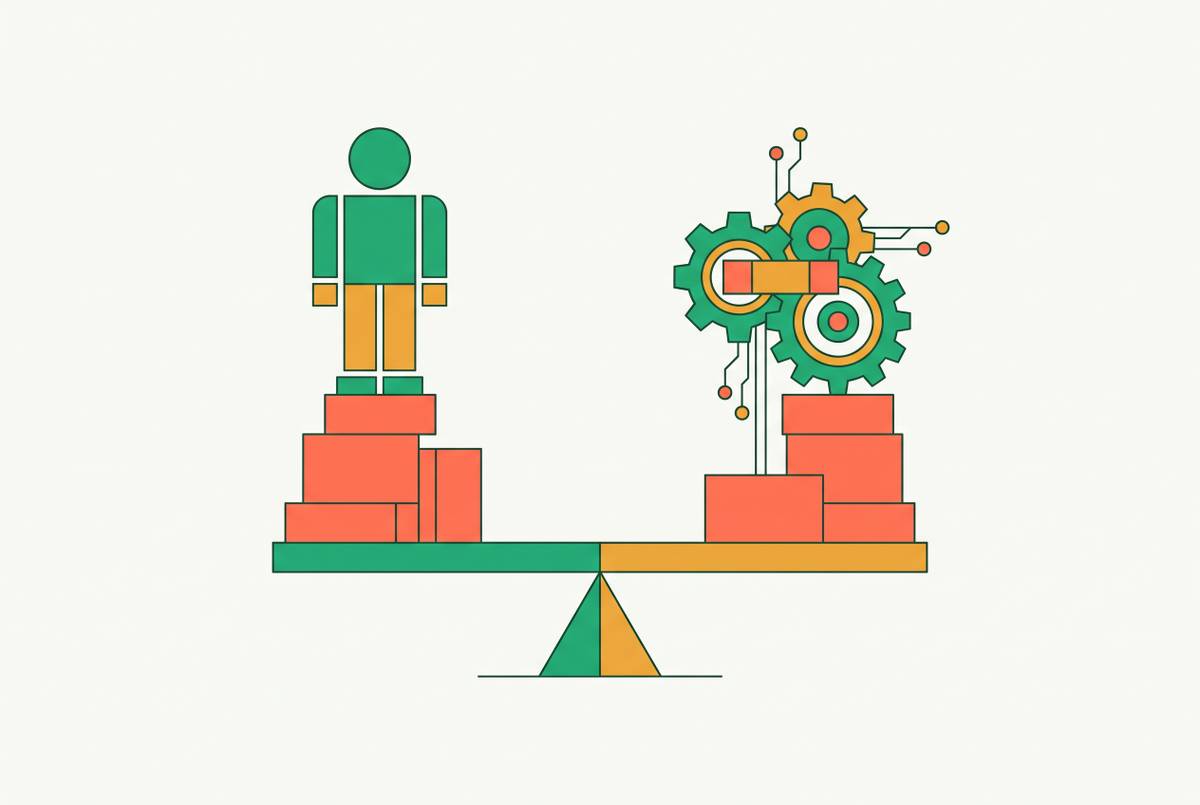
A headcount shortage means there isn't enough human time to get the work done at its current volume, full stop on the definition. A workflow bottleneck means the work takes more human time than it should, because manual steps, approvals, and handoffs are eating capacity that could be handled another way. Hiring into a workflow bottleneck doesn't remove it. It adds a person to a process that was already broken, which slows things down further and pushes off the fix that would have actually worked.
Hiring also carries its own clock. A position typically takes months to fill and months more to ramp to full productivity, and the fully loaded cost of an employee runs well above base salary once benefits, payroll taxes, equipment, software, and management time get added in. Before posting a job description, the more useful question is whether this is a volume problem or a process problem. Whether the right move is a hire, a system, or some combination of both depends on that answer, and getting it wrong is the single most expensive mistake available at this stage.
What Embedding AI Into the Actual Bottleneck Accomplishes
Embedding AI into the specific workflow that's constraining capacity, rather than layering a general-purpose tool on top of the business, removes the ceiling that was forcing the business to hire, wait, or turn work away.
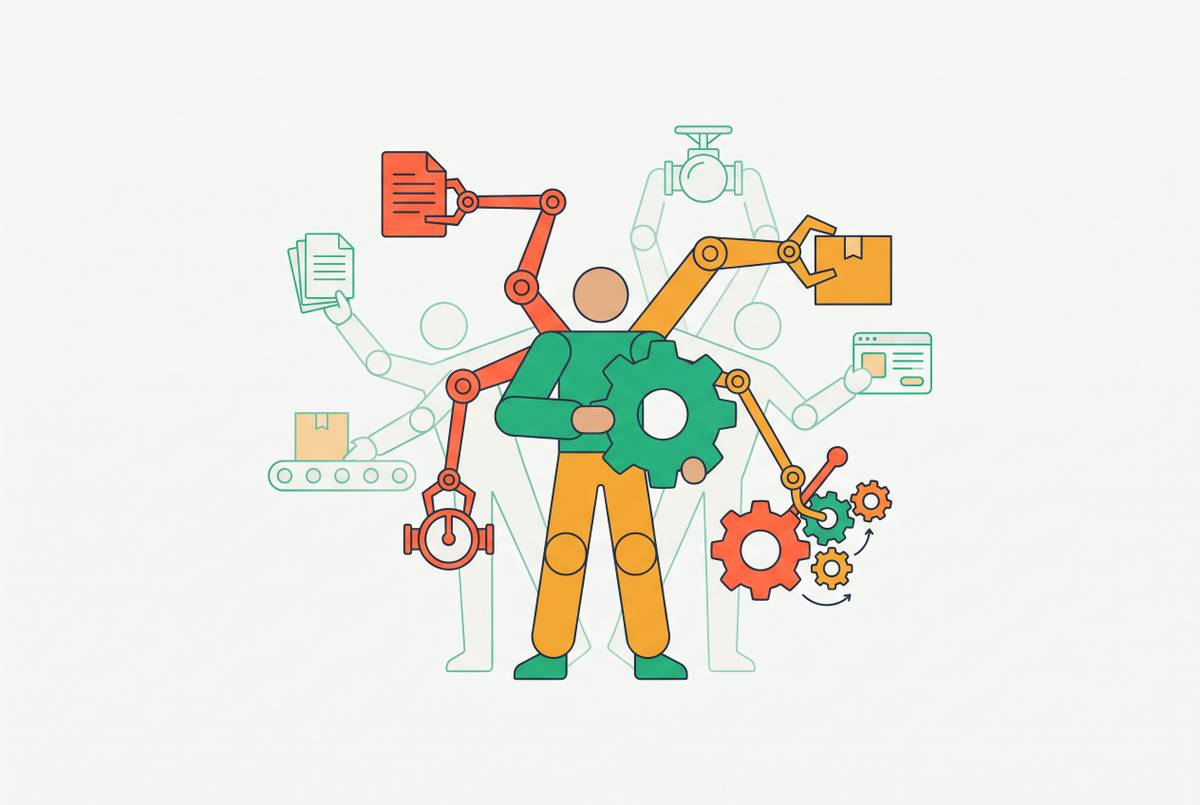
The distinction matters because not all AI deployment does the same job. AI used as a standalone assistant, chat, search, draft generation, adds marginal efficiency to individual tasks one person at a time. AI embedded into the actual bottleneck, the approval step, the data handoff, the intake process, changes the throughput of the entire workflow, which is a different order of impact. One is a faster pen. The other is a wider pipe.
A wholesale insurance broker offers a useful proof point: a dramatic reduction in manual data entry, achieved not by replacing staff but by removing the step that was consuming their time and capping their output, documented by Sansatech. Nobody lost a job. The team got the hours back that had been disappearing into a task that added no judgment and no value beyond moving numbers from one system to another.
The effect compounds. The first embedded system frees capacity that makes the next improvement possible, and the same five-person team can quote faster, take on a service line it couldn't staff before, or make calls that previously required a specialist it couldn't afford to keep on staff. This is a capability upgrade for the people already on the team, not a replacement for them. The ceiling on what the business can do lifts, and the people underneath it do different work, not less of it.
How to find the bottleneck worth targeting first
The highest-volume, most repetitive process that currently eats the most human time and blocks the most downstream work is almost always the bottleneck to target first. Finding it starts with documenting every recurring process across sales, operations, finance, and customer service that consumes significant time, producing a map of where the hours actually go.
From that map, a simple impact-versus-complexity matrix does most of the sorting. High-impact, low-complexity processes are the right first targets because they build momentum and organizational muscle fastest. In SMB contexts, that's usually one of a short list: lead follow-up and qualification, appointment scheduling and reminders, document collection and onboarding, invoice processing, or basic customer service queries.
A process is a good first target when it's done the same way every time, involves moving data between systems, requires little judgment on most instances, and causes a downstream delay whenever it's late. A process is a poor first target when it requires frequent judgment calls, involves sensitive relationship handling, or has high variability in what "correct" even looks like. Sansatech's approach to this diagnostic is to identify the highest-leverage bottleneck within the first two weeks of an engagement, on the premise that speed to the right target beats comprehensive planning, since learning from a working system compounds faster than planning around a hypothetical one.
What a 30-day deployment realistically delivers
A first deployment runs through a consistent sequence: identify the target process, document the current workflow exactly as it happens (not as the org chart says it should), build the automation, connect it to the existing systems of record, test it against real data, and hand it to the team that actually owns the work.
Realistic scope for that first 30 days is three to five workflows covering one high-volume, structured process, lead management, appointment reminders, or document processing are typical candidates, built on tooling that doesn't require a dedicated engineering team to operate afterward. The team doing the work day to day has to be informed and has to adopt the system as part of the build, not after it. AI embedded without the people who do the job is AI that gets quietly routed around within a month, regardless of how well it was built.
Businesses that deploy against their highest-volume, most repetitive processes tend to see payback within months rather than years, and customer service automation and document-handling automation in particular show strong early returns. What separates strong outcomes from weak ones is whether the AI is actually connected to the real workflow and whether the team that owns the work has adopted it. Broad access to AI tools, without that workflow-level ownership, produces limited gains, and that gap is the main reason some SMBs try AI once, see modest results, and conclude it doesn't work for a business their size.
When hiring follows AI instead of replacing it
AI and hiring aren't opposites, and framing them as competing options misses how the two actually work together. The more common sequence, for businesses working through a genuine capacity ceiling, is to embed AI into the bottleneck first and then hire into the capacity that the newly lifted ceiling makes possible.
Hiring is clearly the right call when the constraint is a volume of human judgment that AI cannot replicate: complex relationship management, creative direction, strategic decisions that depend on experience and context no system can supply. Those are jobs for people, and no embedded workflow changes that. What doesn't work is hiring into a process that's still broken. The new hire just inherits the bottleneck, absorbs the same inefficiency the rest of the team has been carrying, and the business is back to layering cost on top of a constraint it never actually fixed.