When to Hire a Human vs Deploy an AI System in a Growing SMB
Diagnose whether your bottleneck needs human judgment or just consistency and speed.
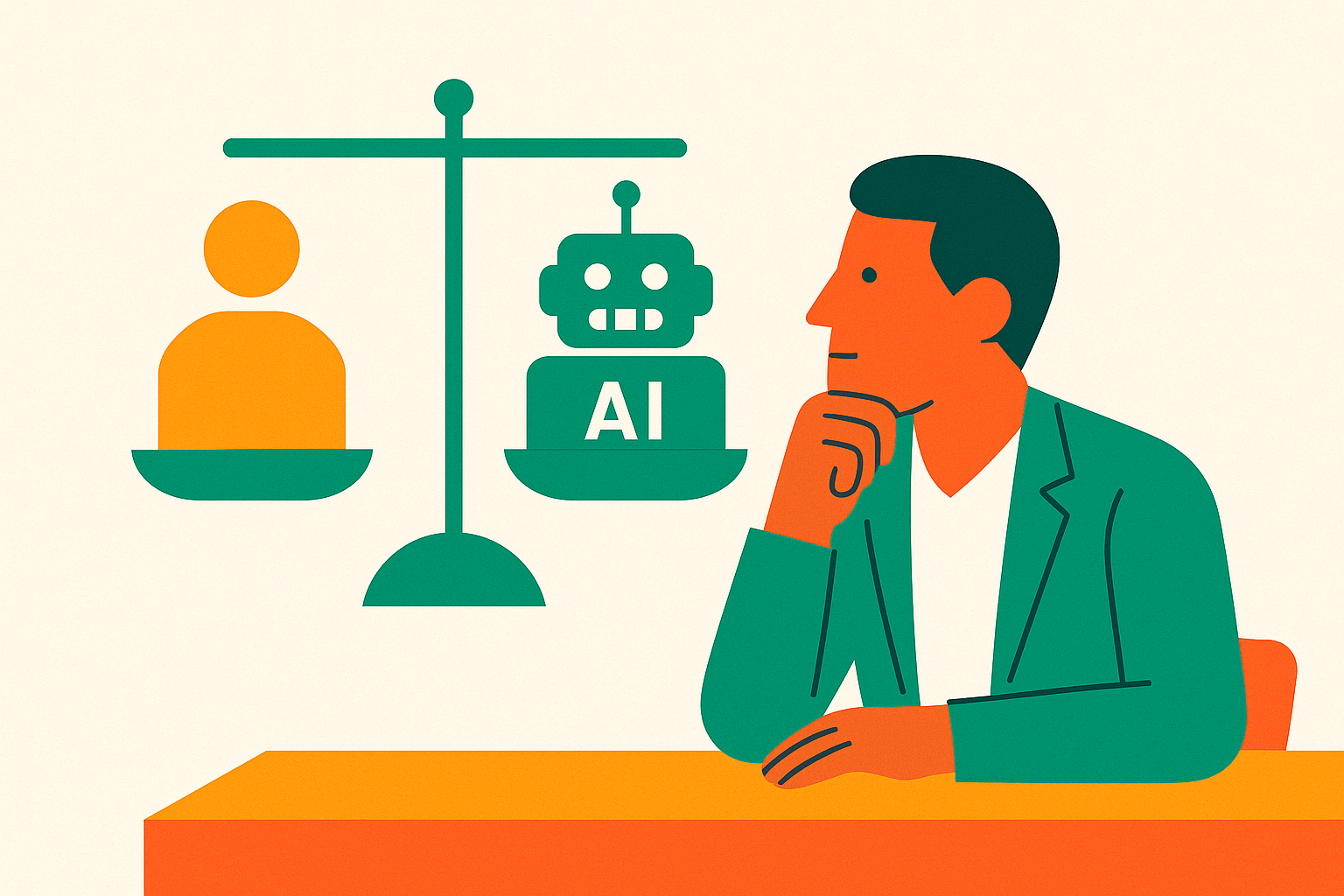
This is a hiring decision most SMB owners get wrong before they even start weighing it, because they ask the wrong question. "Can I afford to hire?" and "Is AI cheaper?" are both cost questions, and cost is a symptom pointing to a deeper diagnosis. The question that actually resolves the decision is whether a bottleneck needs human judgment and relationship, or volume, consistency, and availability at a scale no person sustains without burning out. Frame it that way and the answer flips in both directions: some roles that look expensive to fill turn out to be irreplaceable, and some gaps that feel like "we need another body" turn out to be process failures dressed up as headcount problems. What follows is a framework for telling the two apart before you sign a lease on either option.
What the current wave of SMB AI adoption actually signals
Small business AI adoption jumped from 23% in 2023 to 58% in 2025, according to the U.S. Chamber of Commerce, which calls it the fastest uptake it has tracked since social media. Among growing SMBs, 83% have adopted AI in some form, compared to 55% of declining ones.
That gap deserves genuine scrutiny, not just a citation. A more disciplined read: businesses that are already growing tend to have sharper operational habits generally, and one of those habits is knowing which constraints are worth automating and which aren't. The correlation flatters AI adoption more than the evidence supports. The adoption numbers don't prove AI is the right call for any specific bottleneck a given owner is staring at this quarter.
What they do prove is that undifferentiated adoption, that is, AI bolted onto everything or avoided entirely, has become indefensible in either direction. The businesses pulling ahead have gotten good at the diagnosis, and that's the skill this article is trying to hand over.
The true fully-loaded cost of a human hire most SMBs undercount
Owners anchor on salary. It's the number in the job posting, the number in the budget line, the number that feels concrete, and it's also the smallest piece of the true total cost.
A single full-time U.S. hire runs a small business somewhere between $55,000 and $95,000 a year in fully loaded terms, once benefits, payroll taxes, and overhead get added to the base. That's $4,500 to $8,000 a month for one person, and most owners never sit down and add it up that way until they're forced to.
Then there's everything upstream and downstream of the offer letter. Recruiting alone averages $6,000 to $12,000 per hire before the person's first day. Ramp time typically eats three to six months before someone reaches full productivity, and during that stretch the exact problem the hire was supposed to fix is still sitting there, unsolved, quietly accruing opportunity cost. Turnover is its own tax: average tenure for workers under 35 sits at 2.8 years according to Bureau of Labor Statistics data, which means the clock on replacement cost starts ticking the moment the offer gets accepted, not when someone eventually quits. Nobody puts a line item on the calendar for management overhead, either, but every hour a founder or senior employee spends supervising, correcting, and retraining is an hour that didn't go toward something else.
Hiring can still be the right decision. Most owners are making the decision against a number that omits half its ingredients, and that incomplete figure distorts every comparison built on top of it.
What AI actually costs — and where the vendor math breaks down
Fair's fair: AI's cost side needs the same honest treatment.
The subscription-tool version is cheap. Most AI platforms for structured, repetitive work run $50 to $1,500 a month, which against a human salary is a genuine 95 to 99% cost reduction. The embedded-system version costs more up front and behaves more like an asset than a bill: a purpose-built AI system runs $12,000 to $34,000 in year one, against $65,000 to $80,000 for a fully loaded human doing comparable administrative work.
Vendor pitch decks diverge from reality right about here. BCG's 2025 survey found median ROI on AI deployments of only 10%, and roughly a third of leaders reported limited or no gains at all. The common thread in the disappointing third: companies layered AI on top of an existing broken process instead of redesigning around the actual constraint. A 2024 MIT study found AI automation was economically viable in only 23% of roles that lean heavily on visual tasks, meaning in the other 77%, a human stayed the cheaper option. And an Nvidia executive noted that for some teams, the compute bill for running AI already exceeds what the displaced employees used to cost, which isn't a universal law but is a real trap for the wrong use case.
The pattern across all three data points is the same: AI's cost advantage is real and conditional on the work being the right kind of work. That's precisely why the diagnosis has to come before anyone opens a spreadsheet.
Four signals that the bottleneck is AI-appropriate
Some jobs are begging to be automated and just haven't gotten the memo yet. Four signals tell you when you're looking at one.
The work is high-volume and structurally repetitive. Same inputs every time, predictable outputs, no real judgment call buried in the task. Data entry, document processing, appointment scheduling, first-pass email triage, invoice matching: all of this runs on patience rather than judgment, and patience is exactly the resource AI has in infinite supply. It stays focused through hour six and shows up every day.
Speed and availability matter more than nuance. After-hours lead response, inbound inquiry routing, status updates: these are tasks where a ten-minute delay is the difference between a closed deal and a lost one. AI receptionists and lead qualifiers live here because the actual constraint is latency; speed is what the role demands.
The bottleneck is capping growth, not just adding friction. Irritation and a genuine ceiling are two different problems: one slows you down, the other stops growth entirely. The second one is a ceiling. Put AI at that ceiling and it lifts; put a human hire there instead and you've raised the floor temporarily, until the constraint reappears with a new headcount request attached.
Consistency matters more than creativity. Compliance documentation, reporting, inventory tracking: work where doing it the same way every single time is the entire point. It's no accident that data analysis ranks among the most common SMB use cases for AI precisely because consistency is what makes the output trustworthy in the first place.
The thread running through all four: the work has a learnable structure, and applying human judgment to it is waste.
Four signals that the bottleneck still needs a human
Flip the coin. Four signals say this one demands a human.
The relationship is the product. Six-figure deals with five stakeholders in the room, long-term client accounts where trust is the entire retention mechanism, high-touch account management: Research consistently shows many customers still prefer not to interact with AI for customer service, and that preference is a real constraint wherever relationship itself is what's being sold. AI can book the meeting; a person closes the deal and keeps the account for the next decade.
The decision needs discretion that doesn't live in a rulebook. Exceptions, edge cases, moments where policy should bend because the situation calls for it: all of that requires judgment that lives outside any if-then statement. If a wrong call here creates legal exposure, reputational damage, or a blown client relationship, a human owns that decision, full stop.
The work requires strategic or creative originality. Content generation is squarely AI territory; the judgment upstream of it belongs to humans: what should we build, which market do we enter, how do we position against the competitor who just undercut us. AI accelerates execution of a strategic call; forming that strategy remains a human responsibility.
The role has to own outcomes. Reading what a client left unsaid, escalating a problem that arrived outside the brief, taking initiative when the situation calls for it: this requires skin in the game. Workforce research broadly suggests a significant share of the tasks employees spend time on could be automated; the remainder is disproportionately this exact category, and that hardest-to-replace slice is exactly what human judgment is for.
Worth flagging here: Forrester's "AI boomerang" finding, where a large share of employers who cut headcount based on AI's promised capabilities later regretted it. Many of those cuts hit roles that, on closer inspection, checked one or more of these four boxes the whole time.
How to run the diagnostic before making the call
Four steps, in order, before anyone posts a job or signs a vendor contract.
Name the actual constraint. "We need more help" is a feeling that still requires a diagnosis. What specifically can't happen right now? A service line you can't launch, a quote you can't turn around fast enough, a response time you're losing deals to. Get specific or the rest of the exercise is wasted.
Audit the tasks inside the role, not the job title. Most roles are a blend of structured work and judgment work, and the mistake is evaluating "should we hire an account manager" as a single unit instead of breaking down what an account manager actually does hour by hour. McKinsey's 60 to 70% figure is a useful starting heuristic here: it tells you to expect a mix rather than a clean answer.
Ask whether AI removes the ceiling or just adds capacity underneath it. If AI handles the volume, does that unlock something the business genuinely gains for the first time, or does it merely delay the hire by six months while the same ceiling waits? This is the difference that matters: a system built at the real bottleneck compounds and extends to adjacent problems over time; a hire fills exactly one slot.
Pressure-test who owns the outcome. If something goes wrong, who's accountable? If the honest answer has to be a specific person, that's a hire. If the client expects to speak to "someone" as opposed to a system, that's a hire too, and there's no framework clever enough to automate around that expectation.
Run this properly and it sometimes surfaces a third option nobody considered going in: AI absorbs the structured volume, and that frees up an existing team member to do the human-judgment work that was piling up. A redistribution nobody bothered to map out before can be enough.
The hybrid outcome most growing SMBs land on
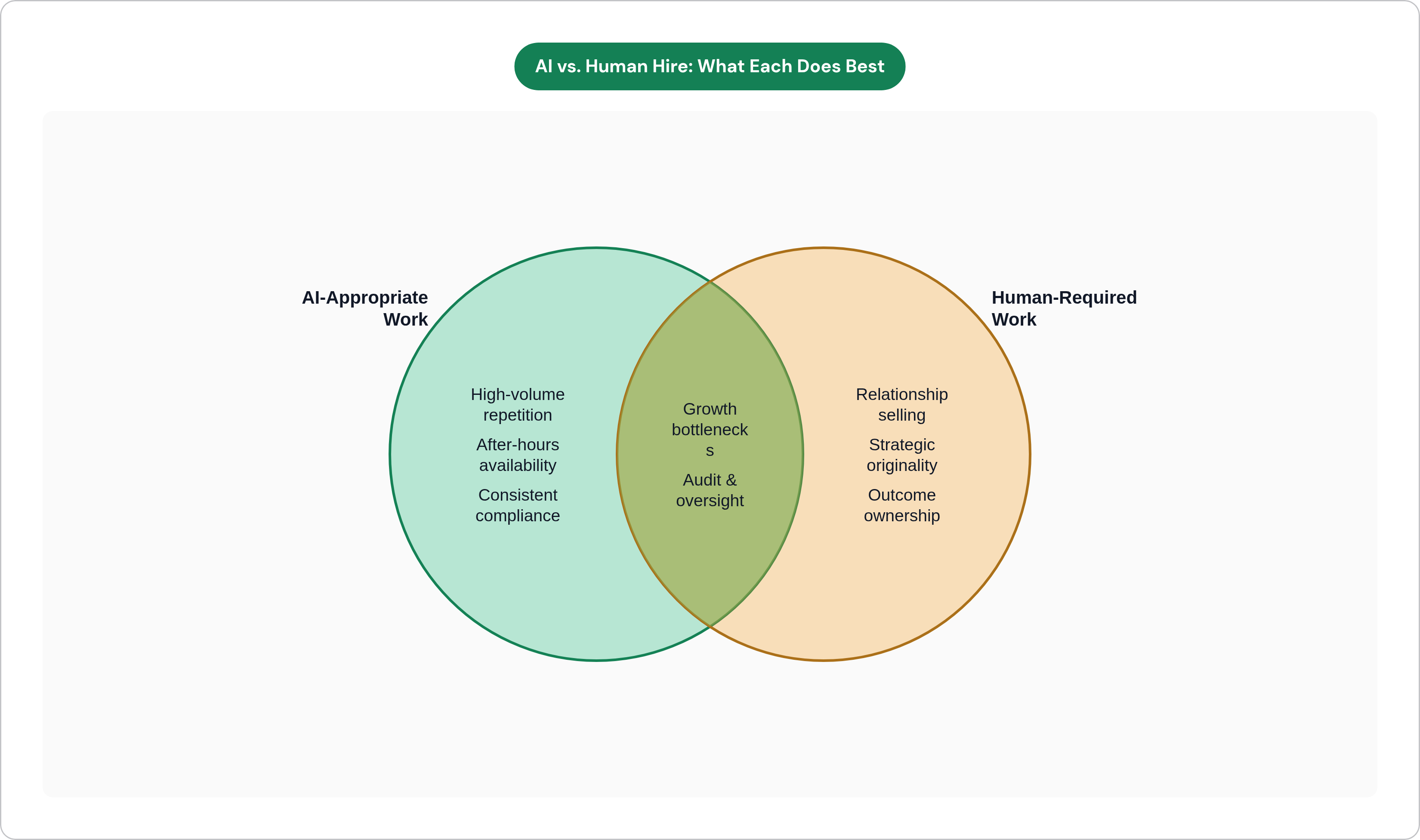
Here's the part that should reassure anyone bracing for a robots-versus-jobs showdown: the reality is mostly a partnership. Evidence from SMB adoption surveys suggests most small businesses using AI have grown their workforce alongside it rather than shrinking it. AI and hiring solve different problems at different layers of most operations.
The pattern that shows up again and again: AI takes top-of-funnel work, back-office repetition, after-hours coverage, and data processing. Humans keep the relationship, the strategy, the exceptions, and the accountability. A five-person team, structured this way, produces the output of a team two or three times its size, while humans remain clearly in charge.
What shifts is who gets hired next. The valuable hire in an operation like this is the person who can supervise the system doing the repetitive task, design the workflow, and audit the output for drift. Systems thinkers who can set up and monitor agent workflows have become the priority hire over coordinators and assistants. Payroll and hiring trends point to a sharp acceleration in AI-related roles at small businesses, with demand spreading even to the smallest operations.
The framing that actually holds up: every layer of the operation has its own requirement, and the real question is whether you are putting the right resource at each one.
Applying the framework: three common SMB scenarios
The insurance broker drowning in data entry. Bottleneck: manual entry of policy and claims data eating hours nobody can get back. Run the diagnostic and it's obvious: structured, high-volume, no real judgment at the task level, and errors are both costly and repetitive in predictable ways. An embedded AI system can dramatically reduce manual data entry, and the team's capacity grows without the team itself growing. A new hire here would have compounded the broken process rather than fixed it.
The freight company losing hours to coordination and reporting. Bottleneck: coordination overhead and manual reporting swallowing substantial hours every month. Same read: repetitive, structured, and consistency is what the work demands every time. Automate it, and those reclaimed hours redirect straight into relationship-building and business development, the work only a person can actually do.
The professional services firm that genuinely needs a human. Bottleneck: senior client relationships that demand strategic counsel, trust built over years, and judgment calls on when to escalate. This is the one where the diagnostic says hire, clearly and without hedging: relationship is the product, accountability has to sit with a named person, and discretion can't be reduced to a decision tree. The smart move is putting AI upstream of that hire so all the admin and prep work is already handled, meaning the new person spends day one doing the human work they were hired for.
Three different businesses, three different answers, one identical process. The diagnosis comes first, and the diagnosis is what changes the outcome.
Where to start if the diagnosis points toward AI
The most common failure mode is picking the right tool and pointing it at the wrong problem, usually because nobody did step one of the diagnostic and just automated whatever felt most annoying that week.
Start narrow. Pick the single bottleneck that hit all four AI-appropriate signals in the audit, the one that's genuinely capping growth rather than just causing daily irritation, and build or buy a system for that specific constraint before touching anything else. Resist the urge to automate five things simultaneously because a vendor demo made it look effortless; BCG's 10% median ROI figure exists precisely because companies did that and layered new tools on top of processes that were broken to begin with, instead of rebuilding around the actual constraint.
Measure the result before expanding. If the system removes the ceiling it was supposed to remove, you've validated the framework for your business specifically, in practice, and the next bottleneck gets easier to diagnose because you've now done it once for real. Should it fall short, you'll know within a quarter, and you'll know because you defined what "removing the ceiling" meant before you started.
That's the whole exercise. Name the constraint, audit the tasks, check who owns the outcome, then decide. The framework moves at the speed of the diagnosis underneath it, and so does the business.