Ways SMBs Can Scale Capacity Without a Full-Time Hire
Fractional AI engineers and workflow automation let SMBs close capacity gaps in weeks, not months.
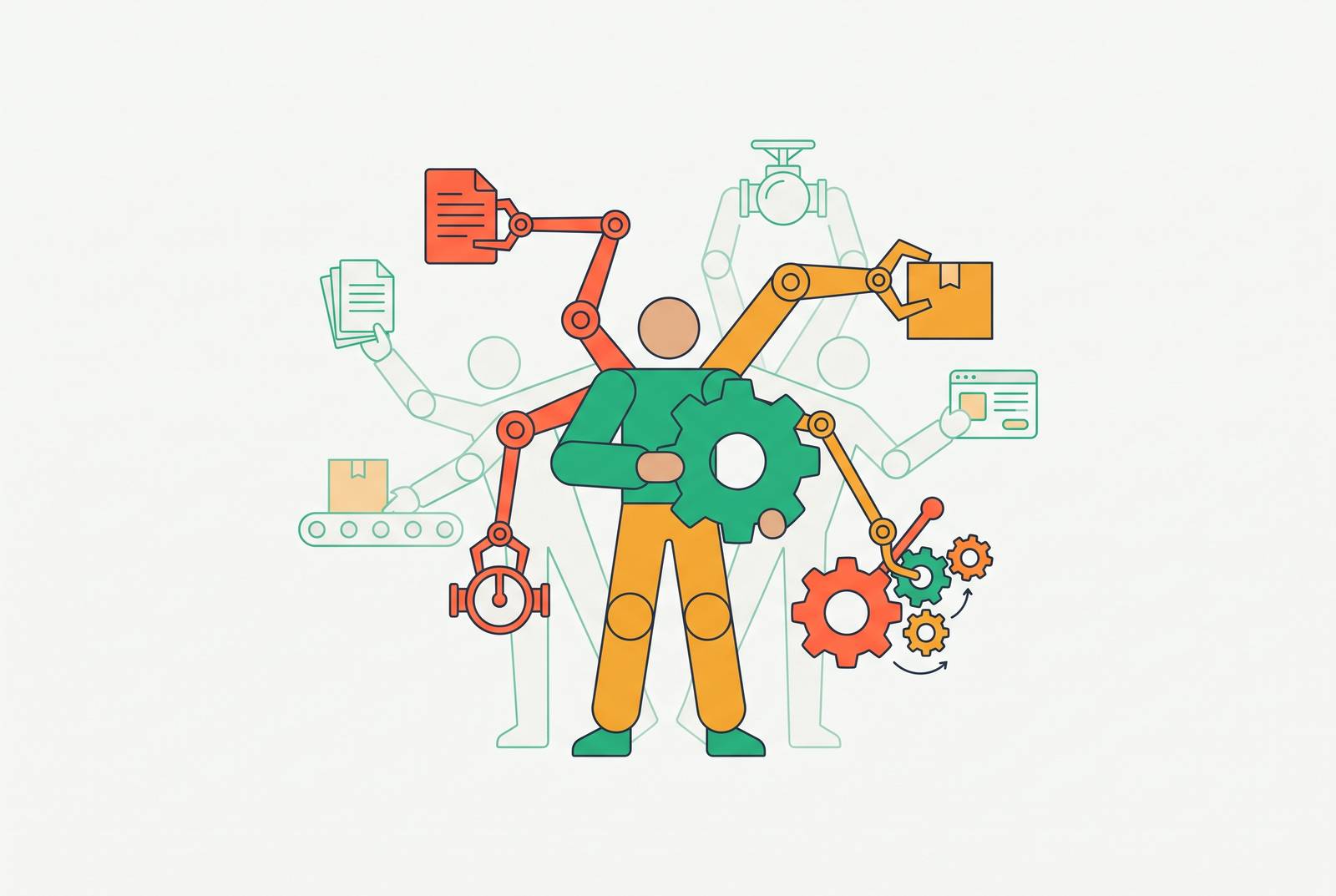
A small business that needs more technical capacity doesn't need another engineer on payroll, it needs the work routed somewhere it clears faster: embedded AI engineers working on fractional, monthly engagements, workflow automation built into the tools a team already runs, or some sequenced combination of both. The alternative to hiring exists, it starts in under a week in some models, and it scales down as easily as it scales up, which a full-time salary never does. The rest of this piece is about how that actually works, and where it doesn't.
Why the full-time hire is still the default for SMBs
An SMB owner looks at a backlog, a missed call log, or a client list that's outgrown the team's ability to serve it, and the thought that follows is automatic: hire someone. Capacity and headcount have fused into a single idea in most small business planning, so that "we need to do more" gets translated, almost without a decision point, into "we need to post a job." The translation skips a step. Plenty of capacity problems are process problems wearing a staffing costume: a bottleneck in how work moves through a CRM or an inbox.
The default persists because hiring is the only lever most SMB owners have been trained to pull. IDC's 2026 SMB research found that a large share of small businesses have no full-time IT employee at all, and yet their technology needs have kept growing regardless. That's a workforce model running out of sync with the actual shape of the work: businesses need flexible, specialized capacity they can direct at the problem in front of them, not a generalist on a fixed salary absorbing whatever the week throws at them. The mismatch is structural, and it's the reason the rest of this piece exists.
What SMBs are buying when they hire
Salary is the number on the job posting. It is not the number that matters most when an SMB owner decides whether to hire. The fully loaded cost of a new employee includes benefits, payroll taxes, equipment, the hours a manager spends onboarding them, and the ramp-up period before they're producing anything close to their eventual output, and all of that persists on the books even in the month the workload drops.
That persistence is the trap. A hire is a fixed capacity increment, locked in regardless of whether the bottleneck that justified it turns out to be exactly as wide as expected, narrower than expected, or something else. Recruiting, interviewing, onboarding, and ramp-up also take time, so the bottleneck that triggered the hiring decision in the first place sits there unresolved for months while the solution gets up to speed.
None of this means a good hire is a bad decision. A strong generalist who sticks around compounds in ways a short engagement can't replicate, and that's a real argument for headcount in the right circumstance. But it's an argument for the right circumstance, not a blanket defense of hiring as the default path to more capacity. For a narrow, high-volume, rules-based bottleneck, the business doesn't need a compounding generalist. It needs the bottleneck gone, and it needs it gone faster than a recruiting cycle allows.
How AI adoption among small businesses became an operational habit
The alternatives to hiring didn't exist in any practical form a decade ago, and now they do, because AI adoption among small businesses has moved from curiosity to routine. Capsule CRM's 2026 roundup of small-business AI adoption draws on data from the U.S. Census Bureau, the U.S. Chamber of Commerce, Salesforce, Thryv, McKinsey, Goldman Sachs, and Deloitte, and the figures vary widely across those sources depending on what each one is actually measuring. Some ask whether a business uses AI to produce goods or services. Others ask whether an owner has used a generative tool like ChatGPT for drafting or scheduling. Both questions return real numbers. They are not the same number, and treating them as interchangeable is how a lot of adoption statistics get misquoted.
What matters is the depth underneath the adoption rate. Casual AI use, the one-off prompt, the occasional generative draft, is close to universal among small businesses at this point. Embedded AI operations, where AI runs inside a workflow continuously and produces output the business can measure, remain a minority practice. The businesses reporting real capacity gains are the ones that closed that gap between casual use and operational integration. The ones stuck at the casual layer are paying for subscriptions that haven't moved their throughput an inch.
What's made the deeper version accessible is a combination of lower tool costs, integrations that plug into platforms a business already runs, like Google Workspace or a standard CRM, and implementation cycles that have compressed from the kind of project that needed a dedicated IT department to something a small team can stand up on its own. The shift from casual use to embedded operations has shortened those implementation cycles considerably. Firms including Sansatech now deploy working systems within a matter of weeks, which lines up with the broader finding that accessible tools and faster deployment are what finally made deeper integration workable for small businesses without dedicated IT staff.
What workflow transformation means
The capacity gain comes from removing a handoff, not from adding a tool to the pile of tools a team already juggles. An AI assistant that employees have to remember to open, prompt, and interpret adds a step to manage rather than removing one, which is the most common way AI deployments fail to produce anything measurable.
The version that works looks different in practice. AI gets embedded directly in the system the team already runs, the CRM, the inbox, the scheduling platform, so it picks up the repetitive step automatically and passes a finished result forward without anyone routing it by hand. When AI is routed through the tool a team already lives in, it removes the handoff rather than creating another one to track, and that's where most deployments either earn their keep or fail to.
A local HVAC company's deployment, documented by AI Crescent, shows what the removed-handoff version looks like at ground level. The company implemented AI call answering, automated scheduling, and automated follow-up sequences. Call answer rates rose sharply and booking conversion improved substantially. The business recovered 20 hours of admin work per week, not by adding a receptionist but by closing the gap between incoming demand and the team's existing ability to respond to it.
That modular pattern matters as much as the result it produces. Rather than building one large system meant to handle everything at once, businesses are increasingly deploying narrow, single-purpose agents, one for customer intake, one for inventory alerts, one for social scheduling, each passing its output to the next. Each piece gets tested and validated on its own before the next one gets added. The headcount doesn't move. What moves is the volume of work clearing without a human touching it, and that's the room a small team gets to either take on more business or redirect effort toward the work that actually needs a person's judgment.
Where workflow AI delivers a return
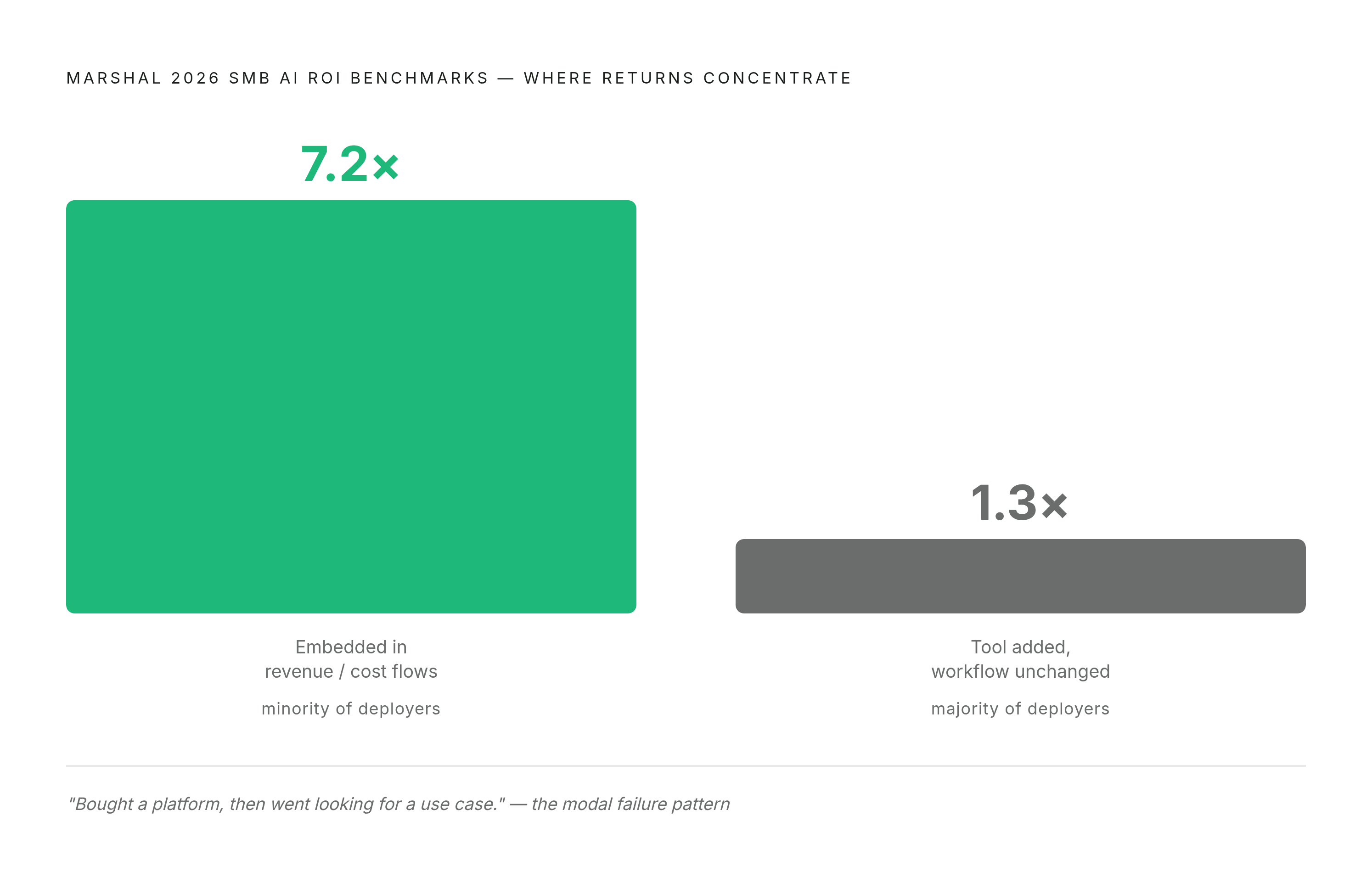
AI embedded in the right workflow produces a measurable return. AI layered onto the wrong one produces a more expensive version of the same bottleneck that existed before, now with a subscription attached. The honest version of this argument has to hold both of those facts at once.
The more useful finding in SMB AI research isn't an adoption percentage, it's the distribution of outcomes across the businesses that actually deploy something. Marshal's 2026 SMB AI ROI benchmarks found that the highest returns concentrate in a small group that embedded AI directly into revenue or cost flows, while most businesses that deploy AI see only modest productivity gains. The failure pattern behind the weaker results is consistent: a business buys a general-purpose platform first and goes looking for a use case to justify it afterward, the same reason most enterprise AI pilots return nothing measurable. The tool exists. The workflow was never redesigned around it, so the tool sits next to the old process.
The win pattern is narrower and more deliberate: pick one high-volume, repetitive process, embed the AI inside the system the team already uses for that process, and instrument the result so the before-and-after appears in hours recovered or conversions changed, not in some vaguer measure of engagement. An eight-person accounting firm, working with Layer3Labs, automated its client onboarding workflow in three weeks at a low implementation cost. The automation recovered roughly twelve staff hours per week, a return that paid back the build cost within the first month.
The strongest objection to all of this comes from outside the SMB literature. An MIT analysis found that only about 23 percent of wages paid for tasks involving computer vision are economically viable for AI automation, meaning human labor remains cheaper for the majority of those roles. The finding is accurate, and it's also answering a different question than the one this piece is asking. It describes roles, assessed broadly across an economy. The argument here is about workflows: high-volume, rules-based, repetitive handoffs inside a specific small business, which is exactly the category where AI wins on cost and speed regardless of what's true for computer-vision tasks at the scale MIT studied. Narrow, honestly instrumented processes are the ones that pay for themselves, and the businesses that get a return are the ones that picked a process narrow enough to instrument that way.
The embedded AI engineer as an alternative to a full-time technical hire
Workflow automation handles the bottleneck that's rules-based and repetitive. It doesn't handle the bottleneck that requires judgment, that connects multiple systems of record, or that sits close enough to revenue that getting it wrong is expensive. For that category, the alternative to a full-time technical hire is an embedded AI engineer working on a fractional basis.
What separates an embedded AI engineer from a freelancer is persistence. A freelancer completes a scoped task and hands it off. An embedded engineer joins the team, builds systems that run inside day-to-day operations, and keeps iterating on them, so the deliverable is agents running and automations shipping on an ongoing basis rather than a finished project file sitting in a folder. That's a different relationship to the business than a contractor engagement, and it's a different relationship than a full-time hire, too: a senior forward-deployed AI engineer brought on as a full-time employee carries a fully loaded cost well beyond what most SMBs can sustain, on top of the months it takes to recruit and onboard someone into that role before they produce anything. The fractional model starts in under a week and runs as a monthly engagement, which lets a business point it at the highest-leverage bottleneck today and redirect it as the operation changes shape.
When an embedded engagement ends, the team is left holding a running system and its documentation, but the person who understood that stack from the inside is gone. The mitigation isn't a promise, it's a design choice, making sure the systems built are owned and operable by the internal team rather than quietly dependent on the engineer's continued presence.
SANSA's model is built around that exact design choice. The engagement is structured to stay embedded as the systems it builds compound, following a three-stage pattern: diagnose the bottleneck in two weeks, build the production system, then stay embedded so the value keeps growing past the first win. What a growing SMB actually needs is flexible, specialized capacity it can call on without a recruiting lag or a fixed payroll obligation attached, and that's the gap embedded AI and fractional expertise models like this one are built to close.
How to sequence the first non-headcount capacity investment
The biggest obstacle to getting started with any of this isn't cost and it isn't the technology: it's picking the wrong first problem, deploying against it, getting a result too thin to measure, and confirming every skeptic in the room who suspected AI doesn't actually do anything.
The sequencing that avoids that outcome is specific. Pick a single high-volume, repetitive process, the one where someone on the team is doing the same routing, data entry, or triage step dozens of times a week. Embed the AI inside the tool already used for that process. Instrument the result in hours recovered or conversions changed, not in impressions or a satisfaction score that won't survive scrutiny from the person signing the check.
Payback periods for a well-scoped deployment like this have compressed from quarters down to weeks. The HVAC case above paid back in days. The accounting firm recovered its build cost within the first month. Speed like that is a function of scope: a narrow deployment is cheap to build and fast to validate, while a sprawling one takes longer to ship and longer to tell whether it worked. The modular approach, one agent for intake, a separate one for follow-up, another for scheduling, lets each piece get tested before the next gets added, which avoids the monolithic failure mode where a large system breaks in a way nobody can isolate or fix quickly.
The decision about which path to take has a fairly clean diagnostic attached to it. If the process is rules-based and runs inside a tool with integrations already available, workflow automation is the starting point. If the bottleneck requires judgment, spans multiple systems of record, or touches a revenue-critical function directly, the embedded engineer model justifies its faster payback despite the higher upfront engagement cost. SANSA's two-week diagnostic exists for exactly this decision, identifying the highest-leverage bottleneck before a business commits to building anything, so the first investment lands where it compounds fastest. The first working system, once it's live, tends to make the second one easier to justify and faster to build, which is the practical argument for shipping something narrow now over waiting for a more complete architecture later.
What becomes possible when capacity isn't tied to headcount
The ceiling on what a small business can take on was never really talent or budget. It was the assumption that more output requires more people, an assumption that collapses once a workflow runs itself and a bottleneck gets solved by someone embedded for a month.
The hours recovered in the cases above, the 20 hours a week at the HVAC company, the twelve at the accounting firm, read like cost savings on the page. They're something closer to inventory: capacity a team can now point at a service line it couldn't staff before, a client tier it used to have to turn away, or a decision that previously waited for a specialist's calendar to open up. None of that required a new desk, a new badge, or a new line on the payroll. It required recognizing that the bottleneck was never a headcount problem to begin with.