AI Readiness Checklist for Small Insurance Brokerages
Clients now expect AI to reshape your service model, not just your toolbox.

Most small brokerages judge AI readiness by shopping. Someone gets a demo from a vendor, checks the line item against the budget, and calls the resulting yes or no "readiness." That is the wrong test entirely: readiness has nothing to do with what a brokerage can afford and everything to do with whether its data, its workflows, and its people can hand AI something real to work on.
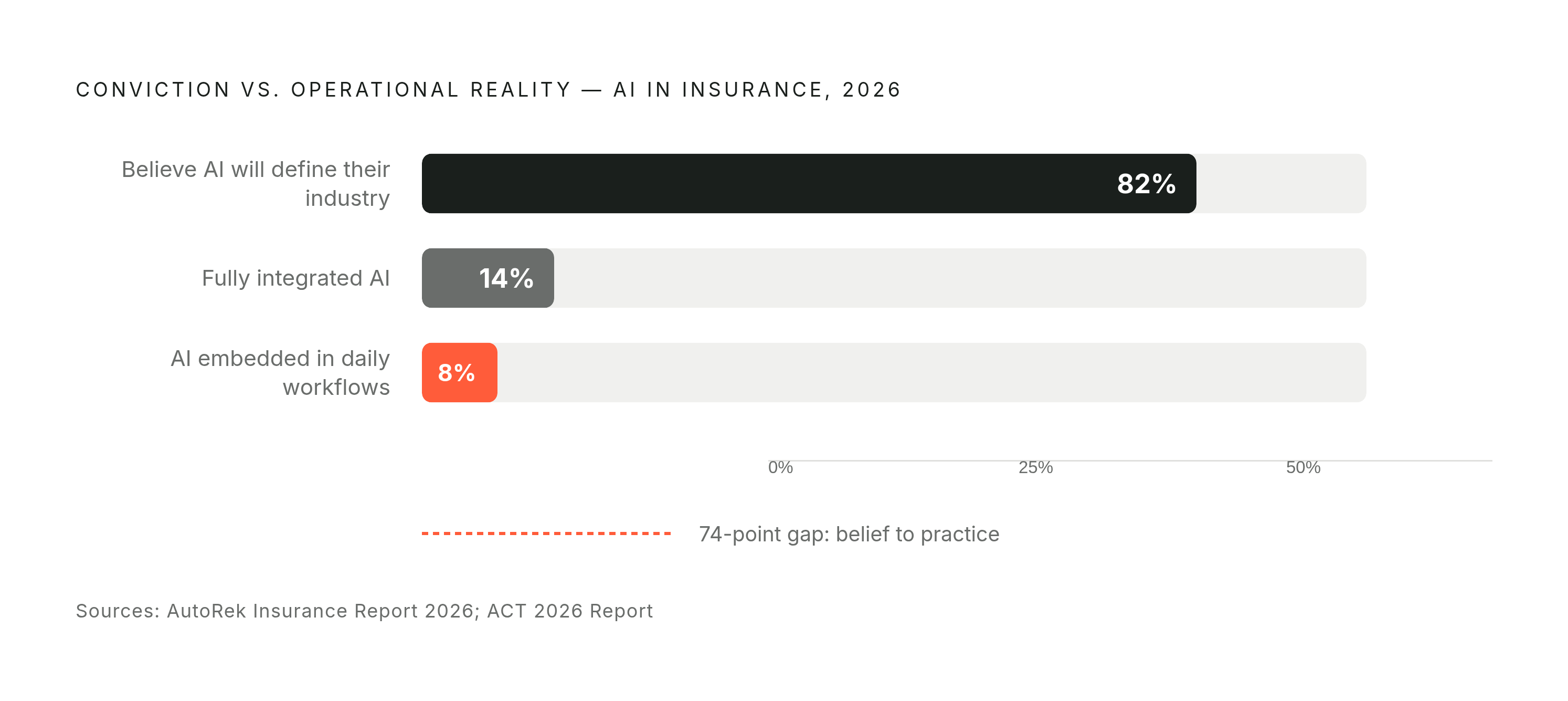
The framing matters because the gap it produces is expensive. AutoRek's 2026 Insurance Report found that 82% of insurers believe AI will define the industry's future, yet only 14% say they've fully integrated it. That is not a technology bottleneck. AutoRek's 2026 Insurance Report found that 82% of insurers say AI will define their industry's future, yet only 14% have fully integrated it (a readiness gap, not a technology shortage). Compounding the error: many brokerages run a pilot, get a decent result on a controlled test, and declare victory. The door3.com framework identifies conflating "we ran a pilot" with "we are ready" as the single most expensive mistake in insurance AI adoption, because a pilot tests whether the model can do the task once, not whether the brokerage can feed it consistently at scale.
Those larger organizations have entirely different readiness math. A ten-person agency does not.
The market pressure that makes this checklist urgent now
Skip the market-size headline for a moment, because it isn't the number that should worry a small broker. The number that should worry a small broker comes from clients themselves. Zywave's 2026 Broker Services Survey found that AI adoption has, for the first time, entered the list of top reasons employers say they'd switch brokers⟚c8⟧. Clients are no longer treating AI use as a nice-to-have footnote in a renewal conversation.
Layered on top of that is a shift in what clients expect a broker to be. Zywave found the share of respondents who expect their broker to act as a trusted strategic advisor climbed from 56% in 2023 to 71% in 2026. At the same time, desired weekly contact fell from 41.9% in 2025 to 33.4% in 2026, as self-service tools absorb the routine touchpoints clients used to want handled by a live person. AI is built to make a trade like this, assuming it's implemented on the right foundation.
Few agencies have made that trade so far. The Big "I" ACT 2026 report found only 8% of agencies have AI embedded in daily workflows, which means the window for a brokerage to differentiate on this basis is still wide open. As Zywave CEO Martin Simoncic put it, AI is no longer optional infrastructure for brokers, it's becoming a visible part of how clients judge value. Clients aren't grading brokers on whether they bought a tool. They're grading them on whether the tool actually changed the experience. What this combination means practically is that clients want more strategic value and less hand-holding on routine work, exactly the trade AI enables if implemented correctly.
What "not ready" looks like inside a small brokerage
The ACT 2026 numbers break down further, and the breakdown is the more useful part. More than half, 56%, have no written AI policy or guidance whatsoever. That last figure deserves a beat of its own: over half the industry has let staff loose on these tools with zero documented guardrails.
"Experimenting" in practice tends to look almost comically modest. Someone on staff has a ChatGPT tab open. Nobody has mapped the workflow it's supposedly helping with. Client and policy data still lives across email threads and a spreadsheet, with nobody having mapped a workflow. That is not a readiness gap so much as a readiness canyon, and the door3.com framework names the risk directly: deploying AI on top of an unstandardized workflow doesn't accelerate the process, it accelerates the inconsistency. A model that inherits chaos doesn't clean it up. It launders it, faster.
A deeper diagnostic question drives all of this: is AI floating on top of the brokerage's existing work, or is it attached to an actual bottleneck? Intake and data entry, renewal processing, and client communication triage are the bottlenecks to test against first. Everything below is built to test whether a brokerage's data, workflows, connectivity, team, and problem choice are actually positioned to let AI attach to one of those three, rather than hover uselessly above them. News.getsuperagent.com's summary of the ACT 2026 survey found 33% of agencies only experimenting, 22% using AI in limited areas, 8% embedded in daily workflows, and 31% not using it at all.
Checklist dimension 1: whether your data is in a condition AI can use
The test here does not require perfect data. It's whether policy, claims, and client data can be queried from one governed place, or whether someone has to manually pull an extract every single time a question comes up, wait, that's addressed below when discussing systems; for data specifically, the core version asks whether the information lives somewhere queryable at all, versus fragmented across the agency management system, email, spreadsheets, and carrier portals with no shared schema tying them together. That fragmentation is the default condition for most small brokerages, not the exception.
The scale of this problem is bigger than insurance-specific complaints suggest. Cloudera's 2026 Data Readiness Index found that nearly 80% of enterprises say limited data access across environments constrains their AI initiatives, even among organizations that claim to have a clear data strategy. Insurance, with its patchwork of legacy AMS platforms, carrier portals, and paper-descended ACORD forms, almost certainly sits above that baseline rather than below it.
Score the dimension with direct, blunt questions. Is there one place where client and policy data lives, or does the answer depend entirely on who's asked? Producing a clean dataset takes an hour, a day, or a week. Is data entry handled the same way across the team, or does every account manager run their own private system? Are documents like ACORD forms, submissions, and renewal packets sitting in a named, findable location, or scattered across inboxes? Passing doesn't mean flawless data. It means data that's centralized, labeled, and reachable without a scavenger hunt. Failing means AI gets pointed at incomplete, inconsistent inputs and produces outputs nobody on staff actually trusts, which widens the readiness gap instead of closing it.
Checklist dimension 2: whether your workflows are defined well enough to hand off
AI cannot improve a process that was never defined in the first place. The door3.com framework states: if a workflow varies by whoever happens to be handling it that day, there's no baseline for AI to replicate. That's not a criticism of small-shop informality, it's just a description of what happens when a ten-person team grows organically without anyone stopping to write the steps down.
"Defined well enough" doesn't require a binder. It requires explicit, plain answers to a short set of questions: who does this step, what triggers it, what does a good output actually look like, and what counts as an exception. Does intake produce the same structured result no matter who handles it? Are renewal touchpoints, what goes out and when and triggered by what, actually written down anywhere? Is there any baseline data on how long core tasks take, because without a baseline you cannot measure ROI? Are exceptions handled by a documented rule, or by whoever happens to be at their desk that afternoon?
The highest-leverage place to test this first is routine administrative work, since licensed agents in most small brokerages spend a meaningful chunk of every day on it, and a documented, repeatable version of that workflow is the cheapest starting point available. Grant Thornton's 2026 survey found only 7% of insurance executives believe their workforce is fully ready to adopt AI, and the leading causes were governance and compliance barriers, cited by 46%, along with operating model issues that require redesigning roles; training gaps appeared too, at 31%, but weren't the primary driver. That ordering matters. The problem usually isn't that staff don't know how to use the tool. It's that nobody redesigned the job around it. If no one on staff can describe the workflow out loud without physically doing it, that workflow is not ready for AI yet.
Checklist dimension 3: whether your systems can connect to AI outputs without manual re-entry
If the model outputs can't get written back into daily operations without someone retyping them, and core systems aren't API-accessible, that tells a vendor what they need to know. If the answer requires a shrug, that's the answer.
The failure mode is familiar enough to be almost a genre. AI summarizes a submission beautifully, flags the right coverage gaps, drafts a clean note, and then a staff member copies all of it into the AMS by hand anyway. Net gain: close to zero, and the team quietly starts resenting the tool that was supposed to help them. Most small brokerages run on Vertafore AMS360, HawkSoft, or EZLynx, with Applied Epic showing up more at larger agencies, and integration depends on what these specific systems will let in and out. Integration friction is not a fringe complaint either: 40% of insurance leaders cite integration hurdles as the top barrier to scaling AI, according to HTEC's State of AI in Financial Services and Insurance 2025-2026.
Test it with direct questions again. Does the AMS expose an API or integration layer, or is it a closed box? Is document storage, whether that's Google Drive, SharePoint, or a carrier portal, reachable programmatically, or only through a login screen? Full API integration is the ideal, but it isn't the only acceptable outcome for a small shop: structured export and import workflows still beat manual re-entry, so this dimension should be scored on a gradient of partial connectivity rather than graded pass or fail. None of this requires hiring a developer to assess. Most of it can get answered in about half an hour on a call with vendor support.
Checklist dimension 4: whether the team will use what gets built
That number sounds encouraging until the fine print gets read: it describes organizations where AI was genuinely adopted, not merely deployed. A tool sitting unused on a shared drive doesn't improve anyone's decision-making.
Low team readiness has a recognizable shape in a small shop: the owner buys the tool, one enthusiastic staffer actually uses it, and everyone else quietly builds a workaround. Part of the cause is structural.
Test it directly. Was the team that will actually use this AI involved in identifying the bottleneck it's meant to solve? Is there a named person, not a vague "someone," who owns adoption day to day? Does the team understand clearly what the AI will decide on its own versus what it will simply surface for a human to review? Is there an actual plan for the first 30 days, or is the plan that everyone will figure it out on their own? Consumer research offers a useful parallel here: per Insurity's 2026 survey, acceptance of AI drops sharply the moment it moves from assisting a decision to making one outright, and staff inside a brokerage respond to the same shift the same way. People will use a tool that helps them do their job. They resist a tool that quietly replaces their judgment without ever explaining why. In plain terms, 62% of insurance organizations say AI is improving their decision-making per Grant Thornton's 2026 survey of 950 executives (that figure comes from organizations where AI was adopted). The door3.com finding shows that 36% of financial services and insurance leaders cite leadership misalignment as a barrier to AI scaling (in a 10-person shop, that means the principal and the account managers have different mental models of what the tool is for).
Checklist dimension 5: whether you have chosen the right first problem
Readiness isn't a single global score. A brokerage can be fully ready for AI in renewal processing and completely unready for it in claims triage, and this checklist exists to find that specific starting point rather than certify the whole operation as "ready" or "not".
Some starting points simply carry a better data-to-effort ratio than others. ACORD intake and AMS data population are near the top of that list, since the work is repetitive, structured, high-volume, and easy to measure against a before-and-after. The test for picking a first problem is consistent regardless of which one gets chosen: does it have enough volume to actually measure, a documented baseline, data that's accessible without heroics, and a specific team member willing to own the output? Anything requiring undocumented judgment calls, anything where exceptions are the norm rather than the edge case, anything whose output can't be verified without calling in a specialist, none of that belongs in the first attempt.
Domain fit matters too. A general-purpose AI tool knows a little about everything and essentially nothing about renewals, carrier appetite, or objection handling, while tools built specifically for insurance close exactly that gap. The first-problem decision should weigh that distinction directly, not treat all AI tools as interchangeable. The problem worth picking first is rarely the biggest one sitting on the whiteboard. It's the one where all five dimensions in this checklist land closest to "ready" at once.
What realistic ROI looks like when the starting point is right
The ROI data doesn't agree with itself, and pretending otherwise would be dishonest. One line of evidence suggests small brokerages can see positive ROI within weeks of implementation. A separate 2026 insurance AI roadmap warns that well-built AI in the industry actually pays back over 12 to 24 months, and that any promise faster than that is, in its own words, selling vapor. Both are probably true, just describing different situations: the gap likely comes down to scope and how deep the implementation actually goes, not which claim is correct and which is marketing.
What separates a ready problem from an unready one is whether all five dimensions of this checklist align closest to "ready". Brokerages that walk in genuinely ready compress the time to value; brokerages that skip the diagnostic and buy the tool anyway stretch it out, sometimes past the point of ever recovering the investment. McKinsey's productivity estimate gives a sense of the ceiling: AI could automate roughly an hour of daily work per employee today, rising to as much as three hours by 2030. Across a ten-person brokerage, that is meaningful recovered time without adding a single headcount line to payroll.
The comparison to hiring makes the point directly. A new employee takes months to reach full productivity, carries payroll tax and benefits overhead, and realistically covers around a quarter of the hours available in a week. An AI system attached to the right bottleneck runs continuously and gets better as the underlying data improves, rather than plateauing the way a new hire's ramp eventually does. Concrete results back this up in specific cases: one insurance broker client saw an 80% reduction in data entry time, and a freight company saved 160+ hours a month via automated freight intelligence tracking roughly 300 routes daily, both achieved through embedded AI attached to an identified bottleneck rather than a tool layered on top of existing work. A Datos Insights August 2026 report on the shift from pilots to production found only 33% of carriers currently report positive ROI from AI Datos Insights / Insurance AI Adoption 2026. ROI from AI is real. The gap between that 33% and everyone else is readiness Datos Insights / Insurance AI Adoption 2026.
How to use this checklist as a starting point, not a finish line
Treat this as a diagnostic, not a gate. A brokerage that scores poorly on every dimension hasn't failed anything, it has just found out where the actual work is before spending money on a vendor contract that assumes the work is already done. The three most common bottlenecks in a small brokerage that AI can actually attach to are intake and data entry, renewal processing, and client communication triage.
The right first problem is not necessarily the biggest problem, it is the problem where all five dimensions of this checklist align closest to "ready". A principal can walk through data condition, workflow definition, system connectivity, team buy-in, and first-problem selection over the course of a single working week, using nothing more sophisticated than a spreadsheet and a few honest conversations with staff. The output isn't a certificate. It's a short, specific list of what needs fixing before the first AI dollar gets spent, and a clear-eyed view of which bottleneck is actually worth attaching a tool to first. Revisit it after the first project lands, because the workflow that was second in line for readiness a month ago may now be first.