What a 50-Person Company Actually Accomplishes in Its First 30 Days of AI Deployment
A 50-person company should solve its actual bottleneck before buying AI tools.

For a 50-person company, a 30-day AI deployment removes one bottleneck. The fastest practical route is to spend the first two weeks defining the constraint, then put a mature, narrowly scoped use case into production. The month’s result should be a measurable change in one workflow.
Why the first 30 days of AI deployment keep failing at companies this size
A property management company wanted AI for “efficiency.” A closer look at its operations showed that coordinating with 30+ vendors across 200+ properties was consuming 15 hours per week of manager time. “Efficiency” could have justified almost any purchase. It was a poor purchasing brief.
The dominant failure at this size is choosing a solution before identifying the problem it must solve. An imperfect process is not necessarily the process holding back the business. Making it faster may help with that task without changing how much work the company can deliver. The distinction matters because a deployment can succeed at its assigned task while failing to address the reason anyone funded it.
Microsoft’s transformation learning describes the same trap. Early efforts helped people do familiar tasks faster but rarely changed the results much. Adding agents to a broken process still leaves a broken process, and accelerating one step can simply lengthen the queue at the next. The work has moved faster, but only as far as the traffic jam.
A 50-person company has less room to absorb that mistake than a business with spare budget and headcount. The wrong first project consumes both money and the time of people already responsible for keeping operations running. It also delays the project that could have relieved the actual pressure. The first decision therefore needs to be about where capacity is constrained, before it becomes a decision about what to buy.
What the bottleneck-first sequencing actually looks like before any tool is chosen
The first two weeks are for discovery. The company needs to identify a workflow whose removal or acceleration would let the existing team take on work it currently cannot staff, quote faster, or stop turning away. That is narrower than asking where the company is inefficient. Almost every process will have an imperfection available for inspection. Not every imperfection is a ceiling.
A ceiling bottleneck directly limits revenue or service delivery through volume, speed, or capacity. Finding it starts with the task list and two criteria, namely volume and data availability. Volume establishes how many hours per week the work consumes. Data availability establishes whether the process produces structured, accessible inputs that AI can use. Together, they distinguish a large, deployable problem from either a minor inconvenience or a substantial problem that is not yet ready for automation.
Sansatech begins its SMB engagements with a two-week diagnosis intended to identify the highest-leverage bottleneck before a build begins. It checks task volume against data availability, then ranks the problems that remain by how much it expects solving each to help. That last step matters because technical feasibility is not enough. A project must also justify a capital commitment that a 50-person company can absorb. The biggest problem on paper is not automatically the right first project.
In the property management example, the scope becomes vendor coordination and the manager time it consumes, rather than every activity involved in running properties. That specificity gives the eventual deployment something concrete to change and the company something concrete to measure. The output of week two is a specific, scoped problem statement.
How long does it really take to deploy AI for a 50-person company?
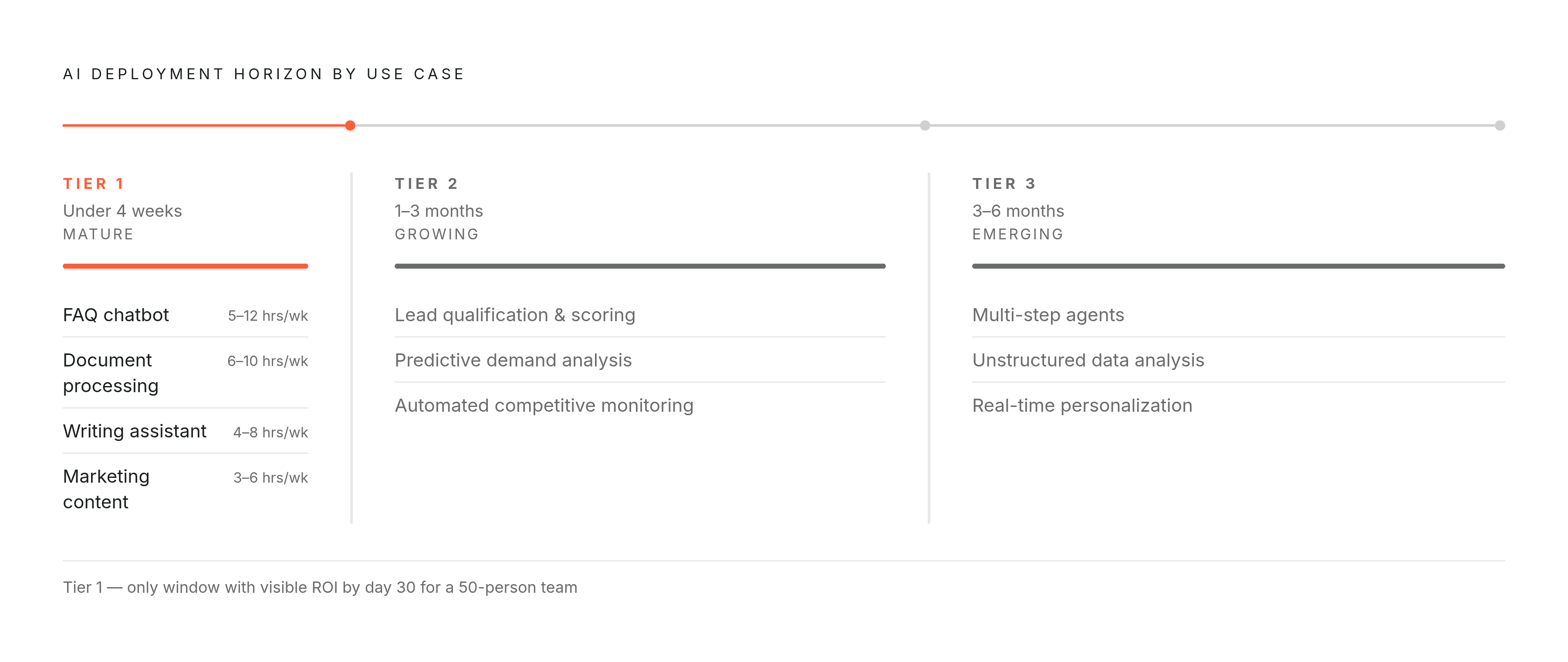
Mature use cases can be in production in under four weeks, while those in growing categories usually need one to three months. Emerging applications take at least three to six months. These deployment horizons apply to different kinds of work. Choosing a mature use case in week two is what makes a week-four result plausible.
Document processing is the most mature category in this map. It covers automatic extraction and classification of invoices, contracts, and emails, which can save 6–10 hours per week. Writing assistants for emails and proposals are in the same near-term group and can save 4–8 hours per week. Internal and external FAQ chatbots can save 5–12 hours per week, while marketing content generation can save 3–6 hours per week. Those figures show how much time a workflow could save, but each company should be cautious about counting on those hours in its budget.
These applications share useful properties. The work is document-heavy or close to everyday communication, the inputs are already digital, and the people doing the work can immediately judge the output. That makes the first result easier to check without waiting for a long business cycle to end. The experience of SMB-focused consultancies, including Sansatech’s implementations under 30 days across finance, logistics, and service firms, supports this weeks-rather-than-months horizon for mature applications. The category makes a short deployment possible, but a particular project still needs a scope that fits that timeline.
By contrast, lead qualification and scoring, predictive demand analysis, and automated competitive monitoring generally need one to three months. They depend on more structured data pipelines or CRM integration before they can run reliably. Starting with one of these may be justified, but it changes when the company should expect its first visible result. Multi-step agents for complex workflows, unstructured data analysis, and real-time customer personalization sit further out, at three to six months minimum. For a company without existing AI infrastructure, they are not 30-day projects with an ambitious attitude.
What actually changes in the first 30 days when the sequencing is right
The first milestone is a working change in the process that was limiting capacity. That might mean less manual data entry or a support system that handles real customer conversations well enough to meet the standard. Team-level transformation, customer support deflection rates, and sales pipeline metrics belong to a 60-to-180-day horizon. Reading them as verdicts at day 30 can turn immature data into a premature cancellation.
Microsoft offers a useful example of workflow design, with an important calendar distinction. Its nine-person cross-functional team of engineers, designers, and product managers shipped an initial product release in 35 days, beyond the 30-day window. The team had freedom to rethink product development with AI embedded from day one. Agents were built into the workflow rather than attached to the old process after the fact. This is evidence for the sequencing principle.
Klarna provides a first-month example from customer service. Its AI assistant handled 2.3 million customer conversations in the first month, with customer satisfaction scores that matched those of human agents. The useful comparison for a 50-person company is the milestone of a system doing live work at parity with the team it supported, even at a very different operating scale. By the end of the month, the evidence concerned actual conversations and customer satisfaction, rather than a demonstration that the assistant could answer questions.
SANSA’s documented results bring the discussion back to narrower operational changes. An insurance broker cut manual data entry by 80%, while a freight company saved more than 160 hours per month. The broker’s change was in the amount of information people had to enter manually, and the freight company’s change was in the time its workflow consumed. Neither figure establishes a company-wide transformation, nor supplies a universal day-30 benchmark. Both show a first win with a clear scope, where cutting a specific burden frees up enough time for the next step.
Why week one through three feel like regression before they feel like progress
That first win can arrive after a period in which the work feels harder. People are learning a new way to complete familiar tasks while still being responsible for the output. In early deployments, user proficiency is the largest category of implementation difficulty, with learning curves, prompt-engineering struggles, and inadequate training together outweighing technical issues. A company that is ready for this plans for it as part of deployment. Even after buying a larger tool, people still need to learn the one already installed.
Before deployment, the company needs to record three to five metrics as a baseline. Those measures need consistent review so that the company can distinguish an adoption dip from a system that is not improving the target workflow. Manager feedback, error ticket volume, and time surveys give early signs of change during the first 90 days. They help show how the work is changing before formal ROI calculations become statistically defensible.
Vendor ROI calculators often assume near-full adoption, clean data integrations, and behavior change within 30 days. Those assumptions do not describe the first 90 days of a real deployment. A gap between the calculator’s promise and the early result is therefore not, by itself, evidence that the technology has failed. The gap may show that the measurement model left out the learning curve. Cancelling at week three of a six-week payback curve makes that accounting mistake expensive.
Measurement also needs a named owner. One person responsible for a single tracking document, reviewed on a set schedule, gives the company a usable record. Without that owner, the company can spend 90 days tracking results and still have no data it can use. With it, the team can judge progress against the original bottleneck while allowing for the effort required to change behavior. Preparation prevents the adoption dip from being mistaken for the destination.
What a 50-person company is actually capable of doing differently after the first win compounds
The first successful deployment changes the next decision. The company now has evidence that AI can ease a defined constraint in production, where before it could only ask whether AI might help somewhere. That is a proof of concept for a method. It gives the team a reason to look for the next ceiling. The compounding begins when that evidence leads to another well-scoped deployment rather than a declaration that the AI project is finished.
The path can remain modest and concrete. Validate the first use case in month one, then deploy the second and third in the following quarter. A semi-annual review can examine cumulative ROI and reassess the remaining problems as tools mature. A 12-month goal of three to five production use cases, generating combined productivity equivalent to one to two full-time employees without hiring, provides a longer horizon.
The underlying advantage is that more work need not always require proportionally more people. A well-deployed AI system can absorb volume spikes in a way that a labor-bound process cannot. For the business, however, the important question is what that additional capacity permits. The same five-person team may be able to quote faster, take on a service line it could not previously staff, or make decisions that once required an unaffordable specialist. Fewer hours for the same output is an efficiency gain, while the same hours producing previously impossible output is a ceiling removed.
That distinction is reflected in SANSA’s embedded model, where the engineer stays to identify the next bottleneck as the first one is resolved. The first system becomes a foundation for continued work. This matters in a market where the overwhelming majority of SMBs adopting agentic AI remain in experimentation, with only a small fraction partially deployed and fewer still operating at scale. The 30-day milestone is the entry point to a business that can take on more kinds of work.