AI Automation ROI Benchmarks for Small Transportation and Logistics Businesses
Real ROI data for small fleets shows which workflows actually pay back, and how fast.
A 10-truck carrier and a global 3PL are not playing the same game, and grading them on the same scorecard is how small operators end up concluding that AI doesn't work for logistics, when it does. The question is which workflow, measured against which baseline, over what window. This piece answers that question workflow by workflow, with the before-and-after numbers that actually apply to an operation that size, not the averages published for companies a hundred times larger.
Measuring AI ROI in Logistics at the SMB Level
Most of what gets published about AI ROI in logistics comes from surveys of the largest players in the industry, and those numbers describe a different set of problems than the ones a small carrier or brokerage actually has. BCG's 2026 AI in Logistics Executive Survey polled 30 leading global logistics companies and found that 97% rank AI as a strategic priority, 70% have a formal AI strategy, and 67% have a dedicated budget for it. Only 13% say AI is delivering measurable financial impact. That gap between investment and payoff gets reported as an indictment of AI in logistics generally, when it's really a diagnosis of what happens when fragmented legacy TMS and WMS systems, disconnected point solutions, and under-resourced change management collide with enterprise scale.
None of that describes a 10-truck fleet or a two-person freight brokerage. A small operator doesn't have a decade of bolted-together legacy systems to untangle, doesn't have five business units each running its own pilot in isolation, and doesn't need a governance committee to approve a new tool. It takes large organizations months to clear integration and compliance review before anything goes live. Small operations can implement a new system in days, because there are fewer stakeholders, fewer systems, and fewer approval layers standing between a decision and a deployment. That speed is a structural advantage, not a consolation prize.
The right question for a small logistics business is what automating one specific, well-defined workflow returns for an operation of a comparable size, not what AI returned across the industry on average. The rest of this piece works through that question one workflow at a time: document processing, dispatch and routing, freight matching, and predictive maintenance, each with its own mechanism and its own payback math.
BOL and document processing: the hidden hours in small freight operations
Document handling in a small freight operation rarely gets counted as a cost center because no single invoice or bill of lading looks expensive on its own. The expense is in the repetition. A dispatcher or back-office staffer receives a bill of lading, keys the data into the TMS by hand, cross-references it against a proof-of-delivery record, and then manually generates or approves the invoice. Each of those handoffs is a place where a number gets transposed wrong, a document goes missing, or the whole chain just sits until someone gets to it.
BOL and POD extraction is one of the top three highest-impact AI use cases for transportation businesses, and it sits alongside route optimization and freight matching. The reason it ranks there isn't exotic: once a delivery is confirmed, an automated system can trigger invoice generation directly, pulling the POD and matching it against the original BOL without a person touching either document. The chain stops depending on whoever happens to be free that afternoon and starts running the moment a delivery event fires.
Billing errors that come out of manual re-entry generate disputes, delayed payment, and in some cases outright write-offs, and a small brokerage absorbs every dollar of that at full margin, because there's no large back-office team to catch the mistake before it reaches the customer. The mechanism that fixes this isn't unique to freight. SANSA documented an 80% reduction in data entry time for a wholesale insurance broker, achieved by eliminating the same kind of manual re-entry between systems that a BOL-to-invoice workflow depends on. The industry is different; the bottleneck is identical, and so is the fix.
Dispatch and route optimization: the fastest payback for small fleets
For a carrier that owns its trucks, dispatch and routing is where AI earns its keep fastest, because driver hours, fuel, and failed first-attempt deliveries are the three largest cost lines a small fleet can actually control, and routing touches all three at once. An AI routing system pulls live traffic data, GPS positioning, and weather feeds to build each day's routes, respecting hours-of-service limits, minimizing total miles, and sequencing stops to cut down on dock wait time and backtracking.
Modern routing engines handle multiple constraints simultaneously: delivery windows, driver hours, and vehicle capacity, all balanced at once, with the system improving its own route quality over time as it learns from historical delivery data. Traditional routing software was never built to juggle that many variables at once. An AI routing engine can evaluate thousands of possible stop sequences in the time it takes a dispatcher to review one.
What actually breaks these deployments is the fleet that turns on optimization before standardizing service times, stop constraints, and exception playbooks, and then blames the software when the output looks wrong. Fleets that do the standardization work first get routes that hold up; fleets that skip it get garbage in, garbage out, with an AI label on it. At SMB scale, the realistic benchmark is closer to SANSA's documented result for a freight company: 160+ hours recovered per month, which came from automating manual freight rate comparisons across roughly 300 tracked routes, not a multinational parcel carrier's routing budget. That's back-office time, not driver time, and it's the same category of win: hours that used to disappear into manual comparison work, now returned to the operation.
What freight matching automation returns for small brokerages specifically
A small freight brokerage's version of dispatch optimization is freight matching, and the return looks different from a cost cut. It's a capacity unlock. The manual version of this job has a broker scrolling load boards, calling carriers, negotiating rates by phone or email, and keying the resulting match into a TMS, and every one of those steps caps how many loads a two- or three-person team can actively work at the same time.
Freight matching automation is one of the top three automation use cases named for transportation businesses, alongside BOL processing and route optimization, and the reason it belongs on that list is straightforward: when matching stops consuming a broker's day, the same team can quote more loads without adding a single hire. Revenue scales against the existing headcount instead of against new headcount, which is the ceiling-removal argument in concrete terms rather than abstract ones.
Speed matters here independently of the cost math. A load matched in minutes goes to whichever brokerage got there first, and a load matched in hours goes to the competitor who didn't need those hours. For a small brokerage, that's whether the business keeps the freight at all. BCG's description of Level 2 maturity captures what this looks like in practice: an AI agent fields a customer inquiry, draws on live pricing that reflects real-time capacity, and generates, adjusts, and books a quote without a human rekeying anything. That's the freight-matching workflow, described from the brokerage's side of the transaction.
Predictive maintenance's fast payback for small fleets through avoided failure costs
Predictive maintenance pays back faster than almost any other AI use case in small-fleet logistics, for a simple reason: the costs it prevents are large, sudden, and easy to point to after the fact. A roadside breakdown means a tow bill, an emergency repair invoice, and a missed load, all landing on the same day. Machine learning models can monitor telematics data, engine vibration, brake wear, and temperature, so they flag an anomaly while it's still a scheduled-service problem instead of a highway problem.
The arithmetic for a small fleet doesn't require a spreadsheet. One avoided engine failure, one tow that never happens, and one load that ships on schedule instead of getting bumped can cover months of a telematics subscription by itself. And in a driver market where every empty seat already costs revenue per day, a truck that breaks down costs twice: the repair, and the load that truck was supposed to be hauling.
Predictive maintenance also asks less of the organization than the other three workflows. Dispatch optimization requires dispatchers to change how they plan a day. BOL automation requires integration work between the TMS and the invoicing system. Predictive maintenance, once the sensors and a monitoring tool are wired in, runs in the background without requiring anyone to change their routine. That lower change-management burden is part of why its payback is visible fast.
How the data and integration step determines whether these workflows deliver
None of the four workflows above pay off if the data underneath them is fragmented, and fragmented data is the reason most logistics AI projects stall. BCG names three structural problems behind the industry's weak ROI numbers: fragmented, siloed legacy systems never built to talk to each other; isolated point solutions that solve one narrow task without connecting to the rest of the operation; and underinvestment in the human side of the change. Most companies deploy AI as disconnected tools bolted onto separate parts of the business instead of running it as one connected capability across a workflow.
Small operators face a lighter version of this problem. A 10-truck carrier's stack is a TMS, an ELD, and an invoicing tool, not the sprawling, decades-old systems a large 3PL has to reconcile. Modern AI layers connect to that smaller stack through APIs and webhooks, so they sit on top of what already exists instead of requiring a rip-and-replace rebuild. Fewer systems means fewer connections to get right, which produces the same SMB speed advantage seen earlier, this time in the integration step rather than the approval process.
The same discipline that makes a 30-day deployment realistic for dispatch or BOL automation applies here: standardize service times, stop constraints, and exception playbooks before turning optimization on. S&P Global Market Intelligence reported that nearly half of AI pilots get scrapped before they ever go live, and the common thread in those failures is unready data, not a weak algorithm.
A realistic 30-day deployment for a small carrier or brokerage
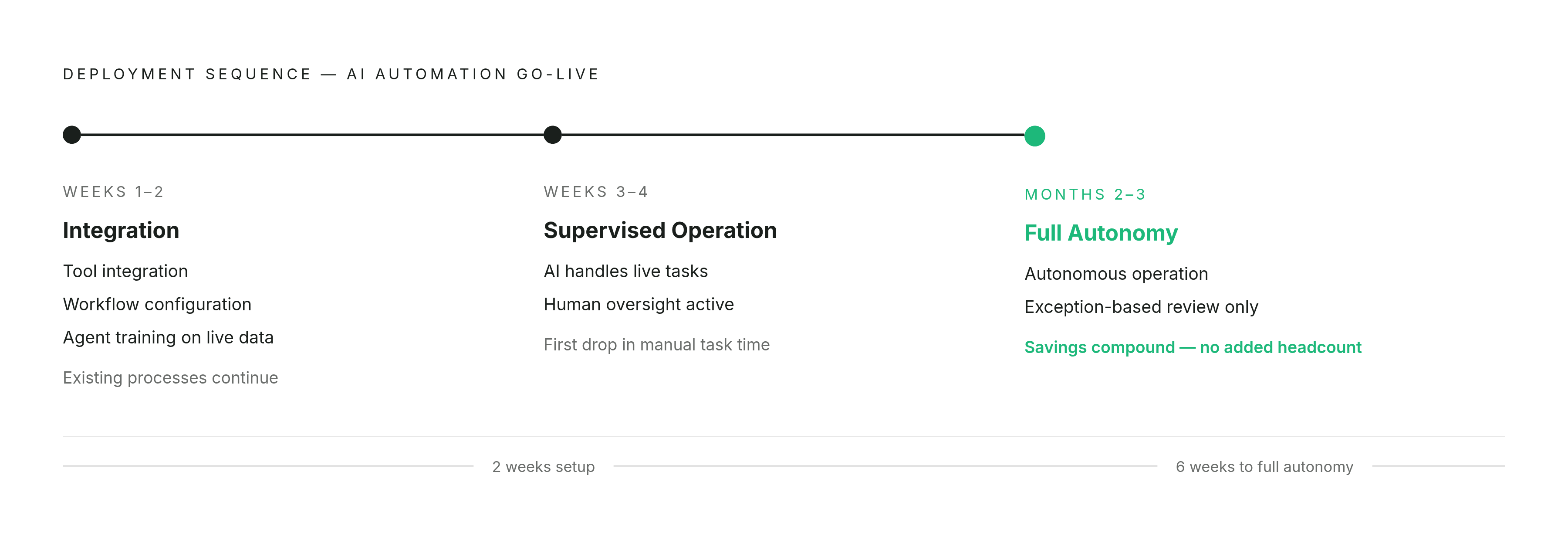
A 30-day deployment window is achievable for a small logistics operator, provided the target is a single workflow with a narrow scope, specific data requirements, and a small change-management footprint. Dispatch optimization and BOL-to-invoice automation both qualify: each has a clear input, a clear output, and a measurable before-and-after state that doesn't require months of model training to produce.
The sequence that tends to work breaks into three phases. Weeks one and two cover setup: tool integration, workflow configuration, and training the AI agents on the operation's actual data, all while existing processes keep running without interruption. Weeks three and four bring the AI agents into live tasks under human oversight, and this is typically where operations first see a measurable drop in manual task time. Months two and three move toward full autonomous operation with exception-based human review, and the savings compound as the system absorbs more volume without any corresponding headcount increase.
Rollouts that miss this timeline almost always skip the data standardization step rather than suffer from a flawed model, so the 30-day window holds if the team agrees on exception playbooks and stop constraints before it flips optimization on. Once that first workflow is live, the integration work behind it, the API connections, the data cleanup, the team's comfort with exception-based review, makes the next deployment faster, not slower. A consultancy focused on SMB logistics work, such as SANSA, builds on that structure deliberately: diagnose the highest-leverage opportunity in roughly two weeks, build the production system, and stay embedded as adoption compounds, which turns that 30-day window into the first of several rather than a one-off project.
Embedded AI support versus hiring: how the cost and capability comparison plays out for small logistics firms
A small transportation business doesn't need to decide which enterprise software to license; it needs to decide whether to hire an internal AI or operations role or to bring in embedded AI support from the outside, and on both speed and compounding value, the embedded model wins that comparison for operations this size.
Hiring has real costs beyond salary. A senior internal AI engineer's fully loaded annual cost runs well above base pay once benefits, payroll taxes, equipment, and management overhead are added in, and filling that role can take months even when the budget is approved. Enterprise AI builds typically take three to twelve months to reach production, and complex or company-wide deployments can run six to twelve months on the longer end. A small freight company usually can't carry that timeline without pushing the project back or pulling an existing employee off their regular job to manage it.
The embedded model's real advantage beyond cost is continuity: an embedded AI engineer owns the 30-day and 90-day reviews, carries the measurement from one build into the design of the next, and compounds the system over time instead of handing off a finished project and disappearing. That matters because small businesses using AI are more likely to report that it helped them grow their team than to report it led to layoffs, which fits the broader pattern: automation frees up budget for revenue-generating hires rather than eliminating the need for people. SANSA's structure, diagnosing the highest-leverage opportunities in two weeks, building a production-ready system, and staying embedded as it compounds, is a concrete version of this trade-off in a logistics context. The 160+ hours a month recovered for its freight company client is the kind of capacity that would otherwise have required hiring another dispatcher, or simply turning away volume the business couldn't handle.
Reading your own operation's ROI potential before committing to a deployment
The industry average is not a useful number for any individual small operator. What predicts ROI is whether the workflow being targeted has clear inputs, a measurable output, and a cost of failure the owner can state in dollars per week without having to look it up.
Three questions sort that out quickly. Where does the team lose the most manual hours to a task that repeats the same pattern every time, whether that's BOL re-entry, dispatch planning, or invoice generation? Where do errors cause the most expensive downstream damage: billing disputes, failed deliveries, or missed loads? And where does a delay in one step hold up everything after it, the way an unmatched POD stalls the invoice, which stalls the payment.
BCG's maturity framework gives a useful gut check here. Most of the industry is at Level 1: single tools pointed at narrow problems, disconnected from each other. The move from there is to connect one workflow end to end, measure what it actually returns, and only then expand. The real financial upside appears in BCG's own framework once tools inside a process begin working together instead of running in isolation.
The ceiling on a small transportation company was never driver talent or owner ambition. It was the manual workflows that capped throughput at whatever pace a human being could physically push paper, key data, and make phone calls. AI deployed against the right bottleneck doesn't just make that ceiling cheaper to hit. It removes it, and what the operation can quote, cover, and deliver starts to be limited by demand again, not by how many hours are left in the day.