Automating Repetitive Logistics Tasks Without an IT Department
Small logistics teams can automate their biggest time drains without hiring engineers or IT staff.
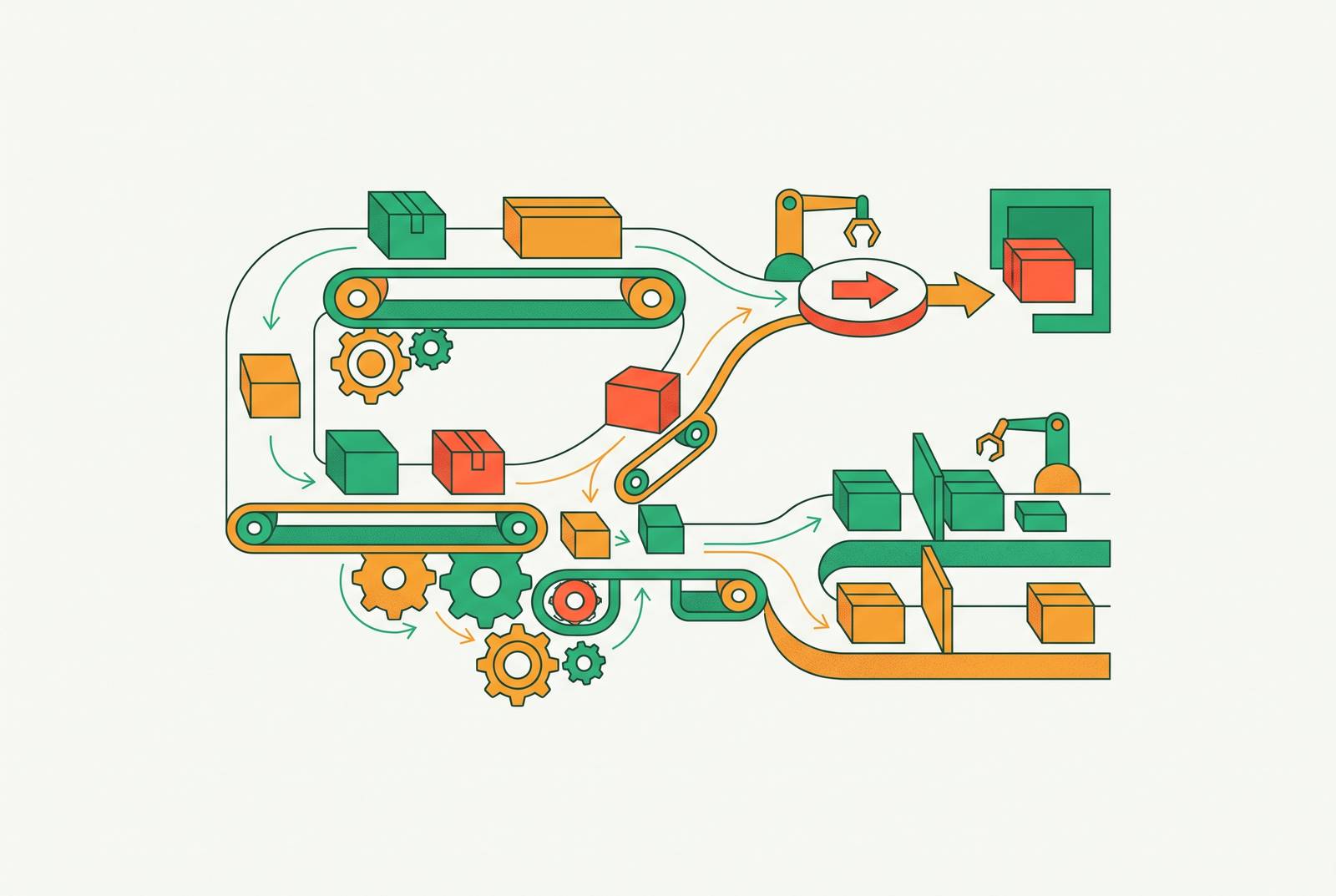
Small freight and logistics teams can automate their most time-consuming repetitive work, shipment tracking, document handling, dispatch updates, route logging, without hiring a single engineer or standing up an IT department. The technology to do this has existed for years and costs a fraction of what it once did. What stalls most small operators is not knowing which workflow to touch first, and not wanting to risk breaking something while trucks are still on the road, since the software itself is already there.
Small logistics teams still doing manually what software can handle
A dispatcher at a five-truck operation is still at the desk at 7 p.m., copying tracking numbers out of a carrier portal into a shared spreadsheet so tomorrow's customer calls have an answer ready. A driver texts an ETA update to a personal phone, and it never makes it anywhere near the system that's supposed to track the shipment. Neither of these is a technology problem. Cloud-based SaaS has already solved the infrastructure side: a five-person freight brokerage can run tools once reserved for companies with dedicated IT staff, accessible from any laptop or phone, scaled up during peak season and back down in the slow months, onboarded in days. The upfront investment objection that used to make sense in the early days of this technology doesn't hold the same weight now.
What's missing is a starting point and a pain threshold for disruption, because deliveries don't pause while a team figures out a new system. That hesitation has a real cost, and it grows with volume. Manual data entry, tracking follow-ups, and status updates eat hours every week that could otherwise go into sourcing new freight, negotiating better rates, or managing the one account that keeps calling with problems. A team that stays manual as volume grows doesn't just work harder. It hits a ceiling it can't see until a competitor who automated two years earlier is already quoting faster and servicing more lanes with the same headcount.
Starting with the single highest-friction workflow before automating everything at once
The teams that get real returns from automation do one thing differently from the teams that don't: they pick a single, well-defined, painful workflow, get it working, and only then expand. Teams that try to automate everything at once tend to end up with five half-built systems and nothing they can point to as a result.
There's a practical filter for picking that first workflow, and it's the same filter whether the business is a marketing consultancy or a freight brokerage. A task worth automating first happens daily or near-daily. It's rule-based: the steps don't change based on circumstance. And it's low-judgment: a reasonably trained person could execute it without weighing competing priorities. Checking a tracking number and updating a customer record passes all three tests. Deciding whether to extend credit to a slow-paying customer does not.
Small logistics teams actually hold a structural advantage here that larger carriers don't. Decision chains are short: the person who notices the bottleneck is often the person who can approve fixing it, without a six-week procurement cycle or a committee. That means a small team can connect the applications it already uses and launch a basic workflow in the time it takes a large carrier to schedule the first planning meeting. The first working system does double duty: it proves the method works, and it reveals the next bottleneck in line. Automation treated as a one-time project stalls after the first win. Automation treated as an ongoing habit, checked and extended, keeps compounding.
None of this applies to work that requires actual judgment. Customer relationship decisions, pricing disputes, contract review, these stay with a person. The repetitive work that surrounds those decisions, the data entry and status updates feeding into them, is what gets automated.
The four logistics workflows where automation pays off fastest for small teams
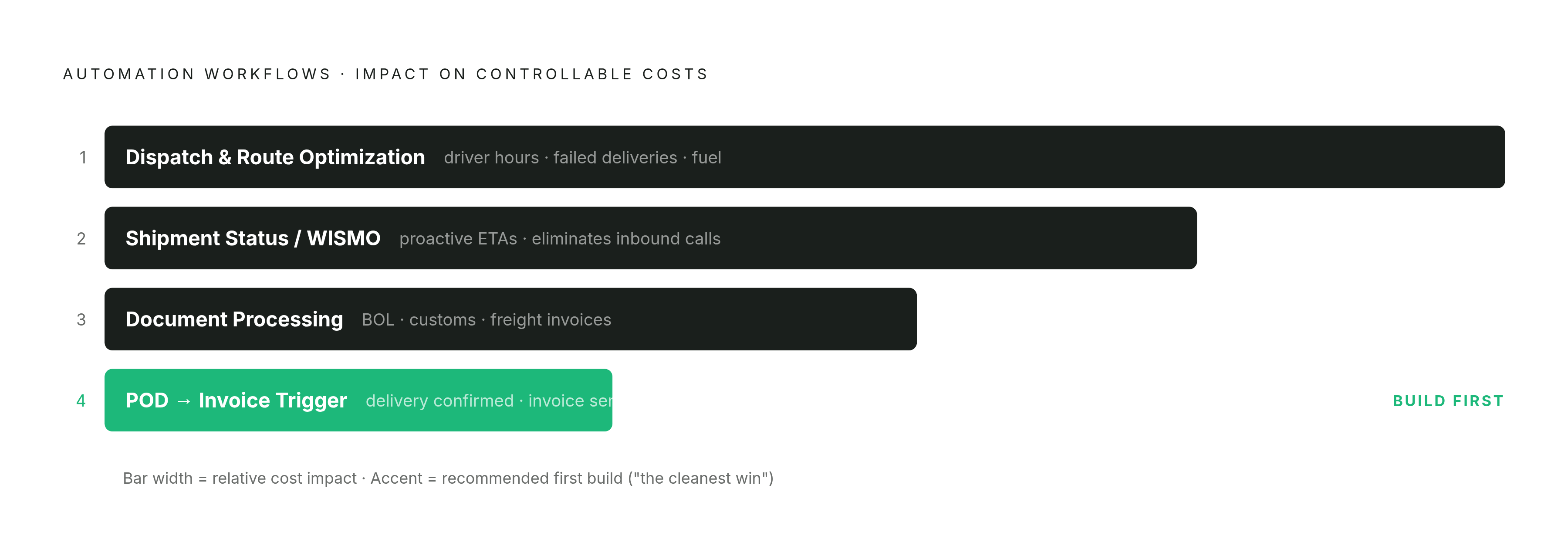
For most small freight and logistics operations, four workflows return value faster than anything else on the list, roughly in this order of impact on controllable costs: dispatch and routing, shipment status communication, document processing, and proof-of-delivery triggering invoicing.
Dispatch and route optimization is the top priority because driver hours, failed first-attempt deliveries, and fuel are the three biggest controllable costs for most SMB fleets, and route optimization touches all three at once. Route planning that used to take a dispatcher hours now takes minutes, using machine learning to weigh traffic, weather, last-minute order changes, and which drivers are actually available that day. UPS's ORION system shows what this looks like at scale: it recalculates the most efficient route for every driver each morning, cutting out unnecessary left turns, and with the Dynamic ORION upgrade launched in 2020, it recalculates mid-route against real-time traffic. UPS credits ORION with saving an estimated $400 million a year. No small fleet is going to see numbers like that, and that's not the point. The optimization logic behind ORION, less wasted mileage, fewer idle hours, works the same way whether the fleet has thousands of trucks or just a handful.
Shipment tracking and customer status updates, often shortened to WISMO ("where is my order?"), are the second-highest-leverage workflow because of how much staff time they absorb. A large share of inbound calls at a small logistics operation are exactly that question, and every one handled manually is a dispatcher pulled off real work to read a status off a screen. Predictive ETAs cut WISMO volume at the source: when customers get a proactive update, they stop calling to ask for one.
Document processing, bills of lading, customs paperwork, freight invoices, comes third. Intelligent document processing reads the documents, pulls the relevant fields, checks them against expected values, and routes the data into the logistics system without a person retyping any of it. That eliminates manual entry along with the errors that come from it and the delays those errors cause three steps downstream.
Proof-of-delivery triggering invoicing rounds out the list, and it's arguably the cleanest win on it. When a delivery confirmation doesn't automatically generate an invoice, the gap between the two is pure friction: missed billables, slower cash conversion, no upside to anyone. The trigger, delivery confirmed, and the action, invoice generated and sent, are both rule-based and require no judgment call, which makes this pairing a strong candidate for a first build. Start with whichever of these four represents the biggest daily time drain at a given operation. For most small fleets that's routing. The test is where the hours are actually going, not a script to follow regardless of what the data shows.
Turning scattered WhatsApp threads and spreadsheets into the first system to automate
A common reason small freight teams never start automating is the belief that their operation is too informal for it, with data scattered across texts and radio calls. That belief gets the problem backwards. Capturing exactly that kind of scattered, informal data is what modern automation tooling is built to do, and a clean system isn't a precondition for starting.
Most of the real operational record at a small logistics firm lives in WhatsApp threads between dispatch and drivers, in radio calls that never get logged, and in spreadsheets that live on one person's laptop. This is "dark data," information generated constantly but never making it into any formal system, and it's often the most accurate record of what actually happened on a given day. Agentic AI is built specifically to capture this kind of unstructured operational context and turn it into a working automation, without needing a system integrator to first migrate everything into a clean format.
Most logistics IT teams, where they exist at all, carry backlogs measured in months. Operations leaders at small firms who have no IT department to wait on are the group best positioned to benefit from tools built to work with data as it already exists, rather than demanding a clean-slate rebuild before anything gets automated. Cloud-based SaaS tools connect to the core platforms a team already runs and cut down on data silos, so the entry point is usually the spreadsheet, the inbox, or the messaging app already in daily use, not a replacement for any of it. That reframing of the dark-data problem is also the bridge into what actual deployment looks like.
A 30-day deployment without an IT team
A working automation system for a small logistics team doesn't require an IT department or a six-month implementation plan. Given a disciplined scope, a small team can move from identifying the bottleneck to running a production-ready workflow in a matter of weeks by following a tight, stage-gated sequence.
That sequence starts before any tool gets touched: map the workflow exactly as it runs today, the trigger, the manual steps, the hand-offs, the places it tends to break. Automating a broken process just makes the mess run faster.
No-code and low-code platforms have put workflow automation within reach of non-technical owners. A basic workflow can be configured in an afternoon using integration platforms that connect the applications a team already has, without a developer on staff. Make.com offers the strongest balance of capability and price for most small teams, and its free plan is genuinely usable for a first build. Zapier has the widest app support and is the easiest starting point for someone building their first automation ever. n8n is self-hosted, which suits teams that want to keep costs down over time and keep their data on infrastructure they control.
For teams that want faster results and less trial-and-error, there's an embedded model: an AI engineer works inside the client's actual operation, in the team's Slack channel or wherever communication already happens, participating in the workflow directly and owning the integration. AI Hive runs this model by placing engineers directly inside the client's delivery cycle, with a first production-ready logistics agent live within four weeks. Sansatech runs a comparable embedded approach: diagnosing the single highest-leverage bottleneck in a two-week window, building a production-ready system around that specific workflow, and staying embedded as the automation expands.
Whichever path a team takes, error handling isn't optional. Retries and failure notifications need to be built in from day one, because a silent error in an automated system can cost a delivery or a customer, and a quietly failing automation is worse than no automation.
Automating One Step While Leaving the Next Manual
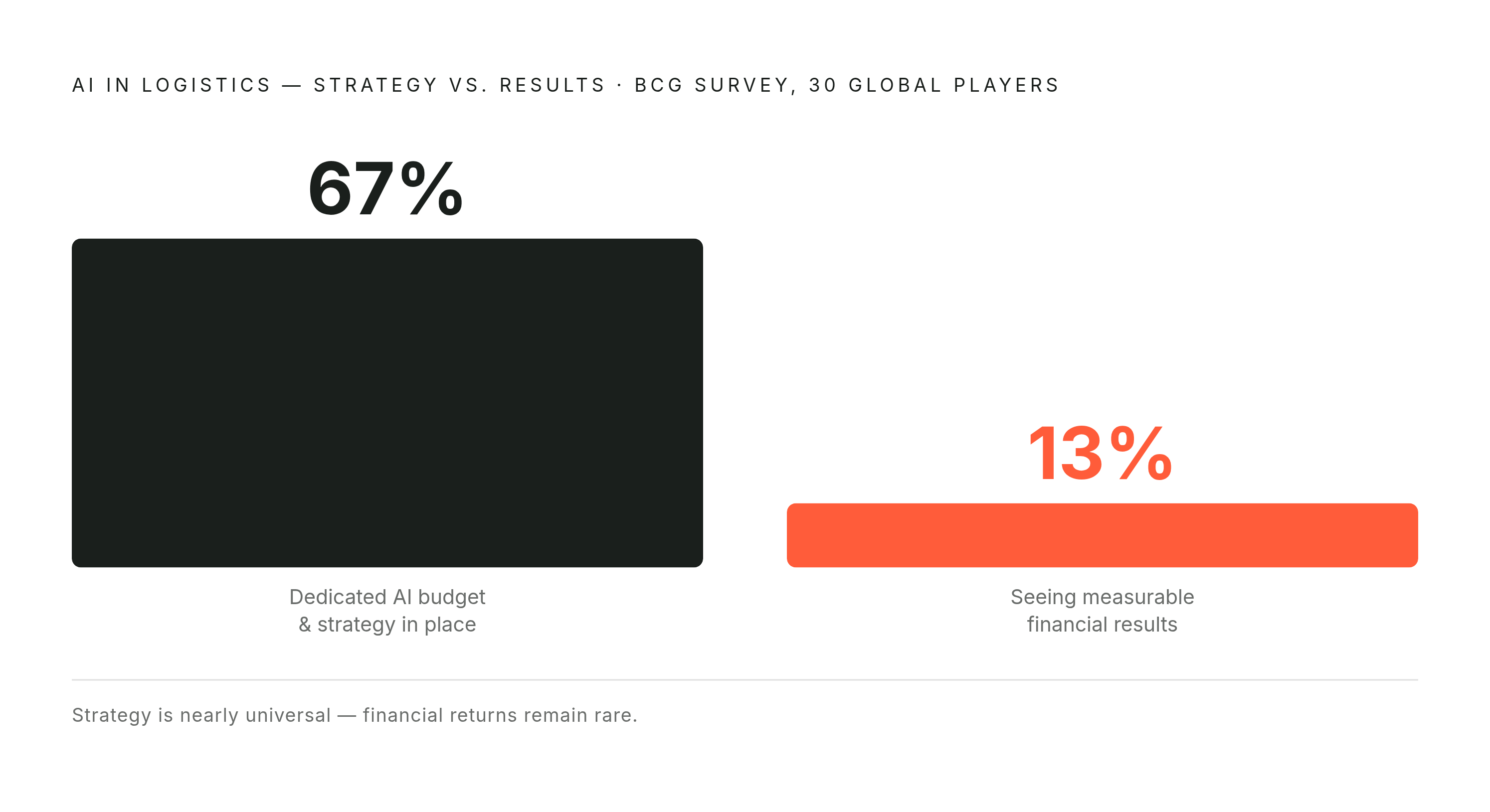
Most logistics operators who have already deployed AI aren't seeing measurable financial results from it.
BCG's AI in Logistics Executive Survey of 30 leading global logistics players found that two-thirds of respondents have a dedicated AI budget and strategy in place, yet only 13% say AI is currently delivering measurable financial results. That gap between strategic intent and financial return is the defining pattern in the survey. BCG's explanation is specific: when a company automates one step in the quote-to-cash cycle but leaves the next step manual, the bottleneck simply moves to whichever part of the workflow AI hasn't touched yet. The manual step becomes the new constraint, and whatever speed the automated step gained gets absorbed sitting in the queue in front of the human who handles the next step.
This is the reason most automation attempts stall without ever producing a result anyone can point to. It's also the argument for the sequencing logic laid out earlier in this piece. Once the first workflow is running and stable, the next automation should connect directly to it, extending the chain rather than jumping to some unrelated workflow that leaves the original hand-off point just as manual as it was before. A freight broker who automates proof-of-delivery but leaves invoicing manual still has a cash-conversion problem. A broker who connects the two has.
How the first automation compounds into new capacity
The real payoff from automating a logistics workflow is that removing the operational ceiling lets a small team quote faster, take on more volume, or offer a service level it couldn't have staffed before.
It's worth reframing what the investment actually is here, against the obvious alternative of hiring. A single full-time logistics hire carries a real annual cost before benefits and overhead even enter the picture. An automation system that handles a defined set of repetitive tasks at that same operational level scales to absorb a volume spike with no incremental cost attached. A competitor scrambling to bring on temporary staff during peak season is paying for the capacity an automated team has already solved. None of this makes automation a like-for-like replacement for a person. It handles the slice of a role that's repetitive and rule-based, and the honest comparison is task-level, not headcount-level: measure the cost of the specific routine work a hire would absorb, then price that against the tool built to do it.
Sansatech's freight company engagement freed more than 160 hours of staff time a month, and that figure marks the start of what became possible, not the end of the engagement. Capacity returned by automation doesn't have to go back into producing more of the same work. It can fund a service line the team couldn't staff before, or faster quoting that wins business the team previously had to turn down. Small operators who treat automation as an ongoing practice, checking periodically whether a given system is still the right fit, adding the next workflow once the last one is stable, build an operational advantage that compounds against competitors still running the same tasks by hand.
For a team ready to move, the starting point is a two-week diagnosis of which single workflow is the actual bottleneck, and building from there, the same entry point Sansatech runs for every logistics engagement it takes on. What changes after that first workflow is live is what a small team can finally say yes to, not just how many hours get freed up.