Freight Load Board Monitoring Automation for Small Brokerages
Automation cuts dispatcher hours and catches fraud that manual vetting misses.
Small brokerages run on a margin that leaves no room for wasted motion, and the biggest waste in most shops is a human being staring at a load board waiting for the right freight to appear. Gross margins in truckload brokerage are around 15% of the freight bill, and once salaries, tech, insurance, and bad debt come out, most mid-sized brokerages push 85 to 95% of net revenue back out the door (tommasomariaricci.com). In that kind of margin environment, every hour a dispatcher spends scanning DAT or Truckstop is a direct cost, not a line item to deal with later. Money already knows this: PW Consulting data cited by guideflow.com puts the freight broker software market on track to roughly double between 2025 and 2032, growing at a 10.25% annual clip. The tools exist. Some brokerages are actually running these tools, and others are still doing this by hand.
What manual load board monitoring looks like across a dispatcher's day
Open DAT One. Scan by lane and equipment type. Check the rate. Call the carrier, confirm authority and insurance, re-key everything into the TMS by hand, post the load, then start over. Somewhere in that loop, the phone is ringing and the inbox is filling with tender emails nobody's opened yet.
DAT One and Truckstop are the two boards that matter in 2026. DAT runs the deeper marketplace with a mobile app and market rate tools, Truckstop runs tiered pricing with a "Book It Now" button and its own rate insights (guideflow.com). Truckstop's own materials describe the daily grind: post loads, source carriers, check rates, process documents, repeat. None of it is hard work. All of it is slow work, and slow is the whole problem.
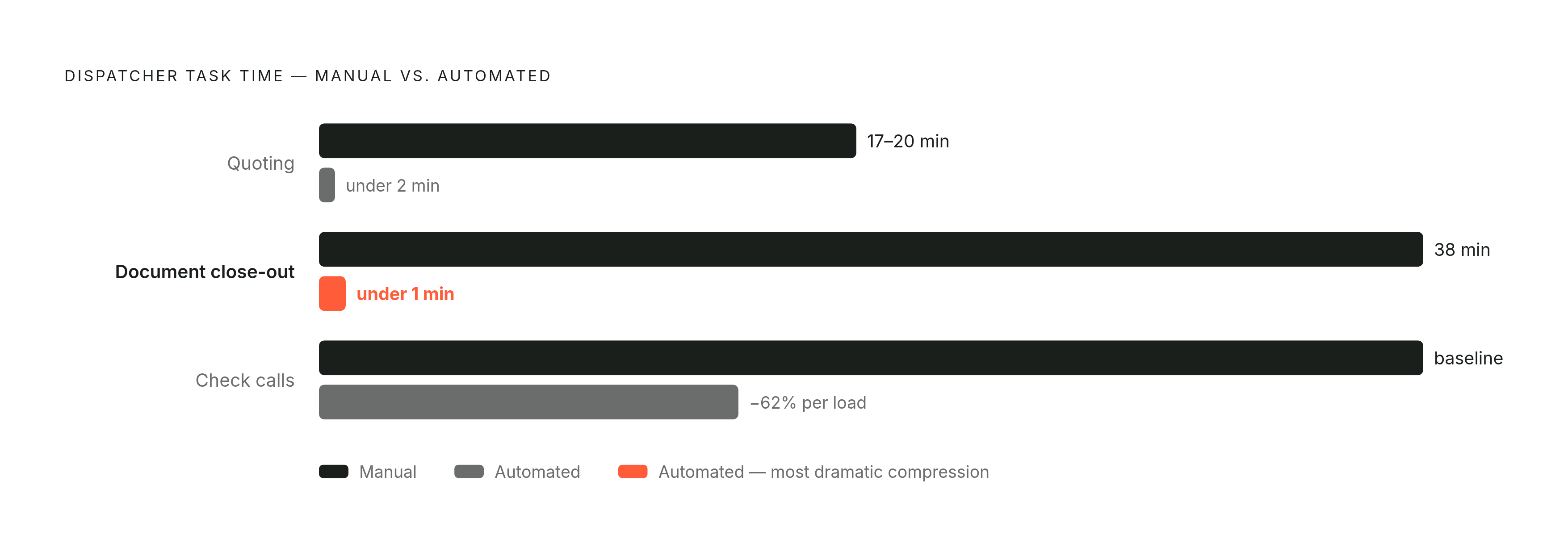
Robinson data cited by numeo.ai shows brokers without AI assistance take 17 to 20 minutes to turn around a price quote. In a tight lane, that's long enough for someone else to book the load before the quote even lands. A dispatcher working manually isn't managing the board so much as chasing it, seeing freight only after it posts and after a faster competitor already has eyes on it. The data feeding this process doesn't help either: pickup windows sit buried in email threads, rates get negotiated over the phone or in scattered texts, and documents arrive in a dozen different formats (arktms.com). That sprawl is what makes manual monitoring error-prone, not just slow.
The load monitoring process when automation handles it
When an automated system takes over, the shape of the day changes. A tender lands, AI reads the PDF or email, pulls origin, destination, commodity, rate, and requirements, then populates the load board in seconds with no re-keying involved (dispatchmvp.ai). Carrier matching happens next: an auto-dispatch engine checks available carriers against location, equipment, and lane history, then assigns the load automatically or on a voice command, the way DispatchMVP's tool "Otto" is built to work.
Check calls, historically the most tedious part of the job, get replaced by automated status updates through the trip, and DispatchMVP reports a 62% drop in check calls per load as a result. Quoting moves just as fast: AI reads the inbound RFQ, pulls historical lane data and market rate indexes, and returns a number in under two minutes (isometrik.ai). At real scale, that speed compounds: a major logistics provider's system handles more than 2,600 quote requests a day at roughly 32 seconds apiece (numeo.ai, tanktransport.com). Document close-out follows the same arc. AI reads the BOL and POD at delivery, confirms the shipment, and fires off a QuickBooks invoice, turning a 38-minute manual task into something that takes under a minute (DispatchMVP).
None of this makes a dispatcher obsolete, and anyone selling that version of the story is selling fiction. Arktms.com's 2026 outlook is blunt about the actual gain: fewer manual re-entry steps and faster conversion of messy inputs into clean records, not some fully autonomous broker AI negotiating rates and handling exceptions on its own. LunaPath frames the shift well: 2025's tools were mostly about visibility, showing a dispatcher what's out there. The 2026 tools coordinate what happens next. None of it works without clean inputs, either. A brokerage running standardized load records and consistent carrier data gets real value out of automation. A brokerage layering AI on top of spreadsheets and six disconnected inboxes just gets a more expensive mess (arktms.com), and that outcome sits on the brokerage, not the software vendor.
Fraud and double-brokering: where automated monitoring becomes a financial control
Cargo theft losses hit roughly $725 million in 2025, up about 60% from the year before, with average loss per theft climbing to around $274,000 (CargoNet's 2025 theft trend analysis, cited via tommasomariaricci.com). Incident volume stayed fairly flat. Value per incident did not, and that gap is the signature of organized fraud picking high-value targets rather than opportunistic theft off a random trailer.
A TIA member survey found 22% of brokers lost more than $200,000 to fraud over a six-month stretch, with unlawful brokerage as the most common scheme (cloudnsite.com). Manual vetting cannot keep pace with that. A dispatcher checking an MC number by hand isn't cross-referencing authority, insurance, banking details, physical address, contact history, and domain age all at once, on every load, all day. Nobody has time for that. That gap is exactly where fraud lives.
Automated systems close it by doing at onboarding what a human can't do fast enough: cross-checking authority, insurance, banking information, addresses, and contact details against each other and against known fraud patterns (tommasomariaricci.com). During execution, the same systems watch for the flags that actually matter: a mid-load request to change banking details, a carrier bidding wildly outside its normal lane and equipment history, duplicate driver or equipment identifiers appearing across supposedly unrelated carriers. Some platforms go further, cross-checking entered data against uploaded documents and catching mismatches, wrong amounts, missing fields, and inconsistent dates, with corrections happening in minutes instead of days. At $274,000 average loss per incident, one fraud event wipes out months of margin at that 15% gross baseline. Call it what it is: a financial control, not a convenience feature.
The tools small brokerages are using in 2026
osforyour.business's breakdown finds the market has settled into three lanes: all-in-one AI platforms that replace the TMS outright, specialized AI modules bolted onto an existing TMS, and AI-enhanced upgrades from the established TMS vendors. Which one fits depends on load volume, what's already installed, and how much operational change a small team can absorb in one quarter.
DispatchMVP handles load management, carrier matching, and voice dispatch through Otto, with direct integration into DAT, Truckstop, and the other major boards. It starts at $49 a month with a 30-day free trial and no credit card required, and and a quick setup process. Emerge positions itself as an AI-native alternative to a traditional TMS, with native ties into DAT, Truckstop.com, and 123LoadBoard for automated matching, plus automated carrier scoring and predictive rate work, though pricing isn't published (osforyour.business). ShipperGuide, built by Loadsmart, moves away from click-driven screens toward what it calls intent-driven workflows, with AI agents handling procurement, scheduling, and settlement; a Red Gold case study cited on the ShipperGuide blog claims an RFP cycle cut from weeks to hours, around 70% of tendering automated, and a team running roughly 25% more efficiently.
For brokerages that want something simpler and cheaper, AscendTMS and Tailwind TMS cover core dispatch, accounting, and carrier portal functions at accessible pricing. AscendTMS's native AI is thin, though, so real automation there usually means bolting on outside integrations (blog.shipperguide.com, osforyour.business). Truckstop's own Broker Assistant, branded "Ask Pat," works as an AI co-pilot inside the platform: type "post a van load from Dallas to Chicago at $2,850" and the form fills itself in, or paste an MC number and get a risk analysis without leaving the screen. Beyond the big platforms, a handful of specialized tools do one job well: Greenscreens.ai for machine-learning pricing intelligence, Raft AI for back-office document automation, Levity for connecting inbox and TMS workflows, and FreightWaves SONAR for rate intelligence that reviewers say often pays for itself in better rate negotiations within 30 to 60 days.
Two newer entrants deserve a caveat before anyone gets excited. project44's AI Freight Procurement Agent, announced in February 2026 and live the following month, automates RFQ generation and carrier negotiation, with a reported 4.1% cut in freight spend and a 75% reduction in sourcing cycle time. LunaPath's AI Workforce for Freight, launched in early 2026, targets broker back-office workflows and claims significant efficiency gains and labor cost reductions, though both figures come from the vendor without independent verification. Both sets of numbers come straight from the vendors, not from an independent audit, so treat them the way you'd treat a carrier's own on-time percentage: probably directionally true, definitely rounded in their own favor.
A different model sits outside this landscape. Instead of buying a subscription and figuring it out alone, a small brokerage can bring in an embedded team that finds the single highest-leverage bottleneck, builds a production system around it, and stays in the loop as it runs. That model maps cleanly onto load monitoring specifically: less a shelf product, more a mechanic who stays in the garage after the repair.
How the adoption split creates a window
A joint Truckstop.com and Bloomberg Intelligence survey found that more than 40% of brokers plan to bring in AI or machine-learning productivity tools in 2026. Meanwhile 48% have no plans to adopt yet. That's close to a coin flip, and nobody's won this argument industry-wide, at least not yet.
Carriers aren't waiting around for brokers to decide. Trimble's Transportation Pulse Report puts carrier-side AI use for load acceptance and dispatch at 29% as of early 2026, and Penske's Fleet Survey found 72% of fleet executives plan to adopt AI within two years (both cited via numeo.ai). As carriers get faster, brokers stuck manually scanning boards face a speed disadvantage on both sides of the transaction, not just their own.
The margin gap is visible in the numbers. AI-enabled brokerages run margins 5 to 7 percentage points higher than traditional competitors, while moving more freight with the same headcount. Against a 15% gross margin baseline, that's not a rounding error, it separates a brokerage that survives a rate downturn from one that doesn't. The 48% still sitting on the sidelines represent the opening for everyone else, but the window narrows the moment these tools stop being a differentiator and start being table stakes. Moving early only matters while it's still early.
The cost question: automating load monitoring versus hiring another dispatcher
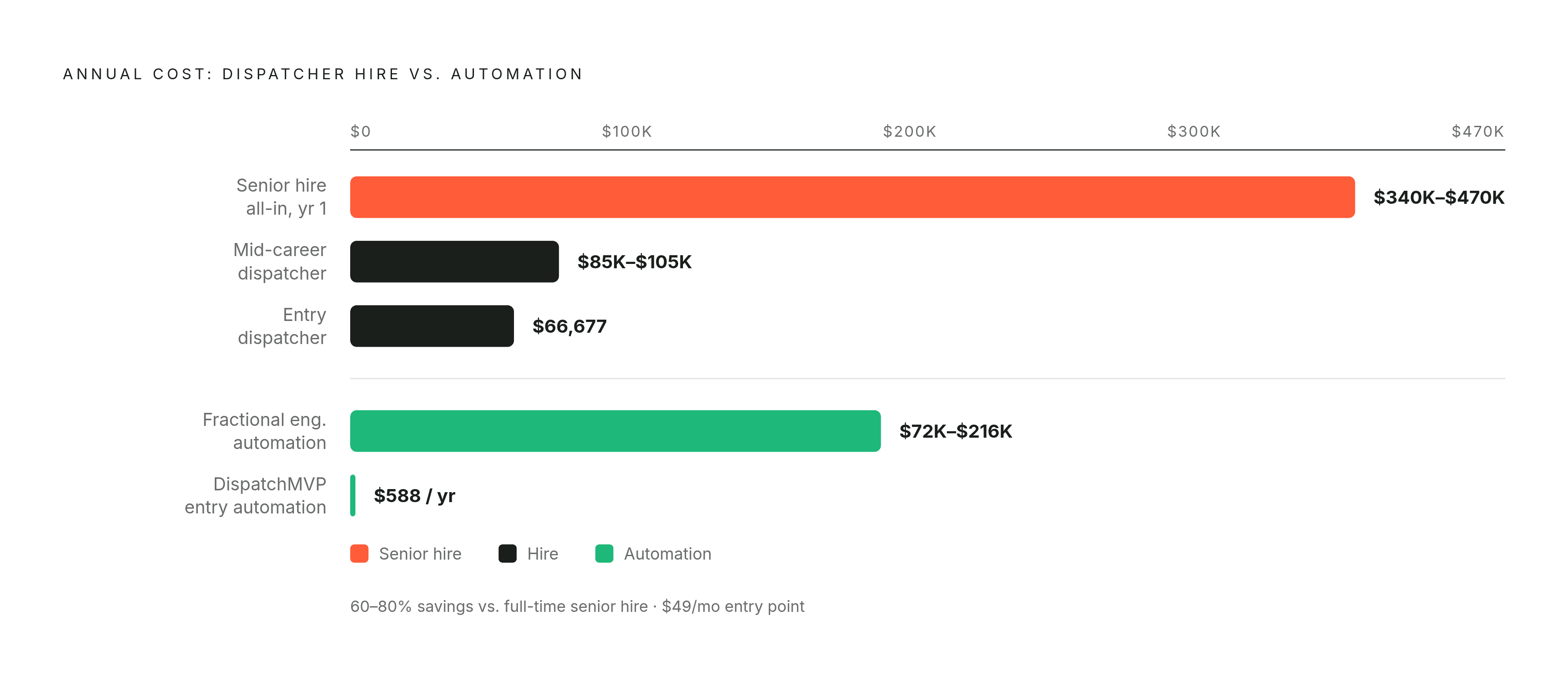
Hiring is the default move, and it's an expensive one. The average freight broker salary runs $66,677 a year, or $32.06 an hour, as of July 2026 (ZipRecruiter). A mid-career broker on a $55,000 base with bonuses can land total comp between $85,000 and $105,000 in a strong market (Glassdoor's freight industry figures, cited via stealthagents.com). Personnel costs dominate brokerage budgets, and headcount is the single biggest lever a small shop pulls.
Hiring also burns time nobody has lying around. A lengthy hiring cycle plus onboarding and ramp-up delivers nothing while freight sits unmoved. Set that against entry-level automation: DispatchMVP starts at $49 a month, a rounding error next to a single salary. The real cost was the implementation, not the license. Getting the thing implemented correctly is where most brokerages actually stall out.
For a brokerage that wants a system built around its specific bottleneck rather than a shrink-wrapped SaaS tool, embedded engineering is worth pricing out. A fractional engagement runs $6,000 to $18,000 a month for 8 to 20 hours a week on retainer, against $340,000 to $470,000 all-in for a full-time senior hire in year one, a savings of 60 to 80% (ayautomate.com), with a working system in production inside the first month rather than the first year. Demand for forward-deployed engineers has grown sharply, which tells you this is becoming a mainstream arrangement. It's becoming the default way mid-sized shops solve exactly this kind of problem.
SANSA's approach fits this model directly: spend two weeks finding the highest-leverage bottleneck, build a production system around it, then stay embedded as the system compounds value over time. Cited results include an 80% reduction in data entry time for an insurance broker client, and substantial hours saved per month for a freight company specifically. Automating load monitoring is affordable for a small brokerage in 2026. At these numbers, against that margin structure, the harder question is what staying manual is quietly costing every single month it continues.
Sources
- AI in Freight Brokerage: How Smart TMS Features Are Changing the Game (2026)
- Top 5 Breakthroughs in AI in Freight Brokerage (2025 Update)
- Best AI-Driven TMS Platforms for Brokers | ShipperGuide
- Best Dispatch Software for Freight Brokers 2026 | DispatchMVP
- Best AI Tools for Freight Brokerage in 2026: A Comprehensive Comparison
- AI for Freight Brokers: The 2026 Operator's Guide | Tommaso Maria Ricci
- guideflow.com
- numeo.ai