AI Workflow Automation in Small Accounting Firms
AI is moving from separate tools into the core systems accountants use every day.

The distinction worth understanding is what AI does when it's already running inside the systems you're in all day. Canopy CEO Davis Bell has described the direction plainly: AI is becoming "a native layer inside the core systems accountants already use, bookkeeping, client management, workflow, document handling, billing and reporting," displacing the separate tool practitioners once opened in another tab. Current deployments are ambient rather than bolt-on, setting them apart from every productivity software wave that preceded them. The tool recedes from awareness because it is already doing the work.
Here's what that looks like concretely. AI extracts structured data from unstructured financial documents, receipts, invoices, bank statements, W-2s, with accuracy that limits manual keying to exception handling. It matches transactions against ledger entries, flags anomalies, and surfaces discrepancies for human review before a staff member would otherwise stumble across them. Some firms report over 80% automation of individual return preparation at the data-extraction and analysis stage. LLM-based tax research tools are cutting document analysis time by more than half in early deployments. Client follow-up sequences, status responses, appointment reminders: drafted and sent without anyone initiating each one.
The more consequential development is agentic AI, systems that plan and execute multi-step workflow sequences rather than responding to individual prompts. Digits' Autonomous General Ledger has powered more than 2,000 month-end closes, with agents running entire workflows from start to finish and pausing only when human judgment is genuinely required. Gartner reports that 39% of finance functions already use AI specifically for anomaly and error detection. The operational difference between "AI as tool" and "AI as team member handling a defined process" shows up in measurable capacity gains.
Advisory judgment, complex tax strategy, and client relationship management require human expertise and remain the firm's actual differentiating value. Automating transactional work returns credentialed professionals to the work that demands their skills.
The Four Workflows That Actually Constrain Small Firm Capacity
The right first target is the automatable task whose removal unlocks the constraint limiting everything else. There's usually one. Four workflows come up repeatedly when small firms trace where their hours actually go.
Data Entry and Document Ingestion
This is the most universally cited bottleneck in small firm operations, and it is also the most indefensible use of a credentialed professional's time. Manually keying figures from client-provided documents into bookkeeping or tax software fills hours with work clients neither see nor value. A joint MIT Sloan and Stanford study found that accountants using AI reallocated about 8.5% of their time away from routine data entry. Every client generates this work, the volume is predictable, the task is almost entirely rule-based, and the automation fit is exceptionally high.
Bank and Account Reconciliation
The monthly close is calendar-constrained by definition. Matching transactions, identifying discrepancies, chasing exceptions: all of it has to happen within a fixed window, and delays cascade immediately into delayed financial statements, delayed tax prep, and delayed client deliverables. The same MIT Sloan and Stanford research found AI cut 7.5 days off the monthly close for firms in the study. For a small firm running multiple client closes simultaneously, 7.5 days recovered per client per month isn't an incremental improvement. It's a structural change in what the team can handle.
Document Review and Tax Research
The expensive version of this bottleneck is a credentialed staff member spending hours reading source documents, cross-referencing tax code, and verifying that all client materials are present so substantive work can begin. LLM-based research tools are reducing document analysis time by more than half in early firm deployments. Assigning high-value practitioners to low-value document triage is the most expensive operating pattern in the profession, and it is remarkably common.
Client Communication and Document Collection
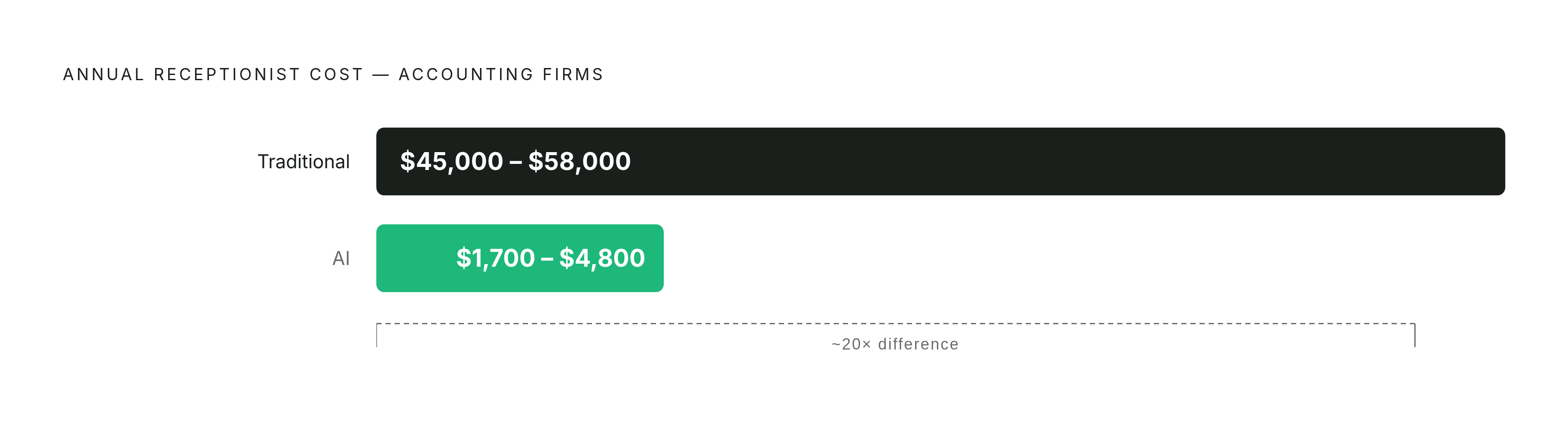
This bottleneck stays invisible because it falls outside engagement budgets entirely. Chasing clients for missing documents, answering status inquiries, sending reminders: all of it consumes staff time, and the cost surfaces only when someone audits where the hours went. A traditional receptionist costs accounting firms $45,000 to $58,000 per year fully loaded. AI receptionist services run $1,700 to $4,800 per year. Automated document collection workflows with built-in follow-up sequences reduce the back-and-forth that delays every downstream workflow. Solve this one and everything that depends on complete client documentation arriving on time moves faster.
How to Decide Which of These Four to Automate First
Most firms stall on AI because the prioritization question goes unanswered. Here's how to answer it.
Three signals identify the highest-leverage first target. Where do staff hours go that produce no client-visible output? Data entry, document chasing, and reconciliation prep all qualify; advisory conversations produce client-visible output. Which bottleneck, if removed, would let the firm take on more clients or deliver faster without adding a person? And where is the work most standardized and rule-based, with the lowest variability and the most predictable inputs and outputs? That intersection is where automation delivers fastest and most legibly.
For most small firms, the evidence-based default is document processing and transaction automation. Time to measurable value runs four to eight weeks. ROI quantification is straightforward because hours saved per client per month is an objective, trackable figure. Every client generates bookkeeping work, so the automation earns its cost across the full client base immediately.
There is one meaningful exception. If the firm's primary constraint is not throughput but client acquisition or retention, prospects who fail to hear back, clients whose calls go unreturned, then automating front-office communication has higher near-term impact. Front-office automation deploys faster and cheaper than back-office workflow changes, carries lower data risk, and runs independently of core accounting systems. For a firm whose growth is limited by responsiveness rather than processing capacity, this is the logical first move.
Firms that pick one process and one tool see 40% faster time-to-value than peers, per implementation benchmark data. Pick the workflow, build the system, measure the output, then move.
What a Realistic First Deployment Looks Like in Practice
A 30-day live deployment is achievable. Most focused AI projects for small and midsize firms go live in two to eight weeks depending on complexity: document processing workflows in four to eight weeks, client communication automation in two to four. Data preparation, API approvals, and internal sign-off typically set the launch date.
Here is the part most implementation plans underestimate: if client documents are inconsistently formatted, if the chart of accounts has years of ad-hoc additions, if contacts live in a spreadsheet with duplicate entries, 30 to 50% of the implementation timeline goes to data cleaning before automation can begin. That is a reason to start the audit immediately, because that work is unavoidable regardless of the AI deployment decision.
A structured first 30 days follows a recognizable pattern. Days one through 14 focus on the data audit, documenting the current workflow in precise detail, identifying the specific handoff points where automation will replace manual steps, and establishing basic team AI literacy. Days 15 through 30 move to a clean data pipeline, validated integration with existing systems, and a pilot use case live with a defined subset of clients or transactions.
Team execution during rollout carries equal weight to the technology itself. A substantial majority of accountants report that AI directly improves productivity and reduces mental load, but those outcomes depend on the team understanding what the system does and owning the handoff points explicitly. The staff who own the workflow need to be involved in defining what good output looks like. Timing matters here too. Deploying during or immediately before busy season introduces a documented 15 to 25% temporary productivity dip at exactly the wrong moment. Post-filing-season rollouts are standard for a reason.
Most clients see automation paying for itself within three to six months of deployment. That payback period shortens significantly when the first target workflow is genuinely high-volume and the data preparation is completed before the clock starts.
Why Hiring to Solve This Problem Keeps Getting Harder and More Expensive
The hiring math for a small firm in 2025 is unfavorable, and it is not going to normalize. The U.S. median wage for bookkeeping, accounting, and auditing clerks sits at about $50,669 per year, per BLS. Fully loaded with benefits and overhead at 1.25 to 1.4 times base, that is roughly $63,000 to $71,000 per year, plus approximately $4,700 in cost-per-hire and 36 to 44 days to fill, per SHRM benchmarks. For CPA-credentialed roles, fill time stretches to 73 days on average, per Robert Half's 2025 Talent Report, and the position will go unfilled if the firm cannot compete on compensation. Over 90% of finance and accounting leaders report difficulty finding qualified professionals. The Big 4 and large regionals have structural salary advantages a 10-person firm simply cannot match.
AI costs are structured differently. The model is front-loaded implementation cost followed by decreasing marginal cost, which is the inverse of human costs: compounding annually with raises, benefits increases, and turnover. Automation capacity is always available, stays with the firm, and never triggers a replacement search.
The emerging alternative to full-time hiring is fractional AI implementation, and the economics are significant. A fractional AI engineer on retainer runs $6,000 to $18,000 per month for eight to 20 hours per week, versus a full-time senior AI engineer at $340,000 to $470,000 all-in year one. For firms with under 20 hours of AI work per week, the fractional model cuts costs by 60 to 80%. LinkedIn's 2026 Jobs on the Rise report ranked AI Engineer as the fastest-growing job title in the U.S., with postings up 143% year-over-year in 2025, which means outright hiring in this category is increasingly competitive even for firms that can afford it.
The fractional model also addresses a documented failure pattern. Gartner projected that at least 30% of generative AI projects would be abandoned after proof of concept by end of 2025, primarily due to poor data, weak controls, and unclear value. An embedded operator who owns execution as well as configuration prevents that outcome. Firms are already making this shift. One industry analyst has observed that firms are "essentially taking any free cash flow they have and investing it right back in AI," with AI absorbing budget that would previously have gone to headcount. Some firms are actively reducing hiring plans in parallel with AI rollout, as a deliberate reallocation of the same dollars toward capacity that compounds.
The Competitive Position That Forms When Automation Compounds Past the First Workflow
The first workflow automated delivers a measurable return. The second delivers something more structural.
Once data entry is automated, reconciliation becomes faster because the inputs are cleaner and more consistent. Once reconciliation is automated, document review accelerates because the underlying ledger is reliable. Once document review is streamlined, client communication improves because exceptions get caught upstream before they reach staff. These workflows are sequential, and each one automated reduces friction in the next.
This is where the competitive divergence between firms becomes visible and durable. A firm that automates one workflow has lower costs and faster turnaround on that specific process. A firm that compounds across two, three, and four linked workflows has a fundamentally different operating model: more clients served with the same headcount, faster turnaround times as a genuine market differentiator, and credentialed staff redeployed toward advisory work that commands higher fees. The firm that has yet to automate faces the same talent shortage, the same rising labor costs, and the same client expectations for responsiveness, with fewer tools to address them.
The 68% of tax and accounting professionals who report feeling excited or hopeful about generative AI, per the Thomson Reuters Institute's 2025 Generative AI in Professional Services Report, are right to feel that way. The firms building durable competitive positions right now are the ones that identified one high-volume, rule-based workflow, deployed automation against it, measured the output, and moved to the next one.