Manual Data Entry Elimination in Insurance Brokerages
Automating manual data entry frees brokerages to grow.

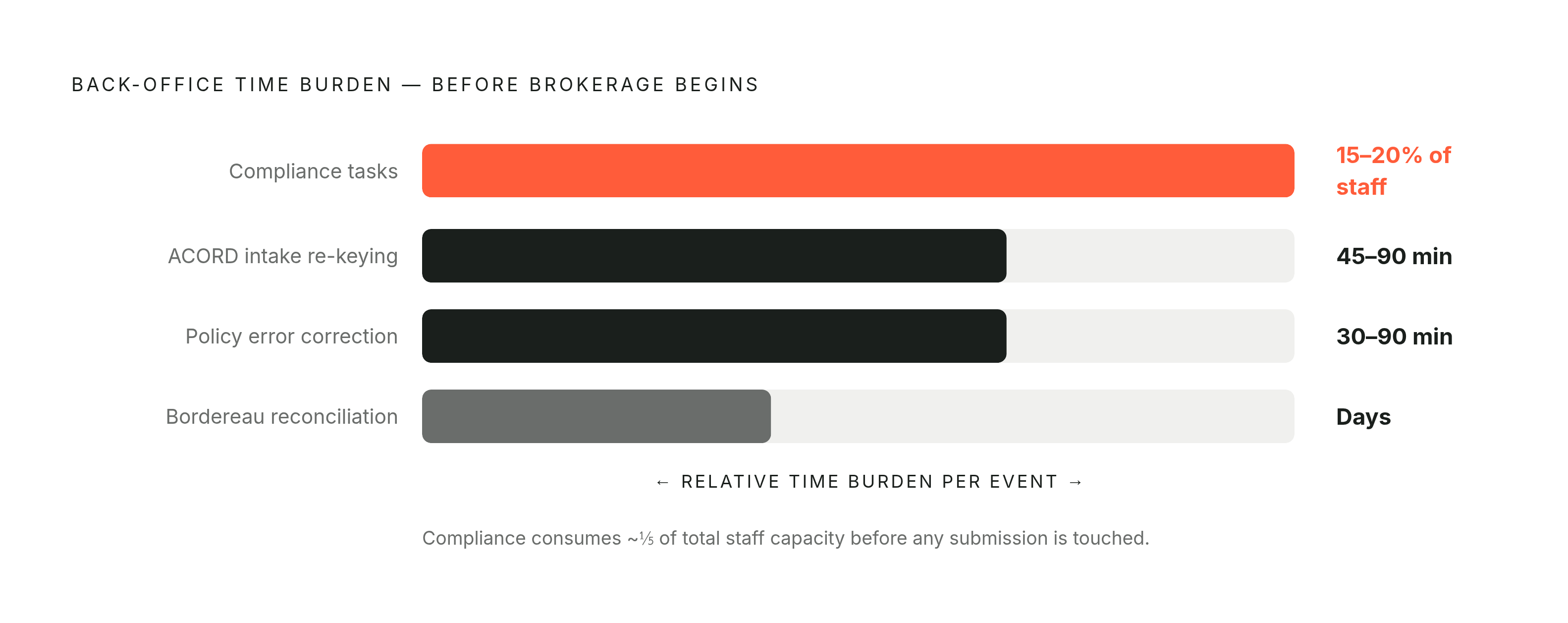
The visible cost is payroll hours, and even those are easy to underestimate. The ACORD intake process alone runs 45 to 90 minutes of manual re-keying per submission. Bordereau management, where premium and loss schedules arrive in whatever format the cedant feels like sending that week, consumes days of reconciliation before anything reaches the carrier. NAIC data privacy standards, CMS rules for health brokers, and Department of Labor fiduciary requirements together eat roughly 15 to 20% of staff time at many firms. And that is before anyone has actually brokered anything.
The less visible cost is error rate, and it compounds in ways that don't show up cleanly on any report. Policy processing delays from data entry mistakes require 30 to 90 minutes each to investigate and correct. Two escalated errors per quarter can trigger formal E&O documentation and carrier notification, which is exactly as miserable as it sounds. Deloitte's commercial insurance AI research found that before AI-assisted submission preparation, submissions arriving at carriers generated 30 to 50% more back-and-forth queries because the underlying data was incomplete or inconsistent. Every one of those queries is someone's afternoon, and it compounds across renewal season in ways that quietly hollow out a team.
The cost nobody tracks is the business the brokerage cannot take on because its people are occupied moving data between systems. That opportunity cost does not appear on any expense report, which is exactly why it persists. The team's ceiling is throughput, not talent, and that inversion should bother people more than it does.
What Elimination Actually Means, and Why It Is Nothing Like Automation Layered on Top
Most brokerages that are disappointed with automation results chose the wrong model. The distinction matters more than vendors typically explain, and vendors rarely explain it at all.
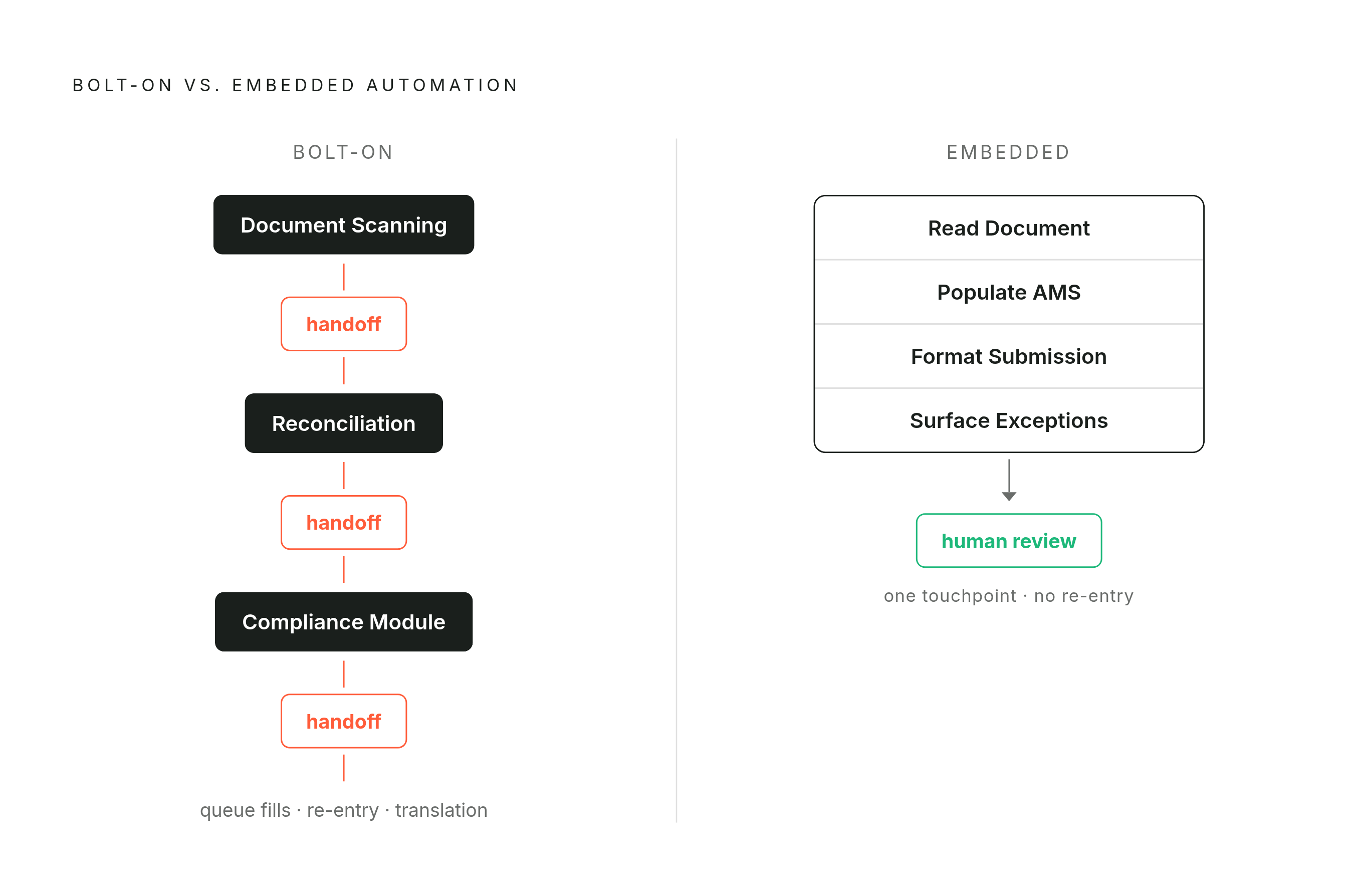
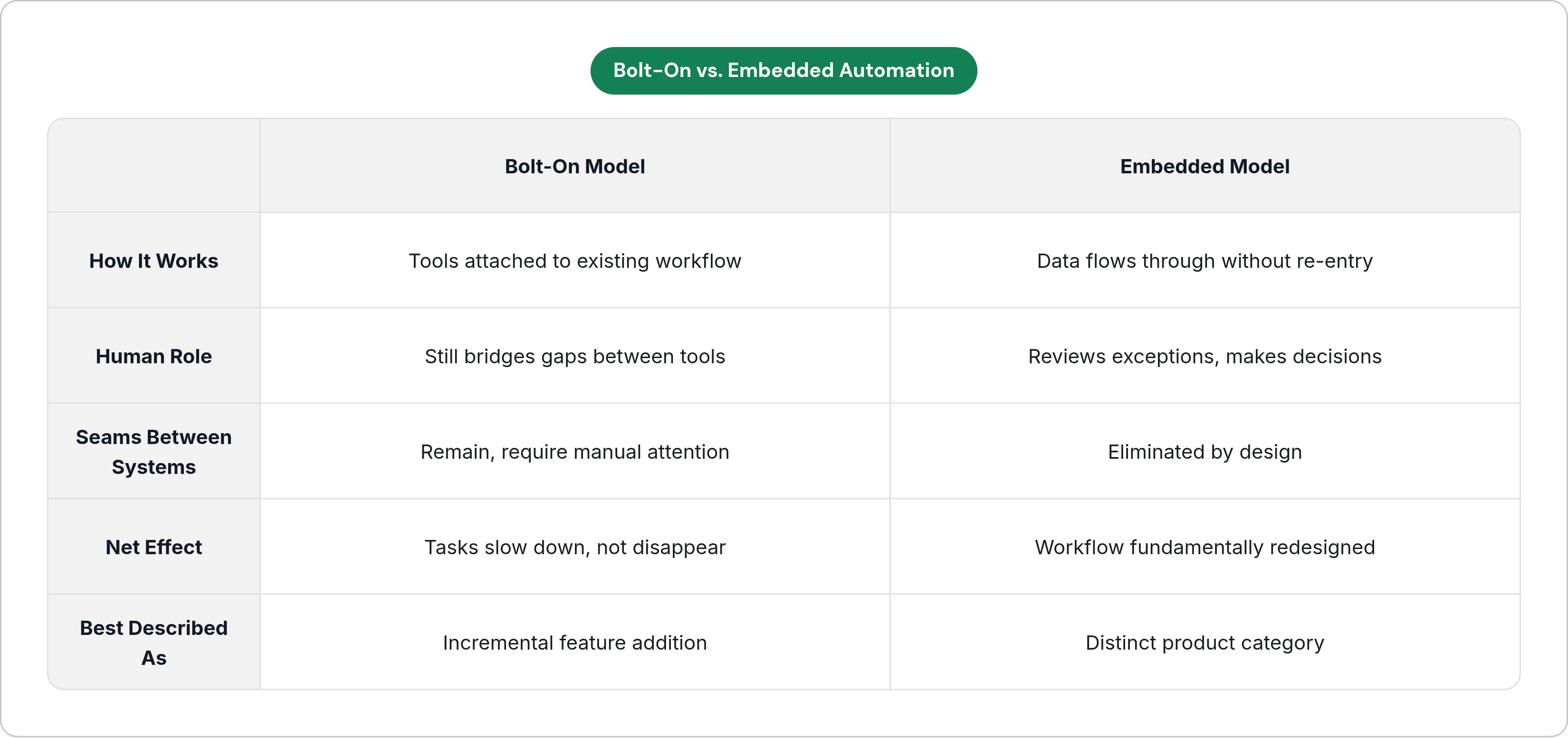
The bolt-on model attaches tools to an existing workflow. A document scanning tool extracts data; a reconciliation tool reads it; a compliance module checks both. Each tool works in its own lane, but the seams between them still require human attention, and occasionally human hands. The task is still in the queue. The inbox still fills. It just fills a little slower. It is modest progress.
The embedded model is different in kind, not degree. Data flows through the workflow without being transferred, translated, or re-entered between modules. What practitioners are calling an "AI co-worker" in this context is a purpose-built workflow engine. reads the document, populates the agency management system, formats the carrier submission, and surfaces exceptions for human review. The agent's role shifts from data mover to decision-maker, which, frankly, is a more interesting job.
Kay.ai raised $3 million in March 2025 to productize exactly this model for brokerages that cannot build it in-house. That capital is evidence that the embedded approach is being treated as a distinct product category rather than an incremental feature bolted onto something older.
The Three Workflows Where Elimination Has the Most Leverage
Not every workflow is worth automating first. The ones that return the most, fastest, share a profile: high frequency, low variance, document-heavy inputs. Insurance has several that fit almost perfectly, which is either a coincidence or an indictment of how the industry was built.
ACORD intake and submission is the obvious starting point, and the numbers justify the obvious choice. An embedded system reads ACORD 125, 126, 140, and supplemental forms; extracts named insured data, prior loss history, and coverage requests; then populates both the agency management system and the carrier submission format without a human touching it. The 45-to-90-minute manual re-keying process compresses to under 10 minutes of reviewed, automated extraction. Deloitte reports 70% faster processing times and a 60% reduction in data entry errors on submissions where this is in place.
Certificate of insurance management is less glamorous but more impactful per hour recovered, because it is relentlessly, stubbornly repetitive. Approximately 80% of COI requests can be automated, saving an estimated 5 to 10 hours per week for a mid-size brokerage, per Layer3 Labs' 2026 research. The requests do not get more interesting over time, and neither does the person handling them.
Bordereau management deserves its own mention because the scope of the problem is underappreciated even by people who deal with it daily. Premium and loss schedules arrive in whatever format the cedant chooses to send. An embedded system ingests those schedules, maps fields to the broker's data model, validates against treaty terms, and flags discrepancies before they reach the carrier, with an audit trail generated automatically. A process that once required days of manual reconciliation runs in hours. That compression is the norm once the system is calibrated, not the exception the vendor uses in the case study.
Renewal automation rounds out the obvious targets: pre-renewal data gathering, carrier comparison preparation, client-facing summaries. Layer3 Labs' research estimates 10 to 15 hours per week recovered during renewal cycles, which is a lot of time to get back during the season when there is the least of it.
How Fast a Brokerage Can Realistically Expect This to Go Live
The timeline question reliably produces inflated expectations from vendors and deflated ones from operators who have been burned before. The honest answer sits between them, and it depends almost entirely on how disciplined someone is about scope before kickoff.
Targeted deployments with a defined scope can be operational within weeks. ACORD intake automation typically runs 3 to 4 weeks from kickoff to live, including testing and staff training; adding multi-carrier quoting connections extends that by 1 to 2 weeks depending on carrier API and Ivans availability. A full brokerage stack covering intake, quoting, renewals, and claims routing takes 3 to 6 months, with phased adoption allowing early gains before full deployment.
Real deployments are more instructive than projections. Allied Trust went live with digital first notice of loss in six weeks and eliminated hold times before CAT season. Branch Insurance completed two phases of Voice AI and Digital FNOL deployment in eight weeks each. These are not exceptional outcomes; they reflect what happens when scope is defined before the contract is signed rather than negotiated in the middle of implementation.
Cost is accessible for most operations. A single ACORD intake automation runs approximately $2,500. A full-brokerage stack runs up to $30,000. A typical 10 to 30 person brokerage deployment falls in the $8,000 to $18,000 range and usually reaches ROI within 60 to 90 days.
The two prerequisites that fast implementations share are not technological. First, the data is in reasonable shape before starting. Second, scope is bounded, not aspirational. The most common failure point is change management, and it is not a close call. The technology is ready before the team is. Workflows need to be redesigned, not just automated, and brokerages that treat this as a software installation rather than an operational change find the tools running at a fraction of their capability. That outcome is predictable every time, and it still surprises people every time.
Why Back-Office Automation Returns More Than Brokerages Expect
Here is the finding that most budget allocation decisions ignore: while roughly half of organizational generative AI spending flows to sales and marketing, back-office automation frequently yields better ROI. MIT researchers, as characterized by Vertafore CPO James Thom, have argued that "AI's return on investment can be greatest for back- and middle-office solutions that sift through data to support humans and the business more comprehensively, quickly, and thoughtfully."
For insurance brokerages specifically, the structural logic holds up under scrutiny. Back-office tasks are high-frequency, low-variance, and document-heavy. That is the exact profile where AI extraction and routing pays back fast. Setup cost amortizes against volume, and insurance brokerages generate volume by design.
The caveat deserves equal weight, because the caveat is real. McKinsey's July 2025 report found that only a small number of insurers have extracted outsized competitive advantage from AI, and 58% of insurance CEOs surveyed by KPMG expected generative AI to take 3 to 5 years to deliver ROI. Payback is real but not instantaneous, and volume matters in ways that smaller operations need to calculate honestly before committing. A brokerage processing three submissions a week will not reach the same return profile as one processing thirty. That is arithmetic, not pessimism.
The U.S. Chamber of Commerce's 2025 data shows small business AI usage jumped from 40% to 58% in a single year. The adoption gap with larger firms is closing, partly because the back-office ROI case is the most legible one at any scale, and partly because the tools have gotten considerably less painful to deploy.
How This Compares to Solving the Same Problem by Hiring
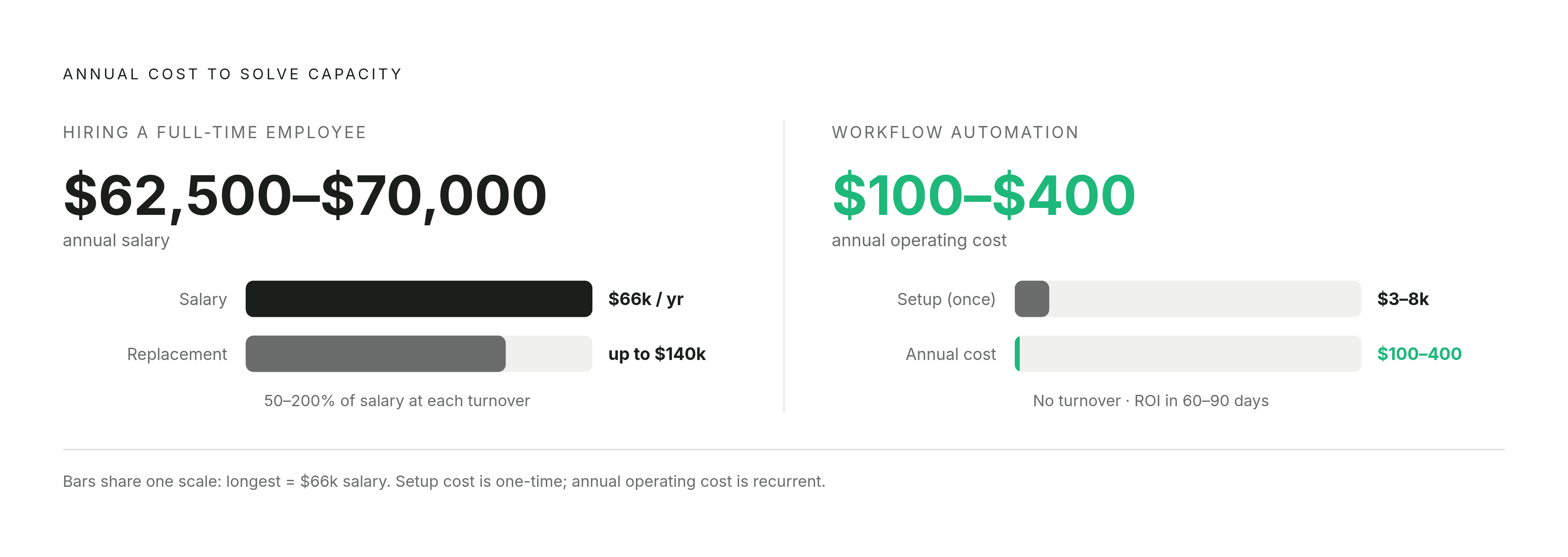
The labor market does not make hiring a neutral alternative, and it has not for several years running.
The U.S. Bureau of Labor Statistics projects the insurance industry will lose approximately 400,000 workers through retirement and attrition by 2026. Industry unemployment sits at 1.5 to 2.9%, well below the national average. Only 4% of millennials express interest in insurance careers, per 2026 research cited by Sonant.ai. This is a structural pipeline problem that no amount of improved job postings resolves.
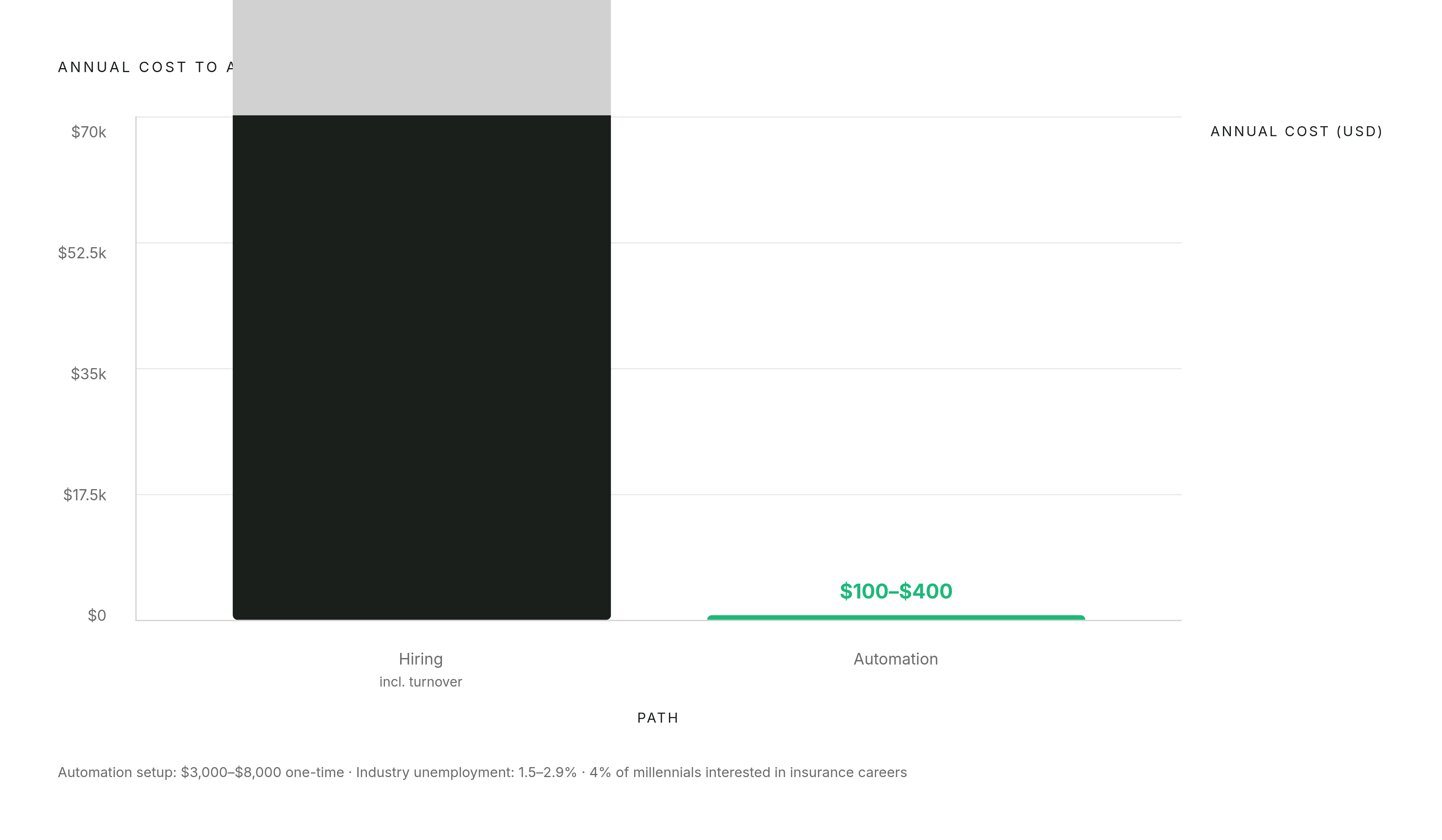
The cost math makes the comparison concrete. A full-time U.S. employee at a $50,000 salary costs roughly $62,500 to $70,000 annually once employer taxes, benefits, and overhead are included. Replacing that employee costs 50 to 200% of annual salary every time the role turns over, and it turns over. A standard workflow automation runs $3,000 to $8,000 for setup and approximately $100 to $400 per year in operating cost. It does not turn over. It does not take the institutional knowledge with it on the way out the door.
A 2026 MIT analysis found AI automation is economically viable in approximately 23% of roles. For the remaining 77%, humans remain cheaper, and that distinction matters for anyone sizing a deployment honestly. The relevant question for any brokerage is whether the specific tasks in scope fall into that 23%. For data entry and document processing in insurance, the answer is consistently yes: high volume, low variance, structured outputs, fast amortization.
Gartner analyst Helen Poitevin offers the appropriate guardrail: workforce reductions alone do not produce AI returns. The organizations extracting real returns invested in redesigned roles and operating models that let experienced people oversee and scale autonomous systems. West Monroe's Peter McMurtrie puts it plainly: "The future belongs to insurance professionals who combine deep insurance industry knowledge with technology, not one or the other." That framing is more honest than most of what the vendor market produces on this subject.
What the Same Team Can Actually Do Once Data Entry Is Off Their Plate
Thirty to 50 hours per week returned to a mid-size brokerage's team is roughly one full-time role's worth of capacity, without the hiring cycle, onboarding cost, or the quiet attrition risk that comes with asking experienced people to spend their days re-keying forms.
That capacity redirects. Quoting, renewals, and client advisory work that was previously deferred or quietly declined moves back into scope. New service lines become viable without requiring a hire, because the constraint was hours, and hours are now available.
Submission quality improves as a byproduct, and the improvement compounds in ways that are easy to undervalue. Cleaner submissions generate fewer back-and-forth queries from carriers, faster quotes, and a better track record with carrier partners over time. E&O exposure decreases alongside it: fewer manual touches produce fewer transcription errors and fewer records out of sync. That compliance benefit accrues whether or not anyone is tracking it explicitly, which most brokerages are not.
The scaling dynamic is where the economics get genuinely interesting. Adding headcount increases cost linearly. An embedded AI system handles volume increases without a proportional cost increase, which means a brokerage that doubles its submission volume does not need to double its staff. The ceiling on what a small brokerage can process, quote, and close was the hours those people spent moving data between systems, and that particular ceiling is removable, which is the problem Sansatech, an AI automation consultancy that diagnoses bottlenecks and builds custom systems for small and mid-sized businesses, was built to address.