Check Call Automation for Small Freight Brokerages
How AI check calls free dispatcher hours for more loads.
Check call automation for small freight brokerages is a capacity tool. It takes routine status checks off dispatchers’ desks and sends back only the exceptions, so the same team can manage more loads without adding headcount. The commercial case rests on a practical condition, though. The agent must work inside the brokerage’s existing systems, with escalation rules its dispatchers trust.
Why check calls consume a disproportionate share of a small brokerage's dispatcher capacity
A dispatcher checks that a pickup has happened, goes back to covering another load, then stops to chase a mid-route update. Delivery confirmations follow, while the next set of pickups starts the cycle again. Harmony.ai’s 2026 guide describes check calls as the same three questions, asked three or more times per load, every load, every day. Each call or message asks for the usual details, including location and ETA. The questions are simple, but the interruptions accumulate.
These contacts are not optional administrative housekeeping. Every load needs its status confirmed at pickup, mid-route, and delivery, because a missed update can leave a field empty and lead to a customer escalation. The dispatcher still has to obtain the answer. That obligation competes with quoting, covering loads, and handling problems already in progress. A call can be routine and still displace work that requires judgment.
For a large brokerage, more calls can mean working out how many people to hire. A 5- to 10-person shop has less room to separate tracking from the other jobs the same people perform. Something else eventually has to give way. Tenfold’s 2026 analysis identifies inbound email triage as an adjacent drain on those hours, with messages including quote requests, status checks, POD requests, and exception alerts. The phone is therefore only one entrance to the same crowded desk. Removing routine calls can change the team’s operating capacity.
What automated check calls actually do, step by step
An AI check-call agent initiates contact. Before automation, the dispatcher dials, waits for a reply, interprets it, and retypes the useful information. After automation, the agent dials, parses, logs, and flags. The underlying task remains a status check. Harmony.ai’s guide describes the same pickup, midpoint, and delivery cadence whether a person or an agent executes it.
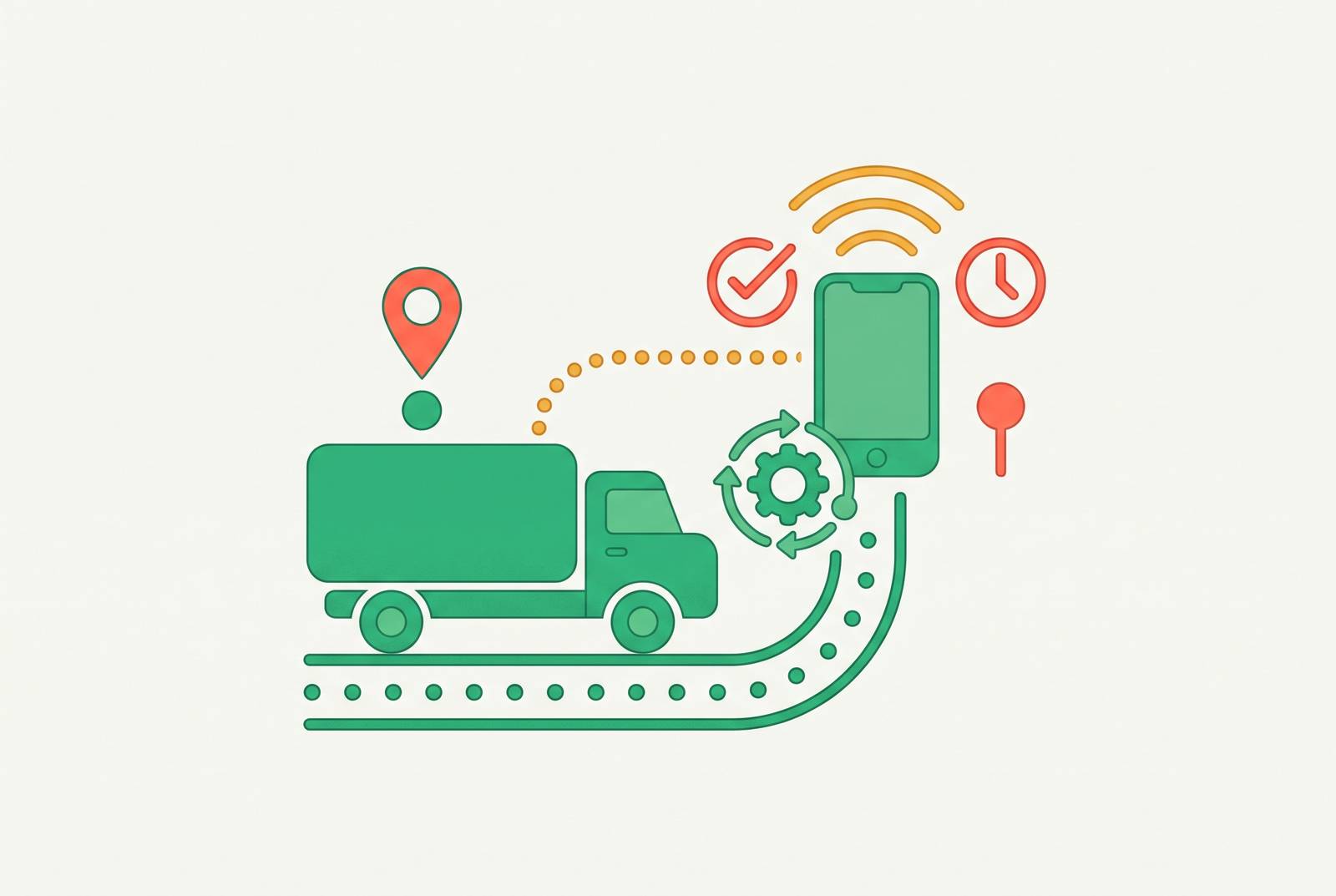
Once a reply arrives, the parsing layer interprets it for location, ETA, and exception flags. That reply might be a text saying “loaded and rolling” or a voice response. The agent writes structured output directly into the load record in the transportation management system, or TMS, without a dispatcher retyping it. A response has not finished the job until its relevant information reaches the record the team works from.
The escalation layer then sorts out which updates are routine and which need someone's attention. The escalation layer closes on-time responses and sends delays, damage reports, missed appointments, and non-responses to a live dispatcher with context attached. Nor does interpreting a response mean the software can resolve every issue it identifies. The mechanism is useful precisely because it divides repetitive information gathering from the judgment needed when a load departs from plan.
How the before-and-after workflow changes for the dispatcher
Before automation, check calls act as calendar anchors for every active load. Pickup, midpoint, and delivery checks keep pulling the dispatcher away from other work, whether that is covering freight or dealing with a customer problem. The call list dictates the next interruption. Even when the answer is entirely ordinary, someone has to initiate the exchange and record it. The dispatcher’s attention is spent finding out whether attention was needed.
After automation, the point of entry changes from a call list to an exception. A flagged alert comes with the load number, carrier, reported issue, and last known location already in it. The dispatcher starts with the problem. Chain reports a large reduction in manual check calls across its broker deployments, with brokers describing a shift toward managing exceptions each morning.
After-hours coverage changes the same way for a small brokerage that cannot staff nights. The agent executes check calls around the clock, closes routine on-time responses, and transfers situations requiring judgment live to whoever is on call. A human still owns the difficult decisions. During staffed hours, the dispatcher’s work shifts toward exceptions, carrier relationships, pricing decisions, and customer escalations, all of which were already competing with routine dialing.
How automated check calls connect to load capacity — the dispatcher math
The capacity calculation starts with hours available for managing loads. When routine dialing consumes part of every dispatcher’s day, that time is unavailable for covering additional freight and managing its movement. If check calls are the constraint, freeing that time gives the same team room to absorb volume it previously could not handle.
Chain says individual brokers on its platform estimate that each rep saves 15+ hours a week on check calls and routine communications. That is broader than check calls alone. It remains an estimate of time savings. The useful commercial connection is that those hours return to load coverage and relationship work. How much load capacity those hours add still depends on how much of a dispatcher’s time each extra load needs, which the figure does not say.
For a small shop, the alternative can be a new dispatcher hire, with salary, benefits, training, and a ramp period attached. Software can absorb routine volume at a fraction of that marginal cost, while leaving judgment work with the existing team. The comparison is therefore about loads per dispatcher. It is not a claim that every recovered hour becomes spare time or that staffing needs disappear.
Some of the reclaimed time will go straight back into managing the same kinds of work at higher volume. That is a fair objection to grander promises of transformation, but not to the capacity argument. More loads on the same headcount is the gain. For a brokerage operating on thin margins, growth does not need to arrive wearing a new business model.
Where check call automation fits in a small brokerage's existing stack
The integration hinge is whether the agent can read from and write to the TMS the brokerage already uses. Debales AI’s 2026 guide says an agent operating as a parallel tool outside the TMS doubles payback time. If someone still has to handle the information before it reaches the load record, the brokerage is still doing some of the work it meant to remove.
The same guide names documented AI-agent connections to McLeod, Alvys, Tai, Turvo, Rose Rocket, and Descartes Aljex. That makes compatibility a vendor evaluation filter. It does not establish every vendor’s compatibility with every system. Tenfold’s analysis says that in April 2026, Tai TMS announced embedded AI-driven communication automation built to replace manual check calls. Chain also describes its autopilot as working inside the team’s existing TMS, email, load boards, and carrier tools, without an extra tab or system replacement.
Telematics changes when a call is needed at all. Agents pull ELD and GPS data as the primary status source, then send check calls when that information is insufficient or absent. The call becomes a fallback for missing visibility.
LYVIA’s 2026 guide recommends beginning a new freight AI workflow under supervision and expanding autopilot as trust builds. Applied here, that means routing flagged exceptions to a human and verifying accurate TMS write-back before expanding automation. The existing tools remain the operating foundation.
Vendors building check-call automation for brokerages in 2026
The 2026 market includes voice-first platforms, email-first agents, and broader brokerage automation tools with check calls among their workflows. These categories group tools by how they communicate, without ranking them. A brokerage whose carriers primarily answer by email has a different deployment starting point from one organized around voice contact. LYVIA’s guide establishes that pricing for most dedicated freight AI vendors is quote-only, so category descriptions alone do not settle the purchase decision.
FreightScout positions itself as an AI execution layer running on the TMS already in place. Its check calls are supervised by default, with autopilot selectable per action and per team. That allows the automation boundary to vary. It also specifies that the last appointment before delivery is always a call by design.
Debales AI’s guide names HappyRobot and Parade’s CoDriver as voice-first vendors leading the check-call workflow. The same guide describes email-first agents as faster to deploy and cleaner to integrate for brokerages whose carriers respond primarily by email. The qualification is important to the comparison. Email-first agents can be faster to deploy where carriers mostly answer by email, but the right channel still depends on the carrier network.
Chain takes the broader brokerage automation approach, describing an autopilot that works across existing operational tools. SANSA’s model instead emphasizes diagnosis before building and an embedded engagement with the team doing the work. These are different starting points for a buyer. SANSA offers a way to work with the team, while the product-specific platforms spell out what their tools can do and how teams can control them. Its fit still depends on establishing the brokerage’s workflow and integration needs rather than assuming a particular check-call implementation is already the answer.
What to verify before deploying a check-call agent at a small brokerage
A small brokerage evaluating these options should start with the depth of TMS integration. Debales AI’s guide says the brokerage should see the agent read and write to its existing TMS in a live demonstration before signing. A compatibility claim is only the starting point. The demonstration should show that the proposed workflow gets information into the load record without someone having to put it there.
Every check-call outcome, TMS write, and escalation decision should be reviewable, so the team can catch errors before they reach a customer or carrier. Without that visibility, a small shop has no dependable way to distinguish useful automation from work it will later have to repair.
Deployment expectations should also be concrete rather than aspirational. The same guide says an email or check-call agent should handle live traffic within days of deployment rather than months, and says to ask vendors for their target coverage rates in week one and week six. Those targets give the rollout an operational test. They also keep the discussion focused on work the agent can actually take on.
The final test is whether dispatchers will use it. A team that distrusts the agent and resumes manual check calls while the brokerage pays for software gets neither the time savings nor the return. Teams should diagnose the workflow with its owners, begin in supervised mode, and enable selective autopilot only for categories the team has verified. Dispatchers need to help configure what the agent escalates. Adoption begins when the people responsible for the loads have a hand in deciding what can safely leave their desks.